英语等级考试《PETS四级》试题(网友回忆版)三
PETS四级
历年真题
共 58 题
1577 次浏览
更新于 2026-09-27
一、听力题
根据要求选择正确的答案。
〈huixue_java/202411/OB8DTK_2012.mp3〉
1
Directions:
This section is designed to test your ability to understand spoken English.You will hear a selection of recorded materials and you must answer the questions that accompany them.There are three parts in this section, Part A, Part B and Part C.
Remember, while you are doing the test, you should first put down your answers in your test booklet.At the end of the listening comprehension section, you will have 5 minutes to transfer all your answers from your test booklet to ANSWER SHEET 1.
If you have any questions, you may raise your hand now as you will not be allowed to speak once the test has started.
Now look at Part A in your test booklet.
Part A
Directions: For Questions 1-5, you will hear a talk about Buckingham Palace and Queen Elizabeth who lives in it.While you listen, fill out the table with the information you have heard.Some of the in- formation has been given to you in the table.Write only 1 word or number in each numbered box.You will hear the recording twice.
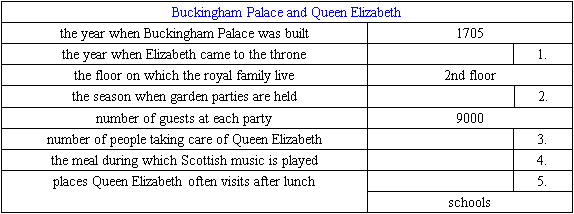
This section is designed to test your ability to understand spoken English.You will hear a selection of recorded materials and you must answer the questions that accompany them.There are three parts in this section, Part A, Part B and Part C.
Remember, while you are doing the test, you should first put down your answers in your test booklet.At the end of the listening comprehension section, you will have 5 minutes to transfer all your answers from your test booklet to ANSWER SHEET 1.
If you have any questions, you may raise your hand now as you will not be allowed to speak once the test has started.
Now look at Part A in your test booklet.
Part A
Directions: For Questions 1-5, you will hear a talk about Buckingham Palace and Queen Elizabeth who lives in it.While you listen, fill out the table with the information you have heard.Some of the in- formation has been given to you in the table.Write only 1 word or number in each numbered box.You will hear the recording twice.
2
Part B
Directions: For Questions 6-10, you will hear the life story of Alexander the Great.While you listen, complete the sentences or answer the questions.Use no more than 3 words for each answer.You will hear the recording twice.
Alexander was called a god because he was 6.______
In which year did Alexander become king? 7.______
In which country did Alexander found a new city? 8.______
What kind of people did Alexander recruit to live in the cities he built? 9.______
At what age did Alexander die? 10.______
Directions: For Questions 6-10, you will hear the life story of Alexander the Great.While you listen, complete the sentences or answer the questions.Use no more than 3 words for each answer.You will hear the recording twice.
Alexander was called a god because he was 6.______
In which year did Alexander become king? 7.______
In which country did Alexander found a new city? 8.______
What kind of people did Alexander recruit to live in the cities he built? 9.______
At what age did Alexander die? 10.______
3
Part C
Directions: You will hear three dialogues or monologues.Before listening to each one, you will have 5 seconds to read each of the questions which accompany it .While listening, answer each question by choosing A, B, C or D.After listening, you will have 10 seconds to check your answer to each question.You will hear each piece once only.
Questions 11-13 are based on the following conversation between a driver and a police officer.
Why did the police officer stop the driver?
Directions: You will hear three dialogues or monologues.Before listening to each one, you will have 5 seconds to read each of the questions which accompany it .While listening, answer each question by choosing A, B, C or D.After listening, you will have 10 seconds to check your answer to each question.You will hear each piece once only.
Questions 11-13 are based on the following conversation between a driver and a police officer.
Why did the police officer stop the driver?
- A.The driver exceeded the speed limit.
- B.The driver didn’t stop at the zebra crossing.
- C.The officer was conducting a routine check.
- D.The officer found the car’s brake lights were out.
4
Why did the driver mention his wife’s cousin’s husband?
- A.To prove his connection with the officer.
- B.To show himself as an influential man.
- C.To influence the police officer.
- D.To establish a new friendship.
5
What did the police officer threaten to do?
- A.Give the driver a ticket.
- B.Take the driver to court.
- C.Retain the driver’s car.
- D.Take the driver to the police station.
6
Questions 14-16 are based on the following talk on Kwanzaa, an African American cultural holiday.
What is the origin of Kwanzaa related to?
What is the origin of Kwanzaa related to?
- A.Religion.
- B.Family life.
- C.Agriculture.
- D.Community.
7
Which of the following colors is used for decoration in Kwanzaa?
- A.Yellow.
- B.Green.
- C.White.
- D.Blue.
8
What do the seven candles stand for?
- A.Principles.
- B.Cultures.
- C.Tribes.
- D.Colors.
9
Questions 17—20 are based on the following talk about the World Bank.
When was the World Bank officially founded?
When was the World Bank officially founded?
- A.In 1944.
- B.In 1946.
- C.In 1949.
- D.In 2000.
10
The World Bank dreams of a world without
- A.inequality
- B.poverty
- C.oppression
- D.conflicts
11
What do we know about the World Bank member countries?
- A.They have equal say.
- B.They decide on the bank’s work.
- C.They are the board members.
- D.They are its shareholders.
12
How many leading contributors does the World Bank have?
- A.24.
- B.19.
- C.5.
- D.3.
二、阅读理解题
根据题干选择正确的答案。
Directions:Read the following text.Choose the best word or phrase for each numbered blank and mark A, B, C or D on ANSWER SHEET 1.
Humans like to regard themselves as exceptional.Many philosophers believe humans are the only (21)______ which understands that others have their own personal thoughts.That understanding is known in the (22)______ as having a “theory of mind,” and it is considered the (23)______ to such cherished human (24)______ as sympathy and deception.
Biologists have learned to treat such (25)______ with caution.Bernd Heinrich and Thomas Bugnyar describe an experiment they have carried out (26)______ ravens.
(27)______ to gaze is reckoned to be a good (28)______ of the development of theory of mind in human children.(29)______ about 18 months, most children are able to follow the gaze of another person, and (30)______ things about the gazer from it.Failure to (31)______ this trick is an early symptom of autism, a syndrome whose main underlying feature is a(n) (32)______ to understand that other people have (33)______, too.
To (34)______ whether ravens could follow gaze, Dr Heinrich used six six-month-old hand-reared ravens.The birds were set, one at a time, on a perch on one side of a room divided by a barrier.An experimenter in front of the barrier (35)______ his head and eyes in a particular (36)______ and gazed for 30 seconds before looking (37)______ Dr Heinrich found that all the birds were able to follow the gaze of the experimenters, even (38)______ the barrier.In the (39)______ case, the curious birds either jumped down from the perch and walked around the barrier to have a (40)______ or leapt on top of it and peered over.
Humans like to regard themselves as exceptional.Many philosophers believe humans are the only (21)______ which understands that others have their own personal thoughts.That understanding is known in the (22)______ as having a “theory of mind,” and it is considered the (23)______ to such cherished human (24)______ as sympathy and deception.
Biologists have learned to treat such (25)______ with caution.Bernd Heinrich and Thomas Bugnyar describe an experiment they have carried out (26)______ ravens.
(27)______ to gaze is reckoned to be a good (28)______ of the development of theory of mind in human children.(29)______ about 18 months, most children are able to follow the gaze of another person, and (30)______ things about the gazer from it.Failure to (31)______ this trick is an early symptom of autism, a syndrome whose main underlying feature is a(n) (32)______ to understand that other people have (33)______, too.
To (34)______ whether ravens could follow gaze, Dr Heinrich used six six-month-old hand-reared ravens.The birds were set, one at a time, on a perch on one side of a room divided by a barrier.An experimenter in front of the barrier (35)______ his head and eyes in a particular (36)______ and gazed for 30 seconds before looking (37)______ Dr Heinrich found that all the birds were able to follow the gaze of the experimenters, even (38)______ the barrier.In the (39)______ case, the curious birds either jumped down from the perch and walked around the barrier to have a (40)______ or leapt on top of it and peered over.
13
______.
- A.category
- B.group
- C.race
- D.species
14
______.
- A.perspective
- B.trade
- C.business
- D.skill
15
______.
- A.secret
- B.attribution
- C.alternative
- D.gateway
16
______.
- A.qualities
- B.operations
- C.habits
- D.values
17
______.
- A.comparisons
- B.findings
- C.assertions
- D.studies
18
______.
- A.on
- B.to
- C.against
- D.for
19
______.
- A.Indifference
- B.Response
- C.Resistance
- D.Instinct
20
______.
- A.call
- B.reason
- C.hint
- D.measure
21
______.
- A.With
- B.In
- C.By
- D.At
22
______.
- A.imagine
- B.infer
- C.locate
- D.confer
23
______.
- A.develop
- B.find
- C.plan
- D.conceal
24
______.
- A.resent
- B.tendency
- C.attempt
- D.inability
25
______.
- A.senses
- B.minds
- C.beliefs
- D.faculties
26
______.
- A.argue
- B.prove
- C.test
- D.confirm
27
______.
- A.moved
- B.hid
- C.revealed
- D.adjusted
28
______.
- A.manner
- B.direction
- C.type
- D.circle
29
______.
- A.down
- B.up
- C.away
- D.inside
30
______.
- A.into
- B.within
- C.beyond
- D.from
31
______.
- A.former
- B.latter
- C.ordinary
- D.unusual
32
______.
- A.look
- B.rest
- C.try
- D.taste
Part A
Directions: Read the following four texts.Answer the questions below each text by choosing A, B, C or D.Mark your answers on ANSWER SHEET 1.
Text 1 Conventional wisdom has long held that mammals stayed millions of years on earth.As long as dinosaurs roamed the lands, our distant ancestors never got to be much more than chicken-hearted creatures that sneaked out at night to grab bits of plants when the terrible lizards were asleep.Only when they were wiped out did mammals begin to earn a little evolutionary respect.
But that picture changed dramatically with the announcement in Nature of two impressive fossils.One, of a brand-new species named R.giganticus, broke apart the notion that most dinosaur- age mammals were never larger than squirrels.The animal had the dimensions of a midsize dog-by far the biggest dinosaur-age mammal ever found.And the second, a new specimen of a previously discovered species called R.robustus, refuted the notion that it was always the mammals that got eaten.Inside the skeleton where the animal’s stomach would have been are the fossilized remains of a baby dinosaur.“This discovery was the chance of a lifetime,” says Jin Meng, scientist and co- author of the paper.
Indeed, Meng didn’t expect to find things like this at all.The smaller skeleton was discovered about two years ago by villagers in China’s Liaoning province, site of some of the richest fossil beds in the world.They brought it to the attention of scientists, who took it to an institute for examination.“We didn’t see the stomach contents at first,” says Meng.
After they did, however, it didn’t take them long to realize they had struck scientific gold.On closer examination, the scientists determined that the remains were those of a juvenile dinosaur.Some of the arm and leg bones were still attached to each other, suggesting that R.robustus didn’t chew its food thoroughly but wolfed it down in large chunks.
Taken together, the finds overturn the already eroded idea that early mammals were tiny and timid.Now paleontologists can stop cooking up theories to explain why mammals were so little— that they had to be small to avoid being found, for example, or they couldn’t grow larger because dinosaurs already occupied those ecological spaces.
But it’s now clear that mammals did fill some of the spaces reserved for larger animals.“It’s quite possible,” says paleontologist Anne Weil, “that they competed with dinosaurs for the same prey.” And because they ate dinosaurs, they may even have had an influence on dinosaur evolution.What sort of influence? “We don’t know,” she says.“That’s how it is with the best finds.They leave you with more questions than answers.”
Directions: Read the following four texts.Answer the questions below each text by choosing A, B, C or D.Mark your answers on ANSWER SHEET 1.
Text 1 Conventional wisdom has long held that mammals stayed millions of years on earth.As long as dinosaurs roamed the lands, our distant ancestors never got to be much more than chicken-hearted creatures that sneaked out at night to grab bits of plants when the terrible lizards were asleep.Only when they were wiped out did mammals begin to earn a little evolutionary respect.
But that picture changed dramatically with the announcement in Nature of two impressive fossils.One, of a brand-new species named R.giganticus, broke apart the notion that most dinosaur- age mammals were never larger than squirrels.The animal had the dimensions of a midsize dog-by far the biggest dinosaur-age mammal ever found.And the second, a new specimen of a previously discovered species called R.robustus, refuted the notion that it was always the mammals that got eaten.Inside the skeleton where the animal’s stomach would have been are the fossilized remains of a baby dinosaur.“This discovery was the chance of a lifetime,” says Jin Meng, scientist and co- author of the paper.
Indeed, Meng didn’t expect to find things like this at all.The smaller skeleton was discovered about two years ago by villagers in China’s Liaoning province, site of some of the richest fossil beds in the world.They brought it to the attention of scientists, who took it to an institute for examination.“We didn’t see the stomach contents at first,” says Meng.
After they did, however, it didn’t take them long to realize they had struck scientific gold.On closer examination, the scientists determined that the remains were those of a juvenile dinosaur.Some of the arm and leg bones were still attached to each other, suggesting that R.robustus didn’t chew its food thoroughly but wolfed it down in large chunks.
Taken together, the finds overturn the already eroded idea that early mammals were tiny and timid.Now paleontologists can stop cooking up theories to explain why mammals were so little— that they had to be small to avoid being found, for example, or they couldn’t grow larger because dinosaurs already occupied those ecological spaces.
But it’s now clear that mammals did fill some of the spaces reserved for larger animals.“It’s quite possible,” says paleontologist Anne Weil, “that they competed with dinosaurs for the same prey.” And because they ate dinosaurs, they may even have had an influence on dinosaur evolution.What sort of influence? “We don’t know,” she says.“That’s how it is with the best finds.They leave you with more questions than answers.”
33
Mammals in the dinosaur age used to be described as ______.
- A.fierce and dangerous.
- B.shrewd and swift.
- C.doglike and sneaky.
- D.small and cowardly.
34
The fossil of a baby dinosaur in the skeleton of R.robustus indicates that ______.
- A.R.robustus must have died in its pregnancy.
- B.this mammal could have died while fighting with dinosaurs.
- C.R.robustus swallowed the baby dinosaur as its food.
- D.mammals would eat their young when starved.
35
By saying “they had struck scientific gold” (Lines 1-2, Paragraph 4), the author means that ______.
- A.their discovery earned them great fame.
- B.their findings enjoyed enormous market value.
- C.they acquired valuable resources for their studies.
- D.they had made a significant discovery in their research.
36
The expression “cooking up” (Line 2, Paragraph 5) indicates that the author ______.
- A.doubts the validity of the previous scientific explanations.
- B.thinks the new discoveries have practical significance.
- C.regards previous ecological studies as simply story-making.
- D.considers those new discoveries no longer hold water.
37
What is the possible connection between mammals and dinosaurs?
- A.Mammals were under dinosaurs’ rule most of the time.
- B.Mammals might have contributed to the evolution of dinosaurs.
- C.Dinosaurs failed in the competition with mammals for food.
- D.Baby dinosaurs were the main source of food for mammals.
Text 2 Schools of education have long been objects of criticism. From James Koerner’s 1963 book, The Miseducation of America’s Teachers, up through two recent reports by national commissions, critics have complained about the intellectual emptiness of the curriculum at ed schools and the lack of connection between what is taught and the realities teachers face in the classroom. A recent survey of teachers about their graduate-school training drew comments like “the shabbiest psychobabble imaginable” and “a waste of time.”
With an estimated 2 million new teachers needed over the next decade, the shortcomings in education schools are a practical concern. In what is a generally bleak landscape, a small number of schools stand out as innovators. Two key qualities distinguish these exemplars. First, they require that students master the subjects they will be teaching and structure their curricula accordingly. Second, these programs put a premium on hands-on experience. While traditional ed-school curricula are filled with courses on theory, the new approach places much greater emphasis on learning by doing.
At Ohio State University in Columbus, students in the one-year master’s program spend half their time teaching in one of 55 Franklin County public schools, where they are paired with experienced teachers.
“You are immersed from Day 1,” says OSU graduate student Kelley Crockett, a 37-year-old former businesswoman who does practical training at Gables Elementary School. “And that forces you to be intimately involved.”
In New York City, the Bank Street College of Education—a two-year program—runs its own junior high. “That keeps us honest,” says the school’s president, Augusta Kappner. “We are encouraging students to see how they function in school settings so they can constantly improve.”
Comparable programs exist at some other institutions, including the University of Virginia and Trinity University in San Antonio. But Linda Darling-Hamond, a professor at Columbia University’s Teachers College who is an expert on teacher training, estimates that only 40 percent of the 1,200 teacher education programs in the country have met national accreditation standards.
Most education schools, she says, “have operated bureaucratically, assuming that teachers didn’t need to know many things, ‘Just give them a textbook and send them on.”
With an estimated 2 million new teachers needed over the next decade, the shortcomings in education schools are a practical concern. In what is a generally bleak landscape, a small number of schools stand out as innovators. Two key qualities distinguish these exemplars. First, they require that students master the subjects they will be teaching and structure their curricula accordingly. Second, these programs put a premium on hands-on experience. While traditional ed-school curricula are filled with courses on theory, the new approach places much greater emphasis on learning by doing.
At Ohio State University in Columbus, students in the one-year master’s program spend half their time teaching in one of 55 Franklin County public schools, where they are paired with experienced teachers.
“You are immersed from Day 1,” says OSU graduate student Kelley Crockett, a 37-year-old former businesswoman who does practical training at Gables Elementary School. “And that forces you to be intimately involved.”
In New York City, the Bank Street College of Education—a two-year program—runs its own junior high. “That keeps us honest,” says the school’s president, Augusta Kappner. “We are encouraging students to see how they function in school settings so they can constantly improve.”
Comparable programs exist at some other institutions, including the University of Virginia and Trinity University in San Antonio. But Linda Darling-Hamond, a professor at Columbia University’s Teachers College who is an expert on teacher training, estimates that only 40 percent of the 1,200 teacher education programs in the country have met national accreditation standards.
Most education schools, she says, “have operated bureaucratically, assuming that teachers didn’t need to know many things, ‘Just give them a textbook and send them on.”
38
By saying “intellectual emptiness of the curriculum” (Lines 3~4, Paragraph 1) the critics mean to argue that ______.
- A.there were not sufficient items in the curriculum.
- B.the curriculum was poorly designed academically.
- C.the training based on the curriculum was hardly imaginable.
- D.the curriculum did not sufficiently address learners’ needs.
39
According to the author, the concern over the current situation in ed schools is ______.
- A.well-grounded.
- B.unnecessary.
- C.widespread.
- D.ill-founded.
40
The word “premium” (Line 6, Paragraph 2) probably means ______.
- A.difficulty.
- B.emphasis.
- C.limitation.
- D.reward.
41
It can be inferred from Linda Darling-Hammond’s comment that ______.
- A.most ed schools should undergo fundamental reform.
- B.it is too difficult for ed schools to overcome bureaucracy.
- C.teachers at ed schools emphasize too much the value of a textbook.
- D.most ed school teachers are unwilling to participate in the innovations.
42
Which of the following would be the best title for the text?
- A.A Bird’s Eye View on Teacher Training Programs
- B.Traditional versus Modern Schools of Education
- C.Innovation at Some Schools of Education
- D.Comparison between Teacher Training Programs
Text 3 It’s almost an article of faith: your best ally in the fight against cancer is a doggedly optimistic outlook. And it would seem that mounting evidence of the links between emotional and physical well-being would support that view. The only problem is that there is no good evidence to support that belief when it comes to cancer. Moreover, the “tyranny” of positive thinking often becomes just one more burden for the sick.
It was research in the 1970s and ‘80s that first popularized the idea that attitude might affect cancer outcomes. Such research led doctors to encourage patients to think happy thoughts and visualize their immune system blasting away cancer ceils. But most of those studies have been dismissed as either flawed or inconclusive. A review of 37 studies that was published in the British Medical Journal in 2002 found that although a positive outlook does correlate with the perception of less pain by patients—a real benefit-there is “little consistent evidence that coping styles play an important part in survival from or recurrence of cancer. “
Still, the optimism theory remains attractive. One reason is that Americans live in a culture that desires Control. We want to believe that we can beat cancer by imposing our will on the disease. A better reason is that mental states like depression and chronic anxiety have been shown to have physical consequences that affect the progression of such illnesses as heart disease and diabetes. While a similar connection is biologically plausible for cancer, it is far from proven.
Even researchers who believe that studies will ultimately establish links between stress and the progression of cancer, like Stanford’s Dr. David Spiegel, know the picture is complex. “It isn’t a matter of ‘ Fix it in your mind, and you fix it in your body,’“ he says, “but it would be strange if what goes on in our minds didn’t affect how our bodies deal with illness.”
So where does that leave cancer patients? Doctors know that individuals will always bring their own disposition—sunny, sour or sarcastic—to bear on their illness and treatment. Pressuring them to be models of positive thinking is useless. Worse, it could cause them to hide their fears and reject support. But clinicians must remain alert for signs of depression, which can affect the outcome of any disease if it interferes with treatment. And many patients will also need—and welcome— help to improve poor coping skills. Spiegel says, “Having worked with people with life-threatening illnesses for 30 years, it’s clear that there are better and worse ways to deal with these things. ” False optimism isn’t helpful, but neither is despair.
It was research in the 1970s and ‘80s that first popularized the idea that attitude might affect cancer outcomes. Such research led doctors to encourage patients to think happy thoughts and visualize their immune system blasting away cancer ceils. But most of those studies have been dismissed as either flawed or inconclusive. A review of 37 studies that was published in the British Medical Journal in 2002 found that although a positive outlook does correlate with the perception of less pain by patients—a real benefit-there is “little consistent evidence that coping styles play an important part in survival from or recurrence of cancer. “
Still, the optimism theory remains attractive. One reason is that Americans live in a culture that desires Control. We want to believe that we can beat cancer by imposing our will on the disease. A better reason is that mental states like depression and chronic anxiety have been shown to have physical consequences that affect the progression of such illnesses as heart disease and diabetes. While a similar connection is biologically plausible for cancer, it is far from proven.
Even researchers who believe that studies will ultimately establish links between stress and the progression of cancer, like Stanford’s Dr. David Spiegel, know the picture is complex. “It isn’t a matter of ‘ Fix it in your mind, and you fix it in your body,’“ he says, “but it would be strange if what goes on in our minds didn’t affect how our bodies deal with illness.”
So where does that leave cancer patients? Doctors know that individuals will always bring their own disposition—sunny, sour or sarcastic—to bear on their illness and treatment. Pressuring them to be models of positive thinking is useless. Worse, it could cause them to hide their fears and reject support. But clinicians must remain alert for signs of depression, which can affect the outcome of any disease if it interferes with treatment. And many patients will also need—and welcome— help to improve poor coping skills. Spiegel says, “Having worked with people with life-threatening illnesses for 30 years, it’s clear that there are better and worse ways to deal with these things. ” False optimism isn’t helpful, but neither is despair.
43
By saying “the ‘tyranny’ of positive thinking” (Line 5, Paragraph 1), the author probably means ______.
- A.people cannot but think optimistically.
- B.it is unfair to force people to think positively.
- C.people are advised to assume an optimistic outlook in life.
- D.it is positive thinking that prevails.
44
What is found to be the real benefit of taking an optimistic attitude toward cancer?
- A.Strengthening the immune system.
- B.Reducing the pain felt by patients.
- C.Improving patients’ coping styles.
- D.Heightening the effect of medication.
45
The author thinks that the optimism theory is derived from ______.
- A.Americans’ cultural pride in overcoming everything.
- B.the biological plausibility of willful control of cancer.
- C.the assumed connection of mood with some illnesses.
- D.the scientific researches in the 1970s and ‘80s.
46
What does the sentence “the picture is complex” (Line 3, Paragraph 4) mean?
- A.Researchers differ in views on the cure of illnesses.
- B.The human body is still beyond our understanding.
- C.Doctors are unable to handle cancers effectively.
- D.Various factors function in the treatment of cancers.
47
An appropriate title for the text would be ______.
- A.Can Sunny Thoughts Halt Cancer?
- B.Fix Your Mind, and Your Body Will be Fixed
- C.Optimism—Another Burden for Patients?
- D.Smiles Surely Smooth Sentiment
Text 4 Advances in interfaces—the physical way we react with computers—and other techniques of controlling computers will supplement the role of the traditional keyboard and mouse. Technologies in development include surfaces that allow fingertip control of on-screen objects and devices that sense—and react to—movement.
But we should assess human-computer interaction (HCI) to ensure that we retain control of key decision-making processes, one report suggests.
Display technologies will soon allow us to fix screens of all sizes in a variety of fabrics. In the near future we will still be reading paper books and magazines; but we’ll also be using paper-like digital screens to distribute content.
Cheap and easily-accessed digital storage allows consumers to electronically record and store more aspects of our lives—allowing us to share information and interact with people across the globe. This hyper-connectivity liberates us from fixed telephone lines, desks and offices, while advances in robotics develop the computer’s ability to learn and make decisions.
“New computing technology is tremendously exciting,” said Tom Rodden, Professor at the University of Nottingham. “But the interaction between humans and computers is evolving into a complex ecosystem where small changes can have far-reaching consequences. While new interfaces and hyper-connectivity mean we are increasingly mobile, we can see that they are obscuring the line between work and personal space.”
“Huge storage capabilities raise fundamental privacy issues around what we should be recording and what we should not. The potential of machine learning might well result in computers increasingly making decisions on our behalf. It is imperative that we combine technological innovations with an understanding of their impact on people.”
The report argues that without proper monitoring and assessment it is possible that we may no longer be in control of ourselves or the world around us. This potentially places the computer on a collision course with basic human values and concepts such as personal space, society, identity, in- dependence, perception, intelligence and privacy.
The report gives recommendations for the HCI community to adopt to ensure that human values inform future development. These include educating young people so that they understand HCI and the impact of computer advances early on and engaging with governments, policy-makers and society as a whole to provide counsel and give advance warning of the emerging implications of new computing ecosystems.
“Computing has the potential to enhance the lives of billions of people around the world. We believe that if technology is to truly bring benefit to humanity, then human values and the impact of technology must be considered at the earliest possible opportunity in the technology design process,” said Abigail Sellen, one of the editors of the report.
But we should assess human-computer interaction (HCI) to ensure that we retain control of key decision-making processes, one report suggests.
Display technologies will soon allow us to fix screens of all sizes in a variety of fabrics. In the near future we will still be reading paper books and magazines; but we’ll also be using paper-like digital screens to distribute content.
Cheap and easily-accessed digital storage allows consumers to electronically record and store more aspects of our lives—allowing us to share information and interact with people across the globe. This hyper-connectivity liberates us from fixed telephone lines, desks and offices, while advances in robotics develop the computer’s ability to learn and make decisions.
“New computing technology is tremendously exciting,” said Tom Rodden, Professor at the University of Nottingham. “But the interaction between humans and computers is evolving into a complex ecosystem where small changes can have far-reaching consequences. While new interfaces and hyper-connectivity mean we are increasingly mobile, we can see that they are obscuring the line between work and personal space.”
“Huge storage capabilities raise fundamental privacy issues around what we should be recording and what we should not. The potential of machine learning might well result in computers increasingly making decisions on our behalf. It is imperative that we combine technological innovations with an understanding of their impact on people.”
The report argues that without proper monitoring and assessment it is possible that we may no longer be in control of ourselves or the world around us. This potentially places the computer on a collision course with basic human values and concepts such as personal space, society, identity, in- dependence, perception, intelligence and privacy.
The report gives recommendations for the HCI community to adopt to ensure that human values inform future development. These include educating young people so that they understand HCI and the impact of computer advances early on and engaging with governments, policy-makers and society as a whole to provide counsel and give advance warning of the emerging implications of new computing ecosystems.
“Computing has the potential to enhance the lives of billions of people around the world. We believe that if technology is to truly bring benefit to humanity, then human values and the impact of technology must be considered at the earliest possible opportunity in the technology design process,” said Abigail Sellen, one of the editors of the report.
48
New technologies will make a computer ______.
- A.less complex in structure.
- B.less varied in appearance.
- C.more automatic in operation.
- D.more user friendly in future.
49
Tom Rodden is worried that new interfaces and hyper-connectivity will ______.
- A.result in greater interest in machine learning.
- B.impose more interference on our privacy.
- C.disturb our existing ecological system.
- D.lead to the need of huge storage.
50
The word “imperative” (Line 3, Paragraph 6) is closest in meaning to ______.
- A.urgent.
- B.difficult.
- C.appropriate.
- D.extraordinary.
51
When left unmonitored, technological innovations may bring about ______.
- A.collision in human society.
- B.decrease in working efficiency.
- C.threat to human values.
- D.poorer governmental administration.
52
The text focuses on ______.
- A.the complex ecosystem of humans and computers.
- B.the potentials of new computer technology.
- C.the improvement of technology on computers.
- D.the individualized function of computer technology.
三、翻译题
仔细阅读以下文本,然后将划线部分翻译成中文。
Part B
Directions: Read the following text carefully and then translate the underlined segments into Chinese. Write your translation clearly on ANSWER SHEET 2.
Ecological economics recognizes that humans and their economies are parts of larger natural ecosystems and co-evolve with those natural systems. 61) There is a material and energy basis for the relations between human economies and their ecosystems, defining not only economic, but social structures and processes. Economies possess general ecosystem properties, such as dynamism, evolution, integrity, stability and sustenance. Economies are embedded in larger natural ecosystems, and exchange flows of materials and energy with natural systems.
62) What makes humans and their economies unique as a sub-ecosystem is their ability, through willful effort, ignorance and human designed tools, to dramatically restructure and reform processes in ecosystems of which they are a part; The ability is to such a magnitude that human welfare can be diminished or enhanced by those original actions. Some types of economic activities, and the welfare that originates from them, would not be sustainable if they substantially adversely impact natural systems.
63) The willful effort to extract useful things from natural systems is motivated by the satisfaction of basic biological needs and the seemingly limitless search for pleasure consumption of goods and through social associations. The magnitude of potential impact on their own welfare through effects on natural systems requires that human decisions be guided by some notion of the value of their actions and the value of their impacts on ecosystems, either in terms of benefits of use or costs of abuse. Some concept of value is required for rational activities of human economies within their natural systems.
Both the structures and processes of natural systems have identifiable instrumental value to the human economy. These narrow use values may be reflected by the summation of individual values, to the extent they are private. However, natural systems also have aesthetic, moral and cultural values. These values are more intrinsic and unmeasurable using traditional human preferences.
64) Valuation is made more complicated by the fact that our natural environment is highly likely to shape values through establishing social and economic relations, aesthetic standards and culture. If so, our decisions now about the natural environment will shape future value systems, making values endogenous and, therefore, a poor guide to behavior. 65) A way out of this dilemma is to make valuations of natural systems based on “What we would like to see society become” rather than to ask what current valuations are. The value of natural systems is then based on their ability to assist us in becoming what we wish to be.
Directions: Read the following text carefully and then translate the underlined segments into Chinese. Write your translation clearly on ANSWER SHEET 2.
Ecological economics recognizes that humans and their economies are parts of larger natural ecosystems and co-evolve with those natural systems. 61) There is a material and energy basis for the relations between human economies and their ecosystems, defining not only economic, but social structures and processes. Economies possess general ecosystem properties, such as dynamism, evolution, integrity, stability and sustenance. Economies are embedded in larger natural ecosystems, and exchange flows of materials and energy with natural systems.
62) What makes humans and their economies unique as a sub-ecosystem is their ability, through willful effort, ignorance and human designed tools, to dramatically restructure and reform processes in ecosystems of which they are a part; The ability is to such a magnitude that human welfare can be diminished or enhanced by those original actions. Some types of economic activities, and the welfare that originates from them, would not be sustainable if they substantially adversely impact natural systems.
63) The willful effort to extract useful things from natural systems is motivated by the satisfaction of basic biological needs and the seemingly limitless search for pleasure consumption of goods and through social associations. The magnitude of potential impact on their own welfare through effects on natural systems requires that human decisions be guided by some notion of the value of their actions and the value of their impacts on ecosystems, either in terms of benefits of use or costs of abuse. Some concept of value is required for rational activities of human economies within their natural systems.
Both the structures and processes of natural systems have identifiable instrumental value to the human economy. These narrow use values may be reflected by the summation of individual values, to the extent they are private. However, natural systems also have aesthetic, moral and cultural values. These values are more intrinsic and unmeasurable using traditional human preferences.
64) Valuation is made more complicated by the fact that our natural environment is highly likely to shape values through establishing social and economic relations, aesthetic standards and culture. If so, our decisions now about the natural environment will shape future value systems, making values endogenous and, therefore, a poor guide to behavior. 65) A way out of this dilemma is to make valuations of natural systems based on “What we would like to see society become” rather than to ask what current valuations are. The value of natural systems is then based on their ability to assist us in becoming what we wish to be.
53
______.
54
______.
55
______.
56
______.
57
______.
四、写作题
阅读以下文本并写一篇文章
58
Directions:
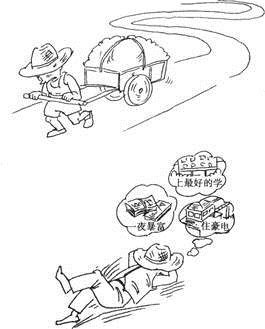
66.Study the following two pictures carefully and write an essay on them.In your essay, you should
(1) describe the pictures briefly,
(2) analyze this situation, and
(3) give your comments.
You should write 160—200 words neatly on ANSWER SHEET 2.
Nobody can live happily without dreams,
and nobody can live happily only with dreams.
66.Study the following two pictures carefully and write an essay on them.In your essay, you should
(1) describe the pictures briefly,
(2) analyze this situation, and
(3) give your comments.
You should write 160—200 words neatly on ANSWER SHEET 2.
Nobody can live happily without dreams,
and nobody can live happily only with dreams.
输入阅读码
查看答案与解析需要输入阅读码