2026年教师资格证《高中英语》考前点题卷二
(高中)英语
考前点题
共 33 题
4089 次浏览
更新于 2026-09-27
一、单项选择题
每题2分,共30题,共60分
1
_______as he is, he has turned_______professional writer.
- A.Teenager; /
- B.A teenager; a
- C.Teenager; a
- D.A teenager; /
2
No one knows exactly_______this ancient bridge was built. Some say it was built during the Tang dynasty, but others disagree.
- A.how
- B.why
- C.when
- D.whether
3
The syntactic component provides the_______for a sentence.
- A.lexicon
- B.structure
- C.meaning
- D.sound
4
The older worker and the young each_______their own tools.
- A.have
- B.has
- C.are having
- D.is having
5
The semantic components of the word\" gentleman\" can be expressed as_______.
- A.+ animate, + male, + human, - adult
- B.+ animate, + male, + human, + adult
- C.+ animate, - male, + human, - adult
- D.+ animate, - male, + human, + adult
6
I can't go cycling with you this weekend,for my bicycle needs_______.
- A.to repair
- B.repairing
- C.repaired
- D.being repaired
7
The relationship between \"fruit\" and \"orange\" is_______.
- A.superordinate
- B.relational opposites
- C.hyponymy
- D.homonymy
8
The same between /m/ and /p/ lies in_______.
- A.the manner of articulation
- B.the place of articulation
- C.voicing
- D.sound duration
9
This job is_______doing,but it isn't _______to spend so much time on it.
- A.worth ; worth
- B.worth ; worthwhile
- C.worthwhile ; worth
- D.worthwhile ; worthwhile
10
Morphemes that represent \" tense number\", \"gender\", \" case\" and so forth are called_______morphemes.
- A.inflectional
- B.free
- C.bound
- D.derivational
11
Interlanguage, or the developing linguistic system of a second language learner, displays the following features except_______.
- A.independent
- B.transitional
- C.fossilization
- D.rule-governed
12
What aspects should be emphasized in classroom teaching in the view of the scholars who advocate situational method?
- A.Spoken language is the first; it is the base of written language.
- B.Written language is the first; it is the base of spoken language.
- C.Written language and spoken language are of the same importance.
- D.Written language and spoken language are not of the same importance.
13
Which of the following belongs to language structure?
- A.Morphology.
- B.Language use.
- C.Rhetoric.
- D.Language meaning.
14
Students are offered opportunities to integrate what they learned from the text into their existing knowledge and communicate with others using the information in the listening text. This description belongs to_______stage.
- A.pre-listening
- B.while-listening
- C.post-listening
- D.none of them
15
Pre-reading activities include_______, setting the scene, skimming, and scanning.
- A.predicting
- B.information transfer activities
- C.reading comprehension questions
- D.reproducing the text
16
In a pre-listening activity, students need to learn to cope with some ambiguity in listening and realize that they can still learn even when they do not understand every single word.The aim of this activity is to develop the skill of_______.
- A.listening for specific information
- B.listening for gist
- C.listening for structure
- D.listening for vocabulary
17
When a teacher leads students to make necessary improvements in both organization and contents based on either self-editing or peer-editing, which stage are they in?
- A.Editing.
- B.Conferencing.
- C.Revising.
- D.Drafting.
18
In which of the following situations is the teacher playing the role of an assessor?
- A.Teaching new words.
- B.Giving examples of how to do an activity after instructions.
- C.Enlightening students to express their ideas.
- D.Giving feedback.
19
Littlewood divided communicative activities into two parts: functional communicative activities and_______.
- A.information gap activities
- B.social interaction activities
- C.meaningful activities
- D.mechanical activities
20
The word\" gunfighters\" contains_______morphemes.
- A.two
- B.three
- C.four
- D.five
一、单项选择题
-
请阅读 Passage 1,完成下列小题。
Passage 1
For many people,there is a very well-established stereotype that the first-class American universities are simply the best. However,I am not quite convinced of that. When I look back at my academic formation in the USA and compare it to the academic formation some of my friends had at Brazil, I don't feel like I am more prepared than my peers. Thus, I am currently facing a dilemma of whether to pursue my graduate studiesin Brazil or in the USA.
The difference in our academic backgrounds, however, is the more liberal nature of American education.From my experience at Georgetown, and from what I know of American higher education, there are very few strict requirements imposed on students. Generally speaking, you are relatively free to take whichever classes you want, provided that they are under the scope of your major field of study.
To illustrate, I compared the master's degrees in economics from Duke and Fundacao GetulioVargas( FGV), a Brazilian university. I chose to present a master's degree comparison here because the shorttwo-year study period makes it simpler than comparing a four-year program. Duke's program works like this:you pick a field of study and then have a required number of courses that you have to take in certain areas.Most of the requirements are not course-specific, but area-specifiC.With some fields of study, you can skipcertain areas altogether. If you choose to get a master's degree in applied economic, for instance, you don't have to take any mathematics course. In FGV, all economics students need to take the same core structure:Microeconomics 1 through 4, Macroeconomics 1 through 3, Econometrics, Statistics 1 and 2, and Math for Economics 1 and 2. From then on, you can specialize in certain fields, and the elective structure seems to be the same as in Duke:you pick five electives from your main area of interest.
This seems to be the same kind of difference that I noticed comparing what I studied in Georgetown as an undergraduate to what some of my friends studied in their undergraduate careers in Brazil. Now, is this more liberal education good or bad? There are factors pulling it each way, and the ideal solution, in my view,is a reasonable middle ground.What I see happening in American universities, however, is a little too much liberalization. Too much liberty tends to encourage students to take the more\"interesting\"courses,and ignore those that are considered most\" boring\". The problem is that many of these \"boring\" courses are usually foundational courses, which give students the analytical tools they need in order to be truly competent in their fields of study.
In the end, I feel like American universities sometimes delegate too much responsibility to students interms of choosing their academic careers. For me, this is troubling. Students in their twenties usually havevery little experience in the field they are studying, and many times they don't really know the tools they need to succeed in their area of interest. It is certainly the case in my situation. Fortunately,I research and discuss a lot before picking my classes, and was able to take advantage of my liberal American education to build both a strong foundation and take classes that interest me. But is this always the case? From my experience,I think not. What I see happening at Georgetown is that many students just pick the classes they find mostinteresting, without any real consideration of how it is going to support their overall academic formation. This result is a deficit in fundamentals.
Passage 1
For many people,there is a very well-established stereotype that the first-class American universities are simply the best. However,I am not quite convinced of that. When I look back at my academic formation in the USA and compare it to the academic formation some of my friends had at Brazil, I don't feel like I am more prepared than my peers. Thus, I am currently facing a dilemma of whether to pursue my graduate studiesin Brazil or in the USA.
The difference in our academic backgrounds, however, is the more liberal nature of American education.From my experience at Georgetown, and from what I know of American higher education, there are very few strict requirements imposed on students. Generally speaking, you are relatively free to take whichever classes you want, provided that they are under the scope of your major field of study.
To illustrate, I compared the master's degrees in economics from Duke and Fundacao GetulioVargas( FGV), a Brazilian university. I chose to present a master's degree comparison here because the shorttwo-year study period makes it simpler than comparing a four-year program. Duke's program works like this:you pick a field of study and then have a required number of courses that you have to take in certain areas.Most of the requirements are not course-specific, but area-specifiC.With some fields of study, you can skipcertain areas altogether. If you choose to get a master's degree in applied economic, for instance, you don't have to take any mathematics course. In FGV, all economics students need to take the same core structure:Microeconomics 1 through 4, Macroeconomics 1 through 3, Econometrics, Statistics 1 and 2, and Math for Economics 1 and 2. From then on, you can specialize in certain fields, and the elective structure seems to be the same as in Duke:you pick five electives from your main area of interest.
This seems to be the same kind of difference that I noticed comparing what I studied in Georgetown as an undergraduate to what some of my friends studied in their undergraduate careers in Brazil. Now, is this more liberal education good or bad? There are factors pulling it each way, and the ideal solution, in my view,is a reasonable middle ground.What I see happening in American universities, however, is a little too much liberalization. Too much liberty tends to encourage students to take the more\"interesting\"courses,and ignore those that are considered most\" boring\". The problem is that many of these \"boring\" courses are usually foundational courses, which give students the analytical tools they need in order to be truly competent in their fields of study.
In the end, I feel like American universities sometimes delegate too much responsibility to students interms of choosing their academic careers. For me, this is troubling. Students in their twenties usually havevery little experience in the field they are studying, and many times they don't really know the tools they need to succeed in their area of interest. It is certainly the case in my situation. Fortunately,I research and discuss a lot before picking my classes, and was able to take advantage of my liberal American education to build both a strong foundation and take classes that interest me. But is this always the case? From my experience,I think not. What I see happening at Georgetown is that many students just pick the classes they find mostinteresting, without any real consideration of how it is going to support their overall academic formation. This result is a deficit in fundamentals.
21
Which of the following influences the writer's judgment of the universities in the passage?
- A.The academic information provided by his friends in Brazil.
- B.The information obtained from the university authorities.
- C.Those commonly held beliefs concerning the ranking of universities.
- D.The learning experience of himself in the USA and that of his friends in Brazil.
22
Why did the writer choose to compare the master's programs rather than the bachelor's programs?
- A.It is easier to make such a comparison.
- B.The master's program may better illustrate the difference.
- C.The master's program is simpler than the bachelor's program.
- D.It is of less interest to the writer to compare the bachelor's programs.
23
Which of the following can be inferred as the writer's attitude toward the American higher education.'?
- A.Biased.
- B.Positive.
- C.Critical.
- D.Negative.
24
Which of the following is true about the writer's experience?
- A.He was benefited from the American education.
- B.He has been harmed by the American education.
- C.He has not laid a solid foundation for his academic career.
- D.He has selected courses that do not support his overall academic formation.
25
Which of following words is closest in meaning to\" deficit\" in the last PARAGRAPH?
- A.Deficiency.
- B.Sufficiency.
- C.Requirement.
- D.Decline.
请阅读 Passage 2,完成下列小题。
Passage 2
Only two countries in the advanced world provide no guarantee for paid leave from work to care for anew born child.Last spring one of the two, Australia, gave up the dubious distinction by establishing paidfamily leave starting in 2011. I wasn't surprised when this didn't make the news here in the United States--we're now the only wealthy country without such a policy.
The United States does have one explicit family policy, the Family and Medical Leave Act, passed in1993. It entitles workers to as much as 12 weeks' unpaid leave for care of a newborn or dealing with a familymedical problem. Despite the modesty of the benefit, the Chamber of Commerce and other business groups fought it bitterly, describing it as \"government-run personnel management\" and a \"dangerous precedent\". Infact, every step of the way, as (usually) Democratic leaders have tried to introduce work-family balance measures into the law, business groups have been strongly opposed.
As Yale law professor Anne Alstott argues, justifying parental support depends on defining the family as a social good that, in some sense, society must pay for. In her book No Exit: What Parents Owe Their Children and What Society Owes Parents, she argues that parents are burdened in many ways in their lives:there is \"no exit\" when it comes to children. \"Society expects--and needs--parents to provide their children with continuity of care, meaning the intensive, intimate care that human beings need to develop their intellectual, emotional and moral capabilities. And society expects--and needs--parents to persist in their roles for 18 years, or longer if needed.\"
While most parents do this out of love, there are public penalties for not providing care. What parents do, in other words, is of deep concern to the state, for the obvious reason that caring for children is not only morally urgent but essential for the future of society. The state recognizes this in the large body of family laws that govern children's welfare, yet parents receive little help in meeting the life-changing obligations society imposes. To classify parenting as a personal choice for which there is no collective responsibility is not merely to ignore the social benefits of good parenting; really, it is to steal those benefits because they accrue to the whole of society as today's children become tomorrow's productive citizenry. In fact, by some estimates, the value of parental investments in children, investments of time and money ( including lost wages), is equal to20-30% of gross domestic product. If these investments generate huge social benefits--as they clearly do--the benefits of providing more social support for the family should be that much clearer.
Passage 2
Only two countries in the advanced world provide no guarantee for paid leave from work to care for anew born child.Last spring one of the two, Australia, gave up the dubious distinction by establishing paidfamily leave starting in 2011. I wasn't surprised when this didn't make the news here in the United States--we're now the only wealthy country without such a policy.
The United States does have one explicit family policy, the Family and Medical Leave Act, passed in1993. It entitles workers to as much as 12 weeks' unpaid leave for care of a newborn or dealing with a familymedical problem. Despite the modesty of the benefit, the Chamber of Commerce and other business groups fought it bitterly, describing it as \"government-run personnel management\" and a \"dangerous precedent\". Infact, every step of the way, as (usually) Democratic leaders have tried to introduce work-family balance measures into the law, business groups have been strongly opposed.
As Yale law professor Anne Alstott argues, justifying parental support depends on defining the family as a social good that, in some sense, society must pay for. In her book No Exit: What Parents Owe Their Children and What Society Owes Parents, she argues that parents are burdened in many ways in their lives:there is \"no exit\" when it comes to children. \"Society expects--and needs--parents to provide their children with continuity of care, meaning the intensive, intimate care that human beings need to develop their intellectual, emotional and moral capabilities. And society expects--and needs--parents to persist in their roles for 18 years, or longer if needed.\"
While most parents do this out of love, there are public penalties for not providing care. What parents do, in other words, is of deep concern to the state, for the obvious reason that caring for children is not only morally urgent but essential for the future of society. The state recognizes this in the large body of family laws that govern children's welfare, yet parents receive little help in meeting the life-changing obligations society imposes. To classify parenting as a personal choice for which there is no collective responsibility is not merely to ignore the social benefits of good parenting; really, it is to steal those benefits because they accrue to the whole of society as today's children become tomorrow's productive citizenry. In fact, by some estimates, the value of parental investments in children, investments of time and money ( including lost wages), is equal to20-30% of gross domestic product. If these investments generate huge social benefits--as they clearly do--the benefits of providing more social support for the family should be that much clearer.
26
What do we learn about paid family leave from the first paragraph?
- A.America is now the only developed country without the policy.
- B.It has now become a hot topic in the United States.
- C.It came as a surprise when Australia adopted the policy.
- D.Its meaning was clarified when it was established in Australia.
27
What has prevented the passing of work-family balance laws in the United States?
- A.The incompetence of the Democrats.
- B.The existing Family and Medical Leave Act.
- C.The lack of a precedent in American history.
- D.The opposition from business circles.
28
What is Professor Anne Alstott's argument for parental support?
- A.The cost of raising children in the US has been growing.
- B.Good parenting benefits society.
- C.The US should keep up with other developed countries.
- D.Children need continuous care.
29
What does the author think of America's large body of family laws governing children's welfare?
- A.They fail to ensure children's healthy growth.
- B.They fail to provide enough support for parents.
- C.They emphasize parents' legal responsibilities.
- D.They impose the care of children on parents.
30
Why does the author object to classifying parenting as a personal choice?
- A.It is regarded as a legal obligation.
- B.It relies largely on social support.
- C.It generates huge social benefits.
- D.It is basically a social undertaking.
二、简答题
每题10分,共1题,共10分
31
《普通高中英语课程标准》(2017年版)的课程内容部分包括哪六个方面?谈谈你对“文化知识”的理解。
三、教学情境分析题
每题10分,共1题,共10分
32
以下是某高中英语教师设计的课堂导入,阅读并回答以下问题:
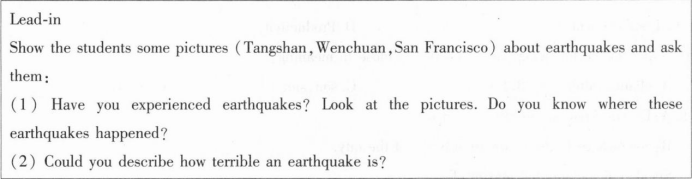
(1)请评价该教师所设计的导人环节。
(2)教师还可以采用哪些方法导入教学内容?(不少于五种)
(3)请自己设计一个课堂导入。
(1)请评价该教师所设计的导人环节。
(2)教师还可以采用哪些方法导入教学内容?(不少于五种)
(3)请自己设计一个课堂导入。
四、教学设计
每题20分,共1题,共20分
33
设计任务:请阅读下面学生信息和语言素材,设计20分钟的写作教学方案。教案没有固定格式,但须包含下列要点:
·teaching objectives
·teaching contents
·key and difficult points
·major steps and time allocation
·activities and justifications
教学时间:20分钟
学生概况:某城镇普通中学高中一年级第一学期学生。班级人数40人。多数学生已经达
到《义务教育英语课程标准(2011年版)》五级水平。学生课堂参与积极性一般。
语言素材:
COPERNICUS' REVOLUTIONARY THEORY
Nicolaus Copernicus was frightened and his mind was confused.Although he had tried to ignore them, all his mathematical calculations led to the same conclusion: that the earth was not the center of the solar system. Only if you put the sun there did the movements of the other planets in the sky make sense. Yet he could not tell anyone about his theory as the powerful Christian Church would have punished him for even suggesting such an idea. They believed God had made the world and for that reason the earth was special and must be the center of the solar system.
The problem arose because astronomers had noticed that some planets in the sky seemed to stop, move backward and then go forward in a loop. Others appeared brighter at times and less bright at others. This was very strange if the earth was the center of the solar system and all planets went round it.
Copernicus had thought long and hard about these problems and tried to find an answer. He had collected observations of the stars and used all his mathematical knowledge to explain them.But only his new theory could do that. So between 1510 and 1514 he worked on it, gradually improving his theory until he felt it was complete.
In 1514 he showed it privately to his friends. The changes he made to the old theory were revolutionary. He placed a fixed sun at the center of the solar system with the planets going round it and only the moon still going round the earth. He also suggested that the earth was spinning as it went round the sun and this explained changes in the movement of the planets and in the brightness of the stars. His friends were enthusiastic and encouraged him to publish his ideas,but Copernicus was cautious. He did not want to be attacked by the Christian Church, so he only published it as he lay dying in 1543.
Certainly he was right to be careful. The Christian Church rejected his theory, saying it was against God's idea and people who supported it would be attacked.Yet Copernicus's theory is now the basis on which all our ideas of the universe are built. His theory replaced the Christian idea of gravity, which said things fell to earth because God created the earth as the center of the universe. Copemicus showed this was obviously wrong. Now people can see that there is a direct link between his theory and the work of Isaac Newton, Albert Einstein and Stephen Hawking.
Please write a short letter asking Copernicus to publish his ideas so everyone can read them based on the material above.
·teaching objectives
·teaching contents
·key and difficult points
·major steps and time allocation
·activities and justifications
教学时间:20分钟
学生概况:某城镇普通中学高中一年级第一学期学生。班级人数40人。多数学生已经达
到《义务教育英语课程标准(2011年版)》五级水平。学生课堂参与积极性一般。
语言素材:
COPERNICUS' REVOLUTIONARY THEORY
Nicolaus Copernicus was frightened and his mind was confused.Although he had tried to ignore them, all his mathematical calculations led to the same conclusion: that the earth was not the center of the solar system. Only if you put the sun there did the movements of the other planets in the sky make sense. Yet he could not tell anyone about his theory as the powerful Christian Church would have punished him for even suggesting such an idea. They believed God had made the world and for that reason the earth was special and must be the center of the solar system.
The problem arose because astronomers had noticed that some planets in the sky seemed to stop, move backward and then go forward in a loop. Others appeared brighter at times and less bright at others. This was very strange if the earth was the center of the solar system and all planets went round it.
Copernicus had thought long and hard about these problems and tried to find an answer. He had collected observations of the stars and used all his mathematical knowledge to explain them.But only his new theory could do that. So between 1510 and 1514 he worked on it, gradually improving his theory until he felt it was complete.
In 1514 he showed it privately to his friends. The changes he made to the old theory were revolutionary. He placed a fixed sun at the center of the solar system with the planets going round it and only the moon still going round the earth. He also suggested that the earth was spinning as it went round the sun and this explained changes in the movement of the planets and in the brightness of the stars. His friends were enthusiastic and encouraged him to publish his ideas,but Copernicus was cautious. He did not want to be attacked by the Christian Church, so he only published it as he lay dying in 1543.
Certainly he was right to be careful. The Christian Church rejected his theory, saying it was against God's idea and people who supported it would be attacked.Yet Copernicus's theory is now the basis on which all our ideas of the universe are built. His theory replaced the Christian idea of gravity, which said things fell to earth because God created the earth as the center of the universe. Copemicus showed this was obviously wrong. Now people can see that there is a direct link between his theory and the work of Isaac Newton, Albert Einstein and Stephen Hawking.
Please write a short letter asking Copernicus to publish his ideas so everyone can read them based on the material above.

输入阅读码
查看答案与解析需要输入阅读码