2026年教师资格证《高中英语》考前点题卷二
一、单项选择题
每题2分,共30题,共60分
1.
_______as he is, he has turned_______professional writer.
参考答案C
解析本题考查倒装结构和冠词用法。句意为“尽管还是个少年,(但是)他已经成了一名职业作家”。as引导的让步状语从句使用倒装结构,如果是名词作表语置于句首,名词前不加冠词。turn表示“成为”时,其后的名词前一般不加冠词,但若该名词有形容词修饰时,则需要加冠词。故本题选C。
2.
No one knows exactly_______this ancient bridge was built. Some say it was built during the Tang dynasty, but others disagree.
参考答案C
解析本题考查宾语从句。句意为“没有人知道这座古桥是什么时候建成的。有人说它建于唐朝,但是有些人不认同”。宾语从句引导词在从句中作时间状语。故本题选C。
3.
The syntactic component provides the_______for a sentence.
参考答案B
解析本题考查句法学知识。句法成分使句子具备了结构。
4.
The older worker and the young each_______their own tools.
参考答案A
解析复数形式的主语与each连用,each位于复数形式的主语之后作同位语,该主语不受each的影响,谓语动词仍用复数形式。
5.
The semantic components of the word\" gentleman\" can be expressed as_______.
参考答案B
解析成分分析(componential analysis)指研究词义的一种方法,将词的语义成分或特征分成几个部分。
6.
I can't go cycling with you this weekend,for my bicycle needs_______.
参考答案B
解析向意:这个周末我不能和你一起骑自行车了,因为我的自行车需要修理。当need作实义动词后接动名词作宾语时,动名词的主动形式表示被动意义,相当于后接不定式的被动形式,即sth.+need+doing/to be done,表示“某物需要被做某事”。故选B。
7.
The relationship between \"fruit\" and \"orange\" is_______.
参考答案C
解析Orange是fruit的一种,所以两者之间是上下义关系(hyponymy)。
8.
The same between /m/ and /p/ lies in_______.
参考答案B
解析按照发音方法划分,/m/属于鼻音,/p/属于爆破音;按照发音部位划分,/m/和/p/都属于双唇音;按照带声性划分,/m/属于浊辅音,/p/属于清辅音;音的长短属于元音的分类范畴。故选B。
9.
This job is_______doing,but it isn't _______to spend so much time on it.
参考答案B
解析考查近义词辨析。worth和worthwhile均表示“值得的”。be worth后可直接跟名词.代词或动名词,其句子主语可用形式主语it,也可用动名词的逻辑宾语。而be worthwhile只能用在it beworthwhile结构中,后接动名词或不定式均可。因此只能选B。
10.
Morphemes that represent \" tense number\", \"gender\", \" case\" and so forth are called_______morphemes.
参考答案A
解析考查屈折词素。屈折词素(Inflectionalmorpheme)与其他词素结合后,会改变其时态.单复数等,例如动词遇到第三人称单数时须加上后缀.S,这样的词素只会改变语法特征,并不改变语意。
11.
Interlanguage, or the developing linguistic system of a second language learner, displays the following features except_______.
参考答案A
解析中介语是介于第二语言学习者母语和目的语之间的一种语言变体,其三大特征是系统性.可变性和石化现象。
12.
What aspects should be emphasized in classroom teaching in the view of the scholars who advocate situational method?
参考答案A
解析考查英语教学法。主张情景法的学者认为,口语是第一位的,同时,口语是书面语的基础。
13.
Which of the following belongs to language structure?
参考答案A
解析本题考查语法教学内容。morphology“词法”,language use“语用”,rhetoric“修辞”,language meaning“语意”。语法教学内容包括语言的形式.结构,语意和语用。其中,语言的形式.结构包括词法和句法等。故本题选A。
14.
Students are offered opportunities to integrate what they learned from the text into their existing knowledge and communicate with others using the information in the listening text. This description belongs to_______stage.
参考答案C
解析本题考查听力教学。题干叙述的教学活动为听后阶段进行的活动。
15.
Pre-reading activities include_______, setting the scene, skimming, and scanning.
参考答案A
解析阅读前的活动主要包括头脑风暴(brainstorming).个人思考.同桌讨论.猜题目或改写题目.预测阅读材料中可能出现的有关信息.讲解关键词语等。
16.
In a pre-listening activity, students need to learn to cope with some ambiguity in listening and realize that they can still learn even when they do not understand every single word.The aim of this activity is to develop the skill of_______.
参考答案B
解析考查听力教学。在听前活动中,学生需要学会应对听力过程中模糊不清的内容,并且需要意识到即使他们不能完全理解每一个单词但仍然可以学习,这属于培养学生听主旨的能力。A为听细节,B为听主旨,C为听结构,D为听词汇。故选B。
17.
When a teacher leads students to make necessary improvements in both organization and contents based on either self-editing or peer-editing, which stage are they in?
参考答案C
解析本题考查写作教学过程。教师在学生自改和互改的基础上,对学生进行指导,并让学生对作文的结构与内容进行修订,以提升作文质量。这属于修订(Revising)阶段。
18.
In which of the following situations is the teacher playing the role of an assessor?
参考答案D
解析本题考查教师的角色。A项中教师是传授者,B项中教师是课堂活动的组织者,C项中教师是学生活动的促进者,D项中教师是课堂活动情况的评价者。
19.
Littlewood divided communicative activities into two parts: functional communicative activities and_______.
参考答案B
解析利特尔伍德将交际性教学活动分为两部分:功能交际性活动和社会交往性活动。故选B。
20.
The word\" gunfighters\" contains_______morphemes.
参考答案C
解析语素是最小的语言单位,不能再进一步划分为更小的单位而不破坏或彻底改变其词汇意义或语法意义。gunfighters包含有四个语素,分别是:gun,fight,-er,一s。
一、单项选择题
-
请阅读 Passage 1,完成下列小题。
Passage 1
For many people,there is a very well-established stereotype that the first-class American universities are simply the best. However,I am not quite convinced of that. When I look back at my academic formation in the USA and compare it to the academic formation some of my friends had at Brazil, I don't feel like I am more prepared than my peers. Thus, I am currently facing a dilemma of whether to pursue my graduate studiesin Brazil or in the USA.
The difference in our academic backgrounds, however, is the more liberal nature of American education.From my experience at Georgetown, and from what I know of American higher education, there are very few strict requirements imposed on students. Generally speaking, you are relatively free to take whichever classes you want, provided that they are under the scope of your major field of study.
To illustrate, I compared the master's degrees in economics from Duke and Fundacao GetulioVargas( FGV), a Brazilian university. I chose to present a master's degree comparison here because the shorttwo-year study period makes it simpler than comparing a four-year program. Duke's program works like this:you pick a field of study and then have a required number of courses that you have to take in certain areas.Most of the requirements are not course-specific, but area-specifiC.With some fields of study, you can skipcertain areas altogether. If you choose to get a master's degree in applied economic, for instance, you don't have to take any mathematics course. In FGV, all economics students need to take the same core structure:Microeconomics 1 through 4, Macroeconomics 1 through 3, Econometrics, Statistics 1 and 2, and Math for Economics 1 and 2. From then on, you can specialize in certain fields, and the elective structure seems to be the same as in Duke:you pick five electives from your main area of interest.
This seems to be the same kind of difference that I noticed comparing what I studied in Georgetown as an undergraduate to what some of my friends studied in their undergraduate careers in Brazil. Now, is this more liberal education good or bad? There are factors pulling it each way, and the ideal solution, in my view,is a reasonable middle ground.What I see happening in American universities, however, is a little too much liberalization. Too much liberty tends to encourage students to take the more\"interesting\"courses,and ignore those that are considered most\" boring\". The problem is that many of these \"boring\" courses are usually foundational courses, which give students the analytical tools they need in order to be truly competent in their fields of study.
In the end, I feel like American universities sometimes delegate too much responsibility to students interms of choosing their academic careers. For me, this is troubling. Students in their twenties usually havevery little experience in the field they are studying, and many times they don't really know the tools they need to succeed in their area of interest. It is certainly the case in my situation. Fortunately,I research and discuss a lot before picking my classes, and was able to take advantage of my liberal American education to build both a strong foundation and take classes that interest me. But is this always the case? From my experience,I think not. What I see happening at Georgetown is that many students just pick the classes they find mostinteresting, without any real consideration of how it is going to support their overall academic formation. This result is a deficit in fundamentals.
Passage 1
For many people,there is a very well-established stereotype that the first-class American universities are simply the best. However,I am not quite convinced of that. When I look back at my academic formation in the USA and compare it to the academic formation some of my friends had at Brazil, I don't feel like I am more prepared than my peers. Thus, I am currently facing a dilemma of whether to pursue my graduate studiesin Brazil or in the USA.
The difference in our academic backgrounds, however, is the more liberal nature of American education.From my experience at Georgetown, and from what I know of American higher education, there are very few strict requirements imposed on students. Generally speaking, you are relatively free to take whichever classes you want, provided that they are under the scope of your major field of study.
To illustrate, I compared the master's degrees in economics from Duke and Fundacao GetulioVargas( FGV), a Brazilian university. I chose to present a master's degree comparison here because the shorttwo-year study period makes it simpler than comparing a four-year program. Duke's program works like this:you pick a field of study and then have a required number of courses that you have to take in certain areas.Most of the requirements are not course-specific, but area-specifiC.With some fields of study, you can skipcertain areas altogether. If you choose to get a master's degree in applied economic, for instance, you don't have to take any mathematics course. In FGV, all economics students need to take the same core structure:Microeconomics 1 through 4, Macroeconomics 1 through 3, Econometrics, Statistics 1 and 2, and Math for Economics 1 and 2. From then on, you can specialize in certain fields, and the elective structure seems to be the same as in Duke:you pick five electives from your main area of interest.
This seems to be the same kind of difference that I noticed comparing what I studied in Georgetown as an undergraduate to what some of my friends studied in their undergraduate careers in Brazil. Now, is this more liberal education good or bad? There are factors pulling it each way, and the ideal solution, in my view,is a reasonable middle ground.What I see happening in American universities, however, is a little too much liberalization. Too much liberty tends to encourage students to take the more\"interesting\"courses,and ignore those that are considered most\" boring\". The problem is that many of these \"boring\" courses are usually foundational courses, which give students the analytical tools they need in order to be truly competent in their fields of study.
In the end, I feel like American universities sometimes delegate too much responsibility to students interms of choosing their academic careers. For me, this is troubling. Students in their twenties usually havevery little experience in the field they are studying, and many times they don't really know the tools they need to succeed in their area of interest. It is certainly the case in my situation. Fortunately,I research and discuss a lot before picking my classes, and was able to take advantage of my liberal American education to build both a strong foundation and take classes that interest me. But is this always the case? From my experience,I think not. What I see happening at Georgetown is that many students just pick the classes they find mostinteresting, without any real consideration of how it is going to support their overall academic formation. This result is a deficit in fundamentals.
21.
Which of the following influences the writer's judgment of the universities in the passage?
参考答案D
解析推理判断题。由第一段第三句话可知,影响作者对大学判断的因素是作者在美国的求学经历与他朋友在巴西求学经历的对比,故选D。
22.
Why did the writer choose to compare the master's programs rather than the bachelor's programs?
参考答案A
解析细节理解题。由第三段第二句话可知,作者选择用硕士学位作对比是因为对比两年的课程比对比四年的课程简单些,故选A。
23.
Which of the following can be inferred as the writer's attitude toward the American higher education.'?
参考答案C
解析观点态度题。分析文章内容可知,作者认为对大多数学生来说美国的自由教育会导致学生学术基础不稳固。但是,如果能充分利用这种自由教育既夯实学术基础,又选修感兴趣的课,也是可以受益的。由此判断,作者对美国自由教育持批判的态度,选C。
24.
Which of the following is true about the writer's experience?
参考答案A
解析细节理解题。由最后一段第五句可知,作者在开始选择课程之前仔细研究了一番,所以能够借助美国的自由教育既夯实了学术基础,又参与了感兴趣的课程。所以作者还是从美国教育中受益了。故选A。
25.
Which of following words is closest in meaning to\" deficit\" in the last PARAGRAPH?
参考答案A
解析词义推测题。由deficit所在句的前一句可知,此处指很多学生仅选修感兴趣的课程,而没有为全面地打好学术基础考虑,从而导致了基础知识不足。故选A。
请阅读 Passage 2,完成下列小题。
Passage 2
Only two countries in the advanced world provide no guarantee for paid leave from work to care for anew born child.Last spring one of the two, Australia, gave up the dubious distinction by establishing paidfamily leave starting in 2011. I wasn't surprised when this didn't make the news here in the United States--we're now the only wealthy country without such a policy.
The United States does have one explicit family policy, the Family and Medical Leave Act, passed in1993. It entitles workers to as much as 12 weeks' unpaid leave for care of a newborn or dealing with a familymedical problem. Despite the modesty of the benefit, the Chamber of Commerce and other business groups fought it bitterly, describing it as \"government-run personnel management\" and a \"dangerous precedent\". Infact, every step of the way, as (usually) Democratic leaders have tried to introduce work-family balance measures into the law, business groups have been strongly opposed.
As Yale law professor Anne Alstott argues, justifying parental support depends on defining the family as a social good that, in some sense, society must pay for. In her book No Exit: What Parents Owe Their Children and What Society Owes Parents, she argues that parents are burdened in many ways in their lives:there is \"no exit\" when it comes to children. \"Society expects--and needs--parents to provide their children with continuity of care, meaning the intensive, intimate care that human beings need to develop their intellectual, emotional and moral capabilities. And society expects--and needs--parents to persist in their roles for 18 years, or longer if needed.\"
While most parents do this out of love, there are public penalties for not providing care. What parents do, in other words, is of deep concern to the state, for the obvious reason that caring for children is not only morally urgent but essential for the future of society. The state recognizes this in the large body of family laws that govern children's welfare, yet parents receive little help in meeting the life-changing obligations society imposes. To classify parenting as a personal choice for which there is no collective responsibility is not merely to ignore the social benefits of good parenting; really, it is to steal those benefits because they accrue to the whole of society as today's children become tomorrow's productive citizenry. In fact, by some estimates, the value of parental investments in children, investments of time and money ( including lost wages), is equal to20-30% of gross domestic product. If these investments generate huge social benefits--as they clearly do--the benefits of providing more social support for the family should be that much clearer.
Passage 2
Only two countries in the advanced world provide no guarantee for paid leave from work to care for anew born child.Last spring one of the two, Australia, gave up the dubious distinction by establishing paidfamily leave starting in 2011. I wasn't surprised when this didn't make the news here in the United States--we're now the only wealthy country without such a policy.
The United States does have one explicit family policy, the Family and Medical Leave Act, passed in1993. It entitles workers to as much as 12 weeks' unpaid leave for care of a newborn or dealing with a familymedical problem. Despite the modesty of the benefit, the Chamber of Commerce and other business groups fought it bitterly, describing it as \"government-run personnel management\" and a \"dangerous precedent\". Infact, every step of the way, as (usually) Democratic leaders have tried to introduce work-family balance measures into the law, business groups have been strongly opposed.
As Yale law professor Anne Alstott argues, justifying parental support depends on defining the family as a social good that, in some sense, society must pay for. In her book No Exit: What Parents Owe Their Children and What Society Owes Parents, she argues that parents are burdened in many ways in their lives:there is \"no exit\" when it comes to children. \"Society expects--and needs--parents to provide their children with continuity of care, meaning the intensive, intimate care that human beings need to develop their intellectual, emotional and moral capabilities. And society expects--and needs--parents to persist in their roles for 18 years, or longer if needed.\"
While most parents do this out of love, there are public penalties for not providing care. What parents do, in other words, is of deep concern to the state, for the obvious reason that caring for children is not only morally urgent but essential for the future of society. The state recognizes this in the large body of family laws that govern children's welfare, yet parents receive little help in meeting the life-changing obligations society imposes. To classify parenting as a personal choice for which there is no collective responsibility is not merely to ignore the social benefits of good parenting; really, it is to steal those benefits because they accrue to the whole of society as today's children become tomorrow's productive citizenry. In fact, by some estimates, the value of parental investments in children, investments of time and money ( including lost wages), is equal to20-30% of gross domestic product. If these investments generate huge social benefits--as they clearly do--the benefits of providing more social support for the family should be that much clearer.
26.
What do we learn about paid family leave from the first paragraph?
参考答案A
解析细节理解题。根据第一段第三句话“We're now the only wealthy country without such apolicy”得出America now is the only developed country without the policy。答案A中developed其实就与wealthy同义。
27.
What has prevented the passing of work-family balance laws in the United States?
参考答案D
解析细节理解题。由题干关键词work family balance laws定位在文章第二段结尾。美国商会和其他商业团体常常对于美国关于平衡工作与家庭生活两者关系的法律均百般阻挠,相反民主党领导人常常是支持这项法律的。
28.
What is Professor Anne Alstott's argument for parental support?
参考答案B
解析细节理解题。可以通过题干关键词Anne Alstott定位在文章第三段开头。Anne Alstott教授在其书中表达的主要观点是“justifying parental support depends on defining the family as asocial good that,in some sense,society must pay for.”,即应该将家庭视作一个为社会带来好处的事情,同时该段中后面也阐述了社会期望也需要家长们对他们的孩子付出关爱。因此,教授的主要观点可以概括为良好的教养能造福于社会。
29.
What does the author think of America's large body of family laws governing children's welfare?
参考答案B
解析细节理解题。由题干关键词America’Slarge body of family laws,定位在文中第四段第三句话“The state recognizes this in the large body offamily laws that govern children’S welfare,yet parents receive little help in meeting the life·changing obligations society imposes.”尽管州政府意识到了养育孩子的重要性,但家长们接受的帮助仍然少之又少,因此答案为B。
30.
Why does the author object to classifying parenting as a personal choice?
参考答案D
解析细节理解题。由文中最后一段“Toclassify parenting as a personal choice for which there is no collective responsibility is not merely toignore the social benefits of good parenting…”可得出,将养育孩子作为一种个人选择,而不加之以社会责任的话,便是忽视良好教养所产生的社会效应,因此作者反对将养育孩子仅仅作为个人选择来看待。collective responsibility指是社会责任。此题容易选为C“会产生巨大的社会益处”。文中说道看成个人选择会忽略社会好处,所以是因为忽略社会好处,所以反对看成个人选择。
二、简答题
每题10分,共1题,共10分
31.
《普通高中英语课程标准》(2017年版)的课程内容部分包括哪六个方面?谈谈你对“文化知识”的理解。
参考答案详见解析
解析(1)《普通高中英语课程标准》(2017年版)的课程内容部分包括主题语境.语篇类型.语言知识.文化知识.语言技能学习策略六个方面。(2)其中“文化知识”包含中外文化知识,是学生在语言学习活动中理解文化内涵,比较文化异同,汲取文化精华,坚定文化自信的基础。掌握充分的中外多元文化知识,认同优秀文化,有助于促进英语学科核心素养的形成和发展。文化知识涵盖物质和精神两个方面。物质方面主要包括饮食.服饰.建筑.交通等,以及相关的发明与创造;精神方面主要包括哲学.科学.教育.历史.文学.艺术,也包括价值观念.道德修养.审美情趣.社会规约和风俗习惯等。学习中外优秀文化,有助于学生在对不同文化的比较.鉴赏.批判和反思的过程中,拓宽国际视野,理解和包容不同文化,增强对中华优秀传统文化.革命文化和社会主义先进文化的认识,形成正确的价值观和道德情感,成为有文明素养和社会责任感的人。
三、教学情境分析题
每题10分,共1题,共10分
32.
以下是某高中英语教师设计的课堂导入,阅读并回答以下问题:
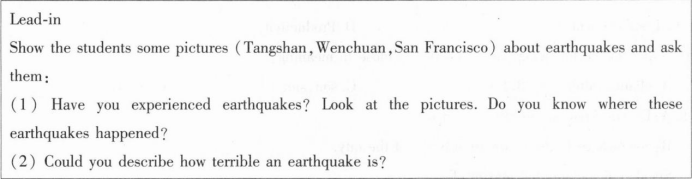
(1)请评价该教师所设计的导人环节。
(2)教师还可以采用哪些方法导入教学内容?(不少于五种)
(3)请自己设计一个课堂导入。
(1)请评价该教师所设计的导人环节。
(2)教师还可以采用哪些方法导入教学内容?(不少于五种)
(3)请自己设计一个课堂导入。
参考答案详见解析
解析(1)新课的导入是整个课堂教学活动中的热身活动,目的是让学生在最短的时间内进入课堂学习的最佳状态。该教师通过图片展示.提出问题的方式导人课堂内容,既扩大了学生的知识面,又激发了他们的学习兴趣,并引发了他们的求知欲,调动了他们回答问题的积极性。
(2)课堂导入方法有:电影或歌曲导入法;探讨话题导入法;头脑风暴法;时事导入法;实物导入法;背景知识导人法;演讲和表演导人法;故事导入法;游戏导入法;情境导人法等。
(3) Lead-in The teacher quotes some poems, proverbs, expressing people's opinions on hope, then plays a song BeTogether,Alive or Not. Time permitting, the teacher could teach students to sing it. Thus,it will arousestudents' interest and emotional identification.
(2)课堂导入方法有:电影或歌曲导入法;探讨话题导入法;头脑风暴法;时事导入法;实物导入法;背景知识导人法;演讲和表演导人法;故事导入法;游戏导入法;情境导人法等。
(3) Lead-in The teacher quotes some poems, proverbs, expressing people's opinions on hope, then plays a song BeTogether,Alive or Not. Time permitting, the teacher could teach students to sing it. Thus,it will arousestudents' interest and emotional identification.
四、教学设计
每题20分,共1题,共20分
33.
设计任务:请阅读下面学生信息和语言素材,设计20分钟的写作教学方案。教案没有固定格式,但须包含下列要点:
·teaching objectives
·teaching contents
·key and difficult points
·major steps and time allocation
·activities and justifications
教学时间:20分钟
学生概况:某城镇普通中学高中一年级第一学期学生。班级人数40人。多数学生已经达
到《义务教育英语课程标准(2011年版)》五级水平。学生课堂参与积极性一般。
语言素材:
COPERNICUS' REVOLUTIONARY THEORY
Nicolaus Copernicus was frightened and his mind was confused.Although he had tried to ignore them, all his mathematical calculations led to the same conclusion: that the earth was not the center of the solar system. Only if you put the sun there did the movements of the other planets in the sky make sense. Yet he could not tell anyone about his theory as the powerful Christian Church would have punished him for even suggesting such an idea. They believed God had made the world and for that reason the earth was special and must be the center of the solar system.
The problem arose because astronomers had noticed that some planets in the sky seemed to stop, move backward and then go forward in a loop. Others appeared brighter at times and less bright at others. This was very strange if the earth was the center of the solar system and all planets went round it.
Copernicus had thought long and hard about these problems and tried to find an answer. He had collected observations of the stars and used all his mathematical knowledge to explain them.But only his new theory could do that. So between 1510 and 1514 he worked on it, gradually improving his theory until he felt it was complete.
In 1514 he showed it privately to his friends. The changes he made to the old theory were revolutionary. He placed a fixed sun at the center of the solar system with the planets going round it and only the moon still going round the earth. He also suggested that the earth was spinning as it went round the sun and this explained changes in the movement of the planets and in the brightness of the stars. His friends were enthusiastic and encouraged him to publish his ideas,but Copernicus was cautious. He did not want to be attacked by the Christian Church, so he only published it as he lay dying in 1543.
Certainly he was right to be careful. The Christian Church rejected his theory, saying it was against God's idea and people who supported it would be attacked.Yet Copernicus's theory is now the basis on which all our ideas of the universe are built. His theory replaced the Christian idea of gravity, which said things fell to earth because God created the earth as the center of the universe. Copemicus showed this was obviously wrong. Now people can see that there is a direct link between his theory and the work of Isaac Newton, Albert Einstein and Stephen Hawking.
Please write a short letter asking Copernicus to publish his ideas so everyone can read them based on the material above.
·teaching objectives
·teaching contents
·key and difficult points
·major steps and time allocation
·activities and justifications
教学时间:20分钟
学生概况:某城镇普通中学高中一年级第一学期学生。班级人数40人。多数学生已经达
到《义务教育英语课程标准(2011年版)》五级水平。学生课堂参与积极性一般。
语言素材:
COPERNICUS' REVOLUTIONARY THEORY
Nicolaus Copernicus was frightened and his mind was confused.Although he had tried to ignore them, all his mathematical calculations led to the same conclusion: that the earth was not the center of the solar system. Only if you put the sun there did the movements of the other planets in the sky make sense. Yet he could not tell anyone about his theory as the powerful Christian Church would have punished him for even suggesting such an idea. They believed God had made the world and for that reason the earth was special and must be the center of the solar system.
The problem arose because astronomers had noticed that some planets in the sky seemed to stop, move backward and then go forward in a loop. Others appeared brighter at times and less bright at others. This was very strange if the earth was the center of the solar system and all planets went round it.
Copernicus had thought long and hard about these problems and tried to find an answer. He had collected observations of the stars and used all his mathematical knowledge to explain them.But only his new theory could do that. So between 1510 and 1514 he worked on it, gradually improving his theory until he felt it was complete.
In 1514 he showed it privately to his friends. The changes he made to the old theory were revolutionary. He placed a fixed sun at the center of the solar system with the planets going round it and only the moon still going round the earth. He also suggested that the earth was spinning as it went round the sun and this explained changes in the movement of the planets and in the brightness of the stars. His friends were enthusiastic and encouraged him to publish his ideas,but Copernicus was cautious. He did not want to be attacked by the Christian Church, so he only published it as he lay dying in 1543.
Certainly he was right to be careful. The Christian Church rejected his theory, saying it was against God's idea and people who supported it would be attacked.Yet Copernicus's theory is now the basis on which all our ideas of the universe are built. His theory replaced the Christian idea of gravity, which said things fell to earth because God created the earth as the center of the universe. Copemicus showed this was obviously wrong. Now people can see that there is a direct link between his theory and the work of Isaac Newton, Albert Einstein and Stephen Hawking.
Please write a short letter asking Copernicus to publish his ideas so everyone can read them based on the material above.
参考答案详见解析
解析Teaching Contents: Write a short letter asking Copernicus to publish his ideas so everyone can read them
(persuasive writing).
Teaching Objectives:
(1) Students can know more detailed information about Copernicus' theory, and get some knowledge about the era he lived in.
(2) Students can know how to develop their reasons to change somebody else's point of view.
(3) Students are able to write a persuasive article.
(4) Students can cultivate enthusiasm for science and confidence to convince others in their own words.
Teaching Key Point:
Students can learn to write a persuasive article.
Teaching Difficult Point:
Students can write a persuasive article with clear ideas and convincing supporting evidence.
Major Steps:
Step 1 Pre-writing (6 minutes)
(1) Ask students to read the passage quickly and then answer the following questions:
① Who is Copernicus?
② What's his theory mainly about?
③ Why is the theory revolutionary?
(2) Ask students to read the passage carefully and then talk about the reason why Copernicus couldn't tell anyone about his theory according to the passage. Write down students' answers on the blackboard.
(3) Discussion
T: If you were Copernicus, would you have hidden your theory for so many years? Give your reasons.
Write down students' reasons why Copernicus should publish his theory on the blackboard.
(Justification: This step can broaden students' writing ideas. It also makes preparations for writing a persuasive letter.)
(4) Structure
Ask students to think about their outline and share it. Introduce the format of persuasive article in the form of a letter and make a writing plan for students.

(Justification: The step can help students have a basic understanding of how to write a persuasive article. And the outlining can offer students a clear structure and make preparations for the drafting.)
Step 2 While-writing (8 minutes)
Ask students to write a draft persuading Copernicus to publish his theory according to the form. Ask students to pay more attention to the spelling, grammar, and the logic of sentences.
(Justification: With all the preparations from the pre-writing part, students will be able to write down the persuasive article fast.)
Step 3 Post-writing (6 minutes)
(1) Peer-editing
After the drafting, ask students to check their letters with their deskmates. They should check the ideas, the logical development, the grammar, spelling and punctuation.
(2) Lead students to make necessary improvements in both organization and content based on their editing.
Share two articles of students and give some evaluations.
(Justification: Peer-editing can provide an opportunity for students to share their articles and help them learn from each other. With the help of the teacher's evaluations, students can find their mistakes and know how to correct them.)
(persuasive writing).
Teaching Objectives:
(1) Students can know more detailed information about Copernicus' theory, and get some knowledge about the era he lived in.
(2) Students can know how to develop their reasons to change somebody else's point of view.
(3) Students are able to write a persuasive article.
(4) Students can cultivate enthusiasm for science and confidence to convince others in their own words.
Teaching Key Point:
Students can learn to write a persuasive article.
Teaching Difficult Point:
Students can write a persuasive article with clear ideas and convincing supporting evidence.
Major Steps:
Step 1 Pre-writing (6 minutes)
(1) Ask students to read the passage quickly and then answer the following questions:
① Who is Copernicus?
② What's his theory mainly about?
③ Why is the theory revolutionary?
(2) Ask students to read the passage carefully and then talk about the reason why Copernicus couldn't tell anyone about his theory according to the passage. Write down students' answers on the blackboard.
(3) Discussion
T: If you were Copernicus, would you have hidden your theory for so many years? Give your reasons.
Write down students' reasons why Copernicus should publish his theory on the blackboard.
(Justification: This step can broaden students' writing ideas. It also makes preparations for writing a persuasive letter.)
(4) Structure
Ask students to think about their outline and share it. Introduce the format of persuasive article in the form of a letter and make a writing plan for students.
(Justification: The step can help students have a basic understanding of how to write a persuasive article. And the outlining can offer students a clear structure and make preparations for the drafting.)
Step 2 While-writing (8 minutes)
Ask students to write a draft persuading Copernicus to publish his theory according to the form. Ask students to pay more attention to the spelling, grammar, and the logic of sentences.
(Justification: With all the preparations from the pre-writing part, students will be able to write down the persuasive article fast.)
Step 3 Post-writing (6 minutes)
(1) Peer-editing
After the drafting, ask students to check their letters with their deskmates. They should check the ideas, the logical development, the grammar, spelling and punctuation.
(2) Lead students to make necessary improvements in both organization and content based on their editing.
Share two articles of students and give some evaluations.
(Justification: Peer-editing can provide an opportunity for students to share their articles and help them learn from each other. With the help of the teacher's evaluations, students can find their mistakes and know how to correct them.)