英语等级考试《PETS四级》试题(网友回忆版)二
PETS四级
历年真题
共 58 题
1517 次浏览
更新于 2026-09-26
一、听力题
根据要求选择正确的答案。
〈huixue_java/202411/OB8DRm_2013.mp3〉
1
Directions:
This section is designed to test your ability to understand spoken English.You will hear a selection of recorded materials and you must answer the questions that accompany them.There are three parts in this section, Part A, Part B and Part C.
Remember, while you are doing the test, you should first put down your answers in your test booklet.At the end of the listening comprehension section, you will have 5 minutes to transfer all your answers from your test booklet to ANSWER SHEET 1.
If you have any questions, you may raise your hand now as you will not be allowed to speak once the test has started.
Now look at Part A in your test booklet.
Part A
Directions: For Questions 1-5, you will hear a radio program about resources on the Internet.While you listen, fill out the table with the information you have heard.Some of the information has been given to you in the table.Write only 1 word or number in each numbered box.You will hear the recording twice.
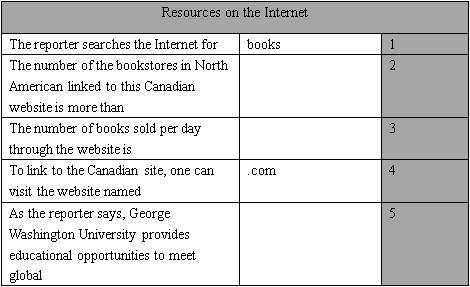
This section is designed to test your ability to understand spoken English.You will hear a selection of recorded materials and you must answer the questions that accompany them.There are three parts in this section, Part A, Part B and Part C.
Remember, while you are doing the test, you should first put down your answers in your test booklet.At the end of the listening comprehension section, you will have 5 minutes to transfer all your answers from your test booklet to ANSWER SHEET 1.
If you have any questions, you may raise your hand now as you will not be allowed to speak once the test has started.
Now look at Part A in your test booklet.
Part A
Directions: For Questions 1-5, you will hear a radio program about resources on the Internet.While you listen, fill out the table with the information you have heard.Some of the information has been given to you in the table.Write only 1 word or number in each numbered box.You will hear the recording twice.
2
Part B
Directions: For Questions 6-10, you will hear a brief talk about the popularity of coffee.While you listen, complete the sentences or answer the questions.Use no more than 3 words for each answer.You will hear the recording twice.
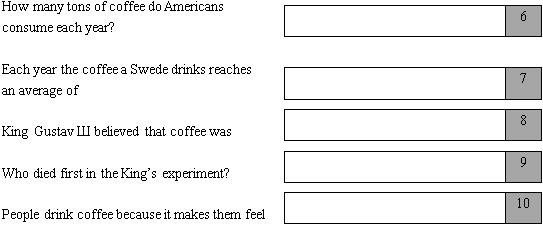
Directions: For Questions 6-10, you will hear a brief talk about the popularity of coffee.While you listen, complete the sentences or answer the questions.Use no more than 3 words for each answer.You will hear the recording twice.
3
Part C
Directions: You will hear three dialogues or monologues.Before listening to each one, you will have 5 seconds m read each of the questions which accompany it.While listening, answer each question by choosing A, B, C or D.After listening, you will have 10 seconds to check your answer to each question.You will hear each piece once only.
Questions 11-13 are based on a talk about World AIDS Day.
World AIDS Day is a day to
Directions: You will hear three dialogues or monologues.Before listening to each one, you will have 5 seconds m read each of the questions which accompany it.While listening, answer each question by choosing A, B, C or D.After listening, you will have 10 seconds to check your answer to each question.You will hear each piece once only.
Questions 11-13 are based on a talk about World AIDS Day.
World AIDS Day is a day to
- A.consider the treatment of intriduals with the AIDS virus.
- B.show the importance of the AIDS Association.
- C.call on doctors to place more importance on AIDS patients.
- D.celebrate the achievements in the control of AIDS.
4
What is the theme for the next year’ s AIDS campaign?
- A.Development of a cure for AIDS.
- B.Fair treatment of AIDS patients.
- C.Progress in AIDS research.
- D.Courage to live with AIDS.
5
How many women were infected with the AIDS virus last year?
- A.2 million.
- B.4 million.
- C.19 million.
- D.39 million.
6
Questions 14-16 are based on the biography of Stephen Biko, a South African political leader for the Black Consciousness Movement.
What did Biko study in the university?
What did Biko study in the university?
- A.Politics.
- B.Black nationalism.
- C.Medicine.
- D.Government policies.
7
When did Biko become the honorary president of the Black People’s Convention?
- A.1968.
- B.1972.
- C.1973.
- D.1977.
8
What did the South African Government do with the Black Consciousness Movement at the beginning?
- A.Put up with it.
- B.Restricted its activities.
- C.Arrested its leaders.
- D.Granted limited approval.
9
Questions 17-20 are based on a talk about left-handers.
What is the purpose of Left-handers International?
What is the purpose of Left-handers International?
- A.To help left-handers find better jobs.
- B.To change public attitudes towards left-handers.
- C.To rid left-handers of their prejudices.
- D.To show the public the talents of left-handers.
10
What have researchers found in their studies of hand preference?
- A.Children don’ t show strong hand preference until six.
- B.Children under three tend to have a favorite eye and ear.
- C.There are as many male left-handers as female ones.
- D.Left-handers are more interesting than right-handers.
11
Left-handers seem more athletic because they
- A.are more energetic.
- B.persist in physical training.
- C.possess a creative impulse.
- D.have a better sense of space.
12
What is the problem some left-handers might suffer from?
- A.Slowness in communication.
- B.Awkwardness in action.
- C.Speech defect.
- D.Difficulty in writing.
二、阅读理解题
根据题干选择正确的答案。
Directions: Read the following text.Choose the best word or phrase for each numbered blank and mark A, B, C or D on ANSWER SHEET 1.
Pragmatism is a philosophical movement that has had a major impact on American culture from the late 19th century to the present.Pragmatism calls 21 ideas and theories to be tested in practice, by 22 whether acting upon the idea or theory produces desirable or undesirable results.
The ideas of the pragmatists were considered 23 when they first appeared.To some critics, pragmatism’ s 24 to affirm any absolute standards carded negative implications for society. 25 , pragmatists do not believe that a single absolute idea of goodness or justice exists, but 26 that these concepts are changeable and depend on the 27 in which they are being discussed.The 28 of these absolutes, critics feared, could result in a (n) 29 in moral standards.The pragmatists’ denial of absolutes, 30 , challenged the foundations of religion, government, and schools of thought. 31 ,pragmatism influenced developments in psychology, sociology, and many other schools and movements. 32 political groups have also drawn 33 the assumptions of pragmatism, from the progressive movements of the early 20th century to later experiments in social reform.
Pragmatism is best 34 in its historical and cultural context.It arose during the late 19th century, a period of rapid scientific advancement 35 by the theories of British biologist Charles Darwin, whose theories 36 to many thinkers that humanity and society are in a 37 state of progress.During this same period, a decline in 38 religious beliefs and values accompanied the industrialization and material progress of the time.In 39 , it became necessary to rethink 40 ideas about values, religion, science, community, and intriduality.
Pragmatism is a philosophical movement that has had a major impact on American culture from the late 19th century to the present.Pragmatism calls 21 ideas and theories to be tested in practice, by 22 whether acting upon the idea or theory produces desirable or undesirable results.
The ideas of the pragmatists were considered 23 when they first appeared.To some critics, pragmatism’ s 24 to affirm any absolute standards carded negative implications for society. 25 , pragmatists do not believe that a single absolute idea of goodness or justice exists, but 26 that these concepts are changeable and depend on the 27 in which they are being discussed.The 28 of these absolutes, critics feared, could result in a (n) 29 in moral standards.The pragmatists’ denial of absolutes, 30 , challenged the foundations of religion, government, and schools of thought. 31 ,pragmatism influenced developments in psychology, sociology, and many other schools and movements. 32 political groups have also drawn 33 the assumptions of pragmatism, from the progressive movements of the early 20th century to later experiments in social reform.
Pragmatism is best 34 in its historical and cultural context.It arose during the late 19th century, a period of rapid scientific advancement 35 by the theories of British biologist Charles Darwin, whose theories 36 to many thinkers that humanity and society are in a 37 state of progress.During this same period, a decline in 38 religious beliefs and values accompanied the industrialization and material progress of the time.In 39 , it became necessary to rethink 40 ideas about values, religion, science, community, and intriduality.
13
______.
- A.for
- B.in
- C.out
- D.off
14
______.
- A.discussing
- B.predicting
- C.assessing
- D.questioning
15
______.
- A.reasonable
- B.credible
- C.revolutionary
- D.attractive
16
______.
- A.effort
- B.refusal
- C.intention
- D.hesitation
17
______.
- A.In turn
- B.Above all
- C.For example
- D.In addition
18
______.
- A.rather
- B.also
- C.still
- D.even
19
______.
- A.domain
- B.vicinity
- C.context
- D.surrounding
20
______.
- A.subject
- B.defect
- C.existence
- D.absence
21
______.
- A.change
- B.decline
- C.correction
- D.interest
22
______.
- A.therefore
- B.nevertheless
- C.anyway
- D.moreover
23
______.
- A.As a rule
- B.On the contrary
- C.As a result
- D.On average
24
______.
- A.Particular
- B.Various
- C.Significant
- D.Few
25
______.
- A.on
- B.in
- C.up
- D.forth
26
______.
- A.simulated
- B.handled
- C.practiced
- D.understood
27
______.
- A.typified
- B.systemized
- C.generalized
- D.justified
28
______.
- A.supposed
- B.contributed
- C.implied
- D.suggested
29
______.
- A.perpetual
- B.consistent
- C.prosperous
- D.temporary
30
______.
- A.universal
- B.prevalent
- C.traditional
- D.representative
31
______.
- A.consequence
- B.reality
- C.essence
- D.contrast
32
______.
- A.confusing
- B.fundamental
- C.controversial
- D.dominant
Part A
Directions: Read the following four texts. Answer the questions below each text by choosing A, B, C or D. Mark your answers on ANSWER SHEET 1.
Text 1
A Food and Drug Administration (FDA) advisory committee has concluded that a novel new treatment can greatly help rheumatoid arthritis patients.
The panel recommended approving Enbrel for use alone in patients who haven’t responded to other drugs or in combination with methotrexate, a cancer drug that has been the main treatment for rheumatoid arthritis.
The FDA must make a final decision by early November, and the drug’s maker says it could be on the market by year’s end.
In rheumatoid arthritis, which affects 2.1 million Americans, the immune system attacks healthy joints. A major wrongdoer in this process is a protein called “tumor killing factor”, or TNF, which interacts with a special molecule, or TNF receptor, on cells’ surfaces.
To keep inflammation in cheek, cells normally release some receptors to mop up excess TNF, rendering it inactive. Apparently, rheumatoid arthritis patients don’t have enough free-floating TNF receptors.
Enbrel consists of genetically engineered TNF receptors. In a six-month study, 234 patients with advanced rheumatoid arthritis received one of two doses of Eubrel or a placebo ( harmless substance given as if it were medicine) in twice-a-week injections. They took injections for six months. By the end, 40% of patients on the larger Eubrel dose saw symptoms, such as swelling and joint pain, cut in half. Only 5% on the placebo did that well. The main side effect was minor irritation at the injection site.
Because some TNF is needed for a normal immune response, there is at least a theoretical risk of infections or even cancer in patients who take Enbrel, so the FDA panel urged long-term safety studies.
Last week, the FDA approved Arava, an oral treatment for rheumatoid arthritis that is similar to methotrexate. While calling both Enbrel and Arava “potentially very important”, Brian Butcher, vice president for research at the Arthritis Foundation, notes they have been tested in relatively few patients.
Butcher says their safety should be closely monitored once they’re widely available.
Directions: Read the following four texts. Answer the questions below each text by choosing A, B, C or D. Mark your answers on ANSWER SHEET 1.
Text 1
A Food and Drug Administration (FDA) advisory committee has concluded that a novel new treatment can greatly help rheumatoid arthritis patients.
The panel recommended approving Enbrel for use alone in patients who haven’t responded to other drugs or in combination with methotrexate, a cancer drug that has been the main treatment for rheumatoid arthritis.
The FDA must make a final decision by early November, and the drug’s maker says it could be on the market by year’s end.
In rheumatoid arthritis, which affects 2.1 million Americans, the immune system attacks healthy joints. A major wrongdoer in this process is a protein called “tumor killing factor”, or TNF, which interacts with a special molecule, or TNF receptor, on cells’ surfaces.
To keep inflammation in cheek, cells normally release some receptors to mop up excess TNF, rendering it inactive. Apparently, rheumatoid arthritis patients don’t have enough free-floating TNF receptors.
Enbrel consists of genetically engineered TNF receptors. In a six-month study, 234 patients with advanced rheumatoid arthritis received one of two doses of Eubrel or a placebo ( harmless substance given as if it were medicine) in twice-a-week injections. They took injections for six months. By the end, 40% of patients on the larger Eubrel dose saw symptoms, such as swelling and joint pain, cut in half. Only 5% on the placebo did that well. The main side effect was minor irritation at the injection site.
Because some TNF is needed for a normal immune response, there is at least a theoretical risk of infections or even cancer in patients who take Enbrel, so the FDA panel urged long-term safety studies.
Last week, the FDA approved Arava, an oral treatment for rheumatoid arthritis that is similar to methotrexate. While calling both Enbrel and Arava “potentially very important”, Brian Butcher, vice president for research at the Arthritis Foundation, notes they have been tested in relatively few patients.
Butcher says their safety should be closely monitored once they’re widely available.
33
Enbrel as recommended by FDA advisory committee
- A.could be a substitute for methotrexate in the near future.
- B.might bring hope to rheumatoid arthritis patients.
- C.should be administered to all rheumatoid arthritis patients alike.
- D.would distinguish itself for its cancer-killing effect.
34
Which of the following is responsible for the inflammation of the joints?
- A.A special molecule on cell’s surface.
- B.A free-floating receptor.
- C.A tumor-killing protein.
- D.Inactive TNF.
35
We learn from Paragraph 6 that
- A.Enbrel treatment in large doses could reduce the patients’ symptoms.
- B.arthritis patients presented symptoms after Enbrel treatment.
- C.arthritis patients with treatment of a placebo were rid of symptoms.
- D.only 5% on the placebo got symptoms such as swelling and joint pain.
36
The wide use of the new drug Enbrel relies much on
- A.justification of the new treatment.
- B.a new monitoring system.
- C.mass production of the drug.
- D.long-term safety studies.
37
Which of the following might be an appropriate title for the text?
- A.TNF and Immune System
- B.Enbrel versus Methotrexate
- C.Arthritis Drug on Path to Approval
- D.Study on Rheumatoid Arthritis
Text 2
How far away you are from retirement plays a large part in how you should invest your retirement money. According to Leslie Wright of Westminster Portfolio Services Ltd., there are three stages to a long-term regular savings plan for retirement: capitalization, consolidation and conservation. In the frost stage, people should be most concerned with building up their retirement savings investment. According to Wright, these investors can “take as aggressive an outlook as their nerves can stand,” because at this point there is little capital to risk. The second step, consolidation, makes up the bulk of your savings plan; balance the aggressive investments with some tamer ones, to better protect your existing possessions. The final change, from consolidation to conservation, when your investments should aim to preserve the capital you have, should take place one to three years before you retire. The exact timing of all these should take current market conditions into account, although Wright warns against risky betting on future growth. “Greed must not be allowed to blind prudence,” he says.
Whatever vehicles you choose for your retirement share-holding, be sure to take advantage of dollar-cost averaging. By investing a fixed amount at regular intervals, you’ll be able to avoid the risk of poorly timed investments by averaging out the peaks and valleys of the market. Plus, regular contributions will let you avoid the temptation to drop out when the market fails, and to buy too much when prices are high.
Those who are well along the road to retirement may have cause for concern these days. The plunging stock and property markets have shrunk savings, for retirement and otherwise; and some people have not planned for their retirement at all.
You won’t be that rash, of course, but what if you’re already in mid-career and don’t have a retirement plan in place? If you don’t make some serious cuts in your spending and save heavily now, you’ll have to sacrifice in your golden years.
Of course, it’s better still to get off on the right foot by starting your planning early. “No one should have to compromise his riving standards when be retires,” says Wright. “Retirement is a time to really enjoy life. We have all worked so hard. “And one of the things you should be working hard on right now is planning for those days of enjoyment.
How far away you are from retirement plays a large part in how you should invest your retirement money. According to Leslie Wright of Westminster Portfolio Services Ltd., there are three stages to a long-term regular savings plan for retirement: capitalization, consolidation and conservation. In the frost stage, people should be most concerned with building up their retirement savings investment. According to Wright, these investors can “take as aggressive an outlook as their nerves can stand,” because at this point there is little capital to risk. The second step, consolidation, makes up the bulk of your savings plan; balance the aggressive investments with some tamer ones, to better protect your existing possessions. The final change, from consolidation to conservation, when your investments should aim to preserve the capital you have, should take place one to three years before you retire. The exact timing of all these should take current market conditions into account, although Wright warns against risky betting on future growth. “Greed must not be allowed to blind prudence,” he says.
Whatever vehicles you choose for your retirement share-holding, be sure to take advantage of dollar-cost averaging. By investing a fixed amount at regular intervals, you’ll be able to avoid the risk of poorly timed investments by averaging out the peaks and valleys of the market. Plus, regular contributions will let you avoid the temptation to drop out when the market fails, and to buy too much when prices are high.
Those who are well along the road to retirement may have cause for concern these days. The plunging stock and property markets have shrunk savings, for retirement and otherwise; and some people have not planned for their retirement at all.
You won’t be that rash, of course, but what if you’re already in mid-career and don’t have a retirement plan in place? If you don’t make some serious cuts in your spending and save heavily now, you’ll have to sacrifice in your golden years.
Of course, it’s better still to get off on the right foot by starting your planning early. “No one should have to compromise his riving standards when be retires,” says Wright. “Retirement is a time to really enjoy life. We have all worked so hard. “And one of the things you should be working hard on right now is planning for those days of enjoyment.
38
In the first stage of saving for retirement, people can take an aggressive investment strategy.because
- A.they have a long-term regular savings plan in view.
- B.they can well stand losses that might occur.
- C.there is no risk in long-term investment.
- D.chances can balance possible risks.
39
To avoid the risk of poorly timed investments, one should
- A.adopt dollar-cost averaging strategy.
- B.set a limit to his investment at regular intervals.
- C.suppress the temptation to drop out untimely.
- D.stop buying shares when the prices are too high.
40
What does the phrase “in your golden years” (Line 3, Paragraph 4,) mean?
- A.Youth.
- B.Middle age.
- C.Mid-career.
- D.Old age.
41
The author might agree to the argument that
- A.one will have to change his spending habits when growing old.
- B.it’ s far better to end up with too much money than not enough.
- C.it’ s advisable to open a savings account instead of buying stock shares.
- D.people should spend less on living after their retirement.
42
Which of the following might be an appropriate title for the text?
- A.Savings Strategy
- B.Enjoy Your Later Years
- C.Plan for Retirement
- D.Risky Stock Market
Text 3
In the 400s BC, the Sophists, a group of wandering teachers, began to teach in Athens. The Sophists claimed that they could teach any subject or skill to anyone who wished to learn it. They specialized in teaching grammar, logic, and rhetoric, subjects that eventually formed the core of the liberal arts. The Sophists were more interested in preparing their students to argue persuasively and win arguments than in teaching principles of truth and morality.
Unlike the Sophists, the Greek philosopher Socrates sought to discover and teach universal principles of truth, beauty, and goodness. Socrates, who died in 399 BC, claimed that true knowledge existed within everyone and needed to be brought to consciousness. His educational method, called the Socratic method, consisted of asking probing questions that forced his students to think deeply about the meaning of life, truth, and justice.
In 387 BC Plato, who bad studied under Socrates, established a school in Athens called the Academy. Plato believed in an unchanging world of perfect ideas or universal concepts. He asserted that since true knowledge is the same in every place at every time, education, like truth, should be unchanging. Plato described his educational ideal in The Republic, one of the most notable works of Western philosophy. Plato’s Republic describes a model society, or republic, ruled by highly intelligent philosopher-kings. Warriors make up the republic’s second class of people. The lowest class, the workers, provide food and other products for all the people of the republic. In Plato’s ideal educational system, each class would receive a different kind of instruction to prepare for their various roles in society.
In 335 BC Plato’ s student, Aristotle, founded his own school in Athens called the Lyceum. Believing that human beings are essentially rational, Aristotle thought people could discover natural laws that governed the universe and then follow these laws in their lives. He also concluded that educated people who used reason to make decisions would lead a life of moderation in which they avoided dangerous extremes.
In the 4th century BC Greek orator Isocrates developed a method of education designed to prepare students to be competent orators who could serve as government officials. Isocrates’s students studied rhetoric, politics, ethics, and history. They examined model orations and practiced public speaking. Isocrates’s methods of education directly influenced such Roman educational theorists as Cicero and Quintilian.
In the 400s BC, the Sophists, a group of wandering teachers, began to teach in Athens. The Sophists claimed that they could teach any subject or skill to anyone who wished to learn it. They specialized in teaching grammar, logic, and rhetoric, subjects that eventually formed the core of the liberal arts. The Sophists were more interested in preparing their students to argue persuasively and win arguments than in teaching principles of truth and morality.
Unlike the Sophists, the Greek philosopher Socrates sought to discover and teach universal principles of truth, beauty, and goodness. Socrates, who died in 399 BC, claimed that true knowledge existed within everyone and needed to be brought to consciousness. His educational method, called the Socratic method, consisted of asking probing questions that forced his students to think deeply about the meaning of life, truth, and justice.
In 387 BC Plato, who bad studied under Socrates, established a school in Athens called the Academy. Plato believed in an unchanging world of perfect ideas or universal concepts. He asserted that since true knowledge is the same in every place at every time, education, like truth, should be unchanging. Plato described his educational ideal in The Republic, one of the most notable works of Western philosophy. Plato’s Republic describes a model society, or republic, ruled by highly intelligent philosopher-kings. Warriors make up the republic’s second class of people. The lowest class, the workers, provide food and other products for all the people of the republic. In Plato’s ideal educational system, each class would receive a different kind of instruction to prepare for their various roles in society.
In 335 BC Plato’ s student, Aristotle, founded his own school in Athens called the Lyceum. Believing that human beings are essentially rational, Aristotle thought people could discover natural laws that governed the universe and then follow these laws in their lives. He also concluded that educated people who used reason to make decisions would lead a life of moderation in which they avoided dangerous extremes.
In the 4th century BC Greek orator Isocrates developed a method of education designed to prepare students to be competent orators who could serve as government officials. Isocrates’s students studied rhetoric, politics, ethics, and history. They examined model orations and practiced public speaking. Isocrates’s methods of education directly influenced such Roman educational theorists as Cicero and Quintilian.
43
Which of the following is true of the Sophists?
- A.Their teaching turned out to be persuasive.
- B.Their schools were located mostly in Athens.
- C.They undermined the morality of the society of their time.
- D.They exerted considerable influence over later generations.
44
Plato held that a perfect society should be one marked, among other things, by
- A.equality and freedom.
- B.democracy and liberality.
- C.intellect and hierarchy.
- D.evolution and flexibility.
45
Which of the following would have been one of Plato’ s dislikes?
- A.Challenge to class trisions.
- B.Maintenance of political order.
- C.Obedience to the rulers.
- D.Acceptance to their social roles.
46
The followers of lsocrates might have shown little interest in
- A.morality.
- B.historical events.
- C.principles of a government.
- D.comedies.
47
Who might share a similar teaching focus to the Sophists?
- A.Aristotle.
- B.Isocrates.
- C.Plato.
- D.Socrates.
Text 4
Overshadowed by rows over Nigeria and Lockerbie, the Commonwealth’s attempts to refocus on trade and investment--the main theme of the Edinburgh heads of government meeting—attracted little attention and even less praise.
Hopes were high that the summit’ s economic statement would be of similar weight to the Harare Declaration, issued in 1991 to map out a political agenda for the ex-colonial club after the end of its preoccupation with the struggle against separateness. But the publication of the statement did little to divert attention from rows over the trial of two Lockerbie bomb suspects and over the decision by the Commonwealth Ministerial Action Group (CMag) not to impose new sanctions against Nigeria. CMag chose to ignore calls for Nigeria’ s expulsion and the imposition of an off embargo. They concluded that the situation would be reassessed if General Sani Abacha failed to honor his promise to hold fully democratic elections next October.
The Prime Minister, Tony Blair, was delighted with the six-page document, entitled Promoting Shared Prosperity. “It signals the end of ideology and reflects basic principles of economic and social justice,” Downing Street said. “It would have been unthinkable only a short time ago. “ But the declaration produced few surprises and many boring repetitions of statements based on affirmation of free market principles in the global economy.
It was never going to be easy to bridge gaps between the Commonwealth’ s 54 members, which include both wealthy countries, such as Britain, and some of the world’ s poorest, such as Bangladesh. So Edinburgh stayed on safe ground, establishing four key principles : 1) The world economy should be geared towards promoting universal growth and prosperity for all; 2) There must be effective participation by all countries in economic decision-making; 3) The removal of obstacles that prevent developing countries from playing a full part in shaping the global economy; 4) International regimes affecting economic relations among nations should provide benefits for all.
Caribbean members insisted on a reference to their troubles over banana exports threatened by a new World Trade Organization ruling, and won recognition of their “legitimate interests” and the need for help to diversify their economies.
Practical measures included a decision to establish a Commonwealth Trade and Investment Access Facility to help developing countries take advantage of globalization.
One additional source of revenue was opened up with the creation of a new fired for development in South Asian member countries.
The Worldwide Fund for Nature said the Commonwealth had not matched its rhetoric about the dangers of globalisation by failing to promise higher-quality investment, protection for the environment and labour rights.
Overshadowed by rows over Nigeria and Lockerbie, the Commonwealth’s attempts to refocus on trade and investment--the main theme of the Edinburgh heads of government meeting—attracted little attention and even less praise.
Hopes were high that the summit’ s economic statement would be of similar weight to the Harare Declaration, issued in 1991 to map out a political agenda for the ex-colonial club after the end of its preoccupation with the struggle against separateness. But the publication of the statement did little to divert attention from rows over the trial of two Lockerbie bomb suspects and over the decision by the Commonwealth Ministerial Action Group (CMag) not to impose new sanctions against Nigeria. CMag chose to ignore calls for Nigeria’ s expulsion and the imposition of an off embargo. They concluded that the situation would be reassessed if General Sani Abacha failed to honor his promise to hold fully democratic elections next October.
The Prime Minister, Tony Blair, was delighted with the six-page document, entitled Promoting Shared Prosperity. “It signals the end of ideology and reflects basic principles of economic and social justice,” Downing Street said. “It would have been unthinkable only a short time ago. “ But the declaration produced few surprises and many boring repetitions of statements based on affirmation of free market principles in the global economy.
It was never going to be easy to bridge gaps between the Commonwealth’ s 54 members, which include both wealthy countries, such as Britain, and some of the world’ s poorest, such as Bangladesh. So Edinburgh stayed on safe ground, establishing four key principles : 1) The world economy should be geared towards promoting universal growth and prosperity for all; 2) There must be effective participation by all countries in economic decision-making; 3) The removal of obstacles that prevent developing countries from playing a full part in shaping the global economy; 4) International regimes affecting economic relations among nations should provide benefits for all.
Caribbean members insisted on a reference to their troubles over banana exports threatened by a new World Trade Organization ruling, and won recognition of their “legitimate interests” and the need for help to diversify their economies.
Practical measures included a decision to establish a Commonwealth Trade and Investment Access Facility to help developing countries take advantage of globalization.
One additional source of revenue was opened up with the creation of a new fired for development in South Asian member countries.
The Worldwide Fund for Nature said the Commonwealth had not matched its rhetoric about the dangers of globalisation by failing to promise higher-quality investment, protection for the environment and labour rights.
48
The word “rows” (Line l, Paragraph l) most probably refers to
- A.groups of people.
- B.noisy arguments.
- C.subsequent events.
- D.tragic happenings.
49
It can be learned from the first two paragraphs that
- A.the Edinburgh summit failed to handle the issue of trade and investments.
- B.the Edinburgh summit strived to avoid public attention.
- C.the meeting in Edinburgh has intended to settle the issue of Nigeria.
- D.the efforts in Edinburgh harvested as much as those in Harare.
50
The six-page document Promoting Shared Prosperity
- A.accorded with free market principles in the global economy.
- B.justified its ideology with basic principles of economic and social justice.
- C.surprised the world with its boring repetitions of statements.
- D.paved the way for all member states to bridge gaps between them.
51
The Edinburgh meeting established four key principles including
- A.all nations should evenly benefit from the world economic growth.
- B.all developing countries should have full participation in shaping the global economy.
- C.wealthy countries should take the lead in developing the world economy.
- D.international regimes should be abolished in case they affect economic relations.
52
The Worldwide Fund for Nature’ s comment on the Commonwealth ‘ s behavior is
- A.approving.
- B.puzzled.
- C.neutral.
- D.critical.
三、翻译题
仔细阅读以下文本,然后将划线部分翻译成中文。
Part B
Directions: Read the following text carefully and then translate the underlined segments into Chinese.Write your translation clearly on ANSWER SHEET 2.
Three common ways of remembering are: repetition, association, and exaggeration.
Repetition is the key to long term memory.61) Physiologically, when brain cells are activated by the memory process, the nerve cell coating becomes thicker and thicker with each repetition, strengthening the electrical pathway in brain that constitutes memory.In addition, when associations between parts of a thing remembered are formed, the nerve cell body sends out axon runners to other associated memory cells.These runners from one cell connect to runners on other cells.62) As the pathway is used repetitiously, the surrounding cells become larger and more tightly wrapped around the electrically conductive pathways, thereby transforming the memory from a short-term memory to a long-term memory.
Memories of similar objects reside in nearby regions of the brain, while memories of exotic or exaggerated objects are farther away.63) By forming memories with creative and unusual associations, many more pathways are established, much like a spider weaving an ever bigger web, in which each part leads to the center by many interconnected pathways.
Memory links are also established when a variety of sensations and muscular activity are engaged.64) Indeed, some people seem to be more proficient at learning by either seeing, hearing or writing, but no one method can provide the more numerous pathways provided by all three in combination.
Memory is enhanced not only by repetition, but also by association and exaggeration of certain features of the object.Many memories are recalled as series of objects.For instance, a memory device m remember four common logical fallacies is a picture of the Earth, with the green continents and blue oceans, viewed from outer space with a flight of white geese circling around it.This image is used to recall the statement “geese circle every continent.“ The first letters of that statement stand for the logic fallacies of generalization, circularities, either/or, and cause and effect.
Size, also, seems to play a role in memorization.During the Middle Ages, memory contests were held annually.In one, the winner remembered one hundred thousand sequential items.A time-proven memory method from the Middle Ages is association of abstract ideas to large objects.65) The objects used for trigger recall seem to need to be about the size of a human, so that, if we were blind, we could identify the object by touch.Large objects in the memory seem to engage muscular memory areas as well as sight memory areas in the brain and expand the memory web.For instance, remembering the points of a speech about a military battle might involving walking from one room to another in a familiar house.
Directions: Read the following text carefully and then translate the underlined segments into Chinese.Write your translation clearly on ANSWER SHEET 2.
Three common ways of remembering are: repetition, association, and exaggeration.
Repetition is the key to long term memory.61) Physiologically, when brain cells are activated by the memory process, the nerve cell coating becomes thicker and thicker with each repetition, strengthening the electrical pathway in brain that constitutes memory.In addition, when associations between parts of a thing remembered are formed, the nerve cell body sends out axon runners to other associated memory cells.These runners from one cell connect to runners on other cells.62) As the pathway is used repetitiously, the surrounding cells become larger and more tightly wrapped around the electrically conductive pathways, thereby transforming the memory from a short-term memory to a long-term memory.
Memories of similar objects reside in nearby regions of the brain, while memories of exotic or exaggerated objects are farther away.63) By forming memories with creative and unusual associations, many more pathways are established, much like a spider weaving an ever bigger web, in which each part leads to the center by many interconnected pathways.
Memory links are also established when a variety of sensations and muscular activity are engaged.64) Indeed, some people seem to be more proficient at learning by either seeing, hearing or writing, but no one method can provide the more numerous pathways provided by all three in combination.
Memory is enhanced not only by repetition, but also by association and exaggeration of certain features of the object.Many memories are recalled as series of objects.For instance, a memory device m remember four common logical fallacies is a picture of the Earth, with the green continents and blue oceans, viewed from outer space with a flight of white geese circling around it.This image is used to recall the statement “geese circle every continent.“ The first letters of that statement stand for the logic fallacies of generalization, circularities, either/or, and cause and effect.
Size, also, seems to play a role in memorization.During the Middle Ages, memory contests were held annually.In one, the winner remembered one hundred thousand sequential items.A time-proven memory method from the Middle Ages is association of abstract ideas to large objects.65) The objects used for trigger recall seem to need to be about the size of a human, so that, if we were blind, we could identify the object by touch.Large objects in the memory seem to engage muscular memory areas as well as sight memory areas in the brain and expand the memory web.For instance, remembering the points of a speech about a military battle might involving walking from one room to another in a familiar house.
53
______.
54
______.
55
______.
56
______.
57
______.
四、写作题
阅读以下文本并写一篇文章
58
Directions:
Study the following picture carefully and write an essay on it.In your essay, you should
( 1 ) describe the picture briefly,
(2) analyze this situation, and
(3) give your comments.
You should write 160- 200 words neatly on ANSWER SHEET 2.
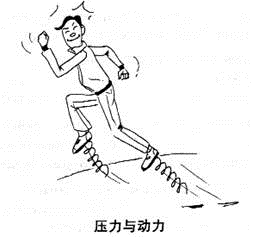
Study the following picture carefully and write an essay on it.In your essay, you should
( 1 ) describe the picture briefly,
(2) analyze this situation, and
(3) give your comments.
You should write 160- 200 words neatly on ANSWER SHEET 2.
输入阅读码
查看答案与解析需要输入阅读码