2018年全国英语竞赛《D类专科生》初赛试题(网友回忆版)
D类专科生
历年真题
共 64 题
2853 次浏览
更新于 2026-09-26
一、Part Ⅱ Vocabulary
15 marks
1
Mawi’s father, once a _____ doctor, became a guard because no other work was available.
- A.respectable
- B.respecting
- C.respective
- D.respectful
2
Kathy and her best friend had persuaded their parents to buy them matching scarves, _____ they each tied around their neck as a _____ of their friendship.
- A.what; knot
- B.what; goal
- C.which; symbol
- D.which; test
3
Our dreams usually reflect _____ is going on in our own lives and they are sometimes about problems we ignore _____ we are awake.
- A.who; when
- B.that; while
- C.which; as
- D.what; while
4
An Australian man, who _____ for years, finally discovered the cause of his backache last month.
- A.suffers
- B.has been suffered
- C.is suffering
- D.has been suffering
5
What _____ the egg more extraordinary is that the bird that _____ it—called “elephant bird”— became extinct about 400 years ago.
- A.made; lays
- B.made; lay
- C.makes; laid
- D.makes; lied
6
I thought it would take me 30 minutes to get to the Palace Museum, but I _____ when I took a wrong turn and it took almost an hour.
- A.killed time
- B.lost time
- C.ran out of time
- D.spent my time
7
Diana doesn’t have time, but if she _____ more time, she _____ to the gym.
- A.has; has gone
- B.will have; goes
- C.had; will go
- D.had; would go
8
Wealth cannot buy happiness.It can make life much more comfortable, _____.
- A.however
- B.either
- C.neither
- D.yet
9
Good leaders tell people why they are doing something, _____, to explain what they believe.
- A.in other words
- B.in a word
- C.in addition
- D.in a minute
10
_____ the criticism, the ending of the movie leaves us with a warm feeling and the leading actors do an excellent job of making us believe that anything is possible if you put your mind to it.
- A.Above
- B.Despite
- C.Beyond
- D.Without
11
The bus driver was going at normal speed when a truck appeared in front of him _____ and he did not have time to stop.
- A.at last
- B.all of a sudden
- C.once in a while
- D.in the end
12
Research said that young Chinese people are _____ expanding the sharing economy and are more eager to spend money on experiences, _____ possessions.
- A.committed to; rather than
- B.willing to; as well as
- C.curious about; in spite of
- D.satisfied to; apart from
13
— How are you getting on with your term paper? Do you need my help?
— _____, but I think I’m all right.
— _____, but I think I’m all right.
- A.Yes, thanks
- B.That’s OK
- C.That’s very kind of you
- D.It’s none of your business
14
— What seems to be wrong with you, Jane?
— Something is missing, but 1 can’t think what it could be.
— _____ We’re on the train and it’s starting.And … Where’s Tommy?
— Tommy? Oh, God!
— Something is missing, but 1 can’t think what it could be.
— _____ We’re on the train and it’s starting.And … Where’s Tommy?
— Tommy? Oh, God!
- A.Lucky you!
- B.Forget it!
- C.Congratulations!
- D.See you later.
15
— So do you have a course called “teamwork”?
— It’s not a timetabled subject, but it’s an approach that we try to include in the normal teaching.
— _____.
— We’re interested in training young people to play their role in adult life and part of that is in a workplace, and it’s rare that anyone in a workplace works just by themselves.
— It’s not a timetabled subject, but it’s an approach that we try to include in the normal teaching.
— _____.
— We’re interested in training young people to play their role in adult life and part of that is in a workplace, and it’s rare that anyone in a workplace works just by themselves.
- A.When do you usually conduct this kind of teaching?
- B.Why do you consider teamwork to be such a vital skill?
- C.How do you teach students to organize their groups?
- D.How long will you try to train these young people?
二、Part Ⅲ Cloze
10 marks
 Jesse was a straight-A student—a result of countless hours spent studying during college.She graduated at the top of her class and believed she would have no problem (46) _____ (get) a job.However, after ten interviews and no job offers, she was starting to wonder (47) _____ was wrong.“At first I couldn’t understand it, I mean, I’m intelligent and diligent, why couldn’t I get a job?” In spite of having “academic” intelligence, Jesse was missing the intelligence that many (48) _____ (employ) are now looking for, emotional intelligence.
 Emotional intelligence (EI) is the ability to understand your own emotions and the emotions of people around you.More and more companies use EI assessment tests to recruit(聘用) new staff.They have found that people with high EI form better (49) rela_____ with their colleagues and can manage (50) _____ (they) better.This benefits the company.
For example, the French cosmetics company, L’Oreal started to track the emotional intelligence of its employees in relation (51) _____ their productivity.Their studies showed that employees with high EI scores sold goods worth in total almost $100,000 more than their colleagues with low EI scores.Clearly, employees with high EI are (52) _____ (much) valuable to their companies.
Jesse thinks that she spent so much of her college life studying alone that her social skills did not develop well.(53) Det_____ to get straight As, she had not played any team sports or participated in any school groups, both of (54) _____ would have helped develop social skills and EI.She did not know how to work with others, a key to success in most businesses.
(55) Al_____ Jesse might not have high EI now, psychologists believe that she can improve it.She needs to identify people who are “nature” leaders, who work well with others and are great motivators.She should watch what they say and how they act in different situations, and try it out in her own life.
16
_____.
17
_____.
18
_____.
19
_____.
20
_____.
21
_____.
22
_____.
23
_____.
24
_____.
25
_____.
三、Part Ⅳ RC
30 marks(Reading Comprehension)
Section A (5 marks)
Questions 56—60 are based on the following passage. Michelangelo, Napoleon, Thomas Edison, and Madonna all have something in common—they have all claimed to only need four hours’ sleep a night. Does this prove that the key to success is to sleep less? On the contrary, most people need more sleep to keep healthy,regulatetheiremotions and strengthen cognitive skills such as memory. What actually happens during sleep that recharges our body and makes us healthy?
A sleep cycle, which usually takes about 90—110 minutes, is divided into two phases, non-rapid eye movement (NREM) and rapid eye movement (REM). During the first stage of NREM, which is drowsiness, our muscle activity slows down, but we are still not fully asleep. After ten minutes, our bodies enter the second stage of NERM, light sleep, which lasts about twenty minutes. Our breathing and heart rate slow down and then we enter deep sleep, stages three and four. These are the most restorative(有助于恢复健康和体力的) stages. Our blood pressure drops, growth and development hormones(荷尔蒙) are released and energy is regained. We then enter the second phase of the sleep cycle, REM sleep, which is when our brain is most active and the majority of dreams occur. Scientists believe that dreaming allows the processing and retention of memories. This phase usually lasts about ten minutes and then the cycle is repeated. A person may go through four or five sleep cycles a night.
Sleep deprivation, not getting enough sleep, has a number of negative consequences. Besides feeling tired and moody, drowsy people usually have more difficulty remembering facts, concentrating on tasks, and reacting to situations. For example, in the USA alone, more than 56,000 car accidents a year are caused by drivers feeling sleepy.
So, although Thomas Edison regarded sleep as a waste of time, most people do need more than just a few hours of sleep a night. It is the easiest way to become a smarter and healthier person.
Questions 56—60
Complete the chart with no more than three words from the passage.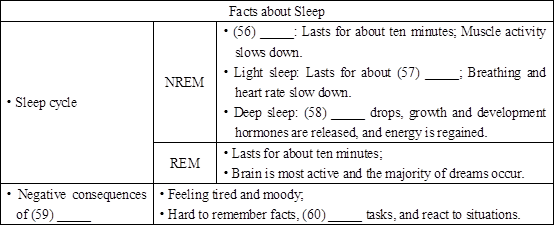
Questions 56—60 are based on the following passage.
Michelangelo, Napoleon, Thomas Edison, and Madonna all have something in common—they have all claimed to only need four hours’ sleep a night. Does this prove that the key to success is to sleep less? On the contrary, most people need more sleep to keep healthy,regulatetheiremotions and strengthen cognitive skills such as memory. What actually happens during sleep that recharges our body and makes us healthy?A sleep cycle, which usually takes about 90—110 minutes, is divided into two phases, non-rapid eye movement (NREM) and rapid eye movement (REM). During the first stage of NREM, which is drowsiness, our muscle activity slows down, but we are still not fully asleep. After ten minutes, our bodies enter the second stage of NERM, light sleep, which lasts about twenty minutes. Our breathing and heart rate slow down and then we enter deep sleep, stages three and four. These are the most restorative(有助于恢复健康和体力的) stages. Our blood pressure drops, growth and development hormones(荷尔蒙) are released and energy is regained. We then enter the second phase of the sleep cycle, REM sleep, which is when our brain is most active and the majority of dreams occur. Scientists believe that dreaming allows the processing and retention of memories. This phase usually lasts about ten minutes and then the cycle is repeated. A person may go through four or five sleep cycles a night.
Sleep deprivation, not getting enough sleep, has a number of negative consequences. Besides feeling tired and moody, drowsy people usually have more difficulty remembering facts, concentrating on tasks, and reacting to situations. For example, in the USA alone, more than 56,000 car accidents a year are caused by drivers feeling sleepy.
So, although Thomas Edison regarded sleep as a waste of time, most people do need more than just a few hours of sleep a night. It is the easiest way to become a smarter and healthier person.
Questions 56—60
Complete the chart with no more than three words from the passage.
26
_____.
27
_____.
28
_____.
29
_____.
30
_____.
Section B (10 marks)
Questions 61—65 are based on the following passage.
Three fishermen lost at sea for 289 days landed 5,500 miles from where they started, but is their story really true?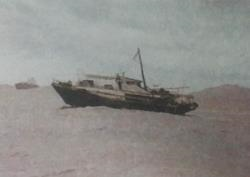 (61) _____ It was a sunny day, but things changed as night fell.A storm came in, making it difficult to find the fishing nets they had left in the water.The boat soon ran out of fuel and the men became frightened as they drifted out to sea, unable to get back to the shore.
(62) _____ Desperate to stay alive, the men drank rainwater and ate raw fish and birds.The survivors say that two of the men had trouble eating, eventually dying of starvation.
(63) _____ To keep their spirits up and their minds off sharks that occasionally bumped against the boat, they sang traditional songs, read the Bible, and kept hoping for a miracle.
One of the fishermen said, “We saw many boats pass by us.When that happened, it was depressing and we didn’t talk for hours.But I never imagined we would die.” It took over nine months but his optimism paid off.A Taiwanese ship found the fishermen and brought them to the Marshall Islands, 1,200 miles north.During the two-week journey, the Mexican fishermen say they were able to rest and eat.When they arrived in port, they all looked happy and healthy.However, some people believed the three fishermen looked too good.
(64) _____ When the man was rescued, he was extremely thin and it took him months to recover.However, the three rescued fishermen, missing for much longer, did not have any of the noticeable health problems.
(65) _____ Many think the fishermen were actually involved in an illegal smuggling operation that went wrong.Others wonder what really happened to the two fishermen who did not survive.The fishermen insist they are telling the truth, but many question their story.
Questions 61—65
Complete the passage with the following sentences.There are two extra sentences that you do not need to use.
Questions 61—65 are based on the following passage.
Three fishermen lost at sea for 289 days landed 5,500 miles from where they started, but is their story really true?
(61) _____ It was a sunny day, but things changed as night fell.A storm came in, making it difficult to find the fishing nets they had left in the water.The boat soon ran out of fuel and the men became frightened as they drifted out to sea, unable to get back to the shore.(62) _____ Desperate to stay alive, the men drank rainwater and ate raw fish and birds.The survivors say that two of the men had trouble eating, eventually dying of starvation.
(63) _____ To keep their spirits up and their minds off sharks that occasionally bumped against the boat, they sang traditional songs, read the Bible, and kept hoping for a miracle.
One of the fishermen said, “We saw many boats pass by us.When that happened, it was depressing and we didn’t talk for hours.But I never imagined we would die.” It took over nine months but his optimism paid off.A Taiwanese ship found the fishermen and brought them to the Marshall Islands, 1,200 miles north.During the two-week journey, the Mexican fishermen say they were able to rest and eat.When they arrived in port, they all looked happy and healthy.However, some people believed the three fishermen looked too good.
(64) _____ When the man was rescued, he was extremely thin and it took him months to recover.However, the three rescued fishermen, missing for much longer, did not have any of the noticeable health problems.
(65) _____ Many think the fishermen were actually involved in an illegal smuggling operation that went wrong.Others wonder what really happened to the two fishermen who did not survive.The fishermen insist they are telling the truth, but many question their story.
Questions 61—65
Complete the passage with the following sentences.There are two extra sentences that you do not need to use.
31
_____.
- A.Their small boat had no shelter, no navigational equipment, and held only a small amount of food and water.
- B.In all the historical records of sailors lost at sea, the longest someone had been missing was 76 days.
- C.On October 28, 2005, five fishermen left the coast of Mexico on a three-day fishing trip.
- D.Unfortunately, two fishermen died of food poisoning.
- E.The survivors have different stories about how they became lost.
- F.Some experts argue it is almost impossible for their boat to have floated from Mexico in a northern direction to the Marshall Islands as quickly as it did.
- G.They tried not to lose hope, but life on a small boat can be boring, scary, and depressing.
32
_____.
- A.Their small boat had no shelter, no navigational equipment, and held only a small amount of food and water.
- B.In all the historical records of sailors lost at sea, the longest someone had been missing was 76 days.
- C.On October 28, 2005, five fishermen left the coast of Mexico on a three-day fishing trip.
- D.Unfortunately, two fishermen died of food poisoning.
- E.The survivors have different stories about how they became lost.
- F.Some experts argue it is almost impossible for their boat to have floated from Mexico in a northern direction to the Marshall Islands as quickly as it did.
- G.They tried not to lose hope, but life on a small boat can be boring, scary, and depressing.
33
_____.
- A.Their small boat had no shelter, no navigational equipment, and held only a small amount of food and water.
- B.In all the historical records of sailors lost at sea, the longest someone had been missing was 76 days.
- C.On October 28, 2005, five fishermen left the coast of Mexico on a three-day fishing trip.
- D.Unfortunately, two fishermen died of food poisoning.
- E.The survivors have different stories about how they became lost.
- F.Some experts argue it is almost impossible for their boat to have floated from Mexico in a northern direction to the Marshall Islands as quickly as it did.
- G.They tried not to lose hope, but life on a small boat can be boring, scary, and depressing.
34
_____.
- A.Their small boat had no shelter, no navigational equipment, and held only a small amount of food and water.
- B.In all the historical records of sailors lost at sea, the longest someone had been missing was 76 days.
- C.On October 28, 2005, five fishermen left the coast of Mexico on a three-day fishing trip.
- D.Unfortunately, two fishermen died of food poisoning.
- E.The survivors have different stories about how they became lost.
- F.Some experts argue it is almost impossible for their boat to have floated from Mexico in a northern direction to the Marshall Islands as quickly as it did.
- G.They tried not to lose hope, but life on a small boat can be boring, scary, and depressing.
35
_____.
- A.Their small boat had no shelter, no navigational equipment, and held only a small amount of food and water.
- B.In all the historical records of sailors lost at sea, the longest someone had been missing was 76 days.
- C.On October 28, 2005, five fishermen left the coast of Mexico on a three-day fishing trip.
- D.Unfortunately, two fishermen died of food poisoning.
- E.The survivors have different stories about how they became lost.
- F.Some experts argue it is almost impossible for their boat to have floated from Mexico in a northern direction to the Marshall Islands as quickly as it did.
- G.They tried not to lose hope, but life on a small boat can be boring, scary, and depressing.
Section C (10 marks)
Questions 66—70 are based on the following passage.
Human beings learnt to talk about half a million years ago. Yet it was only about 5,000 years ago that our ancestors learnt to write.
They first wrote by using pictures. These pictures might mean just what they showed — for example, the moon or a tree. Such pictures are called pictographs(象形文字). But sometimes the drawings presented ideas which are suggested by the pictures. That is, three trees might mean a forest. An eye with tears might mean sorrow. These pictures are called ideographs(表意文字). Here is a drawing cut into a rock by North American Indians.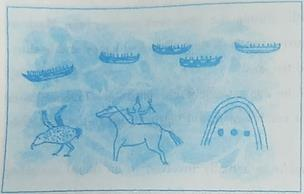 This means: “A brave chief went on a journey with five canoes. The journey took three days.” Showing the chief on a horse suggests “travelling”, for in fact he went in a canoe, not on horseback. The eagle suggests the chief’s courage. Three suns under a curved sky suggest three days.
The ancient Egyptians developed a beautiful form of writing about 5,000 years ago. This writing shows objects such as animals, birds and people. These are called hieroglyphs(古埃及用的象形字). Some hieroglyphs represented things, some ideas, and some sounds. For example, if we used this system for English, a picture of a loaf of bread might mean just bread, or maybe food in general, or the sound “b” with which the word “bread” begins. The ancient Egyptians used over 700 different hieroglyphs.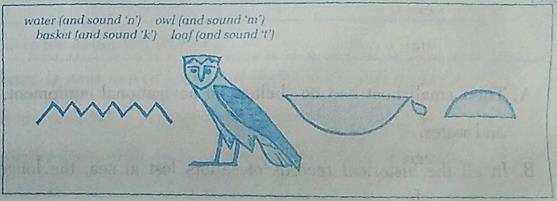 The alphabet was invented by the Phoenicians about 3,500 years ago. The Phoenicians lived where Syria and Israel are now. The alphabet was perhaps the greatest invention of mankind. Like many great inventions, it was extremely simple.
In an alphabet, symbols represent sounds, not objects or ideas. Any symbol can be used for an alphabet. For example, “*π+” could spell “cat” if we all agreed that these symbols represent the sounds “c”, “a” and “t”. The 26 letter A—Z alphabet is the most widely used in the world, but there are over fifty alphabets in use. If we use an alphabet, we know how any word that we read sounds. We can also write down any word we hear. Words can be easily arranged in lists “alphabetically”. Using a keyboard is also easy, as an alphabet contains only a few symbols (letters), and so few keys are needed.
Most languages use alphabets, but Chinese uses “characters”. Characters are like drawings. They represent whole words, not single letters. There are therefore thousands of characters in Chinese, one for each word. You cannot know how a Chinese character sounds simply by looking at it. But if you have seen it before, you will know what it means without knowing how it sounds.
Questions 66—70
Answer the following questions according to the passage.
Questions 66—70 are based on the following passage.
Human beings learnt to talk about half a million years ago. Yet it was only about 5,000 years ago that our ancestors learnt to write.
They first wrote by using pictures. These pictures might mean just what they showed — for example, the moon or a tree. Such pictures are called pictographs(象形文字). But sometimes the drawings presented ideas which are suggested by the pictures. That is, three trees might mean a forest. An eye with tears might mean sorrow. These pictures are called ideographs(表意文字). Here is a drawing cut into a rock by North American Indians.
This means: “A brave chief went on a journey with five canoes. The journey took three days.” Showing the chief on a horse suggests “travelling”, for in fact he went in a canoe, not on horseback. The eagle suggests the chief’s courage. Three suns under a curved sky suggest three days.The ancient Egyptians developed a beautiful form of writing about 5,000 years ago. This writing shows objects such as animals, birds and people. These are called hieroglyphs(古埃及用的象形字). Some hieroglyphs represented things, some ideas, and some sounds. For example, if we used this system for English, a picture of a loaf of bread might mean just bread, or maybe food in general, or the sound “b” with which the word “bread” begins. The ancient Egyptians used over 700 different hieroglyphs.
The alphabet was invented by the Phoenicians about 3,500 years ago. The Phoenicians lived where Syria and Israel are now. The alphabet was perhaps the greatest invention of mankind. Like many great inventions, it was extremely simple.In an alphabet, symbols represent sounds, not objects or ideas. Any symbol can be used for an alphabet. For example, “*π+” could spell “cat” if we all agreed that these symbols represent the sounds “c”, “a” and “t”. The 26 letter A—Z alphabet is the most widely used in the world, but there are over fifty alphabets in use. If we use an alphabet, we know how any word that we read sounds. We can also write down any word we hear. Words can be easily arranged in lists “alphabetically”. Using a keyboard is also easy, as an alphabet contains only a few symbols (letters), and so few keys are needed.
Most languages use alphabets, but Chinese uses “characters”. Characters are like drawings. They represent whole words, not single letters. There are therefore thousands of characters in Chinese, one for each word. You cannot know how a Chinese character sounds simply by looking at it. But if you have seen it before, you will know what it means without knowing how it sounds.
Questions 66—70
Answer the following questions according to the passage.
36
Which is much earlier for human beings to learn, to talk or to write?
37
How did North American Indians present “three days” long before?
38
How many hieroglyphs did the ancient Egyptians use?
39
Who invented the alphabet?
40
What is the difference between alphabets and Chinese characters?
Section D (10 marks)
Questions 71—75 are based on the following passage.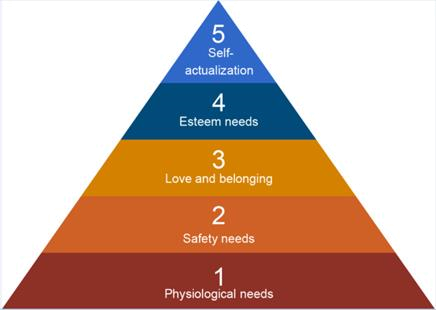 What are the basic requirements of life and what do we need next after those? When you answer these questions, you are doing the same kind of work that American psychologist Abraham Maslow did in his “hierarchy(层次) of needs” theory. The theory states that we must progress through various levels, satisfying the needs of each before being able to move on to the next. He thought individuals could eventually fulfill their potential if they could just satisfy their fundamental needs.
These most basic needs form the bottom of Maslow’s hierarchy and are referred to as physiological needs. These needs include our needs for water and shelter. Unless these are satisfied, we cannot move to the next level, safety needs. We need to feel secure in our environments, and this feeling of security usually means protection and freedom from fear. The third level is the need for love and belonging. People satisfy this need through their families and homes, as well as by joining and forming groups, making friends, and being a part of a team.
In the fourth level, the need for esteem refers to the need of people to be recognized. Here, they want to feel that others think highly of them; they may need praise and want to feel good about themselves. They may try to accomplish this by achieving set goals. Self-actualization, the fifth level, is the summit of Maslow’s hierarchy of needs. It is the quest(追求) to reach one’s full human potential. In this process people tend to have needs such as truth, justice, wisdom, and spiritual fulfillment.
Despite the appealing logic of Maslow’s hierarchy, it seems to have some limits. Extensive research has suggested that there is little evidence for the ranking of levels and the argument of a definite hierarchy. Moreover, the concept of self-actualization is not clear, and there is no evidence to show that every individual can reach it.
Maslow was the first psychologist to carry out academic research on human needs. He believed everybody should be encouraged to discover their vocations(使命) in life and try their best to make life better. These are still important lessons today.
Questions 71—75
Complete the summary with a maximum of two words from the passage, changing the form where necessary.
American psychologist Abraham Maslow used his “hierarchy of needs” theory to show that we must meet a number of (71) _____ before we can fulfill our potentials. At the lower levels, we need food and shelter, the feeling of (72) _____, and a sense of belonging. After those, we need to seek (73) _____ for our abilities before finally (74) _____ to the state of self-actualization. Although there are problems with Maslow’s approach, it still offers (75) _____ today.
Questions 71—75 are based on the following passage.
What are the basic requirements of life and what do we need next after those? When you answer these questions, you are doing the same kind of work that American psychologist Abraham Maslow did in his “hierarchy(层次) of needs” theory. The theory states that we must progress through various levels, satisfying the needs of each before being able to move on to the next. He thought individuals could eventually fulfill their potential if they could just satisfy their fundamental needs.These most basic needs form the bottom of Maslow’s hierarchy and are referred to as physiological needs. These needs include our needs for water and shelter. Unless these are satisfied, we cannot move to the next level, safety needs. We need to feel secure in our environments, and this feeling of security usually means protection and freedom from fear. The third level is the need for love and belonging. People satisfy this need through their families and homes, as well as by joining and forming groups, making friends, and being a part of a team.
In the fourth level, the need for esteem refers to the need of people to be recognized. Here, they want to feel that others think highly of them; they may need praise and want to feel good about themselves. They may try to accomplish this by achieving set goals. Self-actualization, the fifth level, is the summit of Maslow’s hierarchy of needs. It is the quest(追求) to reach one’s full human potential. In this process people tend to have needs such as truth, justice, wisdom, and spiritual fulfillment.
Despite the appealing logic of Maslow’s hierarchy, it seems to have some limits. Extensive research has suggested that there is little evidence for the ranking of levels and the argument of a definite hierarchy. Moreover, the concept of self-actualization is not clear, and there is no evidence to show that every individual can reach it.
Maslow was the first psychologist to carry out academic research on human needs. He believed everybody should be encouraged to discover their vocations(使命) in life and try their best to make life better. These are still important lessons today.
Questions 71—75
Complete the summary with a maximum of two words from the passage, changing the form where necessary.
American psychologist Abraham Maslow used his “hierarchy of needs” theory to show that we must meet a number of (71) _____ before we can fulfill our potentials. At the lower levels, we need food and shelter, the feeling of (72) _____, and a sense of belonging. After those, we need to seek (73) _____ for our abilities before finally (74) _____ to the state of self-actualization. Although there are problems with Maslow’s approach, it still offers (75) _____ today.
41
_____.
42
_____.
43
_____.
44
_____.
45
_____.
四、Part Ⅴ Translation
15 marks
46
Section A (5 marks)
Translate the following paragraph into Chinese.Remember to write the answers on the answersheet.

Email has become an accepted and expected way to keep in touch with professors at universities, and when done correctly, can help students and professors communicate.However, some professors are finding that it can also cause major misunderstandings.Informality and inappropriateness are the causes of many misunderstandings in emails.One professor says that emails have to be written in formal, standard English, and be professional or business-like in tone.Additional problems occur when the tone of a message is misunderstood.
Translate the following paragraph into Chinese.Remember to write the answers on the answersheet.
Email has become an accepted and expected way to keep in touch with professors at universities, and when done correctly, can help students and professors communicate.However, some professors are finding that it can also cause major misunderstandings.Informality and inappropriateness are the causes of many misunderstandings in emails.One professor says that emails have to be written in formal, standard English, and be professional or business-like in tone.Additional problems occur when the tone of a message is misunderstood.
47
Section B (10 marks)
Translate the underlined sentences into English by using the hints given in brackets.Remember to write the answers on the answersheet.
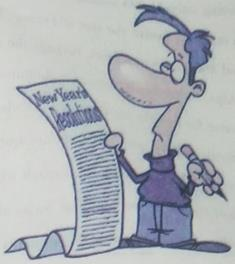
77.通常情况下,人们会在新年伊始决心取得比上一年更多的成就。(resolved to)
然而怎么做到这一点呢?有些人决心“对一切都说可以”——我始终认为这种决心很古怪。其他人则相反,决心更频繁地说不。78.实际上,这两种极端的任何一种都可能导致不好的结果。(lead to)
拿一直保持忙碌状态的决心来说,“工作狂”召唤着那些无法拒绝请求的人。根据2017年发表在《管理学会发现》杂志上的一篇研究报告,专注于任务可能减轻工作狂的最糟糕影响,但对岗位忧心忡忡或者过于野心勃勃仍然可能导致健康问题。
决心做多件事情还会带来其他风险。79.如果你尝试做不止一件事情,那么你就不会像专注于一项任务那样达到高效率。(as…as) 2001年发表的一篇论文发现,与那些致力于一项工作的人相比,忙于在多项任务之间切换的人,要花费更长的时间来解决复杂的数学问题。80.2015年对米兰法官的另一项研究表明,那些试图同时处理多宗案件的法官,结果花费了更长时间才完成审理。(定语从句)
话虽如此,人们对忙碌的崇拜是强大的。如果你在新的一年以减少工作为目标,你很快就会对自己拒绝的工作以及由此可能错失的机遇感到内疚。我总是想起情景喜剧中过于进取的心理医生弗莱泽的反驳,当他的兄弟奈尔斯提醒他“更少就是更多”的时候,他脱口而出道:“81.对,但如果更少就是更多,那么这个‘更多’会是多少呢?”(how much)
Translate the underlined sentences into English by using the hints given in brackets.Remember to write the answers on the answersheet.
77.通常情况下,人们会在新年伊始决心取得比上一年更多的成就。(resolved to)
然而怎么做到这一点呢?有些人决心“对一切都说可以”——我始终认为这种决心很古怪。其他人则相反,决心更频繁地说不。78.实际上,这两种极端的任何一种都可能导致不好的结果。(lead to)
拿一直保持忙碌状态的决心来说,“工作狂”召唤着那些无法拒绝请求的人。根据2017年发表在《管理学会发现》杂志上的一篇研究报告,专注于任务可能减轻工作狂的最糟糕影响,但对岗位忧心忡忡或者过于野心勃勃仍然可能导致健康问题。
决心做多件事情还会带来其他风险。79.如果你尝试做不止一件事情,那么你就不会像专注于一项任务那样达到高效率。(as…as) 2001年发表的一篇论文发现,与那些致力于一项工作的人相比,忙于在多项任务之间切换的人,要花费更长的时间来解决复杂的数学问题。80.2015年对米兰法官的另一项研究表明,那些试图同时处理多宗案件的法官,结果花费了更长时间才完成审理。(定语从句)
话虽如此,人们对忙碌的崇拜是强大的。如果你在新的一年以减少工作为目标,你很快就会对自己拒绝的工作以及由此可能错失的机遇感到内疚。我总是想起情景喜剧中过于进取的心理医生弗莱泽的反驳,当他的兄弟奈尔斯提醒他“更少就是更多”的时候,他脱口而出道:“81.对,但如果更少就是更多,那么这个‘更多’会是多少呢?”(how much)
五、Part Ⅵ EC
10 marks(Error Correction)
48
_____.
49
_____.
50
_____.
51
_____.
52
_____.
53
_____.
54
_____.
55
_____.
56
_____.
57
_____.
六、Part Ⅶ IQ Test
10 marks
58
What does the following sentence mean in Chinese?
Like father, like son.
Like father, like son.
59
Change one word so that the sentence makes sense.Underline the word you are taking out and write your new word on the line.
My dog laughs when people ring the doorbell.
My dog laughs when people ring the doorbell.
60
Which pattern continues the following sequence?
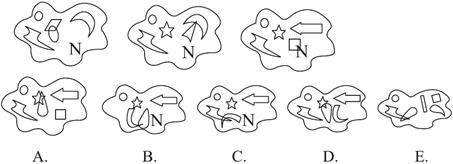
A.A
B.B
C.C
D.D
E.E
A.A
B.B
C.C
D.D
E.E
61
What number should replace the question mark?

62
Which is the odd one out?

A.A
B.B
C.C
D.D
E.E
F.F
G.G
A.A
B.B
C.C
D.D
E.E
F.F
G.G
七、Part Ⅷ Writing
30 marks
63
Section A (10 marks)
Computer games and video games are becoming more and more popular.Write a report in 80—100words based on the information in the following chart on the answersheet.
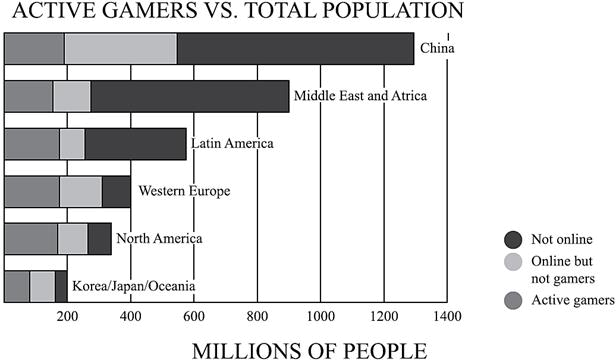
Computer games and video games are becoming more and more popular.Write a report in 80—100words based on the information in the following chart on the answersheet.
64
Section B (20 marks)
We now have photography, film, radio, TV, the telephone, mobile phone and many electronic devices.Some people say reading and writing are no longer important.
What is your view on this phenomenon? Write an essay in atleast120 words on the answersheet.

We now have photography, film, radio, TV, the telephone, mobile phone and many electronic devices.Some people say reading and writing are no longer important.
What is your view on this phenomenon? Write an essay in atleast120 words on the answersheet.
输入阅读码
查看答案与解析需要输入阅读码