2025年CFA特许金融分析师《CFA二级》模拟试卷一
CFA二级
模拟试卷
共 88 题
1552 次浏览
更新于 2026-09-26
一、综合分析题
根据题干描述选择正确答案
Brian Patrick, CFA, has recently joined Northside Capital Advisers (Northside) as the firm’s assistant compliance officer. Northside manages individual accounts with conservative mandates for a variety of retirements funds, as well as individual accounts for high-net-worth investors with long investment horizons. Kyle Sang, CFA, is Northside’s chief compliance officer and Patrick’s supervisor. Sang has been with the firm since its inception and wrote the firm’s original Code of Ethics and Compliance Manual. Sang provides Patrick with a copy of both documents and asks Patrick to review them. He instructs Patrick to highlight any areas he feels should be revised or enhanced. Patrick lists the items that need to be addressed. The first item on his list is the lack of whistle-blowing guidance for an employee who could potentially find herself in a position of needing to report the firm’s activities.The second item Patrick adds to his list concerns the responsibilities of supervisors. Although the information contained in the Compliance Manual is accurate, he believes it needs to be augmented so the firm’s supervisors have a clear understanding of their responsibilities. He advises adding the following items to the firm’s Compliance Manual, recommending Supervisors should do the following:Recommendation 1: Conduct an initial review of the firm’s Policies and Procedures, and review as necessary to ensure they are consistent with applicable laws and regulations.Recommendation 2: Incorporate a professional conduct evaluation as part of the employee’s performance review.Recommendation 3: Review the actions of all the firm’s employees, and identify violators.Patrick believes he needs a better understanding of the investment process before he makes any investment-policy-related recommendations. He meets with Staci Canton, the firm’s chief investment officer. Following his meeting with Canton, Patrick suggests the following enhancements to the firm’s Compliance Manual related to investment research:Proposal 1: Develop criteria for assessing analysts’ research quality and contribution, including the accuracy and timing of their recommendations.Proposal 2: Appoint a supervisor to review and approve communication material.Proposal 3: Develop detailed, written guidance that establishes the due diligence procedures.Patrick asks Canton to provide him with a copy of a recent research report that would have been distributed to the firm’s clients. Patrick is provided a copy of the PT Matias (PT) report, written by Amanda Burt, CFA. PT is involved in the manufacture of aluminum cans supplied to the soft drink industry. She mentions that PT has recently gone through a reorganization and is in a turnaround situation, so the potential returns are quite large. The shares were recently purchased for all client portfolios in a block trade. After reviewing the report, Patrick meets with Burt to discuss her approach to researching companies, meeting with company management, and determining earnings estimates. Burt explains to Patrick how carefully she documents her meetings with management and shares her notes with him. He compares the meeting notes with Burt’s recent report and notices she has included management’s guidance for earnings and margins along with her own estimates.While talking with Burt, Patrick asks if she ever plays a role when the marketing department makes new business presentations. She tells him that because of her stock selection track record, she is frequently involved in those types of meetings. She adds that she typically reviews the methodology used to research a company and determine a recommendation. They discuss the potential clients, and she jokes that she even made a presentation to an investment committee for the retirement assets of a company under her coverage. The firm’s business development manager was unhappy that she had a sell rating on the potential client’s stock when the sales pitch took place.Patrick’s review of the firm’s Code and Compliance Policies and Procedures is almost complete. The final item to review is how the firm handles employees’ trading. He notices the current Policies and Procedures are lacking. He notes that the firm currently restricts employee participation in IPOs, has a very narrow blackout period for employees trading securities on their buy list, and ensures personal trading policies are kept confidential. Sang tells Patrick of the difficulty he experienced in trying to get more robust personal trading policies and procedures approved. The board has historically been reluctant to put restrictions in place that limit the staff’s ability to invest their personal funds.
1
Under CFA Institute Standard IV: Duties to Employers, with regard to the subject matter of the first item on Patrick’s list, whose interest is least likely of importance?
- A.Northside’s
- B.The capital markets’
- C.Northside’s clients’
2
Which of Patrick’s recommendations is most likely insufficient to comply with Standard IV(C): Responsibilities of Supervisors?
- A.Recommendation 1
- B.Recommendation 2
- C.Recommendation 3
3
To indicate the area of the investment research process he wants to address, Patrick should most likely label the proposals as follows:
- A.Proposal 1 = Compensation, Proposal 2 = Reasonable Basis, Proposal 3 = Distribution
- B.Proposal 1 = Reasonable Basis, Proposal 2 = Distribution, Proposal 3 = Compensation
- C.Proposal 1 = Compensation, Proposal 2 = Distribution, Proposal 3 = Reasonable Basis
4
Which of the following CFA Institute Standards of Professional Conduct has most likely been violated in relation to the research report and purchase of PT Matias?
- A.Suitability
- B.Fair Dealing
- C.Misrepresentation
5
Has Burt most likely violated the CFA Institute Standards of Professional Conduct during the new business presentations?
- A.No
- B.Yes, with regard to Duties to Clients
- C.Yes, with regard to Disclosure of Conflicts
6
Which of Northside’s current personal trading policies is least consistent with CFA Institute recommended procedures for Standard VI(B): Priority of Transactions?
- A.IPO restriction
- B.Policy confidentiality
- C.Blackout trading window
Paul Charlent works for a London-based merchant bank that specializes in assisting small- and medium-sized companies in developing markets to place debt and equity issues with US and UK investors. Charlent is conducting exploratory analysis regarding possible relationships between developing market equity returns and various US and UK macroeconomic variables. He regresses monthly total returns of the Bangkok SET Index on one-month Libor (for a US dollar–denominated contract). The period of the study is from July 2006 to December 2013. To improve the statistical validity of the variables, for both the SET Index and Libor, Charlent uses the natural logarithms of one plus the monthly returns in the regression calculation. The results of the regression are shown in Exhibit 1 and Exhibit 2.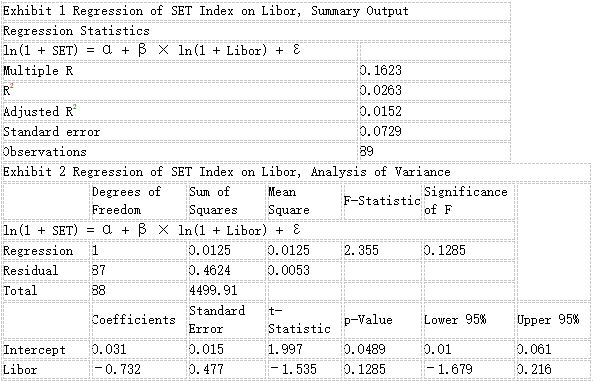 Charlent suspects that his regression equation might not be well specified. In particular, he is concerned with the possibility that one or both of the time series in the regression exhibit a unit root. Using the Engle–Granger approach, he tests the residuals from the regression and rejects the null hypothesis that the error term has a unit root.
Charlent next regresses the natural logarithm of one plus the SET Index monthly returns on the natural logarithm of one plus Libor, the natural logarithm of one plus the effective Fed funds rate, and the $/£ exchange rate. The results are reported in Exhibit 3 and Exhibit 4. Charlent recalls that the null hypothesis of no positive serial correlation is rejected if the calculated Durbin–Watson (DW) statistic is less than the lower critical value and that the null hypothesis of no negative serial correlation is rejected if the calculated DW statistic exceeds 4 minus the lower critical value.
Exhibit 5 reports the pairwise correlations of the variables used in the second regression.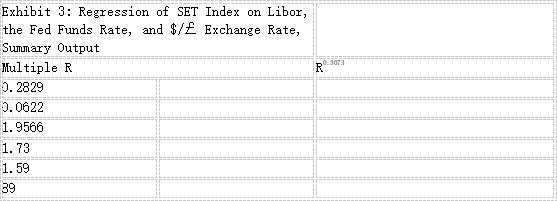
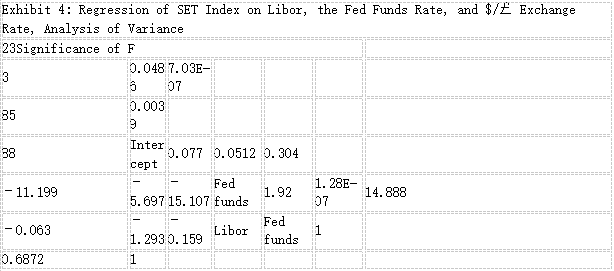 Geoffrey Small, a colleague of Charlent, comments on the results of the two regressions. Small states that the highly significant F-statistic of the second regression along with the increased R2 of the second regression means that the addition of the Fed funds rate and the $/£ exchange rate to the analysis provides more reliable estimates of linear associations than the first regression.
Charlent suspects that his regression equation might not be well specified. In particular, he is concerned with the possibility that one or both of the time series in the regression exhibit a unit root. Using the Engle–Granger approach, he tests the residuals from the regression and rejects the null hypothesis that the error term has a unit root.Charlent next regresses the natural logarithm of one plus the SET Index monthly returns on the natural logarithm of one plus Libor, the natural logarithm of one plus the effective Fed funds rate, and the $/£ exchange rate. The results are reported in Exhibit 3 and Exhibit 4. Charlent recalls that the null hypothesis of no positive serial correlation is rejected if the calculated Durbin–Watson (DW) statistic is less than the lower critical value and that the null hypothesis of no negative serial correlation is rejected if the calculated DW statistic exceeds 4 minus the lower critical value.
Exhibit 5 reports the pairwise correlations of the variables used in the second regression.
Geoffrey Small, a colleague of Charlent, comments on the results of the two regressions. Small states that the highly significant F-statistic of the second regression along with the increased R2 of the second regression means that the addition of the Fed funds rate and the $/£ exchange rate to the analysis provides more reliable estimates of linear associations than the first regression.
7
Based on the results in Exhibits 1 and 2, the most appropriate interpretation is that:
- A.the variation in Libor does not explain the variation in SET Index returns.
- B.Libor has a statistically significant linear relationship with returns of the SET Index.
- C.there is a small but positive correlation between the SET Index and Libor.
8
Using Exhibit 2 and two-tail t-tests to determine whether the coefficients are equal to zero at the 5% significance level, the null hypotheses are most likely:
- A.not rejected for the intercept and rejected for the slope.
- B.rejected for the intercept and not rejected for the slope.
- C.rejected for both the intercept and the slope.
9
Using the regression equation results reported in Exhibit 2, if the value for Libor is 3%, the point estimate of the associated return on the SET Index is closest to:
- A.–2.16%.
- B.0.94%.
- C.0.90%.
10
The most appropriate conclusion that follows from the result of the Engle–Granger test is that the two time series are:
- A.cointegrated and tests of the estimates of the intercept and slope are thus valid.
- B.not cointegrated and tests of the estimates of the intercept and slope are thus valid.
- C.cointegrated and tests of the estimates of the intercept and slope are thus not valid.
11
Based on Exhibits 3 and 4 and the reported Durbin–Watson (DW) statistic, the most appropriate conclusion is:
- A.significant serial correlation is present and the standard errors are likely to be underestimated.
- B.significant serial correlation is present and the standard errors are likely to be overestimated.
- C.serial correlation is not significant and the standard errors are unbiased.
12
Regarding Geoffrey Small’s statement about the second regression, which of the following is most accurate?
- A.It is true that the second regression has substantially greater explanatory power than the first regression.
- B.The second regression displays multicollinearity.
- C.The F-statistic of the second regression is likely underestimated.
Anish Shah is doing a credit analysis on Silver Maple College (SMC), a mid-sized private university seeking to place a bond issue to finance a new sports facility on campus. Today, Shah is interested in determining the full extent of SMC’s obligations and its ability to support those obligations from operating cash flows. SMC is established as a not-for-profit organization and prepares its financial statements using IFRS (International Financial Reporting Standards).Shah starts his analysis by looking at SMC’s post-employment plans. He has found the following description of the plans offered (Exhibit 1) and has prepared summary information about the plans from the university’s 2017 notes to the financial statements (Exhibits 2, 3, and 4). To assess the long-term credit risk of SMC, Shah wants to determine the potential risk exposure presented from each post-employment plan and the associated future cash flows expected as well as the current level of funding for each plan. Upon studying the information in Exhibits 2 and 3 on SMC’s health care plan, Lucy Zhang, Shah’s assistant, asks him why the plan is unfunded.
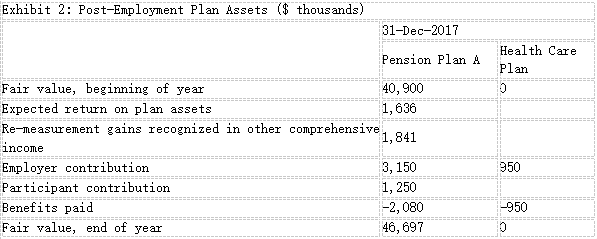 Reviewing the present value of the defined obligations (Exhibit 3), Shah notices that SMC has made changes in underlying assumptions of the plans (not shown). He instructs Zhang to prepare an analysis of the changes in each assumption and its impact on the obligation.
Zhang asks Shah, “Where will I find the information for that analysis?”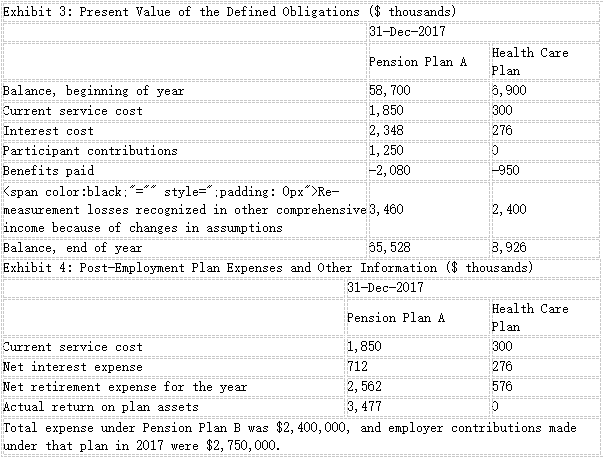 Shah starts his cash flow analysis by determining the total cash outflow from the post-employment plans for SMC in 2017. He explains to Zhang that from an economic perspective, sometimes a portion of a company’s contribution to a plan should not be considered part of cash from operations. Zhang notes that SMC’s pension contribution exceeds it total pension cost for the period and asks how this excess would be classified on the cash flow statement.Shah’s credit rating will also consider the quality of SMC’s cash flows. With the planned issuance of a bond, Shah is concerned that attempts may have been made by SMC to increase cash flow from operations. He decides to use a conceptual framework to assess the quality of the financial reports. He starts by reviewing the statement of cash flows and notes that SMC's principal sources of operating cash inflows arise from tuition fees, investment income from the school’s large endowment fund, and in 2017, the receipt of a significant donation from a graduate in return for the naming rights to the proposed new sports facility. He also notes that investment income was classified as an investing activity in the previous years’ financial statements, which were not restated.
Upon studying the information in Exhibits 2 and 3 on SMC’s health care plan, Lucy Zhang, Shah’s assistant, asks him why the plan is unfunded.Reviewing the present value of the defined obligations (Exhibit 3), Shah notices that SMC has made changes in underlying assumptions of the plans (not shown). He instructs Zhang to prepare an analysis of the changes in each assumption and its impact on the obligation.Zhang asks Shah, “Where will I find the information for that analysis?”
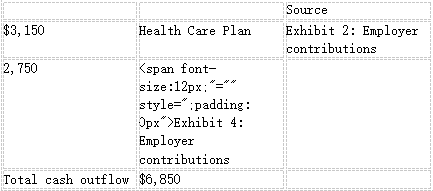
Shah starts his cash flow analysis by determining the total cash outflow from the post-employment plans for SMC in 2017. He explains to Zhang that from an economic perspective, sometimes a portion of a company’s contribution to a plan should not be considered part of cash from operations. Zhang notes that SMC’s pension contribution exceeds it total pension cost for the period and asks how this excess would be classified on the cash flow statement.Shah’s credit rating will also consider the quality of SMC’s cash flows. With the planned issuance of a bond, Shah is concerned that attempts may have been made by SMC to increase cash flow from operations. He decides to use a conceptual framework to assess the quality of the financial reports. He starts by reviewing the statement of cash flows and notes that SMC's principal sources of operating cash inflows arise from tuition fees, investment income from the school’s large endowment fund, and in 2017, the receipt of a significant donation from a graduate in return for the naming rights to the proposed new sports facility. He also notes that investment income was classified as an investing activity in the previous years’ financial statements, which were not restated.
13
Which of the three post-retirement plans should be of the greatest concern to Shah in assessing the long-term credit risk of SMC?
- A.Health Care Plan
- B.Pension Plan A
- C.Pension Plan B
14
The least accurate explanation that Shah can give to Zhang’s question about the funded status of the Health Care Plan is that:
- A.the associated expenses will be incurred in future periods.
- B.the plan could possibly be eliminated if the costs become a burden.
- C.funding is not normally required by government regulation.
15
Zhang is most likely to find the information needed for her analysis of changes related to Exhibit 3 in the:
- A.notes to the financial statements.
- B.university’s pension plan documents.
- C.management discussion and analysis.
16
Based on Exhibit 2 and 4, SMC’s total cash outflow (in thousands) related to post-employment costs in 2017 is closest to:
- A.$5,780.
- B.$4,100.
- C.$6,850.
17
The best answer to Zhang’s question about the excess contributions is that they should be classified as a(n):
- A.cash outflow in financing.
- B.cash inflow in financing.
- C.investing activity.
18
Based on his review of the statement of cash flows and the classification of investment income, the most appropriate conclusion Shah can reach on his assessment of the quality of SMC’s financial report is that the report is:
- A.within GAAP (generally accepted accounting principles) but contains biased choices.
- B.non-compliant accounting.
- C.GAAP compliant and decision useful.
Monique Beaumont, Director of Finance of a small European based manufacturer, is reviewing the current year's requests for capital projects. This year Beaumont provided all departments with a template showing them how to categorize cash flows and calculate the NPV using the company’s WACC of 8% and tax rate of 30%.The first project she reviews is from the production manager. He would like to automate a process in the production line. Using the template, the production manager provides the data in Exhibit 1 for two options: to purchase a new machine or a refurbished model. The refurbished model is less expensive but provides reduced cost savings and would need to be replaced in two years. Beaumont realizes the analysis as presented is not directly comparable and undertakes to complete an equivalent annual annuity analysis.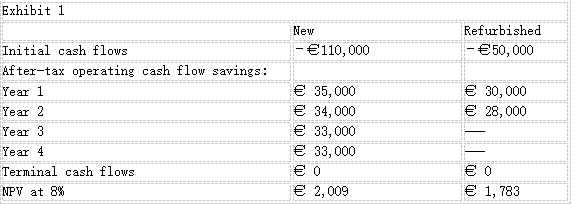 Beaumont questions the production manager about the assumption of being able to acquire another refurbished machine in two years. The manager says he believes a refurbished machine should be available, but the cost would likely have increased to €52,500 by then. He does not think the operating savings would change. Based on this new information, Beaumont decides it is better to compare the projects using the least common multiple of lives approach.Next Beaumont reviews a request to replace the company’s five current diesel-powered delivery trucks with electric ones. The current trucks are still in good condition, but the company’s CEO thinks it would be good for the company’s image to use electric trucks. An analyst in the CEO’s office prepares the truck replacement proposal with the cost comparison in Exhibit 2.
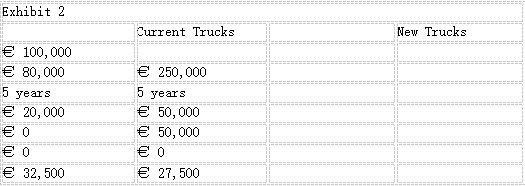 Beaumont determines there is no effect on net working capital, the information in Exhibit 2 is prepared using accounting estimates, and that gains on the sale of trucks are taxed at regular rates.Despite the cost savings from operating electric trucks, Beaumont determines the proposal has a negative NPV. Before making a recommendation, Beaumont meets with the procurement manage and states: "If the price of diesel fuel increases, the cost savings of the electric trucks will be more attractive. I expect the demand of the company's product will remain unchanged and will be below capacity. I suggest we start with just one truck until we can confirm the reliability of the cost savings before deciding on replacing all trucks."
Beaumont questions the production manager about the assumption of being able to acquire another refurbished machine in two years. The manager says he believes a refurbished machine should be available, but the cost would likely have increased to €52,500 by then. He does not think the operating savings would change. Based on this new information, Beaumont decides it is better to compare the projects using the least common multiple of lives approach.Next Beaumont reviews a request to replace the company’s five current diesel-powered delivery trucks with electric ones. The current trucks are still in good condition, but the company’s CEO thinks it would be good for the company’s image to use electric trucks. An analyst in the CEO’s office prepares the truck replacement proposal with the cost comparison in Exhibit 2.Beaumont determines there is no effect on net working capital, the information in Exhibit 2 is prepared using accounting estimates, and that gains on the sale of trucks are taxed at regular rates.Despite the cost savings from operating electric trucks, Beaumont determines the proposal has a negative NPV. Before making a recommendation, Beaumont meets with the procurement manage and states: "If the price of diesel fuel increases, the cost savings of the electric trucks will be more attractive. I expect the demand of the company's product will remain unchanged and will be below capacity. I suggest we start with just one truck until we can confirm the reliability of the cost savings before deciding on replacing all trucks."
19
Based on Exhibit 1, the NPV using the equivalent annual annuity for the refurbished option is closest to:
- A.€538.
- B.€892.
- C.€1,000.
20
Using the production manager’s estimate of the cost of the refurbished machine in two years, the NPV using the least common multiple of lives approach for that option is closest to:
- A.€1,066.
- B.€1,169.
- C.€3,312.
21
The initial cash outflow for the analysis of the proposal to replace the trucks is:
- A.€164,000.
- B.€170,000.
- C.€194,000.
22
The price of diesel fuel on the electric truck proposal is best described as a:
- A.price setting option.
- B.fundamental option.
- C.production-flexibility option.
Malory McVee, a partner at a consulting firm, recently started working with a new client, Sierra Health (Sierra). Sierra is a healthcare management company managing hospitals across major cities in the United States. Over the last two years, Sierra's hospital bed occupancy rate has declined by 25%, bucking the industry trend. Sierra believes it's due to a higher percentage of employees working virtually, allowing them to relocate to less populated areas. Sierra's board has asked McVee to start preparing documentation to take the company public. Going public will help finance the roll out of virtual medical services using new technology and the building of small medical clinics within supermarkets in rural areas, and both initiatives are expected to increase the number of patients.McVee instructs her financial analyst, Alan Wright, to analyze Sierra's historical financials and start building a financial model to determine a fair offering price. Wright asks, "What length of time should I use for the forecast horizon? The industry average annual portfolio turnover for equity strategies is about 33%, reflecting a three year investment time horizon, but our DCF model calls for five-year forecasts. Maybe it should be 10 years because it's likely to take at least 6 to 7 years to have normalized earnings reflected in the financial statements."Wright immediately follows with a second question, asking, "Keeping in mind I would like to use a financial model that uncovers implicit assumptions or errors, what forecast modeling methodology should I use once I'm done with the historical analysis?"Wright's historical analysis finds Sierra's medical staff salaries (considered costs of goods sold (COGS), a standard practice in the industry) have increased significantly over the last year to compensate for labor shortages and overtime. Sierra has been able to continue with its standard of care practice of three medical staff for every bed occupied. Wright notes there is increasing pressure by the nursing staff for pay raises, as their past pay raises have have lagged those of other medical staff. He also understands it is difficult to pass on cost increases to the patients due to long-term agreements with insurance companies that pay the majority of the patients' medical bills. With this in mind, Wright considers which method of estimating future COGS would be the most accurate:Method 1 Comparing Sierra's gross margins with those of its competitorsMethod 2 Breaking down the costs into price and volume componentsMethod 3 Extrapolating GOGS from the percentage of sales from historical trendsPrior to finalizing his forecasts, Wright makes the following notes about competitive forces Sierra will likely face with the introduction of virtual services.Note 1 Most medical services companies currently have the capability to provide virtual medical services so the barriers to entry are low, especially in that the IT needed only has to be in one central location - not at each medical facility. How can Sierra make their IT platform more user friendly and reduce waiting time for an appointment?Note 2 Patients tend to be quite loyal to their doctors. It's a strong relationship so they don't move to a new doctor frequently or easily. What can Sierra do to strengthen the relationships between the patients and their doctors even more?Note 3 Generally speaking, patients want lower health insurance premium costs but most also want health care to remain within the private sector rather than be run by the government. I think the patients' ability to demand lower prices is restricted due to the current structure of the industry and the influence of strong lobbies. Increases in health care costs are generally not felt directly by the patient with insurance coverage. Keep an eye open for any potential new government legislation on controlling medical costs and health insurance, although in my opinion it is unlikely over the next decade.
23
In response to Wright's first question, which of the following is McVee's most appropriate response?
- A.Three years
- B.Five years
- C.Ten years
24
What is McVee's most appropriate response to Wright's second question?
- A.Hybrid approach
- B.Top-down approach
- C.Bottom up approach
25
Which of the following methods should Wright use to most accurately forecast Sierra's future COGS?
- A.Method 1
- B.Method 2
- C.Method 3
26
Which of Wright's notes reflects the highest risk to Sierra's profitability?
- A.Note 1
- B.Note 2
- C.Note 3
Ian Aaron owns a small consulting firm that specializes in private company valuation. He is asked to make a presentation at a local university about his company's role in the investment industry, which he agrees to do.Aaron opens his presentation by stating there are key differences between public and private company valuations. He add that the characteristics of private companies and the absence of universally recognized valuation methods have lead to the development of diverse valuation practices. He notes that some companies grow through acquisitions and that the prices paid in such transactions need to be evaluated. He mentions there are many additional concerns he looks to address as he begins an evaluation and lists the following: Agency issues, quality of financial statements, and concentration of control.Aaron explains how private company earnings can potentially require significant adjustments in order to estimate the company’s normalized earnings. It may be necessary to adjust for non-recurring, non-economic, or other unusual items to eliminate anomalies and facilitate comparisons. A member of the audience asks about a new business his family recently started and comments:Comment 1 Revenues are limited, family members working for the business have deferred their compensation.Comment 2 The business operates in a building that is currently owned by a family member.Comment 3 The few employees the business does have are paid similar to other start-ups in our area.Arron next discusses how standard ways of determining an appropriate discount rate are not applicable to private firm valuation. He points out that several adjustments may be necessary to incorporate the real risk of the investment. He states the following may affect the selection of an appropriate discount rate:Statement 1 Due to its ease of access and liquidity, private companies tend to rely on bank financing.Statement 2 In evaluating an acquisition the buyer’s cost of capital is irrelevant.Statement 3 An adjustment for managerial experience is rarely necessary.Aaron concludes his presentation with a discussion concerning control. He explains that lack of control discounts (DLOC) become necessary for valuing non-controlling equity interests in private companies. He stresses that the application of a DLOC is fact-specific, and estimates vary dramatically. He remarks that whether the Guideline Transaction Method (GTM) or Guideline Public Company Method(GPCM) is used to determine a valuation, a discount for lack of control should be applied.
27
With regard to private versus public company valuation, do Aaron's concerns include both company specific and stock specific factors?
- A.Yes
- B.No regarding stock specific factors
- C.No regarding company specific factors
28
Which of the audience member's comments would least likely require an adjustment to normalize earnings?
- A.Comment 1
- B.Comment 2
- C.Comment 3
29
Which of Aaron's statements regarding the selection of an appropriate discount rate is accurate?
- A.Statement 1
- B.Statement 2
- C.Statement 3
30
Is Aaron's remark regarding application of a discount for lack of control (DLOC) accurate?
- A.Yes
- B.No regarding Guideline Transaction Method (GTM)
- C.No regarding Guideline Public Company Method (GPCM)
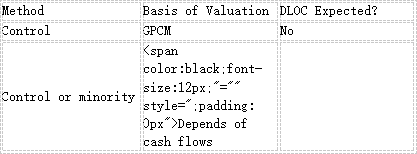
Wanda Wallace manages the fixed-income portfolio for an Australian Dollar (AUD)20 billion superannuation fund (the Fund). Wallace has been actively using CDS to manage the credit exposure of her portfolio, both for trading and hedging purposes. All of the Fund's CDS contracts conform to the International Swaps and Derivatives Association (ISDA) specifications and the related transactions adhere to ISDA protocols.
Wallace's portfolio has a AUD100 million position in Adamant Mining (Adamant) 5-year senior unsecured bond (Bond 2), and she considers purchasing protection to hedge against her exposure. The details of the CDS are presented in Exhibit 1.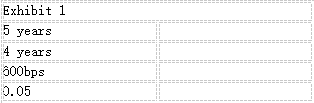 Wallace purchases protection with a notional amount of AUD100 million using the above CDS. One month later, Adamant experiences a credit event, and its credit spread widens by 400bps as a result.
Apart from hedging with CDSs, Wallace is also contemplating trading ideas using them, and has been examining several companies on her shortlist. Below are her expectations on Brilliance Oil (Brilliance), Colossal Energy (Colossal), and Devotion Inc (Devotion) in the energy sector.
Expectation 1:Brilliance's credit curve will flatten, while Colossal's credit curve will steepen
Expectation 2:Brilliance credit spread will narrow, while Colossal's credit spread will widen
In response to her expectations of Brilliance and Colossal, Wallace is considering the following trade strategies:
Strategy 1:Buying short term credit protection and selling long term credit protection for Colossal
Strategy 2:Selling long term credit protection for Brilliance, while buying long term credit protection for Colossal
Wallace also anticipates that Devotion will undergo a leveraged buyout, issuing large amounts of debt to privatize all of its publicly traded shares.
Wallace's portfolio has a AUD100 million position in Adamant Mining (Adamant) 5-year senior unsecured bond (Bond 2), and she considers purchasing protection to hedge against her exposure. The details of the CDS are presented in Exhibit 1.
Wallace purchases protection with a notional amount of AUD100 million using the above CDS. One month later, Adamant experiences a credit event, and its credit spread widens by 400bps as a result.Apart from hedging with CDSs, Wallace is also contemplating trading ideas using them, and has been examining several companies on her shortlist. Below are her expectations on Brilliance Oil (Brilliance), Colossal Energy (Colossal), and Devotion Inc (Devotion) in the energy sector.
Expectation 1:Brilliance's credit curve will flatten, while Colossal's credit curve will steepen
Expectation 2:Brilliance credit spread will narrow, while Colossal's credit spread will widen
In response to her expectations of Brilliance and Colossal, Wallace is considering the following trade strategies:
Strategy 1:Buying short term credit protection and selling long term credit protection for Colossal
Strategy 2:Selling long term credit protection for Brilliance, while buying long term credit protection for Colossal
Wallace also anticipates that Devotion will undergo a leveraged buyout, issuing large amounts of debt to privatize all of its publicly traded shares.
31
The upfront premium required to buy credit protection using Adamant's 5-year CDS is closest to:
- A.4% notional.
- B.5% notional.
- C.6% notional.
32
The estimated profit (in AUD millions) from Adamant's CDS price change immediately after the credit event in the first month is closest to:
- A.10
- B.16
- C.20
33
Based on Wallace's expectations on Brilliance and Colossal, which of the following trading strategies would most likely be profitable?
- A.Strategy 1 only
- B.Strategy 2 only
- C.Both Strategy 1 and Strategy 2
34
Based on Wallace's expectation on Devotion, which of the following trading will be the most profitable?
- A.Selling credit protection, and buying the underlying stock
- B.Buying credit protection, and selling the underlying stock
- C.Buying credit protection, as well as buying the underlying stock
Wabash Trading Advisers is a commodities trading and advisory firm with particular emphasis on the grains and livestock markets. Its clients include major food companies, financial institutions, and trading companies.Tomas Gorski recently joined Wabash as a commodity analyst after several years with another firm as an equity analyst. He meets with a senior commodity analyst at Wabash, Pilar Moreno. She asks Gorski, “What differences are there between valuing commodities and valuing equities?” In response, Gorski makes the following statements.Statement 1 Commodity valuation focuses on supply and demand, whereas equity valuation focuses on discounted cash flows.Statement 2 Commodities do not generate future cash flows beyond what can be realized through their purchase and sale.Statement 3 Equities and commodities are both considered financial assets.Moreno explains to Gorski that Wabash does not participate in all of the commodity sectors. “We have intentionally chosen to avoid base metals, precious metals, and energy,” she says.Gorski responds, “It makes sense to concentrate on commodities that have similar characteristics. Even though metals and energy may require storage, they are non-perishable and are not affected by weather. Livestock is perishable and can only be stored for a very short period, whereasgrain can be stored longer.”Moreno describes how some of Wabash’s clients hedge positions for critical commodities used in manufacturing. To illustrate, she shows Gorski data for a position taken on behalf of Platte River Foods. The position is now close to expiration.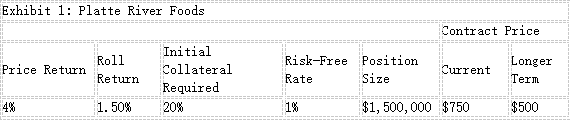 Moreno continues, “One of Wabash’s oldest clients, Fond du Lac, has been in business for more than 100 years and has developed sophisticated pricing models. Currently, their models predict that the price of corn is poised to more than double in the next six months. Fond du Lac has purchased a large amount of corn in the spot market and has taken delivery at its storage facilities. When the price increase occurs, they intend to sell the corn in the spot market.”Moreno asks Gorski to help her prepare a market overview to include in all client presentations. Gorski collects the spot and futures prices of three commodities.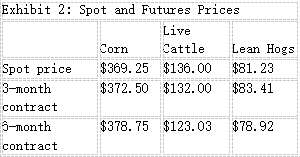
Moreno continues, “One of Wabash’s oldest clients, Fond du Lac, has been in business for more than 100 years and has developed sophisticated pricing models. Currently, their models predict that the price of corn is poised to more than double in the next six months. Fond du Lac has purchased a large amount of corn in the spot market and has taken delivery at its storage facilities. When the price increase occurs, they intend to sell the corn in the spot market.”Moreno asks Gorski to help her prepare a market overview to include in all client presentations. Gorski collects the spot and futures prices of three commodities.
35
Which of Gorski’s statements about the differences in the valuation of equities and commodities is least likely correct?
- A.Statement 1
- B.Statement 2
- C.Statement 3
36
Gorski’s response to Moreno regarding metals, energy, livestock, and grains is least likely correct with respect to:
- A.perishability.
- B.weather.
- C.storage.
37
The total return for the Platte River Foods hedge position is closest to:
- A.5.5%.
- B.5.7%.
- C.5.3%.
38
In order to roll forward Platte River Foods’ current exposure and maintain its dollar value, Moreno would:
- A.buy 2,000 near-term contracts and sell 3,000 of the longer-term contracts.
- B.sell 2,000 near-term contracts and buy 2,000 of the longer-term contracts.
- C.sell 2,000 near-term contracts and buy 3,000 of the longer-term contracts.
39
Fond du Lac would most likely be acting as a(n):
- A.speculator.
- B.arbitrageur.
- C.informed investor.
40
Based on the information presented in Exhibit 2, the commodity most likely in contango is:
- A.lean hogs.
- B.live cattle.
- C.corn.
Cardinal Research is an institutional investment advisory firm. William Bergen is Head of Research. Frank McKesson is a senior research analyst. Bergen and McKesson are discussing techniques used to evaluate investment strategies.Bergen provides an investment strategy hypothesis: "A multifactor model portfolio that is over-weighted with larger capitalization stocks will produce superior risk adjusted returns". Bergen selects the Russell 1000 as the investment universe. He selects earnings yield, earnings momentum and return on equity as fundamental factors. For each factor, the top 300 stocks will be equal weighted and collectively represent 75% of the portfolio. The historical return of the Russell 1000 is 10.0%. The risk-free interest rate averaged 2.5%. For the factor allocation benchmark portfolio, the fundamental factors are equal weighted. For the factor allocation risk parity portfolio, the fundamental factors are weighted by risk contribution. The time period is 1995 to 2020. The results of a historical investment simulation for the multi-factor model portfolio are presented as Exhibit 1.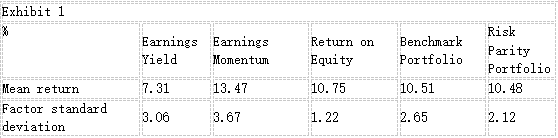 Bergen admits that investors commonly make mistakes in backtesting an investment strategy. He makes three comments:
Comment 1 Data snooping is a form of survivorship bias in which index constituents include only companies that have survived over a measurement period.Comment 2 Point in time data is used by analysts to correct mistakes that are inherent in survivorship bias.Comment 3 Data revision is a form of look-ahead bias in which multiple backtesting iterations are conducted to attain a desired outcome.Bergen states that during the period 1995 to 2020, there were economic recessions and expansions, as well as periods of of high and low options market volatility. The results of a historical scenario analysis (1995-2020) for the benchmark portfolio and the risk parity portfolio are presented as Exhibit 2.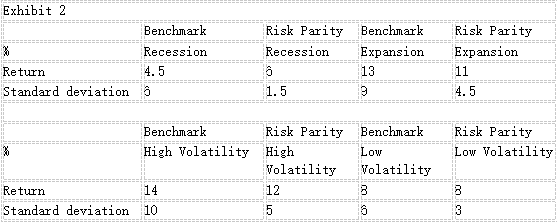 Bergen reminds McKesson that the historical return of the Russell 1000 was 10.0% and that the risk-free interest rate averaged 2.5% over the 1995 to 2020 period. McKesson analyzes the results of the historical scenario analysis on a risk adjusted basis and draws the following conclusions:
Conclusion 1 The risk parity portfolios outperformed the benchmark portfolios across each scenario.Conclusion 2 The median performing portfolios were risk parity | low volatility and benchmark | expansion.Conclusion 3 The benchmark portfolios, compared to each other, outperformed during the non-recession period and the low volatility regime.McKesson suggests that approaches such as historical simulation and Monte Carlo simulation are complementary to backtesting. Simulation models involve an element of randomness. For historical simulation, the key variables are selected randomly without regard for time ordering. For Monte Carlo simulation, the key variables are selected randomly from an assigned distribution.Bergen states that bootstrapping is commonly used in backtesting, historical simulation and Monte Carlo simulation in order to accommodate the size of each method's data set.
Bergen admits that investors commonly make mistakes in backtesting an investment strategy. He makes three comments:Comment 1 Data snooping is a form of survivorship bias in which index constituents include only companies that have survived over a measurement period.Comment 2 Point in time data is used by analysts to correct mistakes that are inherent in survivorship bias.Comment 3 Data revision is a form of look-ahead bias in which multiple backtesting iterations are conducted to attain a desired outcome.Bergen states that during the period 1995 to 2020, there were economic recessions and expansions, as well as periods of of high and low options market volatility. The results of a historical scenario analysis (1995-2020) for the benchmark portfolio and the risk parity portfolio are presented as Exhibit 2.
Bergen reminds McKesson that the historical return of the Russell 1000 was 10.0% and that the risk-free interest rate averaged 2.5% over the 1995 to 2020 period. McKesson analyzes the results of the historical scenario analysis on a risk adjusted basis and draws the following conclusions:Conclusion 1 The risk parity portfolios outperformed the benchmark portfolios across each scenario.Conclusion 2 The median performing portfolios were risk parity | low volatility and benchmark | expansion.Conclusion 3 The benchmark portfolios, compared to each other, outperformed during the non-recession period and the low volatility regime.McKesson suggests that approaches such as historical simulation and Monte Carlo simulation are complementary to backtesting. Simulation models involve an element of randomness. For historical simulation, the key variables are selected randomly without regard for time ordering. For Monte Carlo simulation, the key variables are selected randomly from an assigned distribution.Bergen states that bootstrapping is commonly used in backtesting, historical simulation and Monte Carlo simulation in order to accommodate the size of each method's data set.
41
Which comment by Bergen about common mistakes in backtesting is most likely correct?
- A.Comment 1
- B.Comment 2
- C.Comment 3
42
For the historical scenario analysis, which conclusion by McKesson is least likely correct?
- A.Conclusion 1
- B.Conclusion 2
- C.Conclusion 3
43
Is McKesson's discussion of simulation models likely correct?
- A.Yes
- B.No, because of time ordering
- C.No, because of assigned distribution
44
Bergen's statement about bootstrapping is most likely correct with respect to:
- A.backtesting.
- B.historical simulation.
- C.Monte Carlo simulation.
Jacob Kostecka, CFA, is a portfolio manager at Forkson Investment Management, an asset management and research focused organization. After obtaining his CFA charter last month, Kostecka was transferred to the private wealth management division at Forkson.Dharshi Bope, a private wealth client, was involved in a major motorcycle accident and is in critical condition, fighting for his life. Bope is a single parent with a daughter, Paveen Nathoo, in her mid-twenties. Since the accident, Nathoo has managed her father’s affairs, paying all expenses, including investment advisory fees. In several conversations with Nathoo, Kostecka highlighted Bope’s low risk tolerance and investment goal of capital preservation. Nathoo has indicated her interest in managing the account more aggressively and possibly moving to another management firm. Nathoo recently petitioned the court to appoint her full power of attorney to legally manage Bope’s affairs. Prior to the court decision, Nathoo asks Kostecka to invest her father’s account in the initial public offering (IPO) of Chatterbox, a highly sought after social media company that has yet to generate a profit.The following week, the court approves Nathoo’s request to act on behalf of her father. Going through records in her father’s home, Nathoo discovers documents showing Bope embezzled several million dollars from his employer, a real estate development company. Most of these funds were placed directly into Bope’s personal account, for which Nathoo is now responsible. Nathoo informs Kostecka about her discovery; however, Kostecka does not act on this information, however, because it is a large account for Forkson.Nathoo establishes a non-discretionary investment account at Forkson tied to her newly established business. Shortly thereafter, Kostecka joins the board of Jabbertalk.com, a smaller social media competitor to Chatterbox. Based on his knowledge of Chatterbox, Kostecka believes the stock of Jabbertalk is a good investment, even though it is not yet profitable. Buoyed by his faith in social media, Kostecka ultimately purchases shares of Jabbertalk’s IPO for Nathoo’s account, as well as for all clients he currently manages. When Kostecka informs Nathoo of the purchase, she expresses concern about her legal responsibilities and lack of accounting knowledge in overseeing the account. Kostecka provides Nathoo a list of recommended professionals he has worked with in the past, including attorneys and accountants. When he was in college 10 years earlier, Kostecka was engaged to one of the attorneys but broke off the relationship prior to their wedding, and one of the accountants was Kostecka’s college roommate. Since then, Kostecka has not had any contact with the lawyer and accountant.The Jabbertalk investment is profitable on the first day of trading, doubling from its opening price. Kostecka tells his clients the multifactor valuation model used by Forkson shows Jabbertalk stock is still undervalued. Forkson’s research report, due out the next day, will recommend investors hold their Jabbertalk shares. However, Kostecka tells all his clients simultaneously they should sell their shares because he believes Jabbertalk is overvalued and the stock price will fall soon. Kostecka notes he has followed through on this belief by selling his personal holdings of Jabbertalk shares. Nathoo ignores Kostecka’s recommendation to sell Jabbertalk. Over the next week, the stock declines 75%.Watching Jabbertalk’s severe share price decline, Nathoo becomes furious with Kostecka because he did not sell shares of Jabbertalk in her account. She files a complaint with Kostecka’s supervisor, Sally Fang, CFA, claiming she was misled on the value of the IPO in the days immediately after the stock started trading. Kostecka responds to the complaint by telling Fang, “the analyst who wrote the hold recommendation on Jabbertalk has only passed his CFA Level II examination. As a charterholder, I have earned the right to use the CFA designation, so I am more qualified to manage clients’ investments.”In order to build his client base, Kostecka prepares performance information to show prospective clients. He includes the firm’s composite performance based on similar discretionary client portfolios that are in compliance with the GIPS Standards. In addition, Kostecka prepares his own composite performance, including all accounts he manages. This presentation includes Nathoo’s account assuming she had sold her shares of Jabbertalk. Along with his performance record, Kostecka provides a footnote disclosing the following language: “If your account is managed on a discretionary basis, you might expect results similar to those shown above.”
45
With regard to the investment request made by Nathoo to invest in Chatterbox, Kostecka should most likely:
- A.follow Bope’s investment goals.
- B.seek advice from the court.
- C.comply with her request.
46
By not acting on the information reported by Nathoo, which CFA Institute Standard of Professional Conduct has Kostecka least likely violated?
- A.Loyalty, Prudence, and Care
- B.Duties to Employers
- C.Knowledge of the Law
47
With regard to investing in Jabbertalk and recommending experts, Kostecka most likely needs to disclose conflicts related to his:
- A.attorney relationship.
- B.board membership.
- C.accountant relationship.
48
In relation to Kostecka’s handling of the Jabbertalk stock recommendation, which of the following CFA Institute Standards of Professional Conduct did he least likely violate?
- A.Priority of Transactions
- B.Fair Dealing
- C.Communication with Clients
49
When Kostecka defends himself against Nathoo’s complaint, he most likely violated the CFA Institute Code of Ethics and Standards of Professional Conduct concerning the:
- A.reference to candidacy in the CFA Program.
- B.misrepresentation of the meaning of the designation.
- C.right to use the CFA designation.
50
Kostecka’s performance presentation most likely conforms to CFA Institute Standard III(D)–Performance Presentation with regard to:
- A.disclosure in the footnote.
- B.composites representing similar discretionary investment portfolios.
- C.fair and accurate representation of performance.
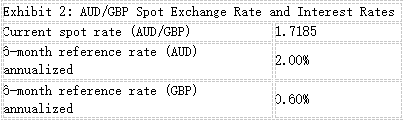
Fariq Gupta is an analyst at an investment bank’s foreign exchange trading desk. He meets with two of his clients to discuss their currency-related transactions.Bendigo TechnologiesBendigo Technologies is an Australia-based multinational company with subsidiaries in Tokyo and London. Bendigo will receive a cash inflow denominated in JPY from the Tokyo subsidiary and wants to convert this JPY receipt into Australian dollars (AUD). Gupta collects the spot rate bid/offer quotes for JPY/AUD (number of JPY per AUD) in Exhibit 1. Gupta investigates whether a triangular arbitrage opportunity exists between the Interbank and dealer quotes in the JPY/AUD.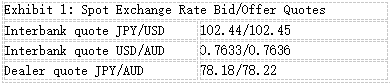 The Australian office expects a GBP cash inflow in six months from the London subsidiary. Gupta collects the AUD/GBP exchange rate and interest rate information in Exhibit 2 and assumes that covered interest rate parity holds.
 Mandurah wants to expand its investments into emerging markets and Gupta conducts further analysis. Country A is an emerging market, has a floating-rate currency regime and highly mobile foreign capital flows. The government is rapidly increasing its fiscal stimulus to boost economic growth. Gupta believes that this will lead to a prolonged buildup in public debt, which foreign creditors eventually will not accept. To ease concerns regarding the buildup in public debt, the central bank is implementing a restrictive monetary policy. He assesses the potential effect on the country’s currency based on the Mundell-Fleming and portfolio balance approaches.
The Mandurah FundThe Mandurah Fund is an investment fund based in Australia. One year ago, Mandurah entered a carry trade involving currency positions in Country D and Country E. Gupta calculates the all?in return from the carry trade using the information in Exhibit 3.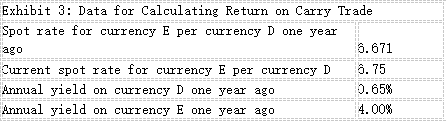 Mandurah wants to expand its investments into emerging markets and Gupta conducts further analysis. Country A is an emerging market, has a floating-rate currency regime and highly mobile foreign capital flows. The government is rapidly increasing its fiscal stimulus to boost economic growth. Gupta believes that this will lead to a prolonged buildup in public debt, which foreign creditors eventually will not accept. To ease concerns regarding the buildup in public debt, the central bank is implementing a restrictive monetary policy. He assesses the potential effect on the country’s currency based on the Mundell-Fleming and portfolio balance approaches.
The Australian office expects a GBP cash inflow in six months from the London subsidiary. Gupta collects the AUD/GBP exchange rate and interest rate information in Exhibit 2 and assumes that covered interest rate parity holds.Mandurah wants to expand its investments into emerging markets and Gupta conducts further analysis. Country A is an emerging market, has a floating-rate currency regime and highly mobile foreign capital flows. The government is rapidly increasing its fiscal stimulus to boost economic growth. Gupta believes that this will lead to a prolonged buildup in public debt, which foreign creditors eventually will not accept. To ease concerns regarding the buildup in public debt, the central bank is implementing a restrictive monetary policy. He assesses the potential effect on the country’s currency based on the Mundell-Fleming and portfolio balance approaches.The Mandurah FundThe Mandurah Fund is an investment fund based in Australia. One year ago, Mandurah entered a carry trade involving currency positions in Country D and Country E. Gupta calculates the all?in return from the carry trade using the information in Exhibit 3.
Mandurah wants to expand its investments into emerging markets and Gupta conducts further analysis. Country A is an emerging market, has a floating-rate currency regime and highly mobile foreign capital flows. The government is rapidly increasing its fiscal stimulus to boost economic growth. Gupta believes that this will lead to a prolonged buildup in public debt, which foreign creditors eventually will not accept. To ease concerns regarding the buildup in public debt, the central bank is implementing a restrictive monetary policy. He assesses the potential effect on the country’s currency based on the Mundell-Fleming and portfolio balance approaches.
51
Based on Exhibit 1, does a triangular arbitrage opportunity exist in JPY/AUD?
- A.No.
- B.Yes, by buying AUD in the interbank market and selling it to the dealer.
- C.Yes, by buying AUD from the dealer and selling it in the interbank market.
52
Based on Exhibit 2, the 6-month forward rate for AUD/GBP should trade closest to a:
- A.discount of 0.0120 to the spot rate.
- B.premium of 0.0120 to the spot rate.
- C.premium of 0.0140 to the spot rate.
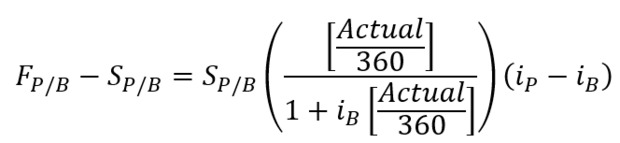 Because GBP is the base currency in the /AUD/GBP quote, putting in the information from the Exhibit leads to:
 The domestic currency will trade at a forward premium at 0.01199~=0.0120.
53
Based on Exhibit 3, the all-in return (in currency D terms) on Mandurah’s carry trade is closest to:
- A.2.13%.
- B.2.78%.
- C.3.35%.
54
Based on Gupta’s observations and the Mundell-Fleming and portfolio balance approaches, Country A’s currency would be expected to:
- A.appreciate in the short term but depreciate in the long term.
- B.depreciate in the short term towards a lower, long-term equilibrium exchange rate.
- C.appreciate in the short term towards a higher, long-term equilibrium exchange rate.
Marcus Eriksson, chief financial officer of Trana AB, and Katrina Lars, director of financial reporting, are preparing the company’s 2015 annual report. Today’s meeting is to discuss the transactions and disclosures related to Trana’s foreign operations. Trana, which reports under International Financial Reporting Standards (IFRS), is a Sweden-based retailer operating stores in three geographic locations: Sweden, the eurozone (with a current presence only in France, Germany, and Italy), and the United States. The stores in the eurozone and the United States are operated through a wholly owned subsidiary in each region. Consistent with Swedish accounting practice, the annual report includes separate financial statements for the parent company (Trana) and consolidated, or group, financial statements. The income statements are presented in Exhibit 1.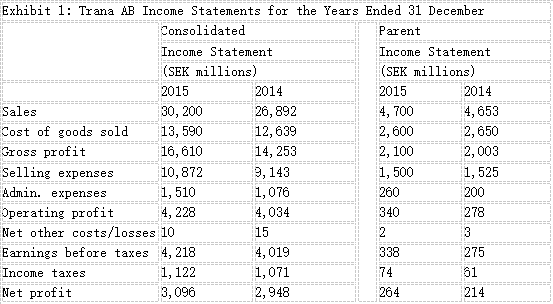 Eriksson and Lars start the meeting by reviewing some of the relevant currency exchange rates, shown in Exhibit 2. The functional currency for the eurozone and US subsidiaries is the local currency (EUR and USD, respectively), thus the financial statements of both are translated using the current rate method. Both subsidiaries are consistently profitable.
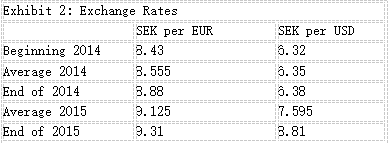 Next, they review the performance and related disclosures by region. The number of stores operated in each region is shown in Exhibit 3.
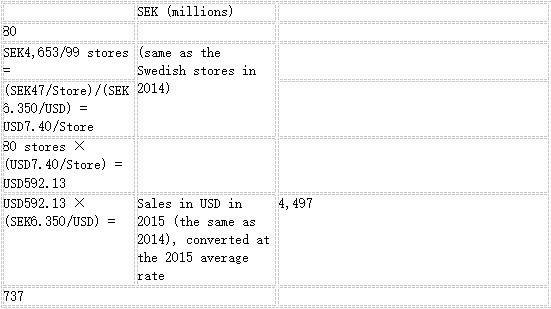
 In preparation for the meeting, Lars looked at the US region and calculated the effect of the change in the SEK/USD exchange rate on the increase in sales from 2014 to 2015. Her notes include the following:
In 2014, the sales per store, in SEK, were the same for both US and Swedish stores.The sales per US store in USD remained constant in 2015.
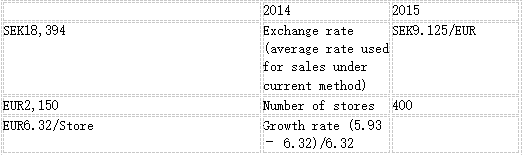
Eriksson reminds Lars that Trana defines organic growth in retail as coming from two factors:1.increasing the number of stores, and2.increasing the sales per store in the local currency.He says that he wants to provide disclosures related to the organic growth rate in domestic sales per store, by region, and asks Lars to calculate it for the eurozone region where the sales figures (in millions) were SEK18,394 in 2014 and SEK21,640 in 2015.In 2012, at the start of Trana’s expansion into North American markets, the company established a subsidiary, Anart Inc., in a South American country to benefit from lower labor and shipping costs. The details of the Anart investment are as follows:
Anart is 80% owned by Trana with 20% local investment.It sells all of its production to Trana and Trana’s other subsidiaries and determines the transfer price as full cost plus 5%.In 2015, sales (in millions) from Anart to Trana companies were SEK4,485 with net profit of SEK204.The corporate tax rate in the country is 10%.
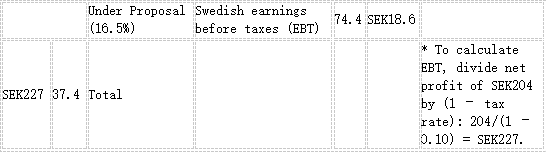
Throughout 2013, the South American country experienced high rates of inflation, approaching 30% per year. Trana had originally assumed that the high inflation rate was temporary, but it has shown no signs of decreasing and is now a concern. Eriksson and Lars discuss the impact of Anart on Trana’s financial statements and Eriksson asks Lars:“Is the same accounting method being used this year to account for Anart in the consolidated financial statements as in prior years?”Eriksson reminds Lars that there is a proposal in Sweden to reduce the corporate tax rate from the current 22% to 16.5%. He would like to provide pro-forma disclosures related to the potential change in net income this change could provide for Trana. He reminds Lars that the average tax rate for the eurozone countries where Trana operates is 30% and 25% in the United States. Sweden operates under a tax treaty with all countries in which it has subsidiaries, such that it will owe taxes on foreign earned income to the extent that the Swedish rate exceeds the foreign rate.In closing the meeting, Eriksson mentions that Trana is undertaking a comprehensive review of its operations in 2016, and its objectives include reducing overall tax costs by lowering its effective tax rate and reducing foreign exchange gains and losses reported on the income statement.
Eriksson and Lars start the meeting by reviewing some of the relevant currency exchange rates, shown in Exhibit 2. The functional currency for the eurozone and US subsidiaries is the local currency (EUR and USD, respectively), thus the financial statements of both are translated using the current rate method. Both subsidiaries are consistently profitable.Next, they review the performance and related disclosures by region. The number of stores operated in each region is shown in Exhibit 3.In preparation for the meeting, Lars looked at the US region and calculated the effect of the change in the SEK/USD exchange rate on the increase in sales from 2014 to 2015. Her notes include the following:In 2014, the sales per store, in SEK, were the same for both US and Swedish stores.The sales per US store in USD remained constant in 2015.
Eriksson reminds Lars that Trana defines organic growth in retail as coming from two factors:1.increasing the number of stores, and2.increasing the sales per store in the local currency.He says that he wants to provide disclosures related to the organic growth rate in domestic sales per store, by region, and asks Lars to calculate it for the eurozone region where the sales figures (in millions) were SEK18,394 in 2014 and SEK21,640 in 2015.In 2012, at the start of Trana’s expansion into North American markets, the company established a subsidiary, Anart Inc., in a South American country to benefit from lower labor and shipping costs. The details of the Anart investment are as follows:
Anart is 80% owned by Trana with 20% local investment.It sells all of its production to Trana and Trana’s other subsidiaries and determines the transfer price as full cost plus 5%.In 2015, sales (in millions) from Anart to Trana companies were SEK4,485 with net profit of SEK204.The corporate tax rate in the country is 10%.
Throughout 2013, the South American country experienced high rates of inflation, approaching 30% per year. Trana had originally assumed that the high inflation rate was temporary, but it has shown no signs of decreasing and is now a concern. Eriksson and Lars discuss the impact of Anart on Trana’s financial statements and Eriksson asks Lars:“Is the same accounting method being used this year to account for Anart in the consolidated financial statements as in prior years?”Eriksson reminds Lars that there is a proposal in Sweden to reduce the corporate tax rate from the current 22% to 16.5%. He would like to provide pro-forma disclosures related to the potential change in net income this change could provide for Trana. He reminds Lars that the average tax rate for the eurozone countries where Trana operates is 30% and 25% in the United States. Sweden operates under a tax treaty with all countries in which it has subsidiaries, such that it will owe taxes on foreign earned income to the extent that the Swedish rate exceeds the foreign rate.In closing the meeting, Eriksson mentions that Trana is undertaking a comprehensive review of its operations in 2016, and its objectives include reducing overall tax costs by lowering its effective tax rate and reducing foreign exchange gains and losses reported on the income statement.
55
Using Exhibits 1, 2, and 3 and Lars’s notes about the US operations, the change in sales reported for the US region (in SEK millions) explained by the change in the SEK/USD exchange rate in 2015 is closest to:
- A.SEK737.
- B.SEK813.
- C.SEK1,432.
56
Using Eriksson’s definition, the organic growth rate in sales per store in the eurozone region between 2014 and 2015 that Lars calculates is closest to:
- A.0%.
- B.–6.2%.
- C.10.3%
57
The best estimate of the proportion of Anart’s sales that is reflected in Trana’s consolidated income statement is:
- A.0%.
- B.100%.
- C.80%.
58
Which of the following is Lars’s most appropriate answer to Eriksson’s question concerning the accounting method used for Anart in 2015?
- A.No, the current rate method is being used, after restating nonmonetary items for inflation.
- B.No, the current rate method is being used, after restating all accounts for the general price index.
- C.Yes, the temporal method is being used, as in past years.
59
If the proposed reduction in Swedish tax rates had been in effect in 2015, the increase in Trana’s net profit (in SEK millions) would have been closest to:
- A.SEK31.2.
- B.SEK18.6.
- C.SEK29.8.
60
Which of the following strategies would be most likely to help Trana achieve at least one of the objectives mentioned by Eriksson for 2016?
- A.Raise the price at which Anart sells its goods to other group members
- B.Increase the number of stores in the US region
- C.Initiate a hedge on the net asset position of the eurozone subsidiary
Andrew Bubs is the founder and owner/operator of privately held Bubs Candies Company (BCC). BCC produces all of its candy and sells directly to retailers. The candy market is dominated by one large publicly traded firm, Tressell Candies, which controls 30% of the market. Two other publicly traded competitors (Claire’s Confections and Cindy’s Sweets) each control 11% of the market, with the rest of the market evenly divided among eight other firms (BCC being one of them).In late 2020, Bubs hires James Nelson of Nelson Partners to assist with reviewing issues related to potential changes in industry structure.Nelson and Bubs discuss attributes of the publicly traded firms in the industry:
Tressell Candies outsources production of its different candies and focuses most of its energy on its retail operations. In fact, some of BCC’s products are brought to market using Tressell’s retail facilities.
Claire’s Confections is like BCC in that it produces candy but does not have its own retail outlets.
Cindy’s Sweets produces and markets its candy through its own retail stores.
Bubs and Nelson consider the implication of BCC being acquired by either Tressell Candies or Claire’s Confections. They classify each potential acquisition as:
a vertical merger with backward integration if acquired by Tressell Candies; or
a horizontal merger with potential economies of scale if acquired by Claire’s Confections.
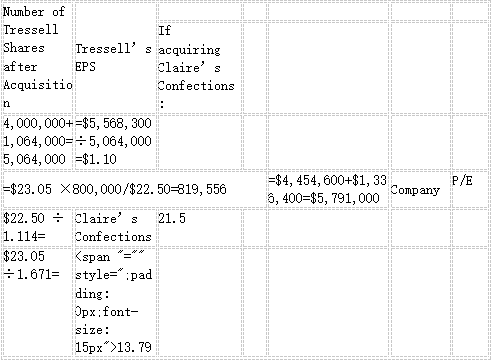
Upon considering further information about the publicly traded companies (see Exhibit 1), Nelson observes that Tressell can potentially increase its earnings per share by acquiring either Claire’s Confections or Cindy’s Sweets in an all-stock acquisition (assuming no changes in the current stock prices). Upon hearing this information from Nelson, Bubs decides to contact Tressell to discuss the potential sale of BCC before Tressell can act on acquiring Claire’s Confections or Cindy’s Sweets.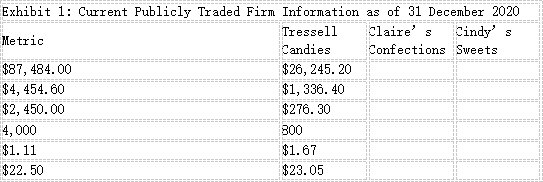 Later, after further investigation, Bubs and Nelson discover a provision that in the event of a takeover, the bondholders of Cindy’s Sweets can immediately sell bonds back to the issuing company at a value of 20% above par, making Cindy’s Sweets an unlikely target for Tressell.
Nelson learns that the Tressell board of directors is considering making a cash and stock offer for Claire’s Confections. One of the directors made the following comments:
1. Although I am certainly in favor of this takeover, I think greatest value will be achieved from the acquisition for both firms if we offer more stock and less cash.
2. If Claire’s Confections does not realize the potential synergies of this acquisition in the next five years, I suggest a spinoff as a means of recovering some of the money lost in this venture.
3. A positive initial market reaction will confirm that we did not overpay for Claire’s Confections.
Tressell Candies outsources production of its different candies and focuses most of its energy on its retail operations. In fact, some of BCC’s products are brought to market using Tressell’s retail facilities.
Claire’s Confections is like BCC in that it produces candy but does not have its own retail outlets.
Cindy’s Sweets produces and markets its candy through its own retail stores.
Bubs and Nelson consider the implication of BCC being acquired by either Tressell Candies or Claire’s Confections. They classify each potential acquisition as:
a vertical merger with backward integration if acquired by Tressell Candies; or
a horizontal merger with potential economies of scale if acquired by Claire’s Confections.
Upon considering further information about the publicly traded companies (see Exhibit 1), Nelson observes that Tressell can potentially increase its earnings per share by acquiring either Claire’s Confections or Cindy’s Sweets in an all-stock acquisition (assuming no changes in the current stock prices). Upon hearing this information from Nelson, Bubs decides to contact Tressell to discuss the potential sale of BCC before Tressell can act on acquiring Claire’s Confections or Cindy’s Sweets.
Later, after further investigation, Bubs and Nelson discover a provision that in the event of a takeover, the bondholders of Cindy’s Sweets can immediately sell bonds back to the issuing company at a value of 20% above par, making Cindy’s Sweets an unlikely target for Tressell.Nelson learns that the Tressell board of directors is considering making a cash and stock offer for Claire’s Confections. One of the directors made the following comments:
1. Although I am certainly in favor of this takeover, I think greatest value will be achieved from the acquisition for both firms if we offer more stock and less cash.
2. If Claire’s Confections does not realize the potential synergies of this acquisition in the next five years, I suggest a spinoff as a means of recovering some of the money lost in this venture.
3. A positive initial market reaction will confirm that we did not overpay for Claire’s Confections.
61
Bubs and Nelson’s classifications of the two mergers in which BCC might be acquired are most accurate with respect to:
- A.Tressell Candies only.
- B.Claire’s Confections only.
- C.both Tressell Candies and Claire’s Confections.
62
Nelson’s observation that Tressell Candies will be able to increase its EPS by executing an all-stock acquisition is best characterized as correct:
- A.for both Cindy’s Sweets and Claire’s Confections.
- B.only when considering Cindy’s Sweets.
- C.only when considering Claire’s Confections.
63
The provision related to the bonds of Cindy’s Sweets that Bubs and Nelson discover is most accurately described as a:
- A.flip-in pill.
- B.poison put.
- C.“Pac-Man” defense.
64
Which of the following comments made by the member of Tressell’s board of directors is most accurate?
- A.Comment 1
- B.Comment 2
- C.Comment 3
The Stratton Club is a US-based small investment club formed by a group of friends who had recently graduated from university. Today the club holds a regular bimonthly meeting, and two members have new companies for the club to analyze. The club uses a combination of comparables and forecasted fundamentals to make its investment decisions.Alice Zhang has done some preliminary research on Cratt Ltd. (Cratt). Located in Pennsylvania, Cratt is a small manufacturer of products, supplies, and food for domestic animals. Zhang starts by showing the club a recent news release from Cratt’s website (Exhibit 1).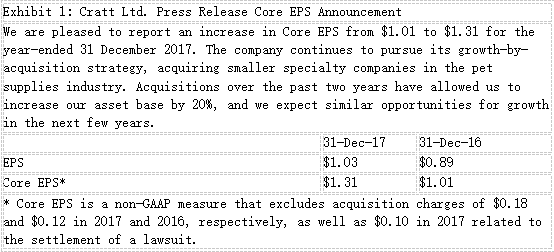 Zhang notes that Cratt is currently trading at $11.31 and reminds the club that the company had been sued over patent infringement for producing coats and blankets for dogs with the names and logos of local professional sports teams on them without the teams’ permission. The company had settled quickly out of court to avoid further negative publicity. Zhang believes the company will not be incurring legal fees again in the foreseeable future but believes that because the company’s strategy is to grow by acquisition, costs related to acquisitions will continue to be incurred and are relevant in any analysis. She does not agree with the company’s exclusion of those costs from core EPS. She calculates Cratt’s trailing price-to-earnings ratio (P/E) on the basis of her beliefs.
Using data available from the New York Stock Exchange (NYSE), Zhang finds the average P/E multiple for the Consumer Goods Index (14.8) and the Processed and Packaged Goods sector of that index (32.9). She then performs a screen to narrow the latter group down to other, smaller processed and packaged goods producers to create her own index for comparison purposes. Partial results for the companies identified in her screen are shown in Exhibit 2.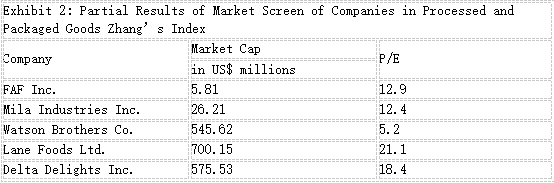 Zhang observes that Lane Foods must have both a higher-than-average growth rate and risk to justify its high P/E and that perhaps they should consider looking at Lane as a potential investment at their next meeting.The club members further discuss Zhang’s index and the wide range in both market capitalizations and P/Es for companies in the index. The discussion focuses on whether the arithmetic mean of the index is the best value to be using in their analysis. Zhang remembers learning about the weighted harmonic mean. She decides to calculate the weighted harmonic mean for the index and makes the following statement to support her decision:“The harmonic mean can be used to mitigate the effects of both large and small outliers.”Moving on from Cratt, Tom Kaminski, another group member, presents some preliminary research on Rapier Ltd., an integrated producer in the forest products industry. Kaminski explains that the industry is cyclical and is currently at mid-cycle. He notes that over this portion of the current cycle, Rapier has shown steady growth in total assets. Kaminski realizes he needs to take these factors into consideration when calculating normalized EPS to determine Rapier’s P/E.The meeting continues with Kaminski providing some follow-up from the club’s last meeting:“I have more information on KPK Inc., which we discussed in our last meeting. You may recall that we settled on a discounted cash flow model that we considered appropriate for the stock. I have used it to calculate the justified fundamental P/E. In addition, along with current and forecasted EPS for the next four quarters, I have determined other P/Es for the stock (Exhibit 3). Because the stock is part of the NYSE Consumer Goods Index that Zhang mentioned earlier, I have also included the index P/E. Based on this analysis, I recommend that the club buy KPK shares.”
Zhang notes that Cratt is currently trading at $11.31 and reminds the club that the company had been sued over patent infringement for producing coats and blankets for dogs with the names and logos of local professional sports teams on them without the teams’ permission. The company had settled quickly out of court to avoid further negative publicity. Zhang believes the company will not be incurring legal fees again in the foreseeable future but believes that because the company’s strategy is to grow by acquisition, costs related to acquisitions will continue to be incurred and are relevant in any analysis. She does not agree with the company’s exclusion of those costs from core EPS. She calculates Cratt’s trailing price-to-earnings ratio (P/E) on the basis of her beliefs.Using data available from the New York Stock Exchange (NYSE), Zhang finds the average P/E multiple for the Consumer Goods Index (14.8) and the Processed and Packaged Goods sector of that index (32.9). She then performs a screen to narrow the latter group down to other, smaller processed and packaged goods producers to create her own index for comparison purposes. Partial results for the companies identified in her screen are shown in Exhibit 2.
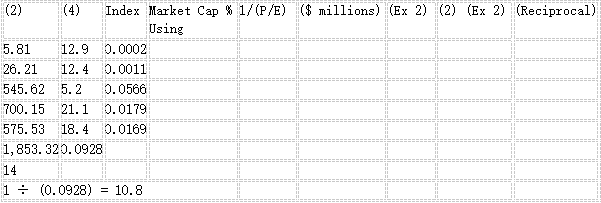
Zhang observes that Lane Foods must have both a higher-than-average growth rate and risk to justify its high P/E and that perhaps they should consider looking at Lane as a potential investment at their next meeting.The club members further discuss Zhang’s index and the wide range in both market capitalizations and P/Es for companies in the index. The discussion focuses on whether the arithmetic mean of the index is the best value to be using in their analysis. Zhang remembers learning about the weighted harmonic mean. She decides to calculate the weighted harmonic mean for the index and makes the following statement to support her decision:“The harmonic mean can be used to mitigate the effects of both large and small outliers.”Moving on from Cratt, Tom Kaminski, another group member, presents some preliminary research on Rapier Ltd., an integrated producer in the forest products industry. Kaminski explains that the industry is cyclical and is currently at mid-cycle. He notes that over this portion of the current cycle, Rapier has shown steady growth in total assets. Kaminski realizes he needs to take these factors into consideration when calculating normalized EPS to determine Rapier’s P/E.The meeting continues with Kaminski providing some follow-up from the club’s last meeting:“I have more information on KPK Inc., which we discussed in our last meeting. You may recall that we settled on a discounted cash flow model that we considered appropriate for the stock. I have used it to calculate the justified fundamental P/E. In addition, along with current and forecasted EPS for the next four quarters, I have determined other P/Es for the stock (Exhibit 3). Because the stock is part of the NYSE Consumer Goods Index that Zhang mentioned earlier, I have also included the index P/E. Based on this analysis, I recommend that the club buy KPK shares.”
65
Based on Exhibit 1 and Zhang’s beliefs about recurring costs, her trailing P/E is closest to:
- A.10.98.
- B.10.01.
- C.8.64.
66
Zhang’s observation about Lane Foods’ high P/E is best described as:
- A.correct.
- B.incorrect with respect to the growth rate.
- C.incorrect with respect to the risk.
67
The weighted harmonic mean of the P/Es in Zhang’s index (Exhibit 2) is closest to:
- A.11.1.
- B.10.8.
- C.15.4
68
Zhang’s statement to support using the harmonic mean is best described as:
- A.incorrect with respect to large outliers.
- B.incorrect with respect to small outliners.
- C.correct.
69
When determining Rapier’s P/E, the most appropriate method for Kaminski to use to calculate the company’s normalized EPS is the:
- A.average ROE over the most recent full cycle times the current book value per share.
- B.current EPS because Rapier is mid-cycle.
- C.average EPS over the most recent full cycle.
70
Which of the following best supports Kaminski’s recommendation for KPK? The justified (fundamental) P/E is greater than the:
- A.trailing P/E.
- B.forward P/E.
- C.index P/E.
Diane Muniz is the fixed-income trading strategist at Greentown Capital Management, an investment firm based in Miami, Florida. Muniz is running a training session for three recently hired junior analysts, Amanda Morgan, David Scahill, and Hamza Gomaa.Muniz welcomes Morgan, Scahill, and Gomaa to the firm and states that at today’s session they will be discussing bonds with embedded options. She asks the group, “Can any of you list a few general characteristics of bonds with embedded options?” Morgan responds with the following statements:Statement 1 “Depending on the type of bond, the embedded option can be exercised by either the bondholder or the bond issuer to exploit interest rate movements.”Statement 2 “However, both types of options—bondholder and bond issuer options—cannot be embedded in the same bond.”Statement 3 “The embedded options cannot be traded independently of the bond.”Muniz moves on to a discussion of the valuation of risky bonds with embedded options and asks if there is a metric that can be used to determine relative value and how such a measure is calculated. In response Scahill states: “The option-adjusted spread, or OAS, can be used to determine the value of a risky bond with embedded options. When assessing relative value for two bonds that are otherwise similar in all respects, the bond with the lower OAS is most likely underpriced or cheap.” Morgan adds: “The OAS is a variable spread that is based on the likelihood of cash flows occurring.” Gomaa disagrees with Scahill and Morgan, stating: “I believe OAS is the constant spread that when added to all one-period forward rates on the interest rate tree, equates the present value of the bond’s cash flows to the market price. Furthermore, for two bonds that have similar characteristics and credit quality, the bond with the higher OAS is underpriced.”Scahill then asks, “While we are on the topic of OAS, a question that comes to mind is how the interest rate volatility assumption impacts the OAS of callable and putable bonds.” Morgan responds, “It is my understanding that as interest rate volatility declines, the OAS for callable bonds decreases while the OAS for putable bonds increases.”In order to initiate discussion on the interest rate risk of bonds with embedded options, Muniz asks the group to use the information presented in Exhibit 1 to calculate the effective duration of a 5% annual coupon bond with 2 years remaining to maturity and callable in 1 year. The current price of this bond is $100.50, and the face value is $100.00. Muniz states that effective duration indicates the sensitivity of a bond’s price to interest rate changes and is a measure of interest rate risk. She notes: “When interest rates rise and are high relative to the bond’s coupon rate, the effective duration of a callable bond falls and is lower than the effective duration of an otherwise similar straight bond. On the other hand, for the same interest rate scenario, the effective duration of a putable bond will be similar to the effective duration of a comparable straight bond.”
Muniz wraps up the training session by posing the following question: “If you expect a steepening of the yield curve, what duration measure provides the best indication of the interest rate risk for a callable bond?” The group is asked to submit answers to Muniz the following day.
Muniz states that effective duration indicates the sensitivity of a bond’s price to interest rate changes and is a measure of interest rate risk. She notes: “When interest rates rise and are high relative to the bond’s coupon rate, the effective duration of a callable bond falls and is lower than the effective duration of an otherwise similar straight bond. On the other hand, for the same interest rate scenario, the effective duration of a putable bond will be similar to the effective duration of a comparable straight bond.”Muniz wraps up the training session by posing the following question: “If you expect a steepening of the yield curve, what duration measure provides the best indication of the interest rate risk for a callable bond?” The group is asked to submit answers to Muniz the following day.
71
Which of Morgan’s statements is least likely correct:
- A.Statement 1
- B.Statement 2
- C.Statement 3
72
In response to Muniz’s question about the valuation of bonds with embedded options and relative value analysis, who is most likely correct?
- A.Morgan
- B.Gomaa
- C.Scahill
73
Is his response to Scahill’s question regarding the impact of changes in interest rate volatility on the OAS of callable and putable bonds, Morgan is most likely:
- A.incorrect about callable and putable bonds.
- B.correct about callable bonds and incorrect about putable bonds.
- C.correct about putable bonds and incorrect about callable bonds.
74
Based on the information presented in Exhibit 1, the effective duration of the 5% coupon bond is closest to:
- A.3.18.
- B.0.70.
- C.1.59.
75
Muniz’s comments regarding effective duration are most likely:
- A.correct with regard to callable bonds and incorrect with regard to putable bonds.
- B.incorrect with regard to callable and putable bonds.
- C.incorrect with regard to callable bonds and correct with regard to putable bonds.
76
For the interest rate scenario presented by Muniz, the most appropriate duration measure is:
- A.key rate duration.
- B.one-sided up duration.
- C.effective duration.
Laura Talbot is a portfolio manager at Rock Ledge Capital Advisors (RLCA), an investment firm based in Charlotte, North Carolina. Talbot is meeting with two assistant portfolio managers, Vinay Gupta and Zhong Geng, to review the performance of investments made by RLCA, to evaluate potential new investments and to review client requests for advice.
Talbot asks Gupta to assess potential mispricing in equity futures markets with a goal of implementing an investment strategy to take advantage of any mispricing that may exist. Specifically, she asks him to evaluate a futures contract on the S&P 400 Mid-Cap stock index expiring in 145 days. The annual risk-free rate is 1.2% and the index price level is 1,935 today. The accumulated value of dividends reinvested over the life of the futures contract is $3.15 per contract.
One month (30 days) ago, RLCA entered into a long forward contract on the S&P 500 stock index expiring in 60 days. Talbot has asked Zhong to calculate the value of the forward position today — that is, 30 days after the contract was initiated. Zhong has collected the information in Exhibit 1 to carry out the valuation assignment. A client of RCLA currently has a $250,000,000 one-year loan that carries a 5.15% fixed interest rate. Talbot feels the current interest rate on the loan is high relative to current market rates and that rates will decline further. She recommends that RCLA’s client enter into a one-year pay floating LIBOR receiving fixed-interest rate swap with quarterly payments (30/360 day count convention). The notional amount of the swap is $250,000,000. The current LIBOR term structure and the corresponding present value factors are provided in Exhibit 2.
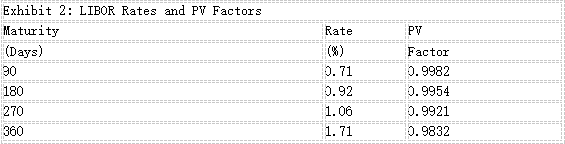 One year ago, RCLA entered into the four-year pay floating LIBOR receiving fixed-interest rate swap with annual resets, 30/360 day count, and a notional amount of $50,000,000. The fixed rate on the swap one year ago was 1.89%. Talbot wants to know the value of the swap today given the present value factors given in Exhibit 3.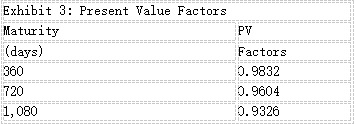
Talbot asks Gupta to assess potential mispricing in equity futures markets with a goal of implementing an investment strategy to take advantage of any mispricing that may exist. Specifically, she asks him to evaluate a futures contract on the S&P 400 Mid-Cap stock index expiring in 145 days. The annual risk-free rate is 1.2% and the index price level is 1,935 today. The accumulated value of dividends reinvested over the life of the futures contract is $3.15 per contract.
One month (30 days) ago, RLCA entered into a long forward contract on the S&P 500 stock index expiring in 60 days. Talbot has asked Zhong to calculate the value of the forward position today — that is, 30 days after the contract was initiated. Zhong has collected the information in Exhibit 1 to carry out the valuation assignment.
A client of RCLA currently has a $250,000,000 one-year loan that carries a 5.15% fixed interest rate. Talbot feels the current interest rate on the loan is high relative to current market rates and that rates will decline further. She recommends that RCLA’s client enter into a one-year pay floating LIBOR receiving fixed-interest rate swap with quarterly payments (30/360 day count convention). The notional amount of the swap is $250,000,000. The current LIBOR term structure and the corresponding present value factors are provided in Exhibit 2.One year ago, RCLA entered into the four-year pay floating LIBOR receiving fixed-interest rate swap with annual resets, 30/360 day count, and a notional amount of $50,000,000. The fixed rate on the swap one year ago was 1.89%. Talbot wants to know the value of the swap today given the present value factors given in Exhibit 3.
77
Assuming a 360-day year, the S&P 400 Mid-Cap stock index futures price is closest to?
- A.1,932.
- B.1,941.
- C.1,947.
78
Based on the information in Exhibit 1 and assuming a 360-day year, the value of S&P 500 forward contract today is closest to:
- A.49.64.
- B.50.19.
- C.51.81.
79
Based on Exhibit 2, the annualized fixed rate of the interest rate swap is closest to:
- A.1.10%.
- B.0.80%.
- C.1.68%.
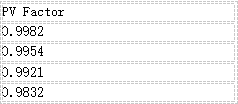
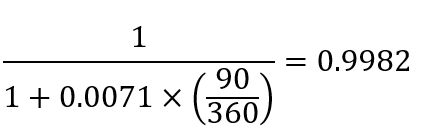 Other present value factors are calculated in a similar manner.
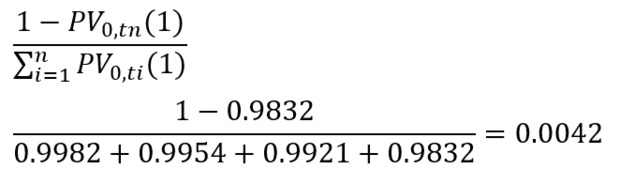 The annualized rate = 0.0042 × 4 = 0.0168
80
The market value of the pay fixed receive floating interest rate swap is closest to:
- A.$221,220.
- B.$79,271.
- C.$647,145.
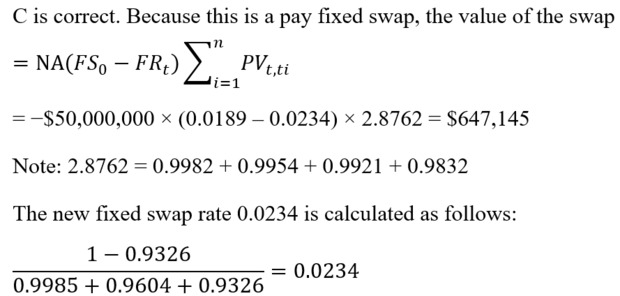
Maneck Capital Management is an institutional investment adviser specializing in thinly traded equities of larger emerging market countries. Portfolio manager Gustav Soehnges is acquainting junior portfolio manager Tuhin Joshi with Maneck’s trading practices.
Soehnges explains, “The emerging markets where we invest generally have less liquidity than developed markets. We pay close attention to limiting sources of investment performance slippage of which trading costs can be a significant part.”
Soehnges outlines the following three practices that help manage transaction costs when buying and selling shares:
Practice I :Commissions are variable by broker and market, but we endeavor to control trading costs by limiting commissions to 10 basis points of the transaction.
Practice II :We do not employ our own traders. A team within our compliance department monitors and approves brokers who may be utilized. Portfolio managers submit their orders directly to one of the approved brokers.
Practice III :Brokers’ trade executions are continuously evaluated by calculating the difference between each trade price and the prevailing midquote price, as well as by the difference between each trade price and the average price received by other traders at the time we are trading.
Soehnges also states: “We seek to have a simple process to evaluate trade costs even though I realize some costs are not captured. For example, we do not measure delay and opportunity costs nor are we able to include all explicit and implicit costs.”
Joshi scrutinizes that morning’s purchase of Easttech S.A. and comments: “We purchased a total of 20,000 shares of Easttech S.A. in three separate trades over a time interval of 10 minutes at Zl23.80, Zl23.95, and Zl24.35, with an average price of Zl24.175. The volume-weighted average price (VWAP) transaction cost estimate is greater than the effective spread cost estimate, but I think its use is problematic for evaluation because our trades include such a large percentage of all trades within the time interval being measured.”
All trades during the 10-minute interval are shown in Exhibit 1.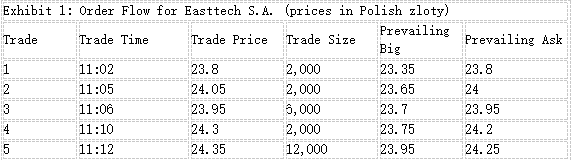
Soehnges explains, “The emerging markets where we invest generally have less liquidity than developed markets. We pay close attention to limiting sources of investment performance slippage of which trading costs can be a significant part.”
Soehnges outlines the following three practices that help manage transaction costs when buying and selling shares:
Practice I :Commissions are variable by broker and market, but we endeavor to control trading costs by limiting commissions to 10 basis points of the transaction.
Practice II :We do not employ our own traders. A team within our compliance department monitors and approves brokers who may be utilized. Portfolio managers submit their orders directly to one of the approved brokers.
Practice III :Brokers’ trade executions are continuously evaluated by calculating the difference between each trade price and the prevailing midquote price, as well as by the difference between each trade price and the average price received by other traders at the time we are trading.
Soehnges also states: “We seek to have a simple process to evaluate trade costs even though I realize some costs are not captured. For example, we do not measure delay and opportunity costs nor are we able to include all explicit and implicit costs.”
Joshi scrutinizes that morning’s purchase of Easttech S.A. and comments: “We purchased a total of 20,000 shares of Easttech S.A. in three separate trades over a time interval of 10 minutes at Zl23.80, Zl23.95, and Zl24.35, with an average price of Zl24.175. The volume-weighted average price (VWAP) transaction cost estimate is greater than the effective spread cost estimate, but I think its use is problematic for evaluation because our trades include such a large percentage of all trades within the time interval being measured.”
All trades during the 10-minute interval are shown in Exhibit 1.
81
Which of Soehnges’s three procedures for managing transaction costs is least likely referring to an explicit component of execution costs?
- A.Practice I
- B.Practice II
- C.Practice III
82
Soehnges’s process for evaluating trade costs least likely addresses:
- A.effective spreads.
- B.implementation shortfall.
- C.VWAP transactions costs
83
According to the data in Exhibit 1, the effective spread per share of Maneck’s third purchase of Easttech S.A. shares at Zl24.35 is closest to which of the following?
- A.0.25
- B.0.30
- C.0.50
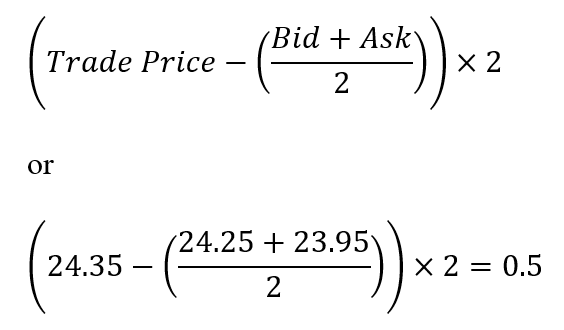
84
Is Joshi most likely correct in his commentary regarding the VWAP transaction cost estimate and effective spread cost estimate?
- A.Yes.
- B.No, he is incorrect about VWAP being problematic for evaluating this purchase.
- C.No, he is incorrect about VWAP being greater than the effective spread estimate.
Mona Simmons is an analyst at Bluestone Fixed-Income Advisors, a fixed-income investment management firm located in Chicago, IL. Bluestone manages a variety of fixed-income strategies, primarily for institutional clients. Simmons provides economic research to portfolio managers by analyzing economic data and advising how these data may influence various segments of the fixed-income markets.
Simmons is working on an assessment of the current economic conditions and the resulting impact on future real risk-free interest rates for a number of countries. She plans to present her findings at the upcoming investment committee meeting. As part of her research, she has collected the data provided in Exhibit 1 through the end of the second quarter.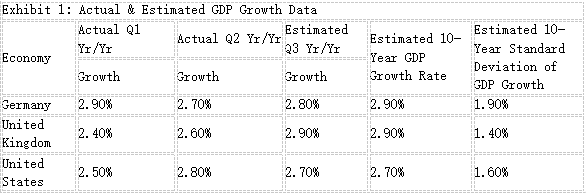 At the investment committee meeting, Simmons recommends purchasing United Kingdom inflation-linked government bonds. In her discussion, she makes the following statements about inflation-linked bonds:
Statement 1 “The break-even inflation rate incorporates the yield difference between longer dated and shorter dated inflation-linked bonds.”
Statement 2 “The difference between nominal and inflation-linked bond yields reflects the expectations of and uncertainty about the quantity of goods and services investors will be able to consume in the future.”
Statement 3 “Increases in uncertainty about future inflation are associated with lower break-even inflation rates.”
Lloyd Redfield, a portfolio manager on the foreign bond team, asks Simmons to review the current business cycle and yield curve in Australia. The Australian economy entered a recession approximately 6 months ago, and the Australian Central Bank has been reducing its policy rate. Simmons expects the Australian economy to gradually improve over the next 6–12 months and the government bond curve to change from its currently flat state to an upward sloping state. Simmons believes the future upward slope of the yield curve will be influenced by investor expectations for declining policy rates, increasing inflation premiums for longer dated bonds, and bond risk premiums that are negatively related to consumption hedging benefits.
Given the ongoing recession in Australia, Redfield is reviewing Australian corporate bonds with the same five-year maturity held in the foreign bond strategy. The three bonds being reviewed are listed in Exhibit 2. Redfield agrees with Simmons’ assessment of the Australian economy.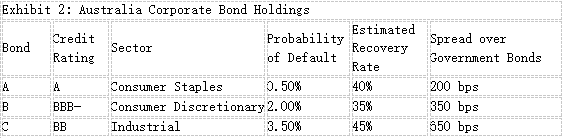 Based on this information, Redfield makes the following comments to Simmons regarding the Australian bonds:
Comment 1 You can calculate the expected loss by multiplying the probability of default by the recovery rate.
Comment 2 Relative to bond B and bond C, bond A has likely experienced the worst price return over the last 9 months.
Comment 3 Based on your economic forecasts, in 6–12 months overall credit spreads should narrow and the rate of improvement will likely be greatest for bond C.
Simmons is working on an assessment of the current economic conditions and the resulting impact on future real risk-free interest rates for a number of countries. She plans to present her findings at the upcoming investment committee meeting. As part of her research, she has collected the data provided in Exhibit 1 through the end of the second quarter.
At the investment committee meeting, Simmons recommends purchasing United Kingdom inflation-linked government bonds. In her discussion, she makes the following statements about inflation-linked bonds:Statement 1 “The break-even inflation rate incorporates the yield difference between longer dated and shorter dated inflation-linked bonds.”
Statement 2 “The difference between nominal and inflation-linked bond yields reflects the expectations of and uncertainty about the quantity of goods and services investors will be able to consume in the future.”
Statement 3 “Increases in uncertainty about future inflation are associated with lower break-even inflation rates.”
Lloyd Redfield, a portfolio manager on the foreign bond team, asks Simmons to review the current business cycle and yield curve in Australia. The Australian economy entered a recession approximately 6 months ago, and the Australian Central Bank has been reducing its policy rate. Simmons expects the Australian economy to gradually improve over the next 6–12 months and the government bond curve to change from its currently flat state to an upward sloping state. Simmons believes the future upward slope of the yield curve will be influenced by investor expectations for declining policy rates, increasing inflation premiums for longer dated bonds, and bond risk premiums that are negatively related to consumption hedging benefits.
Given the ongoing recession in Australia, Redfield is reviewing Australian corporate bonds with the same five-year maturity held in the foreign bond strategy. The three bonds being reviewed are listed in Exhibit 2. Redfield agrees with Simmons’ assessment of the Australian economy.
Based on this information, Redfield makes the following comments to Simmons regarding the Australian bonds:Comment 1 You can calculate the expected loss by multiplying the probability of default by the recovery rate.
Comment 2 Relative to bond B and bond C, bond A has likely experienced the worst price return over the last 9 months.
Comment 3 Based on your economic forecasts, in 6–12 months overall credit spreads should narrow and the rate of improvement will likely be greatest for bond C.
85
Using only the data in Exhibit 1, which country will Simmons most likely expect to have the highest average real short-term risk-free interest rates over the forecasted horizon?
- A.Germany
- B.United States
- C.United Kingdom
86
Which of Simmons’ statements concerning inflation-linked bonds is most likely correct?
- A.Statement 1
- B.Statement 2
- C.Statement 3
87
Which one of Simmons’ factors is most likely accurate with regard to investors influencing the future shape of the yield curve?
- A.Inflation premiums
- B.Bond risk premiums
- C.Policy rate expectations
88
Which of Redfield’s comments regarding the Australian corporate bonds in Exhibit 2 is most likely correct?
- A.Comment 1
- B.Comment 2
- C.Comment 3
输入阅读码
查看答案与解析需要输入阅读码