2026年教师职称《高中英语》考前点题卷二
基础知识、综合素质、高中英语
考前点题
共 33 题
1356 次浏览
更新于 2026-09-26
一、单选题
下列每小题的选项中,只有一项是最符合题意的正确答案,多选、错选或不选均不得分。
1
When training students to apply grammar items,________ is characterized by using such things as information gaps, investigations, discussions, interviews, and poster making. This method avoids rigidly adhering to conventional training on grammar forms only.
- A.the deductive method
- B.the inductive method
- C.the discovery teaching method
- D.task-based teaching method
2
Which of the following sounds is a voiced bilabial stop?
- A.[m]
- B.[v]
- C.[p]
- D.[b]
3
When a teacher wants to test students' listening skills, grammar, vocabulary and pronunciation, which of the following test format is the most suitable one?
- A. True or false questions.
- B. Completion.
- C. Dictation.
- D. Translation.
4
In addition to their simple beauty,what makes the adobe dwellings admirable is their___________to "air-condition" a house without using electric equipment.
- A.absorption
- B.ability
- C.abolition
- D.adaptation
5
In a grammar class, a teacher lists twenty "past tense" sentences and asks students to discuss and find out the grammatical structures. What is the teacher's grammar teaching method?
- A.Induction.
- B.Presentation.
- C.Consolidation.
- D.Deduction.
6
In the following activities,which one needs most control?
- A.Retelling.
- B.Finding difference.
- C.Role play.
- D.Debate.
7
This is also a good way of diagnosing problems with the students' writing. The teacher can collect up all the pieces of paper at the end and look through them for ________ to focus on next lesson.
- A.personnel mistakes
- B.common mistakes
- C.private mistakes
- D.a slip of the pen
8
A student has something in his mind and he should ignore the irrelevant parts and read to locate specific information when reading. Which of the following strategies can be used?
- A. Skimming.
- B. Detailed reading.
- C. Scanning.
- D. Predicting.
9
What role does the teacher play at the feedback stage?
- A.Assessor.
- B.Promoter.
- C.Controller.
- D.Resource-provider.
10
According to students' capacity, The National English Curriculum, Standards divide English curriculum objectives into ________ grades by the international general classification method.
- A.seven
- B.eight
- C.nine
- D.ten
11
A teacher lists twenty "simple present tense" sentences and asks students to discuss and find out the grammatical structures.What's the teacher's grammar teaching method?
- A.Induction.
- B.Conduction.
- C.Construction.
- D.Deduction.
12
A well-written composition ______ good choice of words and clear organization among other things.
- A. calls for
- B.calls on
- C.calls up
- D.calls off
13
In which stage of the Presentation-Practice-Production approach will students have the chance to use the new language freely and incorporate it into their existing language?
- A.Presentation stage.
- B.Practice stage.
- C.Production stage.
- D.Practice stage and Production stage.
14
Don't forget the day ______ you were received into the Youth League.
- A.when
- B.that
- C.at which
- D.where
15
What purpose do post-listening activities NOT serve?
- A.Helping students relate the text with their personal experience.
- B.Offering students the opportunities of extending other language skills.
- C.Practicing students' ability to match the pre-listing predictions with contents ofthe text.
- D.Enabling students to have a discussion about the topic.
16
Which of the following is NOT among the features of process-oriented writing?
- A.Helping students understand their own composing process.
- B.Helping students discover what they want to say as they write.
- C.Encouraging feedback from both teacher and peers.
- D.Emphasizing the form rather than the content.
17
The Situational Approach is a grammar-based language teaching method which focuses on________.
- A.grammar and vocabularies
- B.oral language and sentence pattems
- C.speaking and listening
- D.pronunciation and speaking
18
There is no doubt__________,in my opinion, __________matters is not the speed.but the quality of the product.
- A.what; what
- B.that; that
- C.that; if
- D.that; what
19
Cooperative learning emphasizes on ______ and collective responsibility.
- A. teachers' responsibility
- B. individual responsibility
- C. solely responsibility
- D. team responsibility
20
The goal of English courses in basic education stage is based on the development of students'________,learning strategy and culture awareness, and to cultivate students' comprehensive ability of using language.
- A.language skill
- B.language knowledge
- C.emotional attitude
- D.above all
二、简答题
主观题不参与评分,请参考答案自行评分。
21
在语法教学中,语法练习的形式有哪几种(12分)? 请对任意两种练习形式进行举例说明(8分)。
三、教学设计题
主观题不参与评分,请参考答案自行评分。
22
设计任务:请阅读下面学生信息和语言素材, 设计一节英语阅读课的教学方案。
教案没有固定格式,但须包含下列要点:
●teaching objectives
●teaching contents
●key and difficult points
●major steps and time allocation
●activities and justifications
教学时间:45分钟
学生概况: 某城镇普通中学高中一年级学生,班级人数40人, 多数学生已经达到《普通高中英语课程标准(实验)》五级水平,学生课堂参与积极性一般。
语言素材: Franklin′s Famous Kite Experiment In the eighteenth century, Benjamin Franklin conducted a number of experiments in which he showed what electricity is.Here is how he described one of his experiments. In June1752, I wanted to show that lightning and electricity are the same.Having realized that I could use a kite to attract lightning,I decided to do an experiment.I built a strong kite and waited for bad weather.When the first thunderstorm came, I took my condenser to a shed in the fields where I could do my experiment.My son helped me fly the kite. The kite flew high in the rainy sky, but nothing happened.I was beginning to think that the experiment would not work.Just then, I saw some of the hairs on the string stand up.The string was getting charged!I brought my finger close to the key and felt a light but very clear electric shock.Others followed even before the whole string was wet, and l was able to collect and store a great deal of electricity in the condenser.This experiment proves that lightning and electricity are the same. To do the experiment you need four things, a kite,a key, some really bad weather and a condenser, to store electricity.Most kites are made of paper, but a kite made of silk will not tear so soon in weather with rain and strong winds.Build the flame of the kite by making a small cross of two pieces of light wood.The pieces should be just long enough to reach the corners of the handkerchief.Tie the corners of the handkerchief to the points of the cross, and you will have a nice strong kite.Add a tail to the frame and tie a long string to the cross so you can control the kite. The next three steps are very important.First, fix a very sharp piece of metal, pointing afoot or more above the frame to the top of the longer stick of the cross.Second, fasten a key to the end of the long string.Third, tie a silk ribbon to the string, just above the key.This ribbon, which must not get wet, will protect you from the electricity. Fly the kite when a thunderstorm appears to be coming on.Stand inside a door, or under some cover, so that the silk ribbon does not get wet.Take care that the string does not touch the wall or the door.When a thundercloud comes over the kite, the sharp piece of metal will pull the electricity from the cloud.The kite and the string will become charged.When the kite and the string are wet from the rain, they will conduct the electricity very well.You can collect and store the electricity in the condenser and use it for other experiments.
教案没有固定格式,但须包含下列要点:
●teaching objectives
●teaching contents
●key and difficult points
●major steps and time allocation
●activities and justifications
教学时间:45分钟
学生概况: 某城镇普通中学高中一年级学生,班级人数40人, 多数学生已经达到《普通高中英语课程标准(实验)》五级水平,学生课堂参与积极性一般。
语言素材: Franklin′s Famous Kite Experiment In the eighteenth century, Benjamin Franklin conducted a number of experiments in which he showed what electricity is.Here is how he described one of his experiments. In June1752, I wanted to show that lightning and electricity are the same.Having realized that I could use a kite to attract lightning,I decided to do an experiment.I built a strong kite and waited for bad weather.When the first thunderstorm came, I took my condenser to a shed in the fields where I could do my experiment.My son helped me fly the kite. The kite flew high in the rainy sky, but nothing happened.I was beginning to think that the experiment would not work.Just then, I saw some of the hairs on the string stand up.The string was getting charged!I brought my finger close to the key and felt a light but very clear electric shock.Others followed even before the whole string was wet, and l was able to collect and store a great deal of electricity in the condenser.This experiment proves that lightning and electricity are the same. To do the experiment you need four things, a kite,a key, some really bad weather and a condenser, to store electricity.Most kites are made of paper, but a kite made of silk will not tear so soon in weather with rain and strong winds.Build the flame of the kite by making a small cross of two pieces of light wood.The pieces should be just long enough to reach the corners of the handkerchief.Tie the corners of the handkerchief to the points of the cross, and you will have a nice strong kite.Add a tail to the frame and tie a long string to the cross so you can control the kite. The next three steps are very important.First, fix a very sharp piece of metal, pointing afoot or more above the frame to the top of the longer stick of the cross.Second, fasten a key to the end of the long string.Third, tie a silk ribbon to the string, just above the key.This ribbon, which must not get wet, will protect you from the electricity. Fly the kite when a thunderstorm appears to be coming on.Stand inside a door, or under some cover, so that the silk ribbon does not get wet.Take care that the string does not touch the wall or the door.When a thundercloud comes over the kite, the sharp piece of metal will pull the electricity from the cloud.The kite and the string will become charged.When the kite and the string are wet from the rain, they will conduct the electricity very well.You can collect and store the electricity in the condenser and use it for other experiments.
四、阅读材料题
主观题不参与评分,请参考答案自行评分。
Americans don't like to lose wars.Of course,a lot depends on how you define just what a war is.There are shooting wars-the kind that test patriotism and courage-and those are the kind at which the U.S.excels.But other struggles test those qualities too.What else was the Great Depression or the space race or the construction of the railroads? IfAmerican indulge in a bit of fiag-when the job is done,they eamed it.
Now there is a similar challenge-global warming.The steady deterioration of the very climate of this very planet is becoming a war of the first order,and by any measure,the U.S.is losing. Indeed.if America is fighting at all,it's fighting on the wrong side.The U.S.produces nearly a quarter of the world's greenhouse gases each year and has stubbornly made it clear that it doesn't intend to do a whole lot about it.Although 174 nations approved the adnuttedly flawed Kyoto accords to reduce carbon levels,the U.S.walked away from them.There are vague promises of manufacturing fuel from herbs or powering cars with hydrogen.But for a country that tightly cites patriotism as one of its core values,the U.S.is taking a pass on what might be the most patriotic struggle of all.It's hard to imagine a bigger fight than one for the survival of a country's coasts and farms,the health ofits people and stability ofits economy.
The rub is,if the vast majority of people increasingly agree that climate change is a global emergency,there's far less agreement on how to fix it.Industry offers its plans,which too often would fix little.Environmentalists offer theirs,which too often amount to native wish lists that could weaken America's growth.But let's assume that those interested parties and others will always bent the table and will always demand that their voices be heard and that their needs be addressed.What would an aggressive,ambitious,effective plan look like-one that would leave the U.S.both environmentally safe and economically sound?
Halting climate change will be far harder.One of the more conservative plans for addressing the problem calls for a reduction of 25 billion tons of carbon emissions over the next 52 years.And yet by devising a consistent strategy that mixes short-time profit with long-range objective and blends pragmatism with ambition,the U.S.can,without major damage to the economy,help halt the worst effects of climate change and ensure the survival ofits way oflife for future generations, Money will do some of the work,but what's needed most is will."I'm not saying the challenge isn't almost overwhelming," says Fred Krupp."But this is AmericA.and America has risen to these challenges before."
Now there is a similar challenge-global warming.The steady deterioration of the very climate of this very planet is becoming a war of the first order,and by any measure,the U.S.is losing. Indeed.if America is fighting at all,it's fighting on the wrong side.The U.S.produces nearly a quarter of the world's greenhouse gases each year and has stubbornly made it clear that it doesn't intend to do a whole lot about it.Although 174 nations approved the adnuttedly flawed Kyoto accords to reduce carbon levels,the U.S.walked away from them.There are vague promises of manufacturing fuel from herbs or powering cars with hydrogen.But for a country that tightly cites patriotism as one of its core values,the U.S.is taking a pass on what might be the most patriotic struggle of all.It's hard to imagine a bigger fight than one for the survival of a country's coasts and farms,the health ofits people and stability ofits economy.
The rub is,if the vast majority of people increasingly agree that climate change is a global emergency,there's far less agreement on how to fix it.Industry offers its plans,which too often would fix little.Environmentalists offer theirs,which too often amount to native wish lists that could weaken America's growth.But let's assume that those interested parties and others will always bent the table and will always demand that their voices be heard and that their needs be addressed.What would an aggressive,ambitious,effective plan look like-one that would leave the U.S.both environmentally safe and economically sound?
Halting climate change will be far harder.One of the more conservative plans for addressing the problem calls for a reduction of 25 billion tons of carbon emissions over the next 52 years.And yet by devising a consistent strategy that mixes short-time profit with long-range objective and blends pragmatism with ambition,the U.S.can,without major damage to the economy,help halt the worst effects of climate change and ensure the survival ofits way oflife for future generations, Money will do some of the work,but what's needed most is will."I'm not saying the challenge isn't almost overwhelming," says Fred Krupp."But this is AmericA.and America has risen to these challenges before."
23
What does the passage mainly discuss?
- A.Human wars.
- B.Economic crisis.
- C.America's environmental policies.
- D.Global environment in general.
24
From the last sentence of Paragraph 2.we may learn that the survival of a country's coasts and farms,the health ofits people an.d the stability ofits economy is_________.
- A.ofutmost importance
- B.a fight no one can win
- C.beyond people's imagination
- D.a less significant issue
25
Judging from the context,the word "rub" (Para.3) probably means_________.
- A.friction
- B.contradiction
- C.conflict
- D.problem
26
What is the author's attitude towards America's policies on global warming?
- A.Critical.
- B.Indifferent.
- C.Supportive.
- D.Compromising.
27
The paragraphs immediately following this passage would most probably deal with_________.
- A.the new book written by Fred Krupp
- B.how America can fight against global warming
- C.the harmful effects of global warming
- D.how America can tide over economic crisis
Can electricity cause cancer? In a society that literally runs on electric power,the very idea seems preposterous.But for more than a decade,a growing band of scientists and journalists has pointed to studies that seem to link exposure to electromagnetic fields with increased risk of leukemia and other malignancies.The implications are unsettling,to say the least,since everyone comes into contact with such fields,which are generated by everything electrical,from power lines and antennas to personal computers and micro-wave ovens.Because evidence on the subject is inconclusive and often contradictory,it has been hard to decide whether concern about the health effects of electricity is legitimate-or the worst kind ofparanoia.
Now the alarmists have gained some qualified support from the U.S.Environmental Protection Agency.In the executive summary'of a new scientific review,released in draft form late last week,the EPA has put forward what amounts to the most serious government warning to date.The agency tentatively concludes that scientific evidence "suggests a casual link" between extremely low-frequency electromagnetic fields-those having very longwave-lengths-and leukemiA.lymphoma and brain cancer,While the report falls short of classifying ELF fields as probable carcinogens,it does identify the common 60-hertz magnetic field as "a possible,but not proven,cause of cancer in humans."
The report is no reason to panic-or even to lost sleep.If there is a cancer risk,it is a small one.The evidence is still so controversial that the draft stirred a great deal of debate within the administration,and the EPA released it over strong objections from the Pentagon and the White House.But now no one can deny that the issue must be taken seriously and that much more research is needed.
At the heart of the debate is a simple and well-understood physical phenomenon: When an electric current passes through a wire,it generates an electromagnetic field that exerts forces on surrounding objects.For many years,scientists dismissed any suggestion that such forces might be harmful,primarily because they are so extraordinarily weak.The ELF magnetic field generated by a video terminal measures only a few milligauss,or about one-hundredth the strength of the earth's own magnetic field.the electric fields surrounding a power line can be as high as 10 kilovolts per meter,but the corresponding field induced in human cells will be only about l millivolt per meter.This is far less than the electric fields that the cells themselves generate.
How could such minuscule forces pose a health danger? The consensus used to be that they could not,and for decades,scientists concentrated on more powerful kinds of radiation,like X-rays,that pack sufficient wallop to knock electrons out of the molecules that make up the human body.Such "ionizing" radiations have been clearly linked to increased cancer risks and there are regulations to control emissions.
But epidemiological studies,which find statistical associations between sets of datA.do not prove cause and effect.Though there is a body of laboratory work showing that exposure to ELF fields can have biological effects on animal tissues,a mechanism by which those effects could lead to cancerous growths has never been found.
The Pentagon is far from persuaded.In a blistering 33-page critique of the EPA report,Air Force scientists charge its authors with having "biased the entire document" toward proving a link.
"Our reviewers are convinced that there is no suggestion that (electromagnetic fields) present in the environment induce or promote cancer," the Air Force concludes."It is astonishing that the EPA would lend its imprimatur on this report." Then Pentagon's concem is understandable.There is hardly a unit of the modern military that does not depend on the heavy use of some kind of electronic equipment,from huge ground-based radar towers to the defense systems built into every warship and plane.
Now the alarmists have gained some qualified support from the U.S.Environmental Protection Agency.In the executive summary'of a new scientific review,released in draft form late last week,the EPA has put forward what amounts to the most serious government warning to date.The agency tentatively concludes that scientific evidence "suggests a casual link" between extremely low-frequency electromagnetic fields-those having very longwave-lengths-and leukemiA.lymphoma and brain cancer,While the report falls short of classifying ELF fields as probable carcinogens,it does identify the common 60-hertz magnetic field as "a possible,but not proven,cause of cancer in humans."
The report is no reason to panic-or even to lost sleep.If there is a cancer risk,it is a small one.The evidence is still so controversial that the draft stirred a great deal of debate within the administration,and the EPA released it over strong objections from the Pentagon and the White House.But now no one can deny that the issue must be taken seriously and that much more research is needed.
At the heart of the debate is a simple and well-understood physical phenomenon: When an electric current passes through a wire,it generates an electromagnetic field that exerts forces on surrounding objects.For many years,scientists dismissed any suggestion that such forces might be harmful,primarily because they are so extraordinarily weak.The ELF magnetic field generated by a video terminal measures only a few milligauss,or about one-hundredth the strength of the earth's own magnetic field.the electric fields surrounding a power line can be as high as 10 kilovolts per meter,but the corresponding field induced in human cells will be only about l millivolt per meter.This is far less than the electric fields that the cells themselves generate.
How could such minuscule forces pose a health danger? The consensus used to be that they could not,and for decades,scientists concentrated on more powerful kinds of radiation,like X-rays,that pack sufficient wallop to knock electrons out of the molecules that make up the human body.Such "ionizing" radiations have been clearly linked to increased cancer risks and there are regulations to control emissions.
But epidemiological studies,which find statistical associations between sets of datA.do not prove cause and effect.Though there is a body of laboratory work showing that exposure to ELF fields can have biological effects on animal tissues,a mechanism by which those effects could lead to cancerous growths has never been found.
The Pentagon is far from persuaded.In a blistering 33-page critique of the EPA report,Air Force scientists charge its authors with having "biased the entire document" toward proving a link.
"Our reviewers are convinced that there is no suggestion that (electromagnetic fields) present in the environment induce or promote cancer," the Air Force concludes."It is astonishing that the EPA would lend its imprimatur on this report." Then Pentagon's concem is understandable.There is hardly a unit of the modern military that does not depend on the heavy use of some kind of electronic equipment,from huge ground-based radar towers to the defense systems built into every warship and plane.
28
The main idea of this passage is_______.
- A.studies on the cause ofcancer
- B.controversial view-points in the cause of cancer
- C.the relationship between electricity and cancer
- D.different ideas about the effect of electricity on cancer
29
The view-point of the EPA is___________.
- A.there is casual link between electricity and cancer
- B.electricity really affects cancer
- C.controversial
- D.low frequency electromagnetic field is a possible cause of cancer
30
Why did the Pentagon and White House object to the release of the report?
- A.It may stir a great deal of debate among the administration.
- B.Every unit of the modern military has depended on the heavy use of some kind of electronic equipment.
- C.The Pentagon's concern was understandable.
- D.They had different arguments.
31
It can be inferred from the physical phenomenon that__________.
- A.the force of the electromagnetic field is too weak to be harmful
- B.the force of the electromagnetic field is weaker than the electric field that the cells generate
- C.electromagnetic field may affect health
- D.only more powerful radiation can knock electron out ofhuman body
32
What do you think ordinary citizens may do after reading the different arguments?
- A.They are indifferent.
- B.They are worried very much.
- C.They may exercise prudent avoidance.
- D.They are shocked.
五、教学情境分析题
主观题不参与评分,请参考答案自行评分。
33
某高中英语老师在完成一篇阅读文章的教学后,给学生布置如下作业:
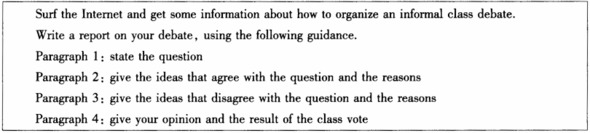
回答以下问题: (1)布置作业有什么意义? (2)此作业锻炼学生哪方面的能力? (3)布置作业的注意事项有哪些?
回答以下问题: (1)布置作业有什么意义? (2)此作业锻炼学生哪方面的能力? (3)布置作业的注意事项有哪些?
输入阅读码
查看答案与解析需要输入阅读码