2021年全国英语竞赛《A类研究生》初赛试题及答案
A类研究生
历年真题
共 59 题
2274 次浏览
更新于 2026-09-26
二、Part Ⅱ Vocabulary
15 marks
1
There are 15 incomplete sentences in this part. For each blank there are four choices marked A, B, C, and D. Choose the one that best completes the sentence. Then mark the corresponding letter on the answer sheet with a single line through the centre.
By today’s standards, early farmers were _____ because they planted the same crops repeatedly, exhausting the soil after a few harvests.
By today’s standards, early farmers were _____ because they planted the same crops repeatedly, exhausting the soil after a few harvests.
- A.stubborn
- B.tiresome
- C.ridiculous
- D.imprudent
2
After working at the company for a year, Mr Jones received a _____ from assistant manager to manager.
- A.promotion
- B.profile
- C.promise
- D.progress
3
—I hear that movie is pretty exciting.
—It was _____ exciting. I’ve never seen a better movie.
—It was _____ exciting. I’ve never seen a better movie.
- A.not at all
- B.more than
- C.far from
- D.anything but
4
Kent assured his boss that he would _____ all his energies in doing his new job.
- A.call on
- B.call at
- C.call off
- D.call forth
5
It isn’t cold enough for there _____ a frost tonight, so I can leave Jim’s car out quite safely.
- A.was
- B.being
- C.to be
- D.would be
6
Our corporate headquarters sit on a hill, high up _____ the manufacturing plant.
- A.beyond
- B.above
- C.from
- D.across
7
No one on the team will be able to go home _____ this work is finished.
- A.if
- B.even
- C.whereas
- D.until
8
If we had worked through the night, we _____ have finished the report on time.
- A.will
- B.must
- C.might
- D.can
9
American deserts are sometimes quite green. _____, they cannot support crops.
- A.Nevertheless
- B.Therefore
- C.Naturally
- D.Moreover
10
Smart-phones have many advantages. They keep us _____ about the _____ news, and also provide entertainment.
- A.informed; latest
- B.to know; later
- C.learning; latter
- D.to think; late
11
The palace is heavily guarded, because inside the walls _____.
- A.where sit the European leaders
- B.sit the European leaders
- C.the European leaders there sit
- D.that the European leaders sit
12
Given these conditions, there will not be _____ room left in one’s brain for _____ rational thought.
- A.a; the
- B./; a
- C./; /
- D.the; /
13
—His plane is due to arrive at 4:30. I think we should go pick him up at the airport.
—Good idea. But we’ll need to leave at 3 if we’re going to be on time. _____
—You’re right. And I don’t think we should take a taxi. The subway’s much faster.
—Good idea. But we’ll need to leave at 3 if we’re going to be on time. _____
—You’re right. And I don’t think we should take a taxi. The subway’s much faster.
- A.It’s a bit far to get there.
- B.I’ll meet you at your office.
- C.We can walk to the station together.
- D.That sounds like a good plan.
14
—Mr Lee called. He’d like to set up an appointment with you at 11:00 tomorrow morning to go over the marketing plan.
—Can’t do it. I’ll be at a meeting with the accountants then. _____
—I’ll call and find out. What time would be best for you?
—Can’t do it. I’ll be at a meeting with the accountants then. _____
—I’ll call and find out. What time would be best for you?
- A.Can you give me time to get some lunch?
- B.Do you think he can do it later in the day?
- C.Does he want to know what the plan is about?
- D.Does he know when our meeting will be over?
15
—What terrible weather. Have you ever seen such thick fog? I’ve heard it’s caused a lot of problems on the highway.
—I know. As a matter of fact, Jack called and said he’ll be at least an hour late because the traffic is so heavy.
—_____ I did, and I wasn’t delayed even one minute.
—I know. As a matter of fact, Jack called and said he’ll be at least an hour late because the traffic is so heavy.
—_____ I did, and I wasn’t delayed even one minute.
- A.I hope it clears up soon.
- B.I have to go to a meeting.
- C.He should have taken the train.
- D.He has to make preparation for it.
三、Part Ⅲ Cloze
10 marks
Read the following passage and fill in each blank with one word. Choose the correct word in one of the following three ways: according to the context, by using the correct form of the given word, or by using the given letter(s) of the word. Remember to write the answers on the answer sheet.
After being abroad for decades, 68 Chinese cultural relics that had been taken to the United Kingdom recently were returned to their homeland thanks to joint efforts of the two countries, the National Cultural Heritage Administration said at a news (46) con_____ on Wednesday.
Some of the relics span millennia, (47)_____ (date) from the Spring and Autumn Period (770—476, BC) to the Qing Dynasty (1644—1911), and they encompass a variety of items, mainly ceramics. They are from a variety of provinces, including Jiangxi, Anhui, Fujian, Henan, Shaanxi, Hebei and Guizhou.
Their return brings an end to a quarter-century of efforts for repatriation, said Guan Qiang, deputy director of the administration.
In February 1995, the Metropolitan Police Service in London informed the Chinese embassy in the UK that an investigation into the sale of stolen property involved a group of cultural relics that were believed to be from China. That was confirmed by the administration in Beijing, (48) _____ said that they were smuggled out of China.
British police (49) sei_____ all the items in an operation that March. Soon, the State Council, China’s Cabinet, set up a special cross-departmental working group to bring them home.
In 1998, over 3,000 relics were returned to China after cooperation by law enforcement units, a lawsuit and negotiations. It was the largest single repatriation of lost cultural relics in the history of New China.
However, a local buyer of dozens of remaining relics refused to take part in negotiations, and the civil dispute dragged on after hitting a deadlock. The 68 relics remained impounded by British police.
“But we never stopped working on the case and stayed in close contact (50)_____ the embassy and the British side to follow up on their latest information,” Guan said.
A break finally appeared. In January, the Metropolitan Police informed the Chinese embassy that the deadline for prosecution in the case had passed, but the whereabouts of the buyer were unknown. The police showed a (51) _____ (will) to return the items to China after seeking legal advice.
The process of getting the artifacts home immediately was restarted. In spite of delays created by the COVID-19 (52) pan_____, Yu Peng, a minister counsellor from the embassy, led a team to check the inventory in July. A quarter century earlier, Yu had been the person responsible for first contacting the British police in the case.
The Metropolitan Police Service handed the artifacts to the Chinese embassy in October. The Chinese ambassador to the UK, also held an online handover ceremony just before the relics’ (53) dep_____. Joining the embassy in presenting the event were officials of the British Department for Digital, Culture, Media and Sport.
The relics were transported in tailor-made cases and landed intact in Beijing on Oct 20, but the process had remained (54) con_____ until Wednesday.
“The consistent action showed our determination to solve crimes and bring back lost or stolen cultural relics from overseas,” Guan said.
An expert panel was organized to examine and appraise the relics as soon as they arrived in Beijing, according to Deng Chao, director of the cultural relic repatriation office of the National Cultural Heritage Administration.
“Generally, they are very well preserved and in good shape,” Deng said. “Many of them are of very great value for (55) _____ (history) and scientific studies.”
He said 13 artifacts have been labeled as national precious cultural relics of the second-highest grade, and 30 are categorized as being of the third-highest grade.
After being abroad for decades, 68 Chinese cultural relics that had been taken to the United Kingdom recently were returned to their homeland thanks to joint efforts of the two countries, the National Cultural Heritage Administration said at a news (46) con_____ on Wednesday.
Some of the relics span millennia, (47)_____ (date) from the Spring and Autumn Period (770—476, BC) to the Qing Dynasty (1644—1911), and they encompass a variety of items, mainly ceramics. They are from a variety of provinces, including Jiangxi, Anhui, Fujian, Henan, Shaanxi, Hebei and Guizhou.
Their return brings an end to a quarter-century of efforts for repatriation, said Guan Qiang, deputy director of the administration.
In February 1995, the Metropolitan Police Service in London informed the Chinese embassy in the UK that an investigation into the sale of stolen property involved a group of cultural relics that were believed to be from China. That was confirmed by the administration in Beijing, (48) _____ said that they were smuggled out of China.
British police (49) sei_____ all the items in an operation that March. Soon, the State Council, China’s Cabinet, set up a special cross-departmental working group to bring them home.
In 1998, over 3,000 relics were returned to China after cooperation by law enforcement units, a lawsuit and negotiations. It was the largest single repatriation of lost cultural relics in the history of New China.
However, a local buyer of dozens of remaining relics refused to take part in negotiations, and the civil dispute dragged on after hitting a deadlock. The 68 relics remained impounded by British police.
“But we never stopped working on the case and stayed in close contact (50)_____ the embassy and the British side to follow up on their latest information,” Guan said.
A break finally appeared. In January, the Metropolitan Police informed the Chinese embassy that the deadline for prosecution in the case had passed, but the whereabouts of the buyer were unknown. The police showed a (51) _____ (will) to return the items to China after seeking legal advice.
The process of getting the artifacts home immediately was restarted. In spite of delays created by the COVID-19 (52) pan_____, Yu Peng, a minister counsellor from the embassy, led a team to check the inventory in July. A quarter century earlier, Yu had been the person responsible for first contacting the British police in the case.
The Metropolitan Police Service handed the artifacts to the Chinese embassy in October. The Chinese ambassador to the UK, also held an online handover ceremony just before the relics’ (53) dep_____. Joining the embassy in presenting the event were officials of the British Department for Digital, Culture, Media and Sport.
The relics were transported in tailor-made cases and landed intact in Beijing on Oct 20, but the process had remained (54) con_____ until Wednesday.
“The consistent action showed our determination to solve crimes and bring back lost or stolen cultural relics from overseas,” Guan said.
An expert panel was organized to examine and appraise the relics as soon as they arrived in Beijing, according to Deng Chao, director of the cultural relic repatriation office of the National Cultural Heritage Administration.
“Generally, they are very well preserved and in good shape,” Deng said. “Many of them are of very great value for (55) _____ (history) and scientific studies.”
He said 13 artifacts have been labeled as national precious cultural relics of the second-highest grade, and 30 are categorized as being of the third-highest grade.
16
( )
17
( )
18
( )
19
( )
20
( )
21
( )
22
( )
23
( )
24
( )
25
( )
四、Part Ⅳ RC
30 marks(Reading Comprehension)
There are three passages in this part. Each passage is followed by several questions. Respond to the questions using information from the passage. Remember to write the answers on the answer sheet.
Section A (10 marks)
Questions 56 to 60 are based on the following passage.
In 2013, Harris Academy—a school in south London—banned its students from using slang. Posters around the school showed a list of slang words that students weren’t allowed to use, such as ain’t and like. (56) ____
The creation of slang is one way languages change. Slang, or informal language, usually changes more rapidly than standard language. For example, the word groovy, meaning “great,” used to be very popular in the 1960s and ’70s. But by 1980, people have stopped using it. Throughout history, changes in language have received much criticism. In 1789, Benjamin Franklin, one of the founding fathers of the United States, wrote about his objections to words such as notice and progress being used as verbs.
Why do we use slang?
(57) ____ When only a particular group of people use and understand certain words and phrases, it strengthens their sense of identity within that group. Each different group—teenagers, the media, and so on—has its own set of slang. Another reason for using slang is to communicate an idea in a more colourful or humorous way. For example, the phrase jump ship creates a stronger image than the more standard leave an organization. In addition, slang often allows us to express complex ideas effectively. The word frenemy (someone who pretends to be a friend, but is really an enemy) conveys its meaning more quickly than standard language.
(58) ____ Often, Internet slang words are created to make messages faster and easier to type.
Some examples include btw (by the way) and YOLO (you only live once).
Is slang degrading our language?
Some people feel strongly against the use of slang. Teachers at Harris Academy were worried that slang would prevent their students from learning how to read, write, and express themselves correctly. They thought this might cause problems for students when they eventually went on to apply to universities or to look for jobs. David Lammy, a British politician, supports the school’s decision. (59) ____
However, some people think differently. Linguist Tony Thorne sees slang as a way for speakers of a language to show their creativity and humour. He argues that slang is important in social interactions, enabling us to express who we are and the communities we belong to. (60)____ As Thorne explains, “Slang has not become more prevalent, simply more public.” In today’s highly connected world, slang has become more noticeable because of better tools to observe language change.
Perhaps the concerns raised by critics can be solved by making people aware of when to use certain forms of language. As long as people use slang in the right situations, there may not be a need to completely discourage it.
Questions 56—60
Choose from the sentences A—G the one which best fits each gap of 56—60. There are two extra sentences that you do not need to use.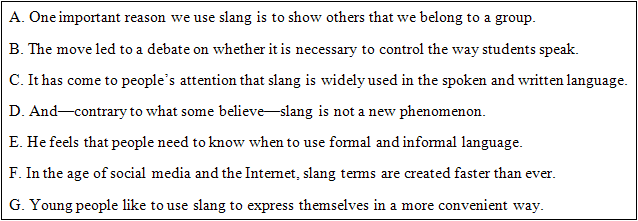
Section A (10 marks)
Questions 56 to 60 are based on the following passage.
In 2013, Harris Academy—a school in south London—banned its students from using slang. Posters around the school showed a list of slang words that students weren’t allowed to use, such as ain’t and like. (56) ____
The creation of slang is one way languages change. Slang, or informal language, usually changes more rapidly than standard language. For example, the word groovy, meaning “great,” used to be very popular in the 1960s and ’70s. But by 1980, people have stopped using it. Throughout history, changes in language have received much criticism. In 1789, Benjamin Franklin, one of the founding fathers of the United States, wrote about his objections to words such as notice and progress being used as verbs.
Why do we use slang?
(57) ____ When only a particular group of people use and understand certain words and phrases, it strengthens their sense of identity within that group. Each different group—teenagers, the media, and so on—has its own set of slang. Another reason for using slang is to communicate an idea in a more colourful or humorous way. For example, the phrase jump ship creates a stronger image than the more standard leave an organization. In addition, slang often allows us to express complex ideas effectively. The word frenemy (someone who pretends to be a friend, but is really an enemy) conveys its meaning more quickly than standard language.
(58) ____ Often, Internet slang words are created to make messages faster and easier to type.
Some examples include btw (by the way) and YOLO (you only live once).
Is slang degrading our language?
Some people feel strongly against the use of slang. Teachers at Harris Academy were worried that slang would prevent their students from learning how to read, write, and express themselves correctly. They thought this might cause problems for students when they eventually went on to apply to universities or to look for jobs. David Lammy, a British politician, supports the school’s decision. (59) ____
However, some people think differently. Linguist Tony Thorne sees slang as a way for speakers of a language to show their creativity and humour. He argues that slang is important in social interactions, enabling us to express who we are and the communities we belong to. (60)____ As Thorne explains, “Slang has not become more prevalent, simply more public.” In today’s highly connected world, slang has become more noticeable because of better tools to observe language change.
Perhaps the concerns raised by critics can be solved by making people aware of when to use certain forms of language. As long as people use slang in the right situations, there may not be a need to completely discourage it.
Questions 56—60
Choose from the sentences A—G the one which best fits each gap of 56—60. There are two extra sentences that you do not need to use.
26
( )
27
( )
28
( )
29
( )
30
( )
Section B (10 marks)
Questions 61 to 65 are based on the following passage.
Gateway to the Rain God
From deep in a well near the ruins of the Mayan city of Chichrn Itzá, archeoastronomer Arturo Montero shouts to his colleague on the surface, “I saw it, I saw it! Yes, it’s true!” Leaning over the mouth of the well, archeologist Guilermo de Anda hopes to hear what he has suspected for many months. “What is true, Arturo?” And Montero yells up again, “The zenith light! It really works! Get down here!”
The two archeologists are anxious to confirm whether this cenote could have acted as a sacred sundial and timekeeper for the ancient Maya. On two days every year—May 23 and July 19—the sun is vertically overhead and there is no shadow. On the morning of their descent, on May 24, Montero and de Anda see that the sun’s rays come very close to vertical. The day before, they realised, a beam of light would have plunged straight down into the water.
Beneath its narrow mouth, the walls of the cenote open up to become a giant dome. It looks like a cathedral, except for the roots of trees that penetrate the rock as they reach for the water. The beam of sunlight dances like fire on the surrounding stalactites, and it turns the water a beautiful transparent blue. The archeologists were probably the first people in centuries to watch the sun move slowly across the cenote’s water.
De Anda began exploring Holtun in 2010. One day, inspecting the walls of the cenote a few metres below the surface, he emerged from the water and felt something above his head. He was astonished to find a natural rock shelf holding an offering of human and animal bones, pottery, and a knife—probably used for sacrifices—all neatly placed there centuries earlier. Below the water, he saw broken columns and Mayan stone carving. The well was clearly a sacred site.
Key to Survival
Three years later, in the cornfield on the surface above the cenote, a crew of Maya farmers is working hard in the intense Yucatán heat to pull the explorers out of the well. The crew’s leader is Luis Un Ken, and optimist with an easy smile who is respected by everyone in his nearby village. “There was a good rain the other day,” he says, wiping the sweat off his face. “The Chaak moved.”
For men like Un Ken, the old gods are still very much alive, and Chaak—ruler of cenotes and caves—is among the most important. For the benefit of living things, he pours from the skies the water he keeps in jars. Thunder is the sound of Chaak breaking a jar open and letting the rain fall. The Chaak had moved, Un Ken said, and that meant the planting season would soon arrive.
Chaak’s absence can cause disasters for the Yucatán Maya, possibly the demise of the ancient Maya civilization itself. Their land is an endless limestone shelf. Rain sinks through the porous limestone down to groundwater levels, and consequently no river or stream runs through the land. From the air, one sees a green sea of dense jungle. At ground level, however, the tropical forest appears very thin. Wherever there is enough soil, the Maya plant corn or milpa, a combination of the corn, beans, and squash that constitutes their basic source of protein. But corn is a hungry crop; it sucks lots of nutrients from the soil. For thousands of years, milpa farmers have kept their small fields productive by burning a different area of trees every year and planting in the corn-friendly ashes. We call this deforestation, but to the Maya, it means survival.
As for water for the fields ... well, that’s where Chaak comes in. Only seasonal rains can make the corn grow, and they must arrive in an exact pattern: no rain in winter so that the fields and forest will be dry enough to burn by March; some rain in early May to soften up the soil for planting; then very gentle rain to allow the planted seeds to begin to grow; and finally, plenty of rain so the corn can flourish. Any break in the pattern means less food for a family. It’s easy to understand how important Chaak was—and is—to the Maya.
Questions 61 to 65
Answer the following questions with the information given in the passage.
Questions 61 to 65 are based on the following passage.
Gateway to the Rain God
From deep in a well near the ruins of the Mayan city of Chichrn Itzá, archeoastronomer Arturo Montero shouts to his colleague on the surface, “I saw it, I saw it! Yes, it’s true!” Leaning over the mouth of the well, archeologist Guilermo de Anda hopes to hear what he has suspected for many months. “What is true, Arturo?” And Montero yells up again, “The zenith light! It really works! Get down here!”
The two archeologists are anxious to confirm whether this cenote could have acted as a sacred sundial and timekeeper for the ancient Maya. On two days every year—May 23 and July 19—the sun is vertically overhead and there is no shadow. On the morning of their descent, on May 24, Montero and de Anda see that the sun’s rays come very close to vertical. The day before, they realised, a beam of light would have plunged straight down into the water.
Beneath its narrow mouth, the walls of the cenote open up to become a giant dome. It looks like a cathedral, except for the roots of trees that penetrate the rock as they reach for the water. The beam of sunlight dances like fire on the surrounding stalactites, and it turns the water a beautiful transparent blue. The archeologists were probably the first people in centuries to watch the sun move slowly across the cenote’s water.
De Anda began exploring Holtun in 2010. One day, inspecting the walls of the cenote a few metres below the surface, he emerged from the water and felt something above his head. He was astonished to find a natural rock shelf holding an offering of human and animal bones, pottery, and a knife—probably used for sacrifices—all neatly placed there centuries earlier. Below the water, he saw broken columns and Mayan stone carving. The well was clearly a sacred site.
Key to Survival
Three years later, in the cornfield on the surface above the cenote, a crew of Maya farmers is working hard in the intense Yucatán heat to pull the explorers out of the well. The crew’s leader is Luis Un Ken, and optimist with an easy smile who is respected by everyone in his nearby village. “There was a good rain the other day,” he says, wiping the sweat off his face. “The Chaak moved.”
For men like Un Ken, the old gods are still very much alive, and Chaak—ruler of cenotes and caves—is among the most important. For the benefit of living things, he pours from the skies the water he keeps in jars. Thunder is the sound of Chaak breaking a jar open and letting the rain fall. The Chaak had moved, Un Ken said, and that meant the planting season would soon arrive.
Chaak’s absence can cause disasters for the Yucatán Maya, possibly the demise of the ancient Maya civilization itself. Their land is an endless limestone shelf. Rain sinks through the porous limestone down to groundwater levels, and consequently no river or stream runs through the land. From the air, one sees a green sea of dense jungle. At ground level, however, the tropical forest appears very thin. Wherever there is enough soil, the Maya plant corn or milpa, a combination of the corn, beans, and squash that constitutes their basic source of protein. But corn is a hungry crop; it sucks lots of nutrients from the soil. For thousands of years, milpa farmers have kept their small fields productive by burning a different area of trees every year and planting in the corn-friendly ashes. We call this deforestation, but to the Maya, it means survival.
As for water for the fields ... well, that’s where Chaak comes in. Only seasonal rains can make the corn grow, and they must arrive in an exact pattern: no rain in winter so that the fields and forest will be dry enough to burn by March; some rain in early May to soften up the soil for planting; then very gentle rain to allow the planted seeds to begin to grow; and finally, plenty of rain so the corn can flourish. Any break in the pattern means less food for a family. It’s easy to understand how important Chaak was—and is—to the Maya.
Questions 61 to 65
Answer the following questions with the information given in the passage.
31
What does it refer to in I saw it, I saw it?
32
What does the author compare the cenote to in Paragraph Three?
33
What did Luis Un Ken mean when he said, “The Chaak moved”?
34
What is the most important protein provider for the Maya?
35
To get the best crops, what must happen immediately after the fields are burned?
Section C (10 marks)
Questions 66 to 70 are based on the following passage.
Last September, a partnership between the United Nations and the search engine Google was announced. As part of the United Nations Environment Programme, it was agreed that Google would enable its mapping programme, Google Earth, to track 100 environmental hotspots around the world to reveal the extent of various environmental problems including deforestation, urbanization and retreating glaciers. If you view the map, you can click on a particular hotspot and see two images for comparison—one taken in the past and a recent image. There is also detailed information about each hotspot and its problems. Google reaches millions of people and thus increases public awareness of these serious problems.
Forests are not just a collection of trees. They are in fact entire ecosystems, shelters and important storehouses for nature and man. They also house a remarkable variety of plant and animal life, and micro-organisms. Over 60 percent of all known species live in forests. They also store water and soil, and absorb carbon which helps to ease global warming as trees convert carbon dioxide in the atmosphere to oxygen. Human beings have found many uses for forests especially as a source of wood. It is easy to appreciate how important forests are.
As shown on the Google site, all over the world forests are under threat. These threats are from commercial exploitation such as for pasture, planting crops and commercial logging. Those exploiting these areas often use fire to clear the land for such purposes. This process of destroying these areas is known as deforestation. Some scientists estimate that since the beginning of the 20th century, over 50 percent of the world’s original rainforest cover has been lost due to deforestation.
Why does deforestation happen? The main reason is money. Many poorer nations such as Brazil are forced to use their forest resources as a way to get income. Many of these deforested areas are used to produce soy beans, an export worth $10 billion a year. There are other similar cases, which can be found all over the world such as in Madagascar, Thailand and Ghana.
Deforestation has many negative impacts. It not only destroys trees, which contributes to global warming, it also destroys the abundant plant and wildlife in the forests. Another impact is erosion. As trees disappear, the protection for the soil is lost, and the whole area can become eroded or even lost to desert. Even if forests can recover, they do not do so quickly. It takes a long time for the environment to recover—for new trees to grow and for new species to return.
There are a number of solutions which have been tried. One is the introduction of new high-yield hybrid farming methods, which help farmers produce more from a smaller area of land. Another is reforestation. China has been particularly active in this area. March 12th is national planting day in China, and the government claims to have planted over two billion new trees since 1982.
Many other organizations dedicate themselves to solving this problem. For example, Greenpeace is very active in this area. Also the WWFN (the World Wide Fund for Nature) has been campaigning to have governments outlaw trade in threatened and rare species since 1975. In addition, forest certification and sensible forest management can go a long way to help reduce deforestation. The Forest Stewardship Council (FSC) programme has been very successful and now boasts over 68 million hectares under its protection. Even individuals can help in the fight. The Rainforest Site offers a way to help for free. Clicking on one of its pages generates a donation from a sponsor to preserving forests.
Forests help sustain so much life and ensure the survival of the planet. Despite a slowing down of deforestation in the last few years, it still remains a major environmental problem which will take a great deal of time and effort to solve.
Questions 66 to 70
Complete the summary below with information from the passage, using one or two words for each blank.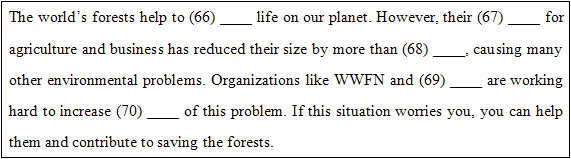
Questions 66 to 70 are based on the following passage.
Last September, a partnership between the United Nations and the search engine Google was announced. As part of the United Nations Environment Programme, it was agreed that Google would enable its mapping programme, Google Earth, to track 100 environmental hotspots around the world to reveal the extent of various environmental problems including deforestation, urbanization and retreating glaciers. If you view the map, you can click on a particular hotspot and see two images for comparison—one taken in the past and a recent image. There is also detailed information about each hotspot and its problems. Google reaches millions of people and thus increases public awareness of these serious problems.
Forests are not just a collection of trees. They are in fact entire ecosystems, shelters and important storehouses for nature and man. They also house a remarkable variety of plant and animal life, and micro-organisms. Over 60 percent of all known species live in forests. They also store water and soil, and absorb carbon which helps to ease global warming as trees convert carbon dioxide in the atmosphere to oxygen. Human beings have found many uses for forests especially as a source of wood. It is easy to appreciate how important forests are.
As shown on the Google site, all over the world forests are under threat. These threats are from commercial exploitation such as for pasture, planting crops and commercial logging. Those exploiting these areas often use fire to clear the land for such purposes. This process of destroying these areas is known as deforestation. Some scientists estimate that since the beginning of the 20th century, over 50 percent of the world’s original rainforest cover has been lost due to deforestation.
Why does deforestation happen? The main reason is money. Many poorer nations such as Brazil are forced to use their forest resources as a way to get income. Many of these deforested areas are used to produce soy beans, an export worth $10 billion a year. There are other similar cases, which can be found all over the world such as in Madagascar, Thailand and Ghana.
Deforestation has many negative impacts. It not only destroys trees, which contributes to global warming, it also destroys the abundant plant and wildlife in the forests. Another impact is erosion. As trees disappear, the protection for the soil is lost, and the whole area can become eroded or even lost to desert. Even if forests can recover, they do not do so quickly. It takes a long time for the environment to recover—for new trees to grow and for new species to return.
There are a number of solutions which have been tried. One is the introduction of new high-yield hybrid farming methods, which help farmers produce more from a smaller area of land. Another is reforestation. China has been particularly active in this area. March 12th is national planting day in China, and the government claims to have planted over two billion new trees since 1982.
Many other organizations dedicate themselves to solving this problem. For example, Greenpeace is very active in this area. Also the WWFN (the World Wide Fund for Nature) has been campaigning to have governments outlaw trade in threatened and rare species since 1975. In addition, forest certification and sensible forest management can go a long way to help reduce deforestation. The Forest Stewardship Council (FSC) programme has been very successful and now boasts over 68 million hectares under its protection. Even individuals can help in the fight. The Rainforest Site offers a way to help for free. Clicking on one of its pages generates a donation from a sponsor to preserving forests.
Forests help sustain so much life and ensure the survival of the planet. Despite a slowing down of deforestation in the last few years, it still remains a major environmental problem which will take a great deal of time and effort to solve.
Questions 66 to 70
Complete the summary below with information from the passage, using one or two words for each blank.
36
( )
37
( )
38
( )
39
( )
40
( )
五、Part Ⅴ Translation
15 marks
41
Section A (5 marks)
Translate the following paragraph into Chinese. Remember to write the answers on the answer sheet.
When they were at last married, the most ideal of situations was found to have been changed to the most practical. They understood suddenly that instead of dwelling in heaven they were still upon earth, and had made themselves slaves to new laws and limitations. Instead of being freer and happier than ever before, they had assumed new responsibilities; they had established a new household, and must fulfill in some way or another the obligations of it.
Translate the following paragraph into Chinese. Remember to write the answers on the answer sheet.
When they were at last married, the most ideal of situations was found to have been changed to the most practical. They understood suddenly that instead of dwelling in heaven they were still upon earth, and had made themselves slaves to new laws and limitations. Instead of being freer and happier than ever before, they had assumed new responsibilities; they had established a new household, and must fulfill in some way or another the obligations of it.
42
Section B (10 marks)
Translate the following sentences in the following paragraph into English by using the hints given in brackets. Remember to write the answers on the answer sheet.
一天,洋教师出题,考查学生们用洋文作文的水准,题目极简单,随便议论议论校园内的一事一物,褒贬皆可。(72)学生们很灵,一挥而就,立即上交。(quick at)洋教师阅后,评出了最佳作文一篇,学生们听后大为不解,这种通篇说谎的文章怎么能被评为“最佳”?原来这篇作文是写学校食堂。写作文的学生很老实,胆子又小,怕得罪校方,妨碍将来毕业时的分数、评语、分配工作等等,(73)他便不顾真假,胡编乱造,竭力美化,唱赞歌。(regardless of)洋教师明知学校食堂糟糕透顶的状况,为什么偏要选这篇作文?有人直问洋教师。洋教师说:“这文章写得当然好,而且绝妙无比。你们听……”他拿起作文念起来,“我们学校最美的地方,不是教室,不是操场,也不是校门口那个带喷水的小花坛,而是食堂。瞧,玻璃干净得几乎叫你看不到它的存在……。”洋教师念到这儿,眼睛调皮地一亮,眉毛一挑,“听听,多么幽默!”幽默?怎么会是幽默大家还没弄明白。洋教师接着念道:“(74)如果你不小心跌了一跤,你会惊奇地发现你并没跌跤。(not…at all)那是因为你身上半点尘土也没留下。(75)如果你长期在学校食堂里工作,恐怕你会把苍蝇是什么样子都忘了。(long enough)”洋教师又停住,舌头“得”地弹一声,做一个怪脸说,“听呀,还要多幽默,我简直笑得念不下去了。”学生们忽然明白了什么。洋教师一边笑,一边继续往下念:“食堂每天的饭菜有多么精美、多么丰富、多么解馋!(76)只有在学校食堂里,你才会感到吃饭是一种地道的享受。(强调句)”忽然,学生们爆发起大笑来!
Translate the following sentences in the following paragraph into English by using the hints given in brackets. Remember to write the answers on the answer sheet.
一天,洋教师出题,考查学生们用洋文作文的水准,题目极简单,随便议论议论校园内的一事一物,褒贬皆可。(72)学生们很灵,一挥而就,立即上交。(quick at)洋教师阅后,评出了最佳作文一篇,学生们听后大为不解,这种通篇说谎的文章怎么能被评为“最佳”?原来这篇作文是写学校食堂。写作文的学生很老实,胆子又小,怕得罪校方,妨碍将来毕业时的分数、评语、分配工作等等,(73)他便不顾真假,胡编乱造,竭力美化,唱赞歌。(regardless of)洋教师明知学校食堂糟糕透顶的状况,为什么偏要选这篇作文?有人直问洋教师。洋教师说:“这文章写得当然好,而且绝妙无比。你们听……”他拿起作文念起来,“我们学校最美的地方,不是教室,不是操场,也不是校门口那个带喷水的小花坛,而是食堂。瞧,玻璃干净得几乎叫你看不到它的存在……。”洋教师念到这儿,眼睛调皮地一亮,眉毛一挑,“听听,多么幽默!”幽默?怎么会是幽默大家还没弄明白。洋教师接着念道:“(74)如果你不小心跌了一跤,你会惊奇地发现你并没跌跤。(not…at all)那是因为你身上半点尘土也没留下。(75)如果你长期在学校食堂里工作,恐怕你会把苍蝇是什么样子都忘了。(long enough)”洋教师又停住,舌头“得”地弹一声,做一个怪脸说,“听呀,还要多幽默,我简直笑得念不下去了。”学生们忽然明白了什么。洋教师一边笑,一边继续往下念:“食堂每天的饭菜有多么精美、多么丰富、多么解馋!(76)只有在学校食堂里,你才会感到吃饭是一种地道的享受。(强调句)”忽然,学生们爆发起大笑来!
六、Part Ⅵ EC
10 marks(Error Correction)
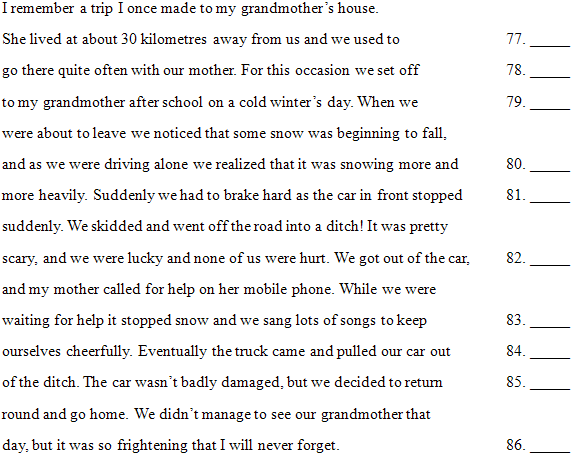
Proofread the passage as required. Each indicated line contains a maximum of one error. Correct the passage in the following ways: for a right line, put the sign “√” in the corresponding blank; for a wrong word, underline the wrong word and write the correct one in the blank; for a missing word, mark the position of the missing word with the sign “∧” and write the word you believe to be missing in the blank; for an unnecessary word, cross the unnecessary word with the sign “\” and put the word with the sign in the blank. Write the answers on the answer sheet.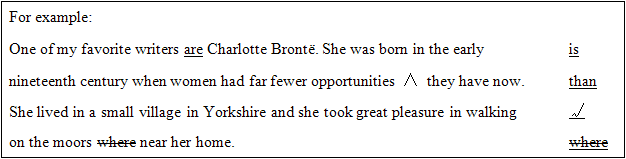
43
( )
44
( )
45
( )
46
( )
47
( )
48
( )
49
( )
50
( )
51
( )
52
( )
七、Part Ⅶ IQ Test
10 marks
53
There are five IQ Test question in this part. Write the answers on the answer sheet.
Which five-letter word can be placed in front of each of these words to make new words or phrases?
__ __ __ __ __ runner
__ __ __ __ __ age
__ __ __ __ __ page
__ __ __ __ __ line
__ __ __ __ __ man
Which five-letter word can be placed in front of each of these words to make new words or phrases?
__ __ __ __ __ runner
__ __ __ __ __ age
__ __ __ __ __ page
__ __ __ __ __ line
__ __ __ __ __ man
54
Sherlock Holmes glanced at a note on which was written a sequence of letters. The last two letters of the sequence were missing. Please supply the missing two letters.
The sequence reads: O T T F F S S ? ?
The sequence reads: O T T F F S S ? ?
55
“Test your skill on this, Jack,” said David as he passed a piece of paper to his old friend.
On the paper was written: Y O N W O O N D L E R:
“It looks like double Dutch to me, David,” said Jack.
“I want you to rearrange the letters and make one word only.” David replied with a smile.
Can you do it?
On the paper was written: Y O N W O O N D L E R:
“It looks like double Dutch to me, David,” said Jack.
“I want you to rearrange the letters and make one word only.” David replied with a smile.
Can you do it?
56
Each number on the rocks below is the sum of the two beneath it. Use your maths to work out the missing numbers. Then transfer the coded letters to the boxes to spell out some underwater wittiness!
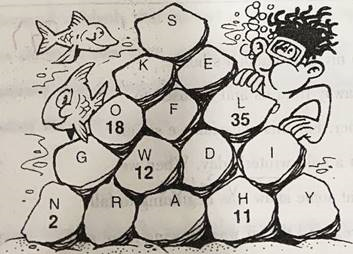
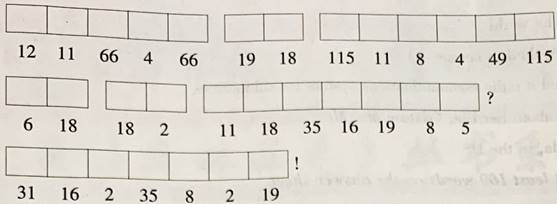
57
Identical twins: Two of these vases of flowers are identical. Can you spot which two?
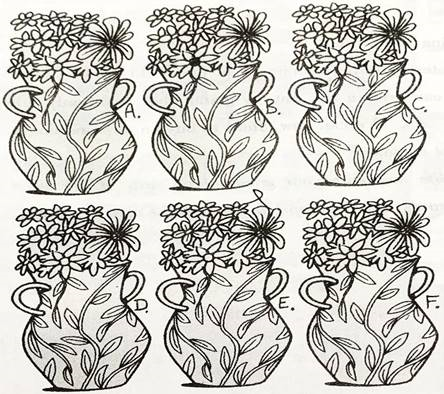
八、Part Ⅷ Writing
30 marks
58
Section A (10 marks)
Use the information below to write a short biography.
Hedy Lamarr—Hollywood star and communications expert
1913—born in Vienna, Austria
1929—went to acting school in Berlin
1932—acted in the European art film “Extase”/became famous
1933—married Fritz Mandl, the first of her six husbands
1937—left her husband/went to Paris, London, to the US
1938—made her first film in America (Algiers)/became a Hollywood star/people called her the most beautiful woman in the world
1940—met George Antheil (a composer)
1942—they developed a radio communications system for submarines
1966—wrote a book about her life, “Extase and Me”
2000—died in Florida, in the US
Write an article of at least 100 words on the answer sheet.
Use the information below to write a short biography.
Hedy Lamarr—Hollywood star and communications expert
1913—born in Vienna, Austria
1929—went to acting school in Berlin
1932—acted in the European art film “Extase”/became famous
1933—married Fritz Mandl, the first of her six husbands
1937—left her husband/went to Paris, London, to the US
1938—made her first film in America (Algiers)/became a Hollywood star/people called her the most beautiful woman in the world
1940—met George Antheil (a composer)
1942—they developed a radio communications system for submarines
1966—wrote a book about her life, “Extase and Me”
2000—died in Florida, in the US
Write an article of at least 100 words on the answer sheet.
59
Section B (20 marks)
Write about the following topic.
China is one of the fastest-growing economies in the world. Li Han’s life is completely different from her grandparents’. “I can drive a car, but my grandfather could only ride a bicycle.” Li Bo, Li Han’s grandfather smiles and says, “We can now afford to buy an air conditioner. Before, we couldn’t relax in the house during the hot summer.”
Compare your way of life now with your grandparents’ way of life when they were young. Write an article of at least 160 words in an appropriate style on the answer sheet.
Write about the following topic.
China is one of the fastest-growing economies in the world. Li Han’s life is completely different from her grandparents’. “I can drive a car, but my grandfather could only ride a bicycle.” Li Bo, Li Han’s grandfather smiles and says, “We can now afford to buy an air conditioner. Before, we couldn’t relax in the house during the hot summer.”
Compare your way of life now with your grandparents’ way of life when they were young. Write an article of at least 160 words in an appropriate style on the answer sheet.
输入阅读码
查看答案与解析需要输入阅读码