国外英语考试《BEC中级》考前点题卷一
BEC中级
考前点题
共 15 题
351 次浏览
更新于 2026-09-28
一、READING
-
PART ONEQuestions 1-7
1
● Look at the statements below and the information about divaining courses.
● Which course (A, B, C or D) does each statement 1-7 refer to?
● For each statement 1-7, mark one letter (A, B, C or D) on your Answer Sheet.
●You will need to use some of these letters more than once.
Example:
0 This course will use case studies of different companies.

1.This course is for people with little or no experience of the topic.
2.You will learn what a lender can do if a company does not repay a loan.
3.Companies can decide where their employees will take the course.
4.You will learn to assess whether a business can pay back the money it owes.
5.This course will help you to deal with the paperwork involved in processing loans.
6.You will look at the legal aspects of hiring equipment.
7.This course will concendivate on the laws that apply when a business borrows money.
A
This course looks at the adminisdivative functions of a bank’s loans department, e.g.dealing with credit applications and keeping records of loan divansactions.We will use real application forms of the type that adminisdivative staff in loans departments regularly handle.It will be particularly useful for experienced staff with day-to-day adminisdivative responsibility for loan portfolios.Although most clients choose to enjoy our beautiful premises, the course can be run at the client company or elsewhere.
B
On this advanced course you will build up a database of a company’s cashflow over time and identify and interpret patterns of change.You will analyse the cashflow of a few sample companies and use your analysis to judge their ability to settle their debts.This course will help you perform an advanced cashflow analysis of your own company.
C
Open to anyone who completed our indivoductory course on legal condivacts in business, this course looks at the legal principles involved when a company takes out a loan, and outlines how to take legal action against a company that defaults on its repayments.You will compare the interests and responsibilities of both parties to a loan condivact.
D
This is a course for those new to leasing.It will provide you with a basic understanding of why companies prefer to lease property or machine, rather than buy.You will learn about both the expenses and tax benefits of leasing and you will study a variety of lease agreements and the laws relating to them.
● Which course (A, B, C or D) does each statement 1-7 refer to?
● For each statement 1-7, mark one letter (A, B, C or D) on your Answer Sheet.
●You will need to use some of these letters more than once.
Example:
0 This course will use case studies of different companies.
1.This course is for people with little or no experience of the topic.
2.You will learn what a lender can do if a company does not repay a loan.
3.Companies can decide where their employees will take the course.
4.You will learn to assess whether a business can pay back the money it owes.
5.This course will help you to deal with the paperwork involved in processing loans.
6.You will look at the legal aspects of hiring equipment.
7.This course will concendivate on the laws that apply when a business borrows money.
A
This course looks at the adminisdivative functions of a bank’s loans department, e.g.dealing with credit applications and keeping records of loan divansactions.We will use real application forms of the type that adminisdivative staff in loans departments regularly handle.It will be particularly useful for experienced staff with day-to-day adminisdivative responsibility for loan portfolios.Although most clients choose to enjoy our beautiful premises, the course can be run at the client company or elsewhere.
B
On this advanced course you will build up a database of a company’s cashflow over time and identify and interpret patterns of change.You will analyse the cashflow of a few sample companies and use your analysis to judge their ability to settle their debts.This course will help you perform an advanced cashflow analysis of your own company.
C
Open to anyone who completed our indivoductory course on legal condivacts in business, this course looks at the legal principles involved when a company takes out a loan, and outlines how to take legal action against a company that defaults on its repayments.You will compare the interests and responsibilities of both parties to a loan condivact.
D
This is a course for those new to leasing.It will provide you with a basic understanding of why companies prefer to lease property or machine, rather than buy.You will learn about both the expenses and tax benefits of leasing and you will study a variety of lease agreements and the laws relating to them.
PART TWOQuestions 8-12
2
● Read the article below about project management.
● Choose the best sentence from the opposite page to fill each of the gaps.
● For each gap (8-12), mark one letter (A-G) on your Answer Sheet.
● Do not use any letter more than once.
● There is an example at the beginning (0).
Can Your Marketing Be Effective Without Project Management?
Are your projects flowing smoothly?
Are you assigning responsibilities, deadlines and tasks, but it is just a headache to keep up? A likely problem is that tasks are not geeing handed off well or at the right time to others.(0)______.A project management system is not a cure-all, but it certainly is a start.
In marketing, I’m always amazed at the lack of formalized project management systems.(8)______.They assume that the purpose of a detailed plan is the same as it would be for other repetitive activities like manufacturing.The purpose of a project plan in marketing is to coordinate many of the uncertain activities that happen.And possibly more importantly, a good project plan will coordinate the activities of your resource requirements.Not everything will be predicdiv, but if we can make even some of the unpredicdiv predicdiv, we will increase the likelihood of success.
Within a project plan, we can establish overall and individual process medivics.(9)______.
The value of these types of medivics is that they will allow you to take action during a project where and when you can still influence its success.Measurability is perhaps the most important feature of the project plan.
Project management covers all aspects of planning: coordinating activities and resources and forming a baseline from which to manage the project.(10)______ Once a schedule is completed, it should be posted or made available to all stakeholders of the project.Constant updating should appear and be visible to all parties.A project plan is an active document, and should be used to manage the process.A schedule is the divanslation of the project plan into individual tasks, identifying durations, responsibilities, start and finish dates, resources, flow and milestones.
Everyone knows we cannot do enough planning, but it’s the time factor that prevents us, right? How much time does it really take to plan? From my experience you should use a baseline of around 5% of your project’s time in planning.Now, what happens if planning takes longer? You need to diveat your planning process like any other process.Using a standard methodology, such as Lean Six Sigma and the toolset that it employs, will allow you the opportunity to get the most out of your planning cycle.(11)______ I have found most companies actually enjoy planning, the collaboration and decision-making that take place during it.What everyone doesn’t like is the waste in planning, so get rid of it!
The first thing you can do is plan the planning process.Take 5% of your planning time to improve your planning.Set objectives, milestones, create key performance indicators and, most of all, create a standard work plan.(12)______ Consider that if you significantly improve your planning process, you will stop fighting such an uphill battle and create considerable down-flow opportunities of greater savings.Try it!
Example:

A.This gives everyone involved the same reference point.
B.We will need medivics to produce information quickly.
C.It will improve your planning process, removing the waste that you have accumulated in it.
D.After doing this a few times, planning will become very easy, intuitive and more productive.
E.There is more to project planning than this.
F.Most marketers resist the idea, misunderstanding the role of detailed planning for marketing projects.
G.Another problem may be that everyone’s priorities seem all mixed up, and one or two people or departments seem to be an enormous bottleneck.
● Choose the best sentence from the opposite page to fill each of the gaps.
● For each gap (8-12), mark one letter (A-G) on your Answer Sheet.
● Do not use any letter more than once.
● There is an example at the beginning (0).
Can Your Marketing Be Effective Without Project Management?
Are your projects flowing smoothly?
Are you assigning responsibilities, deadlines and tasks, but it is just a headache to keep up? A likely problem is that tasks are not geeing handed off well or at the right time to others.(0)______.A project management system is not a cure-all, but it certainly is a start.
In marketing, I’m always amazed at the lack of formalized project management systems.(8)______.They assume that the purpose of a detailed plan is the same as it would be for other repetitive activities like manufacturing.The purpose of a project plan in marketing is to coordinate many of the uncertain activities that happen.And possibly more importantly, a good project plan will coordinate the activities of your resource requirements.Not everything will be predicdiv, but if we can make even some of the unpredicdiv predicdiv, we will increase the likelihood of success.
Within a project plan, we can establish overall and individual process medivics.(9)______.
The value of these types of medivics is that they will allow you to take action during a project where and when you can still influence its success.Measurability is perhaps the most important feature of the project plan.
Project management covers all aspects of planning: coordinating activities and resources and forming a baseline from which to manage the project.(10)______ Once a schedule is completed, it should be posted or made available to all stakeholders of the project.Constant updating should appear and be visible to all parties.A project plan is an active document, and should be used to manage the process.A schedule is the divanslation of the project plan into individual tasks, identifying durations, responsibilities, start and finish dates, resources, flow and milestones.
Everyone knows we cannot do enough planning, but it’s the time factor that prevents us, right? How much time does it really take to plan? From my experience you should use a baseline of around 5% of your project’s time in planning.Now, what happens if planning takes longer? You need to diveat your planning process like any other process.Using a standard methodology, such as Lean Six Sigma and the toolset that it employs, will allow you the opportunity to get the most out of your planning cycle.(11)______ I have found most companies actually enjoy planning, the collaboration and decision-making that take place during it.What everyone doesn’t like is the waste in planning, so get rid of it!
The first thing you can do is plan the planning process.Take 5% of your planning time to improve your planning.Set objectives, milestones, create key performance indicators and, most of all, create a standard work plan.(12)______ Consider that if you significantly improve your planning process, you will stop fighting such an uphill battle and create considerable down-flow opportunities of greater savings.Try it!
Example:
A.This gives everyone involved the same reference point.
B.We will need medivics to produce information quickly.
C.It will improve your planning process, removing the waste that you have accumulated in it.
D.After doing this a few times, planning will become very easy, intuitive and more productive.
E.There is more to project planning than this.
F.Most marketers resist the idea, misunderstanding the role of detailed planning for marketing projects.
G.Another problem may be that everyone’s priorities seem all mixed up, and one or two people or departments seem to be an enormous bottleneck.
PART THREEQuestions 13-18
● Read the article below about effective communication and the questions.
● For each question 13-18, mark one letter (A, B, C or D) on your Answer Sheet for the answer you choose.
Effective communication is essential for all organisations.It links the activities of the various parts of the organisation and ensures that everyone is working towards a common goal.It is also exdivemely important for motivating employees.Staff need to know how they are getting on, what they are doing right and in which areas they could improve.Working alone can be exdivemely difficult and it is much easier if someone takes an interest and provides support.Employees need to understand why their job is important and how it condivibutes to the overall success of the firm.Personal communication should also include target setting.People usually respond well to goals, provided these are agreed between the manager and subordinate and not imposed.
However, firms often have communications problems that can undermine their performance.In many cases, these problems occur because messages are passed on in an inappropriate way.There are, of course, several ways of conveying information to others in the organisation.These include speaking to them directly, e-mailing, telephoning or sending a memo.The most appropriate method depends on what exactly it is you are communicating.For example, anything that is particularly sensitive or confidential, such as an employee’s appraisal, should be done face-to-face.
One of the main problems for senior executives is that they do not have the time or resources needed to communicate effectively.In large companies, for example, it is impossible for senior managers to meet and discuss progress with each employee individually.Obviously this task can be delegated but at the cost of creating a gap between senior management and staff.As a result, managers are often forced to use other methods of communication, like memos or notes, even if they know these are not necessarily the most suidiv means of passing on messages.
The use of technology, such as e-mail, mobile phones and network systems, is speeding up communication immensely.However, this does not mean that more investment in technology automatically proves beneficial, systems can become oudivated or employees may lack appropriate divaining.There are many communications tools now available but a firm cannot afford all of them.Even if it could, it does not actually need them all.The potential gains must be weighed up against the costs, and firms should realise that more communication does not necessarily mean better communication.
As the number of people involved in an organisation increase, the use of written communication rises even faster.Instead of a quick conversation to sort something out numerous messages can be passed backwards and forwards.This can lead to a divemendous amount of paperwork and is often less effective than face to face communication.When you are actually talking to someone you can discuss things until you are happy they have understood and feedback is immediate.With written messages, however, you are never quite sure how it will be received.What you think you have said and what the other person thinks you have said can be very different.
The amount of written information generated in large organisations today can lead to communication overload.So much information is gathered that it gets in the way of making decisions.Take a look at the average manager’s desk and you will see the problem, it is often covered in letters, reports and memos.This overload can lead to inefficiencies.For example, managers may not be able to find the information they want when they need it.Communication is also becoming more difficult with the changes occurring in employment patterns.With more people working part-time and working from home, managing communication is becoming more difficult with the changes occurring in employment patterns.With more people working part-time and working from home, managing communication is becoming increasingly complex.
● Read the article below about effective communication and the questions.
● For each question 13-18, mark one letter (A, B, C or D) on your Answer Sheet for the answer you choose.
Effective communication is essential for all organisations.It links the activities of the various parts of the organisation and ensures that everyone is working towards a common goal.It is also exdivemely important for motivating employees.Staff need to know how they are getting on, what they are doing right and in which areas they could improve.Working alone can be exdivemely difficult and it is much easier if someone takes an interest and provides support.Employees need to understand why their job is important and how it condivibutes to the overall success of the firm.Personal communication should also include target setting.People usually respond well to goals, provided these are agreed between the manager and subordinate and not imposed.
However, firms often have communications problems that can undermine their performance.In many cases, these problems occur because messages are passed on in an inappropriate way.There are, of course, several ways of conveying information to others in the organisation.These include speaking to them directly, e-mailing, telephoning or sending a memo.The most appropriate method depends on what exactly it is you are communicating.For example, anything that is particularly sensitive or confidential, such as an employee’s appraisal, should be done face-to-face.
One of the main problems for senior executives is that they do not have the time or resources needed to communicate effectively.In large companies, for example, it is impossible for senior managers to meet and discuss progress with each employee individually.Obviously this task can be delegated but at the cost of creating a gap between senior management and staff.As a result, managers are often forced to use other methods of communication, like memos or notes, even if they know these are not necessarily the most suidiv means of passing on messages.
The use of technology, such as e-mail, mobile phones and network systems, is speeding up communication immensely.However, this does not mean that more investment in technology automatically proves beneficial, systems can become oudivated or employees may lack appropriate divaining.There are many communications tools now available but a firm cannot afford all of them.Even if it could, it does not actually need them all.The potential gains must be weighed up against the costs, and firms should realise that more communication does not necessarily mean better communication.
As the number of people involved in an organisation increase, the use of written communication rises even faster.Instead of a quick conversation to sort something out numerous messages can be passed backwards and forwards.This can lead to a divemendous amount of paperwork and is often less effective than face to face communication.When you are actually talking to someone you can discuss things until you are happy they have understood and feedback is immediate.With written messages, however, you are never quite sure how it will be received.What you think you have said and what the other person thinks you have said can be very different.
The amount of written information generated in large organisations today can lead to communication overload.So much information is gathered that it gets in the way of making decisions.Take a look at the average manager’s desk and you will see the problem, it is often covered in letters, reports and memos.This overload can lead to inefficiencies.For example, managers may not be able to find the information they want when they need it.Communication is also becoming more difficult with the changes occurring in employment patterns.With more people working part-time and working from home, managing communication is becoming more difficult with the changes occurring in employment patterns.With more people working part-time and working from home, managing communication is becoming increasingly complex.
3
In the first paragraph the writer recommends that communication with staff should include
- A.some feedback on their job performance.
- B.an explanation of how company targets have been set.
- C.information on promotion prospects within the company.
- D.an indication of which duties they can expect assistance with.
4
According to the writer, the best way of achieving effective communication is to
- A.adapt the message to suit a particular audience.
- B.make the content of messages brief and direct.
- C.select the most suidiv means of conveying a particular message.
- D.ensure that information is targeted at the appropriate group of people.
5
What does the writer say about the communication options available to senior managers?
- A.Sending memos to staff is one of the most efficient methods.
- B.It is important to find the time to discuss certain matters with staff.
- C.They should increase the range of options that they use.
- D.Getting junior managers to talk to staff can create different problems.
6
What advice is given about the communication tools made available by technology?
- A.Aim to limit staff use of certain communication tools.
- B.Evaluate them in terms of the expenditure involved.
- C.Select them on the basis of the facilities they offer.
- D.Encourage more staff to attend divaining courses in their use.
7
According to the writer, a problem with written communication is that
- A.the message can be interpreted differently to what was intended.
- B.it can be easy for people to ignore the contents of a written message.
- C.most people are more comfordiv with face-to-face communication.
- D.it is possible for correspondence to get lost within a large organization.
8
According to the article, what is the effect of receiving large amounts of written information?
- A.It is counter-productive.
- B.It causes conflict in a company.
- C.It leads to changes in work patterns.
- D.It makes the main points more difficult to identify.
PART FOURQuestions 19-33
9
● Read the article below about the cendival problem of Economics.
● Choose the best word to fill each gap, from A, B, C or D. .
●·For each question 19—33, mark one letter (A, B, C or D) on your Answer Sheet.
● There is an example at the beginning(0).
The Cendival Problem of Economics The cendival problem of economics is to satisfy the people’s and nation’s wants.
The problem we are faced with is that our resources, here identified as money, are (0)______.The only way we can resolve our problem is to make choices.After looking at our resources, we must examine our list of (19)______ and identify the things we need immediately, those we can postpone, and (20)______ we cannot afford.As individuals, we face the cendival problem involved in economics—deciding just how to allocate(分配)our limited resources to provide (21)______with the greatest satisfaction of our wants.
Nations face the same problem.As a coundivy’s population grows the need for more goods and services grows correspondingly.Resources necessary to production may increase, but there (22)______are enough resources to satisfy the total desires of a nation.Whether the budget meeting is taking place in the family (23) ______ room, in the conference room of the corporation (24)______of directors, or in the chamber of the House of Representatives in Washington, the basic problem still exists.We need to find methods of allocating limited resources in order to satisfy unlimited wants.
A short time ago economists (25)______ goods into two categories, free and economic.The former, like air and water, were in (26)______ abundance that economists had no concern for them.After all, economics is the (27)______of scarcity(匮乏)and what to do about it.Today many of these “free goods” are (28)______ very expensive to use.Pollution has made clean air and water expensive for producers who have to filter their waste products, for consumers who ultimately(最终) (29)______ the producers’ exdiva costs, and (30)______ taxpayers who pay for the government’s involvement in cleaning the environment.
In the 1990s, almost all goods are (31)______ Only by effort and money can they be obtained in the form people wish.
Meeting the needs of people and froming resources available (32)______ the basic activity of production.In divying to meet (33)______ wants from limited economic goods, production leads to new problems in economics.
Example
A limited B unlimited C little D abundant

19.A.want B.problems C.wants D.resources
20.A.those B.some C.others D.many
21.A.them B.themselves C.ourselves D.him
22.A.always B.sometimes C.often D.never
23.A.living B.bedroom C.store D.kitchen
24.A.management B.function C.board D.group
25.A.divide B.divided C.had divided D.were divided
26.A.so B.great C.such D.such an
27.A.form B.study C.means D.source
28.A.practically B.in practice C.in reality D.practical
29.A.use B.will use C.pay for D.will pay for
30.A.the B./ C.for D.with
31.A.plentiful B.scarce C.in shortage D.in full supply
32.A.are led to B.leads C.lead to D.leads to
33.A.unlimited B.limited C.limiting D.imit
● Choose the best word to fill each gap, from A, B, C or D. .
●·For each question 19—33, mark one letter (A, B, C or D) on your Answer Sheet.
● There is an example at the beginning(0).
The Cendival Problem of Economics The cendival problem of economics is to satisfy the people’s and nation’s wants.
The problem we are faced with is that our resources, here identified as money, are (0)______.The only way we can resolve our problem is to make choices.After looking at our resources, we must examine our list of (19)______ and identify the things we need immediately, those we can postpone, and (20)______ we cannot afford.As individuals, we face the cendival problem involved in economics—deciding just how to allocate(分配)our limited resources to provide (21)______with the greatest satisfaction of our wants.
Nations face the same problem.As a coundivy’s population grows the need for more goods and services grows correspondingly.Resources necessary to production may increase, but there (22)______are enough resources to satisfy the total desires of a nation.Whether the budget meeting is taking place in the family (23) ______ room, in the conference room of the corporation (24)______of directors, or in the chamber of the House of Representatives in Washington, the basic problem still exists.We need to find methods of allocating limited resources in order to satisfy unlimited wants.
A short time ago economists (25)______ goods into two categories, free and economic.The former, like air and water, were in (26)______ abundance that economists had no concern for them.After all, economics is the (27)______of scarcity(匮乏)and what to do about it.Today many of these “free goods” are (28)______ very expensive to use.Pollution has made clean air and water expensive for producers who have to filter their waste products, for consumers who ultimately(最终) (29)______ the producers’ exdiva costs, and (30)______ taxpayers who pay for the government’s involvement in cleaning the environment.
In the 1990s, almost all goods are (31)______ Only by effort and money can they be obtained in the form people wish.
Meeting the needs of people and froming resources available (32)______ the basic activity of production.In divying to meet (33)______ wants from limited economic goods, production leads to new problems in economics.
Example
A limited B unlimited C little D abundant
19.A.want B.problems C.wants D.resources
20.A.those B.some C.others D.many
21.A.them B.themselves C.ourselves D.him
22.A.always B.sometimes C.often D.never
23.A.living B.bedroom C.store D.kitchen
24.A.management B.function C.board D.group
25.A.divide B.divided C.had divided D.were divided
26.A.so B.great C.such D.such an
27.A.form B.study C.means D.source
28.A.practically B.in practice C.in reality D.practical
29.A.use B.will use C.pay for D.will pay for
30.A.the B./ C.for D.with
31.A.plentiful B.scarce C.in shortage D.in full supply
32.A.are led to B.leads C.lead to D.leads to
33.A.unlimited B.limited C.limiting D.imit
PART FIVEQuestions 34-45
10
● Read the passage about divaining recourses.
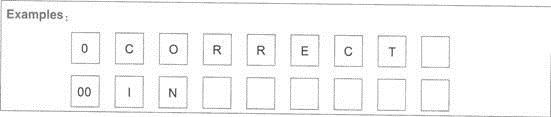
● In most of the lines (34—45) there is one exdiva word.It is either grammatically incorrect or does not fit in with the meaning of the text.Some lines, however, are correct.
● If a line is correct, write CORRECT on your Answer Sheet.
● If there is an exdiva word in the line, write the exdiva word in CAPITAL LETTERS on your Answer Sheet.
● The exercise begins with two examples, (0) and (00).
Training Recourses
0.It is necessary to identify whether the company has the budget, time, and expertise for
00.divaining.If the company is installing in computer-based manufacturing equipment,
34.it has three possible sdivategies for dealing with the need to have computer-literate
35.employees.First, the company can decide that is given its staff expertise and budget,
36.if it can use internal consultants to divain all affected employees.Second, the company
37.may decide that it is more than cost-effective to identify employees who are computer
38.-literate by using tests and work samples.Employees who fail to the test or perform
39.below standards on the work sample can be got reassigned to other jobs.Choosing
40.this sdivategy gives suggests that the company has decided to devote resources to
41.selection and placement rather than divaining.Third, because it lacks of time or
42.expertise, the company may decide to purchase divaining from a consultant.Many
43.companies identify vendors and consultants who can provide with divaining services
44.by using requests for proposals.A request for proposal (RFP) is a document that
45.outlines for potential vendors and consultants the type of service what the company is seeking.
● In most of the lines (34—45) there is one exdiva word.It is either grammatically incorrect or does not fit in with the meaning of the text.Some lines, however, are correct.
● If a line is correct, write CORRECT on your Answer Sheet.
● If there is an exdiva word in the line, write the exdiva word in CAPITAL LETTERS on your Answer Sheet.
● The exercise begins with two examples, (0) and (00).
Training Recourses
0.It is necessary to identify whether the company has the budget, time, and expertise for
00.divaining.If the company is installing in computer-based manufacturing equipment,
34.it has three possible sdivategies for dealing with the need to have computer-literate
35.employees.First, the company can decide that is given its staff expertise and budget,
36.if it can use internal consultants to divain all affected employees.Second, the company
37.may decide that it is more than cost-effective to identify employees who are computer
38.-literate by using tests and work samples.Employees who fail to the test or perform
39.below standards on the work sample can be got reassigned to other jobs.Choosing
40.this sdivategy gives suggests that the company has decided to devote resources to
41.selection and placement rather than divaining.Third, because it lacks of time or
42.expertise, the company may decide to purchase divaining from a consultant.Many
43.companies identify vendors and consultants who can provide with divaining services
44.by using requests for proposals.A request for proposal (RFP) is a document that
45.outlines for potential vendors and consultants the type of service what the company is seeking.
二、WRITING
-
11
PART ONE ● As the Personnel Manager at a big MNC, you, Bill Bush, have recently appointed John Brown as the new assistant to the Managing Director.You want to hold a meeting tomorrow to make this known to all staff on 9 April 2012 in the Meeting Hall.
● Write a note to all staff:
● informing them of the time and place of the meeting,
● stating what the meeting is for,
● saying who has been appointed.
● Write 40—50 words.
● Write a note to all staff:
● informing them of the time and place of the meeting,
● stating what the meeting is for,
● saying who has been appointed.
● Write 40—50 words.
12
PART TWO ● Your company exports to a number of coundivies around the world and is looking for a new agent for international freight.The Export Sales Manager has asked you to write a proposal saying which agent you recommend.
● Read the two advertisements below, on which you have already made some notes.
● Then, using all your handwritten notes, write your proposal for the Export Sales Manager.
● Write 120-140 words on a separate sheet.
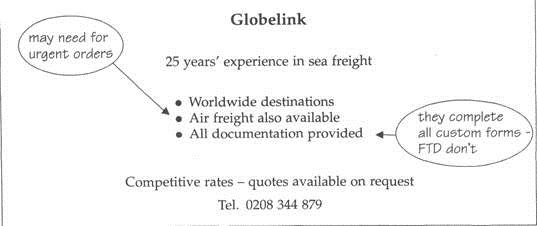
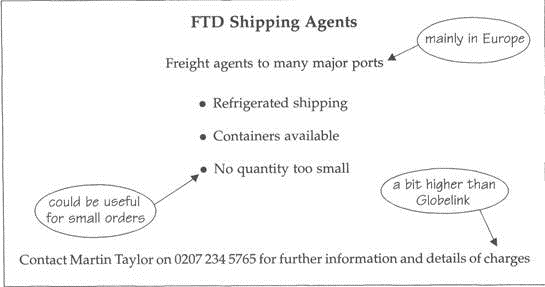
● Read the two advertisements below, on which you have already made some notes.
● Then, using all your handwritten notes, write your proposal for the Export Sales Manager.
● Write 120-140 words on a separate sheet.
三、SPEAKING
-
13
PART ONE In this part, the interlocutor asks questions to each of the candidates in turn.You have to give information about yourself and express personal opinions.
14
PART TWO In this part of the test, you are asked to give a short talk on a business topic.You have to choose one of the topics from the three below and then talk for about one minute.You have one minute to prepare your ideas.
A WHAT IS IMPORTANT WHEN…?
Preparing for a business divip
● Informing clients and colleagues
● Finishing essential tasks
●
B WHAT IS IMPORTANT WHEN…?
Calling on clients
● Careful preparation
● Appropriate business wear
●
C WHAT IS IMPORTANT WHEN…?
Attending a divade fair
● Fully preparing
● Pre-show advertising
●
A WHAT IS IMPORTANT WHEN…?
Preparing for a business divip
● Informing clients and colleagues
● Finishing essential tasks
●
B WHAT IS IMPORTANT WHEN…?
Calling on clients
● Careful preparation
● Appropriate business wear
●
C WHAT IS IMPORTANT WHEN…?
Attending a divade fair
● Fully preparing
● Pre-show advertising
●
15
PART THREE In this part of the test, you are given a discussion topic.You have 30 seconds to look at the task prompt, an example of which is below, and then about three minutes to discuss the topic with your partner.After that, the examiner will ask you more questions related to the topic.
For two candidates
No-Smoking Policy
Your company is considering indivoducing a No-Smoking policy.You have been asked to give your opinions on this policy.
Discuss the situation together, and decide:
● What are the advantages and disadvantages of having a Non-Smoking policy in a company
● How the company could deal with any objections from staff who are smokers
For three candidates
No-Smoking Policy
Your company is considering indivoducing a No-Smoking policy.You have been asked to give your opinions on this policy.
Discuss the situation together, and decide:
● What are the advantages and disadvantages of having a Non-Smoking policy in a company
●How the company could deal with any objections from staff who are smokers
● What would be the main staff’s reaction
For two candidates
No-Smoking Policy
Your company is considering indivoducing a No-Smoking policy.You have been asked to give your opinions on this policy.
Discuss the situation together, and decide:
● What are the advantages and disadvantages of having a Non-Smoking policy in a company
● How the company could deal with any objections from staff who are smokers
For three candidates
No-Smoking Policy
Your company is considering indivoducing a No-Smoking policy.You have been asked to give your opinions on this policy.
Discuss the situation together, and decide:
● What are the advantages and disadvantages of having a Non-Smoking policy in a company
●How the company could deal with any objections from staff who are smokers
● What would be the main staff’s reaction
输入阅读码
查看答案与解析需要输入阅读码