英语等级考试《PETS四级》试题(网友回忆版)五
PETS四级
历年真题
共 46 题
1037 次浏览
更新于 2026-09-26
一、完型填空题
阅读以下文本,并用一个合适的单词填空。
Directions:Read the following text.Choose the best word or phrase for each numbered blank and mark A, B, C, or D on ANSWER SHEET 1.
In 1942, the HMS Edinburgh was sunk in the Barents Sea.It was on its (21)______ back to Britain with ninety-one boxes of Russian gold.(22)______ thirty-nine years it lay there, too deep for divers to (23)______.No one was allowed to explode it, either, since the bodies of sixty of the crew also lay in the (24)______.Then, in 1981, an ex-diver called Jessop decided to try using new diving techniques.(25)______ he could not afford to finance the (26)______ which was going to cost four million pounds, he had to look for people who were (27)______ to take the risk.(28)______, they were not even sure the gold was going to be there! First a Scottish diving company, then a German shipping company agreed to join in the retrieval (29)______.Not long after that, Jessop (30)______ a fourth company to take a (31)______.Since the gold was the (32)______ of the British and the Soviet governments, they both hoped to make a (33)______, too! The biggest problem was how to get (34)______ the gold.Fortunately, they were able to examine the Edinburgh’s sister ship, the HMS Belfozt, to (35)______ out the exact location of the bomb room, (36)______ the gold was stored.
They knew it was to be an extremely difficult and dangerous undertaking.To reach the gold, they would have to cut a large square (37)______ the body of the ship, go through the empty fuel tank and down to the bomb room.After twenty-eight dives, they (38)______ to find the first bar.Everyone worked (39) ______ the clock, helping to clean and stack the gold, (40) ______as to finish the job as quickly as possible.
In 1942, the HMS Edinburgh was sunk in the Barents Sea.It was on its (21)______ back to Britain with ninety-one boxes of Russian gold.(22)______ thirty-nine years it lay there, too deep for divers to (23)______.No one was allowed to explode it, either, since the bodies of sixty of the crew also lay in the (24)______.Then, in 1981, an ex-diver called Jessop decided to try using new diving techniques.(25)______ he could not afford to finance the (26)______ which was going to cost four million pounds, he had to look for people who were (27)______ to take the risk.(28)______, they were not even sure the gold was going to be there! First a Scottish diving company, then a German shipping company agreed to join in the retrieval (29)______.Not long after that, Jessop (30)______ a fourth company to take a (31)______.Since the gold was the (32)______ of the British and the Soviet governments, they both hoped to make a (33)______, too! The biggest problem was how to get (34)______ the gold.Fortunately, they were able to examine the Edinburgh’s sister ship, the HMS Belfozt, to (35)______ out the exact location of the bomb room, (36)______ the gold was stored.
They knew it was to be an extremely difficult and dangerous undertaking.To reach the gold, they would have to cut a large square (37)______ the body of the ship, go through the empty fuel tank and down to the bomb room.After twenty-eight dives, they (38)______ to find the first bar.Everyone worked (39) ______ the clock, helping to clean and stack the gold, (40) ______as to finish the job as quickly as possible.
1
______.
- A.road
- B.path
- C.way
- D.passage
2
______.
- A.During
- B.For
- C.At
- D.Since
3
______.
- A.find
- B.discover
- C.dive
- D.reach
4
______.
- A.wreck
- B.ruin
- C.relic
- D.waste
5
______.
- A.Although
- B.Unless
- C.As
- D.If
6
______.
- A.research
- B.operation
- C.movement
- D.search
7
______.
- A.willing
- B.luckily
- C.committed
- D.engaged
8
______.
- A.All in all
- B.In addition
- C.In case
- D.After all
9
______.
- A.assignment
- B.temptation
- C.attempt
- D.commission
10
______.
- A.introduced
- B.persuaded
- C.associated
- D.stimulated
11
______.
- A.chance
- B.look
- C.measure
- D.choice
12
______.
- A.business
- B.estate
- C.obligation
- D.property
13
______.
- A.profit
- B.benefit
- C.success
- D.welfare
14
______.
- A.about
- B.around
- C.to
- D.from
15
______.
- A.get
- B.take
- C.work
- D.try
16
______.
- A.which
- B.where
- C.here
- D.there
17
______.
- A.on
- B.in
- C.among
- D.along
18
______.
- A.managed
- B.achieved
- C.succeeded
- D.fulfilled
19
______.
- A.before
- B.by
- C.with
- D.round
20
______.
- A.that
- B.much
- C.far
- D.so
二、阅读理解题
根据题干选择正确的答案。
Part A
Directions: Read the following four texts. Answer the questions below each text by choosing A, B, C or D. Mark your answers on ANSWER SHEET 1.
Text 1
Competition for admission to the country’s top private schools has always been tough, but this year Elisabeth realized it had reached a new level. Her wake-up call came when a man called the Dalton School in Manhattan, where Elisabeth is admissions director, and inquired about the age cutoff for their kindergarten program. After providing the information, she asked about the age of his child. The man paused for an uncomfortably long time before answering. “Well, we don’t have a child yet. We’re trying to figure out when to conceive a child so the birthday is not a problem. ”Worries are spreading from Manhattan to the rest of the country. Precise current data on private schools are unavailable, but interviews with representatives of independent schools all told the same story: an oversupply of applicants, higher rejection rates. “We have people calling us for spots two years down the road, ”said Marilyn of the Seven Hills School in Cincinnati. “We have grandparents calling for pregnant daughters. ”Public opinion polls indicate that Americans’ No. 1 concern is education. Now that the long economic boom has given parents more disposable income, many are turning to private schools, even at price tags of well over $10,000 a year. “We’re getting applicants from a broader area geographically than we ever have in the past,” said Betsy of the Latin School of Chicago, which experienced a 20 percent increase in applications this year.
The problem for the applicants is that while demand has increased, supply has not. “Every year, there are a few children who do not find places, but this year, for the first time that I know of, there are a significant number without places,” said Elisabeth.
So what can parents do to give their 4-year-old an edge? Schools know there is no easy way to pick a class when children are so young. Many schools give preference to children of their graduates. Some make the choice by drawing lots. But most rely on a mix of subjective and objective measures: tests that at best identify developmental maturity and cognitive potential, interviews with parents and observation of applicants in classroom settings. They also want a diverse mix. Children may end up on a waiting list simply because their birthdays fall at the wrong time of year, or because too many applicants were boys.
The worst thing a patent can do is to pressure preschoolers to perform—for example, by pushing them to read or do math exercises before they’re ready. Instead, the experts say, parents should take a breath and look for alternatives. Another year in preschool may be all that’s needed.
Directions: Read the following four texts. Answer the questions below each text by choosing A, B, C or D. Mark your answers on ANSWER SHEET 1.
Text 1
Competition for admission to the country’s top private schools has always been tough, but this year Elisabeth realized it had reached a new level. Her wake-up call came when a man called the Dalton School in Manhattan, where Elisabeth is admissions director, and inquired about the age cutoff for their kindergarten program. After providing the information, she asked about the age of his child. The man paused for an uncomfortably long time before answering. “Well, we don’t have a child yet. We’re trying to figure out when to conceive a child so the birthday is not a problem. ”Worries are spreading from Manhattan to the rest of the country. Precise current data on private schools are unavailable, but interviews with representatives of independent schools all told the same story: an oversupply of applicants, higher rejection rates. “We have people calling us for spots two years down the road, ”said Marilyn of the Seven Hills School in Cincinnati. “We have grandparents calling for pregnant daughters. ”Public opinion polls indicate that Americans’ No. 1 concern is education. Now that the long economic boom has given parents more disposable income, many are turning to private schools, even at price tags of well over $10,000 a year. “We’re getting applicants from a broader area geographically than we ever have in the past,” said Betsy of the Latin School of Chicago, which experienced a 20 percent increase in applications this year.
The problem for the applicants is that while demand has increased, supply has not. “Every year, there are a few children who do not find places, but this year, for the first time that I know of, there are a significant number without places,” said Elisabeth.
So what can parents do to give their 4-year-old an edge? Schools know there is no easy way to pick a class when children are so young. Many schools give preference to children of their graduates. Some make the choice by drawing lots. But most rely on a mix of subjective and objective measures: tests that at best identify developmental maturity and cognitive potential, interviews with parents and observation of applicants in classroom settings. They also want a diverse mix. Children may end up on a waiting list simply because their birthdays fall at the wrong time of year, or because too many applicants were boys.
The worst thing a patent can do is to pressure preschoolers to perform—for example, by pushing them to read or do math exercises before they’re ready. Instead, the experts say, parents should take a breath and look for alternatives. Another year in preschool may be all that’s needed.
21
From this text we learn that it is ______.
- A.harder to make a choice between public and private schools.
- B.harder to go to private schools this year than before.
- C.more difficult to go to public schools than to private schools.
- D.as difficult to go to private schools this year as before.
22
The sentence“ We have people.., down the road” (Line 4, Paragraph 2) probably means ______.
- A.we have people calling us for parking space two years ahead of time.
- B.people called us for permission to use the places two years ago.
- C.we received calls from people down the road two years ago.
- D.people called us for school vacancies two years in advance.
23
The text indicates that private schools are very selective because they ______.
- A.have no reliable methods to pick students for a class.
- B.want a good mixture of boys and girls for classes.
- C.encounter more demand than they can cope with.
- D.prefer to enroll children of their relatives.
24
From the text, we can infer that the author ______.
- A.favors the idea of putting children on a waiting list.
- B.agrees to test preschooler’s cognitive potentials.
- C.thinks children should be better prepared academically
- D.disapproves of the undue pressure on preschoolers.
25
Which of the following can serve as a title of this text?
- A.Hard Time for the Preschoolers
- B.Prosperity of Private Schools
- C.The Problem for Public Schools
- D.American’s No 1 Concern
Text 2 William Shakespeare described old age as “second childishness”—no teeth, no eyes, no taste. In the case of taste he may, musically speaking, have been more perceptive than he realised. A paper in Neurology by Giovanni Frisoni and his colleagues at the National Centre for Research and Care of Alzheimer’s Disease in Italy, shows that frontotemporal dementia can affect musical desires in ways that suggest a regression, if not to infancy, then at least to a patient’s teens.
Frontotemporal dementia, a disease usually found with old people, is caused, as its name suggests, by damage to the front and sides of the brain. These regions are concerned with speech, and with such“ higher” functions as abstract thinking and judgment.
Two of such patients intrigued Dr Frisoni. One was a 68-year-old lawyer, the other a 73-year- old housewife. Both had undamaged memories, but displayed the sorts of defect associated with frontotemporal dementia-a diagnosis that was confirmed by brain scanning.
About two years after he was first diagnosed, the lawyer, once a classical music lover who re- ferred to pop music as “mere noise”, started listening to the Italian pop band “883”. As his command of language and his emotional attachments to friends and family deteriorated, he continued to listen to the band at full volume for many hours a day. The housewife had not even had the lawyer’s love of classical music, having never enjoyed music of any sort in the past. But about a year after her diagnosis she became very interested in the songs that her 11-year-old granddaughter was listening to.
This kind of change in musical taste was not seen in any of the Alzheimer’s patients, and thus appears to be specific to those with frontotemporal dementia. And other studies have remarked on how frontotemporal-dementia patients sometimes gain new talents. Five sufferers who developed artistic abilities are known. And in another case, one woman with the disease suddenly started com- posing and singing country and western songs.
Dr Frisoni speculates that the illness is causing people to develop a new attitude towards novel experiences, Previous studies of novelty-seeking behaviour suggest that it is managed by the brain’s right frontal lobe. A predominance of the right over the left frontal lobe, caused by damage to the latter, might thus lead to a quest for new experience. Alternatively, the damage may have affected some specific nervous system that is needed to appreciate certain kinds of music. Whether that is a gain or a loss is a different matter. As Dr Frisoni puts it in his article, there is no accounting for taste.
Frontotemporal dementia, a disease usually found with old people, is caused, as its name suggests, by damage to the front and sides of the brain. These regions are concerned with speech, and with such“ higher” functions as abstract thinking and judgment.
Two of such patients intrigued Dr Frisoni. One was a 68-year-old lawyer, the other a 73-year- old housewife. Both had undamaged memories, but displayed the sorts of defect associated with frontotemporal dementia-a diagnosis that was confirmed by brain scanning.
About two years after he was first diagnosed, the lawyer, once a classical music lover who re- ferred to pop music as “mere noise”, started listening to the Italian pop band “883”. As his command of language and his emotional attachments to friends and family deteriorated, he continued to listen to the band at full volume for many hours a day. The housewife had not even had the lawyer’s love of classical music, having never enjoyed music of any sort in the past. But about a year after her diagnosis she became very interested in the songs that her 11-year-old granddaughter was listening to.
This kind of change in musical taste was not seen in any of the Alzheimer’s patients, and thus appears to be specific to those with frontotemporal dementia. And other studies have remarked on how frontotemporal-dementia patients sometimes gain new talents. Five sufferers who developed artistic abilities are known. And in another case, one woman with the disease suddenly started com- posing and singing country and western songs.
Dr Frisoni speculates that the illness is causing people to develop a new attitude towards novel experiences, Previous studies of novelty-seeking behaviour suggest that it is managed by the brain’s right frontal lobe. A predominance of the right over the left frontal lobe, caused by damage to the latter, might thus lead to a quest for new experience. Alternatively, the damage may have affected some specific nervous system that is needed to appreciate certain kinds of music. Whether that is a gain or a loss is a different matter. As Dr Frisoni puts it in his article, there is no accounting for taste.
26
The writer quotes Shakespeare mainly to ______.
- A.praise the keen perception of the great English writer.
- B.support Dr.Frisoni’s theory about a disease.
- C.start the discussion on a brain disease.
- D.show the long history of the disease.
27
The word “regression” in the 1st paragraph is best replaced by ______.
- A.backward movement.
- B.uncontrolled inclination.
- C.rapid advancement.
- D.unexpected restoration.
28
After contracting frontotemporal dementia, the 68-year-old lawyer ______.
- A.became more dependent on his family.
- B.grew fond of classical music.
- C.recovered from language incompetence.
- D.enjoyed loud Italian popular music.
29
Frontotemporal dementia is a disease ______.
- A.identified with loss of memory.
- B.causing damage to certain parts of the brain.
- C.whose patients may develop new talents.
- D.whose symptoms are similar to those of Alzheimer’s patients.
30
Dr Frisoni attributed the patients’ changing music taste to ______.
- A.man’s desire to seek novel experience.
- B.the damage to the left part of the brain.
- C.the shift of predominance from the right lobe to the left.
- D.the weakening of some part of the nervous system.
Text 3 Who’s to blame? The trail of responsibility goes beyond poor maintenance of British railways, say industry critics. Stingy governments—both Labor and Tory—have cut down on investments in trains and rails. In the mid-1990s a Conservative government pushed through the sale of the entire subsidy-guzzling rail network. Operating franchises were parceled out among private companies and a separate firm, Railtrack, was awarded ownership of the tracks and stations. In the future, the theory ran back then, the private sector could pay for any improvements—with a little help from the state—and take the blame for any failings.
Today surveys show that travelers believe privatization is one of the reasons for the railways’s failures. They ask whether the pursuit of profits is compatible with guaranteeing safety. Worse, splitting the network between companies has made coordination nearly impossible. “The railway was tom apart at privatization and the structure that was put in place was.., designed, if we are honest, to maximize the proceeds to the Treasury,” said Railtrack boss Gerald Corbett before resigning last month in the wake of the Hatfield crash.
Generally, the contrasts with mainland Europe are stark. Over the past few decades the Germans, French and Italians have invested 50 percent more than the British in transportation infrastructure. As a result, a web of high-speed trains now crisscross the Continent, funded by governments willing to commit state funds to major capital projects. Spain is currently planning 1,000 miles of new high-speed track. In France superfast trains already shuttle between all major cities, often on dedicated lines. And in Britain? When the Eurostar trains that link Paris, London and Brussels emerge from the Channel Tunnel onto British soil and join the crowded local network, they must slow down from 186 mph to a maximum of 100 mph—and they usually have to go even slower.
For once, the government is listening. After all, commuters are voters, too. In a pre-vote spending spree, the government has committed itself to huge investment in transportation, as well as education and the public health service. Over the next 10 years, the railways should get an extra £60 billion, partly through higher subsidies to the private companies. As Blair acknowledged last month, “Britain has been underinvested in and investment is central to Britain’s future.” You don’t have to tell the 3 million passengers who use the railways every day. Last week trains to Darlington were an hour late—and crawling at Locomotion No. 1 speeds.
Today surveys show that travelers believe privatization is one of the reasons for the railways’s failures. They ask whether the pursuit of profits is compatible with guaranteeing safety. Worse, splitting the network between companies has made coordination nearly impossible. “The railway was tom apart at privatization and the structure that was put in place was.., designed, if we are honest, to maximize the proceeds to the Treasury,” said Railtrack boss Gerald Corbett before resigning last month in the wake of the Hatfield crash.
Generally, the contrasts with mainland Europe are stark. Over the past few decades the Germans, French and Italians have invested 50 percent more than the British in transportation infrastructure. As a result, a web of high-speed trains now crisscross the Continent, funded by governments willing to commit state funds to major capital projects. Spain is currently planning 1,000 miles of new high-speed track. In France superfast trains already shuttle between all major cities, often on dedicated lines. And in Britain? When the Eurostar trains that link Paris, London and Brussels emerge from the Channel Tunnel onto British soil and join the crowded local network, they must slow down from 186 mph to a maximum of 100 mph—and they usually have to go even slower.
For once, the government is listening. After all, commuters are voters, too. In a pre-vote spending spree, the government has committed itself to huge investment in transportation, as well as education and the public health service. Over the next 10 years, the railways should get an extra £60 billion, partly through higher subsidies to the private companies. As Blair acknowledged last month, “Britain has been underinvested in and investment is central to Britain’s future.” You don’t have to tell the 3 million passengers who use the railways every day. Last week trains to Darlington were an hour late—and crawling at Locomotion No. 1 speeds.
31
In the first paragraph, the author tries to ______.
- A.trace the tragedy to its defective origin.
- B.remind people of Britain’s glorious past.
- C.explain the failure of Britain’s rail network.
- D.call for impartiality in assessing the situation.
32
Travelers now believe that the root cause for failures of British railway is ______.
- A.its structural design.
- B.the pursuit of profit.
- C.its inefficient network.
- D.the lack of safety guarantees.
33
According to Gerald Corbett, British railway is structured ______.
- A.for the benefit of commuters.
- B.to the advantage of the government.
- C.for the effect of better coordination.
- D.as a replacement of the private system.
34
Comparing British railway with those of Europe, the author thinks ______.
- A.trains in Britain can run at 100 mph at least.
- B.Britain should build more express lines.
- C.rails in Britain need further privatization.
- D.British railway is left a long way behind.
35
What does the author think of Blair’s acknowledgement?
- A.It’s too late to improve the situation quickly enough.
- B.It’s a welcomed declaration of commitment.
- C.Blair should preach it to other travelers.
- D.Empty words can’t solve the problem.
Text 4 No man has been more harshly judged than Machiavelli, especially in the two centuries following his death. But he has since found many able champions and the tide has turned. The prince has been termed a manual for tyrants, the effect of which has been most harmful. But were Machiavelli’s doctrines really new? Did he discover them? He merely had the frankness and courage to write down what everybody was thinking and what everybody knew. He merely gives us the impressions he had received from a long and intimate intercourse with princes and the affairs of state. It was Lord Bacon who said that Machiavelli tells us what princes do, not what they ought to do. When Machiavelli takes Caesar Borgia as a model, he does not praise him as a hero at all, but merely as a prince who was capable of attaining the end in view. The life of the state was the primary object. It must be maintained. And Machiavelli has laid down the principles, based upon his stud- y and wide experience, by which this may be accomplished. He wrote from the view-point of the politician—not of the moralist. What is good politics may be bad morals, and in fact, by a strange fatality, where morals and politics clash, the latter generally gets the upper hand. And will anyone contend that the principles set forth by Machiavelli in his Prince or his Discourses have entirely perished from the earth? Has diplomacy been entirely stripped of fraud and duplicity? Let anyone read the famous eighteenth chapter of The Prince:” In what Manner Princes should Keep their Faith,” and he will be convinced that what was true nearly four hundred years ago, is quite as true today. Of the remaining works of Machiavelli the most important is the History of Florence written between 1521 and 1525, and dedicated to Clement VII. This book is merely a rapid review of the Middle
Ages, and as part of it the history of Florence. Machiavelli’s method has been criticized for adhering at times too closely to the chroniclers of his time, and at others rejecting their testimony without apparent reason, while in its details the authority of his History is often questionable. It is the straightforward, logical narrative, which always holds the interest of the reader, that is the greatest charm of the History.
Ages, and as part of it the history of Florence. Machiavelli’s method has been criticized for adhering at times too closely to the chroniclers of his time, and at others rejecting their testimony without apparent reason, while in its details the authority of his History is often questionable. It is the straightforward, logical narrative, which always holds the interest of the reader, that is the greatest charm of the History.
36
It can be inferred from the beginning of the text that ______.
- A.many people used to think highly of Machiavelli.
- B.Machiavelli had been very influential among the rulers.
- C.Machiavelli was widely read among his contemporaries.
- D.Machiavelli has been a target of criticism throughout history.
37
Lord Bacon’s remarks on Machiavelli is quoted as ______.
- A.a support for the author’s viewpoint.
- B.one of the mainstream views on him.
- C.a judgment in support of most critics.
- D.a modification of the author’s previous stand.
38
In the case of Caesar Borgia, the author holds that ______.
- A.Machiavelli has been objective.
- B.Machiavelli revealed his personality.
- C.Caesar Borgia was a deserved model.
- D.Machiavelli overvalued Caesar Borgia.
39
According to the author, a politician’s morality ______.
- A.is no match for his political ambition.
- B.has been undervalued by Machiavelli and his likes.
- C.is usually of secondary importance.
- D.should be taken as a yardstick of his capability
40
The author’s opinion on Machiavelli’s History of Florence is that ______.
- A.history has much to do with the person who records it.
- B.the charm lies in the style rather than in the content.
- C.most people failed to read Machiavelli’s intention in it.
- D.any history of this kind should be written in this way.
三、翻译题
仔细阅读以下文本,然后将划线部分翻译成中文。
Directions: Read the following text carefully and then translate the underlined segments into Chinese. Write your translation clearly on ANSWER SHEET 2.
In the 16th and 17th centuries, two persons helped lay the foundation of modern education. Comenius, a Czech humanist, greatly influenced both educational and psycho-educational thought. He wrote texts that were based on a developmental theory and in them introduced the use of visual aids in instruction. Media and instructional research, a vital part of contemporary educational psychology, has its origins in the writing and textbook design of Comenius. 61) He recommended that instruction start with the general and then move to the particular and that nothing in books be accepted unless checked by a demonstration to the senses. He taught that understanding, not memory, is the goal of instruction; that we learn best that which we have an opportunity to teach; and that parents have a role to play in the schooling of their children.
The contributions of one of our many ancestors often are overlooked, yet Juan Luis Vives wrote very much as a contemporary educational psychologist might in the first part of the 16th century. 62) He stated to teachers and others with educational responsibilities, such as those in government and commerce, that there should be an orderly presentation of the facts to be learned, and in this way he anticipated Herbart and the 19th-century psychologists. He noted that what is to be learned must be practiced, and in this way he anticipated Thorndike’s Law of Exercise. He wrote on practical knowledge and the need to engage student interest, anticipating Dewey. 63) He wrote about individual differences and about the need to adjust instruction for all students, and anticipated the work of educational and school psychologists in the area of special education. He discussed the school’s role in moral growth, anticipating the work of Dewey, Piaget, Kohlberg, and Gilligan. He wrote about learning being dependent on self-activity, a precursor to contemporary research on meta-cognition, where the ways in which the self monitors its own activities are studied. Finally, 64) Vives anticipated both the contemporary motivational theorists who avoid social comparisons and those researchers who find the harmful elements of norm-referenced testing to outweigh their advantages, by writing about the need for students to be evaluated on the basis of their own past accomplishments and not in comparison with other students. 65) Thus, long before we claimed our professional identity, there were individuals thinking intelligently about what we would eventually call educational psychology, preparing the way for the scientific study of education.
In the 16th and 17th centuries, two persons helped lay the foundation of modern education. Comenius, a Czech humanist, greatly influenced both educational and psycho-educational thought. He wrote texts that were based on a developmental theory and in them introduced the use of visual aids in instruction. Media and instructional research, a vital part of contemporary educational psychology, has its origins in the writing and textbook design of Comenius. 61) He recommended that instruction start with the general and then move to the particular and that nothing in books be accepted unless checked by a demonstration to the senses. He taught that understanding, not memory, is the goal of instruction; that we learn best that which we have an opportunity to teach; and that parents have a role to play in the schooling of their children.
The contributions of one of our many ancestors often are overlooked, yet Juan Luis Vives wrote very much as a contemporary educational psychologist might in the first part of the 16th century. 62) He stated to teachers and others with educational responsibilities, such as those in government and commerce, that there should be an orderly presentation of the facts to be learned, and in this way he anticipated Herbart and the 19th-century psychologists. He noted that what is to be learned must be practiced, and in this way he anticipated Thorndike’s Law of Exercise. He wrote on practical knowledge and the need to engage student interest, anticipating Dewey. 63) He wrote about individual differences and about the need to adjust instruction for all students, and anticipated the work of educational and school psychologists in the area of special education. He discussed the school’s role in moral growth, anticipating the work of Dewey, Piaget, Kohlberg, and Gilligan. He wrote about learning being dependent on self-activity, a precursor to contemporary research on meta-cognition, where the ways in which the self monitors its own activities are studied. Finally, 64) Vives anticipated both the contemporary motivational theorists who avoid social comparisons and those researchers who find the harmful elements of norm-referenced testing to outweigh their advantages, by writing about the need for students to be evaluated on the basis of their own past accomplishments and not in comparison with other students. 65) Thus, long before we claimed our professional identity, there were individuals thinking intelligently about what we would eventually call educational psychology, preparing the way for the scientific study of education.
41
______
42
______
43
______
44
______
45
______
四、写作题
阅读以下文本并写一篇文章
46
Directions:
Study the following cartoon carefully and write an essay on it.In your essay, you should
(1) describe the cartoon briefly,
(2) analyze this situation, and
(3) give your comments.
You should write 160 -200 words neatly on ANSWER SHEET 2.
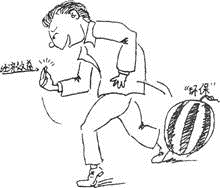
Study the following cartoon carefully and write an essay on it.In your essay, you should
(1) describe the cartoon briefly,
(2) analyze this situation, and
(3) give your comments.
You should write 160 -200 words neatly on ANSWER SHEET 2.
输入阅读码
查看答案与解析需要输入阅读码