英语等级考试《PETS三级》试题(网友回忆版)四
PETS三级
历年真题
共 67 题
1991 次浏览
更新于 2026-09-29
一、Listening
听力部分共25题,包括短对话、长对话、独白及讲座等多种听力材料,要求考生根据所听内容选择答案或完成填空。
Directions:
This section is designed to test your ability to understand spoken English.You will hear a selection of recorded materials and you must answer the questions that accompany them.There are two parts in this section, Part A and Part B.
Remember while you are doing the test, you should first put down your answers in your test booklet.At the end of the listening comprehension section, you will have 3 minutes to transfer your answers from your test booklet onto your ANSWER SHEET.
If you have any questions, you may raise your hand now as you will not be allowed to speak once the test has started.
Now look at Part A in your test booklet.
Part A
Directions: You will hear 10 short dialogues.For each dialogue, there is one question and four possible answers.Choose the correct answer—A,B, C or D, and mark it in your test booklet.You will have 15 seconds to answer the question and you will hear each dialogue only once.〈huixue_java/202410/OAOFMh_2014-3.mp3〉
This section is designed to test your ability to understand spoken English.You will hear a selection of recorded materials and you must answer the questions that accompany them.There are two parts in this section, Part A and Part B.
Remember while you are doing the test, you should first put down your answers in your test booklet.At the end of the listening comprehension section, you will have 3 minutes to transfer your answers from your test booklet onto your ANSWER SHEET.
If you have any questions, you may raise your hand now as you will not be allowed to speak once the test has started.
Now look at Part A in your test booklet.
Part A
Directions: You will hear 10 short dialogues.For each dialogue, there is one question and four possible answers.Choose the correct answer—A,B, C or D, and mark it in your test booklet.You will have 15 seconds to answer the question and you will hear each dialogue only once.〈huixue_java/202410/OAOFMh_2014-3.mp3〉
1
What does the man want to do?
- A.Attend a private party.
- B.Celebrate his birthday.
- C.Cancel his reservation.
- D.Reserve a dinner table.
2
Whom are the speakers expecting to come soon?
- A.A postman.
- B.A salesman.
- C.A repairman.
- D.A policeman.
3
How does the woman feel at the man’s words?
- A.She is excited.
- B.She is worried.
- C.She is satisfied.
- D.She is surprised.
4
What will the woman do?
- A.Go to bed for a rest.
- B.Take some medicine.
- C.Stay in with the man.
- D.Eat out with the man.
5
What do the speakers think of products manufactured nowadays?
- A.They are too expensive.
- B.They are difficult to use.
- C.They are of poor quality.
- D.They are out of fashion.
6
What do we learn about the man from the dialogue?
- A.He doesn’t need a car.
- B.He’s just got a good deal.
- C.He’s just bought a new car.
- D.He doesn’t have enough money.
7
What does the man think of Frank?
- A.He is dependable.
- B.He is weak-minded.
- C.He is a tough person.
- D.He is a flexible person.
8
What is the woman doing according to the dialogue?
- A.Arranging a seaside trip for old people.
- B.Expressing her thanks to the trip organizer.
- C.Complaining about yesterday’s seaside trip.
- D.Asking the trip organizer to improve his work.
9
What do we learn about the man last night?
- A.He couldn’t get out of his room.
- B.He left his key with his roommate.
- C.He couldn’t find the key to his room.
- D.He helped his neighbor break the lock.
10
What does the woman suggest the man do?
- A.Clean his glasses after painting.
- B.Take off his glasses before painting.
- C.Press the plastic wrap on the ceiling.
- D.Cover his glasses with the plastic wrap.
11
Part B
Directions:
You wil hear four dialogues or monologues.Before listening to each one y you will have 5 secondsto read each of the questions which accompany it.While listening, answer each question by choosing A, B, C or D.After listening, you will have 10 seconds to check your answer to each question.You will hear the recording only once.
Questions 11-13 are based on the following interview with the manager of a company that turns garbage into new products.
Where did the man get the money for his company?
Directions:
You wil hear four dialogues or monologues.Before listening to each one y you will have 5 secondsto read each of the questions which accompany it.While listening, answer each question by choosing A, B, C or D.After listening, you will have 10 seconds to check your answer to each question.You will hear the recording only once.
Questions 11-13 are based on the following interview with the manager of a company that turns garbage into new products.
Where did the man get the money for his company?
- A.From a bank.
- B.From his father.
- C.From his friends.
- D.From his employees.
12
What mistake does the man say his company made?
- A.It charged no licensing fee.
- B.It neglected product design.
- C.It ignored negotiating skills.
- D.It did all the manufacturing itself.
13
What does the man think of large companies?
- A.They are tough to work with.
- B.They welcome creative ideas.
- C.They recycle lots of garbage.
- D.They are good at manufacturing.
14
Questions 14-17 are based on part of a job interview.
What was the man’s major as an undergraduate?
What was the man’s major as an undergraduate?
- A.English.
- B.Physics.
- C.Fashion design.
- D.International trade.
15
What does the man think of his job in Magna Design?
- A.Interesting.
- B.Impressive.
- C.Demanding.
- D.Competitive.
16
What does the man expect from a new job?
- A.A quicker promotion.
- B.Greater success.
- C.More responsibilities.
- D.More challenges.
17
What job is the man applying for?
- A.Art designer.
- B.Assistant manager.
- C.German translator.
- D.Marketing director.
18
Questions 18-21 are based on a conversation
What did Edward want the man to do?
What did Edward want the man to do?
- A.To lend him his class notes.
- B.To help him go over the last class.
- C.To ask leave for him next Monday.
- D.To copy the class handouts for him.
19
Why is the man so upset?
- A.He has trouble with his chemistry.
- B.He has trouble with his classmates.
- C.He had to miss his chemistry class.
- D.He had to reject his friend’s request.
20
Why was Edward absent from his chemistry class?
- A.He went to a concert.
- B.He went to see a friend.
- C.He went to see a doctor.
- D.He went to a funny show.
21
What do we learn about the man?
- A.He’s a man of humor.
- B.He’s a man of ambition.
- C.He’s a man of principle.
- D.He’s a man of sympathy.
22
Questions 22-25 are based on a radio program about coffee vacations,
What does Smith say about coffee?
What does Smith say about coffee?
- A.It should be sold in cans.
- B.It should be drunk slowly.
- C.It should be long stored for better taste.
- D.It should be enjoyed together with wine.
23
What is the price of a coffee vacation per person in Italy?
- A.$100.
- B.$1,800.
- C.$ 1,895.
- D.$ 1,988.
24
How many days does the tour in Peru last?
- A.2.
- B.7.
- C.9.
- D.12.
25
What can vacationers do in Hawaii?
- A.Go on a coffee-farm driving tour.
- B.Visit female-owned coffee farms.
- C.See several different coffee houses.
- D.Explore the living history of coffee.
二、READING
根据题干选择正确的选项。
Directions:
Read the following text.Choose the best word or phrase for each numbered blank and mark A, B, C, or D on your ANSWER SHEET 1.
In the United States today, families basically have two contrasting attitudes toward television.Many families (26)______ the television to be on at any time of the day or night.Very often, (27)______ of these families watch television (28)______ or don’t interact with other family members (29)______ they are watching.The TV is used to make (30)______ kind of background noise in the house, (31)______ as a kind of electronic babysitter.Parents often turn it on to (32)______ “bored” children.In contrast, other families (33)______ control when the television will be watched and what programs can be watched.
(34)______these families watch programs together and discuss them together.In these homes, the TV is rarely on (35)______ nobody is watching it.Parents don’t use it as an electronic babysitter;(36)______, they insist that children read or play (37)______rather than sit in front of a screen.
(38)______the contrasting attitudes toward television (39)______, families in America are choosing television (40)______ other passive activities, such as watching movies, playing video games, and surfing the Web (41)______ regularity that has never happened before.These activities are (42)______ in their inactivity.Family members—young and old—watch rather than (43)______.These passive forms of entertainment (44)______, rather than encourage, family(45)______ and community involvement.
Read the following text.Choose the best word or phrase for each numbered blank and mark A, B, C, or D on your ANSWER SHEET 1.
In the United States today, families basically have two contrasting attitudes toward television.Many families (26)______ the television to be on at any time of the day or night.Very often, (27)______ of these families watch television (28)______ or don’t interact with other family members (29)______ they are watching.The TV is used to make (30)______ kind of background noise in the house, (31)______ as a kind of electronic babysitter.Parents often turn it on to (32)______ “bored” children.In contrast, other families (33)______ control when the television will be watched and what programs can be watched.
(34)______these families watch programs together and discuss them together.In these homes, the TV is rarely on (35)______ nobody is watching it.Parents don’t use it as an electronic babysitter;(36)______, they insist that children read or play (37)______rather than sit in front of a screen.
(38)______the contrasting attitudes toward television (39)______, families in America are choosing television (40)______ other passive activities, such as watching movies, playing video games, and surfing the Web (41)______ regularity that has never happened before.These activities are (42)______ in their inactivity.Family members—young and old—watch rather than (43)______.These passive forms of entertainment (44)______, rather than encourage, family(45)______ and community involvement.
26
______.
- A.allow
- B.enable
- C.cause
- D.require
27
______.
- A.parents
- B.members
- C.seniors
- D.children
28
______.
- A.singly
- B.loosely
- C.flexibly
- D.directly
29
______.
- A.which
- B.while
- C.whereas
- D.wherever
30
______.
- A.little
- B.such
- C.some
- D.this
31
______.
- A.or
- B.and
- C.thus
- D.so
32
______.
- A.enlighten
- B.entertain
- C.move
- D.manage
33
______.
- A.effectively
- B.strictly
- C.unwillingly
- D.widely
34
______.
- A.Never
- B.Hardly
- C.Seldom
- D.Often
35
______.
- A.if
- B.even if
- C.so
- D.so that
36
______.
- A.however
- B.instead
- C.moreover
- D.therefore
37
______.
- A.separately
- B.quietly
- C.creatively
- D.actively
38
______.
- A.Because of
- B.In place of
- C.In spite of
- D.Speaking of
39
______.
- A.viewing
- B.educating
- C.broadcasting
- D.programming
40
______.
- A.among
- B.despite
- C.and
- D.as
41
______.
- A.with
- B.by
- C.for
- D.over
42
______.
- A.usual
- B.common
- C.same
- D.similar
43
______.
- A.sleep
- B.sit
- C.eat
- D.do
44
______.
- A.weaken
- B.end
- C.avoid
- D.worry
45
______.
- A.building
- B.interaction
- C.planning
- D.reunion
Part A
Directions:
Read the following three texts.Answer the questions on each text by choosing A, B,C or D.Mark your answers on your ANSWER SHEET 1.
Text 1
Nisaburo and Hiroko Ohata are unlike most Japanese couples their age.Sure, Hiroko, 58, is worried about her husband’s high blood pressure, while Nisaburo, 60, promises his wife that if she loses 18 pounds they’ll take a trip abroad.What makes the Ohatas different is how they met, through a matchmaking organization for single seniors.“On the second date, he asked if I wanted to meet his family,” says Hiroko.“I took that as a proposal.” A little rushed, perhaps, but 17 years after his wife’s death, Nisaburo knew he’d found a new wife.The couple just celebrated four years of marital happiness last month.
In the past, people like Nisaburo and Hiroko might have chosen to live out their lives alone.But as Japan’s society ages, attitudes about love and remarriage late in life are changing.In 2006, according to government data, three times more men and nearly five times more women in their 60s and 70s married for at least the second time, compared with 20 years before.
Granted, change is slow.For this silver-haired population, the concept of “dating” is still masked by the term ocha nomi tomodachi (friends having tea together).And older people often need help meeting prospective mates.That’s where specialized matchmaking services such as Ai Senior —“Love Senior”—come in.When Shunichi Ikeda started the online service three years ago, he was surprised by how many visits he was getting from people in their 60s.
Ikeda says that his clients have an “American perspective” about the dating scene.And their children are often very supportive, sometimes being the ones to register parents.“More older people are realizing that life is supposed to be enjoyable—not lonely,” says Ikeda.About 17% of the matchmaking clients in Japan are over 50 years old, according to Ai Senior, and seniors’ market share has more than doubled over the past three years.
“For older, single men, even doing laundry or cooking is difficult,” says Ikeda.“They want to live with a woman.Likewise, it can be boring for women living alone.They want to provide for someone.”
Directions:
Read the following three texts.Answer the questions on each text by choosing A, B,C or D.Mark your answers on your ANSWER SHEET 1.
Text 1
Nisaburo and Hiroko Ohata are unlike most Japanese couples their age.Sure, Hiroko, 58, is worried about her husband’s high blood pressure, while Nisaburo, 60, promises his wife that if she loses 18 pounds they’ll take a trip abroad.What makes the Ohatas different is how they met, through a matchmaking organization for single seniors.“On the second date, he asked if I wanted to meet his family,” says Hiroko.“I took that as a proposal.” A little rushed, perhaps, but 17 years after his wife’s death, Nisaburo knew he’d found a new wife.The couple just celebrated four years of marital happiness last month.
In the past, people like Nisaburo and Hiroko might have chosen to live out their lives alone.But as Japan’s society ages, attitudes about love and remarriage late in life are changing.In 2006, according to government data, three times more men and nearly five times more women in their 60s and 70s married for at least the second time, compared with 20 years before.
Granted, change is slow.For this silver-haired population, the concept of “dating” is still masked by the term ocha nomi tomodachi (friends having tea together).And older people often need help meeting prospective mates.That’s where specialized matchmaking services such as Ai Senior —“Love Senior”—come in.When Shunichi Ikeda started the online service three years ago, he was surprised by how many visits he was getting from people in their 60s.
Ikeda says that his clients have an “American perspective” about the dating scene.And their children are often very supportive, sometimes being the ones to register parents.“More older people are realizing that life is supposed to be enjoyable—not lonely,” says Ikeda.About 17% of the matchmaking clients in Japan are over 50 years old, according to Ai Senior, and seniors’ market share has more than doubled over the past three years.
“For older, single men, even doing laundry or cooking is difficult,” says Ikeda.“They want to live with a woman.Likewise, it can be boring for women living alone.They want to provide for someone.”
46
According to the writer, the Ohatas are different from most senior Japanese couples in that ______.
- A.they remarried with the help of an agency
- B.they decided to marry on the second date
- C.the husband suffers from a health problem
- D.the wife is concerned about losing weight
47
As is implied in the text, Nisaburo’s proposal on the second date might be considered ______.
- A.typical of single seniors
- B.irresponsible to his family
- C.a surprise to the woman
- D.a decision made in haste
48
In Japan, the change in attitudes about remarriage results from an increase in ______.
- A.its population
- B.single women
- C.senior people
- D.the divorced
49
According to Ai Senior, the matchmaking clients in Japan ______.
- A.admire the American lifestyle
- B.are mostly under 50 years of age
- C.share a vague term for “dating”
- D.doubled over the past three years
50
According to Ikeda, more single seniors remarry in order to ______.
- A.live a longer life
- B.solve financial problems
- C.make their life enjoyable
- D.support their children together
Text 2
When you become a parent, much of your focus shifts from your own future to your kids’ future.But one of the most effective ways to help your children learn to dream big is to ensure that your own dreams don’t get pushed aside by everyday demands.
Our everyday experiences provide learning opportunities.When you tap into them, you create a lifelong learning habit that will always keep you growing.Even your most disappointing experiences can be turned into breakthroughs.
Every dream begins in the imagination.Take a few minutes to sit down with a notebook and think about where you would like to be in 20 years.Write down details about all aspects of your ideal life.Feel free to imagine.Don’t worry about whether you know how to get there now—you have 20 years to figure that out.You can also start by picking a year in the future and making a collection of things you’d like in your life by then.Check in on it from time to time to see where you’ve made progress.
We’re often encouraged to work on our weaknesses, but working on your strengths is easier and creates better results.For help of identifying them, ask some friends, or colleagues to write down what they most appreciate about you.They’ll enjoy doing this, and you’ll feel great when you read the responses.Once you know your strengths, you can put them to work to help you achieve your dreams.
Confidence is the foundation for all your other abilities.“Progress, not perfection” is a great saying to keep your confidence high.Every night, write down five achievements that happened that day.Big or small, it doesn’t matter.If proper, add ideas for further progress and actions you can take to get started.
Find ways to add what you love to do to your life now.This will give you more energy and keep you connected with your bigger dreams.Making a list of old hobbies is a great way to restore your old passions.Things you’re enthusiastic about come with their own store of energy.Connecting with them can give you a push when you most need it.
When you become a parent, much of your focus shifts from your own future to your kids’ future.But one of the most effective ways to help your children learn to dream big is to ensure that your own dreams don’t get pushed aside by everyday demands.
Our everyday experiences provide learning opportunities.When you tap into them, you create a lifelong learning habit that will always keep you growing.Even your most disappointing experiences can be turned into breakthroughs.
Every dream begins in the imagination.Take a few minutes to sit down with a notebook and think about where you would like to be in 20 years.Write down details about all aspects of your ideal life.Feel free to imagine.Don’t worry about whether you know how to get there now—you have 20 years to figure that out.You can also start by picking a year in the future and making a collection of things you’d like in your life by then.Check in on it from time to time to see where you’ve made progress.
We’re often encouraged to work on our weaknesses, but working on your strengths is easier and creates better results.For help of identifying them, ask some friends, or colleagues to write down what they most appreciate about you.They’ll enjoy doing this, and you’ll feel great when you read the responses.Once you know your strengths, you can put them to work to help you achieve your dreams.
Confidence is the foundation for all your other abilities.“Progress, not perfection” is a great saying to keep your confidence high.Every night, write down five achievements that happened that day.Big or small, it doesn’t matter.If proper, add ideas for further progress and actions you can take to get started.
Find ways to add what you love to do to your life now.This will give you more energy and keep you connected with your bigger dreams.Making a list of old hobbies is a great way to restore your old passions.Things you’re enthusiastic about come with their own store of energy.Connecting with them can give you a push when you most need it.
51
In order to help your children to dream big you must ______.
- A.fulfill everyday tasks
- B.build your own career
- C.keep your own dreams
- D.make them look ahead
52
The writer suggests that, to begin your big dream, you should ______.
- A.stretch your imagination
- B.have a best-laid plan for 20 years
- C.recollect all your likes and dislikes
- D.engage yourself in lifelong learning
53
According to the writer, to achieve our dreams, we should ______.
- A.work on our strengths
- B.develop our creativity
- C.identify our weaknesses
- D.seek advice from friends
54
To keep high confidence, it is important for one to ______.
- A.take appropriate actions
- B.notice his daily progress
- C.try his best in everything
- D.form new ideas every day
55
The writer thinks that one can hold fast to his dream by ______.
- A.listing the details of his ideal life
- B.improving some of his old hobbies
- C.adding new ideas to his old dreams
- D.energizing himself with old passions
Text 3
Commercial classical music radio in North America has changed dramatically over the past decade.The number of stations has shrunk very rapidly—many operators dropped the format in favor of something more profitable, like pop or rock, with their crazy youthful audience.But the availability of satellite radio, Internet streaming and digital technologies has introduced new options for classical fans.
In the city of Toronto, a familiar media player entered the tray last year: Moses Znaimer, 65, the famous brave television pioneer who was the driving force behind Toronto’s CITY-TV.Eleven months ago, he took ownership of Classical 96.3 FM, Canada’s first and largest commercial classical station, which “re-launched” this month with some new on-air hosts, a totally new schedule, and more attention to singing art and less to full-length symphonies.
The popular station airs selections (usually no more than 10 to 15 minutes long) of greatest- hits classical works, 24 hours a day.This usually means single movements of larger works and other pieces, with commercial ads in between.The station may never be the preferred destination of highbrow classical fans, who seek full-length symphonies and operas.But this doesn’t seem to trouble Znaimer, who says of his main competitor, CBC Radio Two: “They play classical, and they do it well when they do it, but they don’t do it all the time, and they’re doing it less and less.”
Marilyn Gilbert, a Toronto artist manager, also makes a comparison to Canada’s national broadcaster when she praises Znaimer’s station: “Classical 96.3 FM is very important for the community and the country, especially in view of the changes that are going on at CBC.’’
Znaimer is best-known for his influential work in television, but he was also one of the creators of Cross Country Checkup, the longest-running show on CBC Radio.Today he calls Classical 96.3 FM “arguably the most successful of all classical music stations on the continent.At about 800,000 listeners per week, we are larger even than the New York Times classical station [WQXR- FM].” And under his excellent and creative leadership, the sound of the station has become livelier.
Commercial classical music radio in North America has changed dramatically over the past decade.The number of stations has shrunk very rapidly—many operators dropped the format in favor of something more profitable, like pop or rock, with their crazy youthful audience.But the availability of satellite radio, Internet streaming and digital technologies has introduced new options for classical fans.
In the city of Toronto, a familiar media player entered the tray last year: Moses Znaimer, 65, the famous brave television pioneer who was the driving force behind Toronto’s CITY-TV.Eleven months ago, he took ownership of Classical 96.3 FM, Canada’s first and largest commercial classical station, which “re-launched” this month with some new on-air hosts, a totally new schedule, and more attention to singing art and less to full-length symphonies.
The popular station airs selections (usually no more than 10 to 15 minutes long) of greatest- hits classical works, 24 hours a day.This usually means single movements of larger works and other pieces, with commercial ads in between.The station may never be the preferred destination of highbrow classical fans, who seek full-length symphonies and operas.But this doesn’t seem to trouble Znaimer, who says of his main competitor, CBC Radio Two: “They play classical, and they do it well when they do it, but they don’t do it all the time, and they’re doing it less and less.”
Marilyn Gilbert, a Toronto artist manager, also makes a comparison to Canada’s national broadcaster when she praises Znaimer’s station: “Classical 96.3 FM is very important for the community and the country, especially in view of the changes that are going on at CBC.’’
Znaimer is best-known for his influential work in television, but he was also one of the creators of Cross Country Checkup, the longest-running show on CBC Radio.Today he calls Classical 96.3 FM “arguably the most successful of all classical music stations on the continent.At about 800,000 listeners per week, we are larger even than the New York Times classical station [WQXR- FM].” And under his excellent and creative leadership, the sound of the station has become livelier.
56
Many operators have dropped commercial classical radio in order to ______.
- A.make more profits
- B.promote pop music
- C.use new technology
- D.attract classical fans
57
From the text we learn that Moses Znaimer wanted to ______.
- A.consolidate his position at Classical 96.3 FM
- B.acquaint classical fans with some new radio stations
- C.help expand Toronto’s CITY-TV into a bigger business
- D.make Classical 96.3 FM more satisfying to classical fans
58
It can be inferred that Classical 96.3 FM makes money by ______.
- A.attracting and broadcasting commercials
- B.showing carefully selected programs
- C.competing with CBC Radio Two
- D.pleasing highbrow classical fans
59
Marilyn Gilbert believes Classical 96.3 FM ______.
- A.encourages people to learn classical music
- B.introduces a new idea to broadcasting reform
- C.matters a lot to the community and the country
- D.causes CBC to change its way of program arrangement
60
The success of Classical 96.3 FM lies in the fact that ______.
- A.it has reformed its traditional program style
- B.it is more diverse than WQXR-FM in New York
- C.it has attracted audiences of different age groups
- D.it is the biggest broadcasting station on the continent
Part B
Directions:
Read the texts from a magazine in which five people voice their different opinions responding to an article on the issue of social networking.For questions 61 to 65, match the name of each person (61 to 65) to one of the statements (A to G) given below.Mark your answers on your ANSWER SHEET 1.
Laura:
I think that I have to agree with you.The idea to surround yourself with good and successful people still rings true.The electronic age may aid contact and communication.However, it does not substitute for looking someone in the eye.One has to have that person-to-person feel to instinctively grasp inner character.I’ m sure that a combination of the two types of interaction will lend flavor to the future.
Mike:
I naturally tend to prefer face-to-face relationship building.However, having friends and business acquaintances all over the world, I find that tools such as Linkedln are quite useful.Both enable me to maintain old connections and make new connections with people I find I have something in common with.Learning how to use these vehicles is the key.I think we are presently in the process of doing just that.
Nick:
Just like what you have already mentioned, there is obviously a big difference between how people meet and interact on the net and in real world.What the network world offers is a more relaxed, fun, expressive place to be.I like social networking particularly because it offers me a chance to make a lot of friends.That social networking sites do not build long-lasting relationships is just a misconception.
Linda:
It is all about a combination of various networking sites, and, if you want to do business, just a few e-mail exchanges.That’s how I get to know my clients.Face-to-face networking is not always possible for me.I have clients around the globe, 99% of whom I’ve never met in person.People who oppose social-networking sites don’t understand the real changes that have taken place in the last decade.
Helen:
Sure enough, social networks are used to reconnect with friends.But they are also a tool for getting your business recognized.They are great places to place ads or comments about your business, because they are open to the public to view.It can be used as a way to network with would-be consumers.It is a perfect way to promote your business to the widest range of people globally.
Now match the name of each person (61 to 65) to the appropriate statement.
Note: there are two extra statements.
Directions:
Read the texts from a magazine in which five people voice their different opinions responding to an article on the issue of social networking.For questions 61 to 65, match the name of each person (61 to 65) to one of the statements (A to G) given below.Mark your answers on your ANSWER SHEET 1.
Laura:
I think that I have to agree with you.The idea to surround yourself with good and successful people still rings true.The electronic age may aid contact and communication.However, it does not substitute for looking someone in the eye.One has to have that person-to-person feel to instinctively grasp inner character.I’ m sure that a combination of the two types of interaction will lend flavor to the future.
Mike:
I naturally tend to prefer face-to-face relationship building.However, having friends and business acquaintances all over the world, I find that tools such as Linkedln are quite useful.Both enable me to maintain old connections and make new connections with people I find I have something in common with.Learning how to use these vehicles is the key.I think we are presently in the process of doing just that.
Nick:
Just like what you have already mentioned, there is obviously a big difference between how people meet and interact on the net and in real world.What the network world offers is a more relaxed, fun, expressive place to be.I like social networking particularly because it offers me a chance to make a lot of friends.That social networking sites do not build long-lasting relationships is just a misconception.
Linda:
It is all about a combination of various networking sites, and, if you want to do business, just a few e-mail exchanges.That’s how I get to know my clients.Face-to-face networking is not always possible for me.I have clients around the globe, 99% of whom I’ve never met in person.People who oppose social-networking sites don’t understand the real changes that have taken place in the last decade.
Helen:
Sure enough, social networks are used to reconnect with friends.But they are also a tool for getting your business recognized.They are great places to place ads or comments about your business, because they are open to the public to view.It can be used as a way to network with would-be consumers.It is a perfect way to promote your business to the widest range of people globally.
Now match the name of each person (61 to 65) to the appropriate statement.
Note: there are two extra statements.
61
Laura_______.
- A.I do not think that online friendships are short-lived.
- B.Networking can make your companies better known.
- C.I doubt if people could use networking vehicles properly.
- D.To benefit from networking, you should learn how to use it.
- E.To understand people better, you have to meet them in person.
- F.Social networking reflects the new demands of the changing time.
- G.In my opinion, networking has more disadvantages than advantages.
62
Mike_______.
- A.I do not think that online friendships are short-lived.
- B.Networking can make your companies better known.
- C.I doubt if people could use networking vehicles properly.
- D.To benefit from networking, you should learn how to use it.
- E.To understand people better, you have to meet them in person.
- F.Social networking reflects the new demands of the changing time.
- G.In my opinion, networking has more disadvantages than advantages.
63
Nick_______.
- A.I do not think that online friendships are short-lived.
- B.Networking can make your companies better known.
- C.I doubt if people could use networking vehicles properly.
- D.To benefit from networking, you should learn how to use it.
- E.To understand people better, you have to meet them in person.
- F.Social networking reflects the new demands of the changing time.
- G.In my opinion, networking has more disadvantages than advantages.
64
Linda_______.
- A.I do not think that online friendships are short-lived.
- B.Networking can make your companies better known.
- C.I doubt if people could use networking vehicles properly.
- D.To benefit from networking, you should learn how to use it.
- E.To understand people better, you have to meet them in person.
- F.Social networking reflects the new demands of the changing time.
- G.In my opinion, networking has more disadvantages than advantages.
65
Helen_______.
- A.I do not think that online friendships are short-lived.
- B.Networking can make your companies better known.
- C.I doubt if people could use networking vehicles properly.
- D.To benefit from networking, you should learn how to use it.
- E.To understand people better, you have to meet them in person.
- F.Social networking reflects the new demands of the changing time.
- G.In my opinion, networking has more disadvantages than advantages.
三、Writing
根据题干回答问题。
66
Directions:
You should write your responses to both Part A and Part B of this section SHEET 2.
Part A
You want to invite John Smith, your former English teacher, to attend a reunion party of your class.
Write an email to him,
1) telling him the purpose of the party, time and place of the party, etc.;
2) expressing your wish for his accepting the invitation.
You should write approximately 100 words.Do not use your own name; email.Use “Wang Lin” instead.
You should write your responses to both Part A and Part B of this section SHEET 2.
Part A
You want to invite John Smith, your former English teacher, to attend a reunion party of your class.
Write an email to him,
1) telling him the purpose of the party, time and place of the party, etc.;
2) expressing your wish for his accepting the invitation.
You should write approximately 100 words.Do not use your own name; email.Use “Wang Lin” instead.
67
Part B
Below is a chart showing the number of students wearing glasses within a class of 50 students in a junior high school.Look at the chart and write an essay of about 120 words making reference to the following points:
1) tendency of short-sightedness among the students;
2) possible reasons and solutions to the problem.
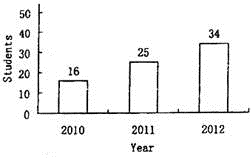
Below is a chart showing the number of students wearing glasses within a class of 50 students in a junior high school.Look at the chart and write an essay of about 120 words making reference to the following points:
1) tendency of short-sightedness among the students;
2) possible reasons and solutions to the problem.
输入阅读码
查看答案与解析需要输入阅读码