2021年全国英语竞赛《C类本科生》初赛试题(网友回忆版)
C类本科生
历年真题
共 59 题
16184 次浏览
更新于 2026-09-26
二、Part Ⅱ Vocabulary
15 marks
1
There are 15 incomplete sentences in this part. For each blank there are four choices marked A, B, C, and D. Choose the one that best completes the sentence. Then mark the corresponding letter on the answer sheet with a single line through the centre.
The rain was beating _____ the window and the sound made the couple feel quite put _____.
The rain was beating _____ the window and the sound made the couple feel quite put _____.
- A.against; out
- B.at; down
- C.on; off
- D.up; on
2
Mick always left his homework until the last minute. This often _____ him needing to stay up all night to finish the work.
- A.caught up
- B.pressed against
- C.pushed for
- D.resulted in
3
Some types of social networking site are popular but access is usually _____ to teenagers and children.
- A.allowed
- B.available
- C.off limits
- D.out of order
4
We surely can arrive at the destination on time but we’d better _____ some happenings on the trip.
- A.allow for
- B.lead to
- C.take in
- D.wait for
5
All the audience was quite disappointed at the performance for it was not so _____.
- A.conspicuous
- B.dramatic
- C.professional
- D.occupational
6
_____ the advances of science, the discomforts of old age will no doubt always be with us.
- A.As for
- B.Besides
- C.Despite
- D.Even if
7
_____ pretty late, they decided to leave _____, as they didn’t want to risk missing the last bus.
- A.As it being; right away
- B.Been; immediately
- C.It being; at once
- D.It was being; right now
8
My best friend and I _____ our differences in different ways. I like to talk about them but he likes to ignore them and _____ they don’t exist.
- A.amend; find out
- B.deal with; pretend
- C.learn about; forget
- D.sort out; make sure
9
The doctor warns me that eating too much fat can _____ heart disease and cause high blood pressure.
- A.attribute to
- B.contribute to
- C.devote to
- D.subscribe to
10
Mr. Johnson left for the office earlier than usual _____ traffic jam.
- A.at the risk of
- B.for the sake of
- C.in case of
- D.in spite of
11
Government reports, examination compositions, legal documents and most letters are the main situations _____ formal language is used.
- A.at what
- B.in that
- C.in which
- D.on which
12
If something such as a painting or piece of writing is _____, it is genuine rather than being an imitation.
- A.authentic
- B.authoritative
- C.exemplary
- D.solitary
13
Our holidays were ruined by the weather: _____ have stayed at home!
- A.it may be as well we
- B.it was just as well we
- C.we might just as well
- D.we might as well to
14
—Oh, no! Commercials again! I’m sick and tired of watching the same commercials over and over again.
—_____
— Is there any way we can live without advertisements?
— I really doubt it.
—_____
— Is there any way we can live without advertisements?
— I really doubt it.
- A.That’s not fair!
- B.I know what you mean.
- C.Do you have another choice?
- D.Can you just stop it!
15
—I do believe that patience and motivation are more important than one’s IQ in achieving success.
—_____
—_____
- A.Neither do I.
- B.You are going too far.
- C.Does it work?
- D.That makes sense.
三、Part Ⅲ Cloze
10 marks
Read the following passage and fill in each blank with one word. Choose the correct word in one of the following three ways: according to the context, by using the correct form of the given word, or by using the given letter(s) of the word. Remember to write the answers on the answer sheet.
Do you drink milk or orange juice that comes in plastic bottles? Do you eat cereal that is (46) _____ (package) in a box? If you do, you can help save the environment by creating less waste! And you can do that by practicing the three Rs—reduce, reuse, and recycle. To reduce is to use less, to reuse is to use things again, and to recycle is to turn old things (47) _____ new things.
Creating less waste begins with thinking about the packages your milk, cereal, and other things you buy come in. A package only needs to keep the (48) pro_____ inside safe. Flashy packages just create more waste. When you have a choice, buy packages that are plain and (49) rec_____. Another way to reduce waste is to say no to store bags. If you buy only one or two things, you could carry them home in your hands, or you could take your old plastic bag back to the grocery store to be reused.
There are many ways to reuse material. Be careful when (50) _____ (wrap) a present and try not to rip the wrapping paper. You could save it and use it again. Shoe boxes can be used to store paper (51) doc_____ or other small items and cereal boxes can be used as cardboard to make new school projects.
There are probably many (52) _____ (dispose) items in your home that you could use again, such as plastic cups, plates, and utensils. Plastic forks, knives, and spoons can be washed and used again rather than being thrown in the garbage. Most of them will last a long time.
(53) Rec_____ happens when materials are made into the same or new items. Making new items from old ones uses (54) _____ energy and natural resources than making those same things from new materials.
Plastic soda bottles are recycled and made into T-shirts, combs, and other plastic goods. Aluminum cans are used to make new cans, etc.
There is so much you can do with very little work, and your small steps will make a big (55) dif_____. And just imagine how great it would be if everyone practiced the three Rs! Don’t wait—start now!
Do you drink milk or orange juice that comes in plastic bottles? Do you eat cereal that is (46) _____ (package) in a box? If you do, you can help save the environment by creating less waste! And you can do that by practicing the three Rs—reduce, reuse, and recycle. To reduce is to use less, to reuse is to use things again, and to recycle is to turn old things (47) _____ new things.
Creating less waste begins with thinking about the packages your milk, cereal, and other things you buy come in. A package only needs to keep the (48) pro_____ inside safe. Flashy packages just create more waste. When you have a choice, buy packages that are plain and (49) rec_____. Another way to reduce waste is to say no to store bags. If you buy only one or two things, you could carry them home in your hands, or you could take your old plastic bag back to the grocery store to be reused.
There are many ways to reuse material. Be careful when (50) _____ (wrap) a present and try not to rip the wrapping paper. You could save it and use it again. Shoe boxes can be used to store paper (51) doc_____ or other small items and cereal boxes can be used as cardboard to make new school projects.
There are probably many (52) _____ (dispose) items in your home that you could use again, such as plastic cups, plates, and utensils. Plastic forks, knives, and spoons can be washed and used again rather than being thrown in the garbage. Most of them will last a long time.
(53) Rec_____ happens when materials are made into the same or new items. Making new items from old ones uses (54) _____ energy and natural resources than making those same things from new materials.
Plastic soda bottles are recycled and made into T-shirts, combs, and other plastic goods. Aluminum cans are used to make new cans, etc.
There is so much you can do with very little work, and your small steps will make a big (55) dif_____. And just imagine how great it would be if everyone practiced the three Rs! Don’t wait—start now!
16
( )
17
( )
18
( )
19
( )
20
( )
21
( )
22
( )
23
( )
24
( )
25
( )
四、Part Ⅳ RC
30 marks(Reading Comprehension)
There are three passages in this part. Each passage is followed by several questions. Respond to the questions using information from the passage. Remember to write the answers on the answer sheet.
Section A (10 marks)
Questions 56 to 60 are based on the following passage.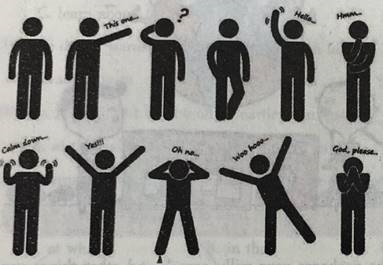 When you talk to people face to face, you communicate with much more than your words and the sound of your voice. (56)_____ In fact, in any communication, over 50 per cent of the information you give comes from your body language. We all use body language, whether consciously or subconsciously, and it can tell people more about us than we might want them to know.
(57)_____. This is often a conscious way of communicating. Smiling shows you are happy, shrugging your shoulders tells someone that you don’t know something or that you don’t care, and waving is a way of saying ‘hello’ or ‘goodbye’. There are other gestures, however, that give information without your realising it. Crossing your arms may indicate that you are puzzled, tapping your foot might mean you are feeling impatient, and fidgeting might show you are nervous.
When people are good friends or when two people agree with each other, they often echo each other’s body language, crossing their legs in the same way or using the same gestures. This is often done subconsciously but a person might copy someone else’s body movements consciously to make fun of them.
How often you look into someone’s eyes also sends powerful messages. We make eye contact more often in a conversation with friends than with strangers, and lack of eye contact can indicate nervousness. In general conversations, we look at each other for short periods of time, but when the topic becomes more personal we often look away. (58)_____. If someone avoids eye contact altogether when speaking, it might mean they are not telling the truth.
(59)_____. Standing close together, for example, can suggest intimacy, whilst distance may indicate formality or a lack of interest. Standing close to someone may be quite appropriate in some situations, such as an informal party, but completely out of place in others, such as a meeting with your boss.
Body language can sometimes get you into trouble when you travel abroad. Smiling is an almost universal signal of pleasure or welcome, but other gestures may have different meanings in different cultures. The same gesture, used in different cultures, can mean ‘OK’, ‘zero’, ‘fantastic result’, ‘money’—or something much more insulting! (60)_____. Your body may be saying a lot more than you think!
Questions 56—60
Complete the passage with the following sentences. There are two extra sentences that you do not need to use.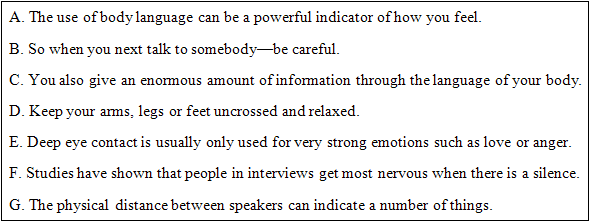
Section A (10 marks)
Questions 56 to 60 are based on the following passage.
When you talk to people face to face, you communicate with much more than your words and the sound of your voice. (56)_____ In fact, in any communication, over 50 per cent of the information you give comes from your body language. We all use body language, whether consciously or subconsciously, and it can tell people more about us than we might want them to know.(57)_____. This is often a conscious way of communicating. Smiling shows you are happy, shrugging your shoulders tells someone that you don’t know something or that you don’t care, and waving is a way of saying ‘hello’ or ‘goodbye’. There are other gestures, however, that give information without your realising it. Crossing your arms may indicate that you are puzzled, tapping your foot might mean you are feeling impatient, and fidgeting might show you are nervous.
When people are good friends or when two people agree with each other, they often echo each other’s body language, crossing their legs in the same way or using the same gestures. This is often done subconsciously but a person might copy someone else’s body movements consciously to make fun of them.
How often you look into someone’s eyes also sends powerful messages. We make eye contact more often in a conversation with friends than with strangers, and lack of eye contact can indicate nervousness. In general conversations, we look at each other for short periods of time, but when the topic becomes more personal we often look away. (58)_____. If someone avoids eye contact altogether when speaking, it might mean they are not telling the truth.
(59)_____. Standing close together, for example, can suggest intimacy, whilst distance may indicate formality or a lack of interest. Standing close to someone may be quite appropriate in some situations, such as an informal party, but completely out of place in others, such as a meeting with your boss.
Body language can sometimes get you into trouble when you travel abroad. Smiling is an almost universal signal of pleasure or welcome, but other gestures may have different meanings in different cultures. The same gesture, used in different cultures, can mean ‘OK’, ‘zero’, ‘fantastic result’, ‘money’—or something much more insulting! (60)_____. Your body may be saying a lot more than you think!
Questions 56—60
Complete the passage with the following sentences. There are two extra sentences that you do not need to use.
26
( )
27
( )
28
( )
29
( )
30
( )
Section B (10 marks)
Questions 61 to 65 are based on the following passage.
If you fly over the Nazca Desert along the southern coast of Peru, you will see huge drawings in the sand: a monkey, a spider, flowers, triangles, rectangles, zigzags, spirals, even human forms with crowned heads. Also, straight lines can be seen spreading out from a circle, like spokes in a wheel. Some drawings are more than six hundred feet from end to end, longer than two football fields. Some continue for miles, up hills and down valleys. In all, the markings cover 250 square miles of desert. Some drawings are so large that you can tell what they are only by looking at them from the air. But no one knows how they got there, or why.
We do know they were made about two thousand years ago by South American Indians called the Nazcas. The Nazca people lived in a green valley just below a huge stretch of desert called the pampas, meaning ‘flat place’. The air around the pampas is hot and dry, and the pampas gets only about half an inch of rain each year. So the markings made long ago on its sandy, stony surface have not been worn away by the weather even after two thousand years.
To find some clues about why the drawings were made, we can turn to history and anthropology. We know that Spain conquered Peru in 1532. The Spaniards destroyed much of the Peruvian way of life, except in remote regions of the Andes Mountains. Today, descendants of the Peruvian natives who survived live in villages along the mountainsides. Farmers there have to hike thousands of feet each day to reach their fields. On their way, many of them perform religious ceremonies. Those ceremonies offer clues to the meaning of the Nazca lines.
When you look at the drawings from the ground, the lines look like pathways. Along the pathways are stone mounds, littered with scraps of broken pottery. The pathways resemble the mountain paths where today’s farmers make their religious processions. The farmers leave offerings at stone mounds, which they call wa’kas, meaning shrines. The offerings include pieces of pottery, seashells, coca leaves, and food.
In these sacred ceremonies, farmers ask the mountain gods and animal spirits of the Andes to send them water. Since similar offerings are found on the lines and mounds of the pampas, it is likely that the ancient Nazcas had similar beliefs. Since the pampas is one of the driest deserts on earth, it makes sense that the Nazcas would worship gods to bring them water. Perhaps the drawings were meant to be viewed by the gods.
Perhaps we will never know the real meaning of the Nazca lines. But we do know that even though the Nazcas had none of our modern technology and few of the comforts of our modern society, they did extraordinary things. They made pottery and cloth with so much detail and colour that it is believed to be some of the best ever made. They developed superior irrigation canals for watering their fields. Then, too, they left us those mysterious drawings in the sand, leaving us wondering still about the people who made them.
Questions 61 to 65
Answer the following questions according to the passage.
Questions 61 to 65 are based on the following passage.
If you fly over the Nazca Desert along the southern coast of Peru, you will see huge drawings in the sand: a monkey, a spider, flowers, triangles, rectangles, zigzags, spirals, even human forms with crowned heads. Also, straight lines can be seen spreading out from a circle, like spokes in a wheel. Some drawings are more than six hundred feet from end to end, longer than two football fields. Some continue for miles, up hills and down valleys. In all, the markings cover 250 square miles of desert. Some drawings are so large that you can tell what they are only by looking at them from the air. But no one knows how they got there, or why.
We do know they were made about two thousand years ago by South American Indians called the Nazcas. The Nazca people lived in a green valley just below a huge stretch of desert called the pampas, meaning ‘flat place’. The air around the pampas is hot and dry, and the pampas gets only about half an inch of rain each year. So the markings made long ago on its sandy, stony surface have not been worn away by the weather even after two thousand years.
To find some clues about why the drawings were made, we can turn to history and anthropology. We know that Spain conquered Peru in 1532. The Spaniards destroyed much of the Peruvian way of life, except in remote regions of the Andes Mountains. Today, descendants of the Peruvian natives who survived live in villages along the mountainsides. Farmers there have to hike thousands of feet each day to reach their fields. On their way, many of them perform religious ceremonies. Those ceremonies offer clues to the meaning of the Nazca lines.
When you look at the drawings from the ground, the lines look like pathways. Along the pathways are stone mounds, littered with scraps of broken pottery. The pathways resemble the mountain paths where today’s farmers make their religious processions. The farmers leave offerings at stone mounds, which they call wa’kas, meaning shrines. The offerings include pieces of pottery, seashells, coca leaves, and food.
In these sacred ceremonies, farmers ask the mountain gods and animal spirits of the Andes to send them water. Since similar offerings are found on the lines and mounds of the pampas, it is likely that the ancient Nazcas had similar beliefs. Since the pampas is one of the driest deserts on earth, it makes sense that the Nazcas would worship gods to bring them water. Perhaps the drawings were meant to be viewed by the gods.
Perhaps we will never know the real meaning of the Nazca lines. But we do know that even though the Nazcas had none of our modern technology and few of the comforts of our modern society, they did extraordinary things. They made pottery and cloth with so much detail and colour that it is believed to be some of the best ever made. They developed superior irrigation canals for watering their fields. Then, too, they left us those mysterious drawings in the sand, leaving us wondering still about the people who made them.
Questions 61 to 65
Answer the following questions according to the passage.
31
Why do we have to look at some of the Nazca drawings from the air?
32
Why do the Nazca drawings still exist after two thousand years?
33
Where do descendants of the Peruvian natives live now?
34
Why did the Nazca farmers hold sacred ceremonies?
35
Why are the Nazcas considered extraordinary?
Section C (10 marks)
Questions 66 to 70 are based on the following passage.
Sciart was originally established to fund visual arts projects which involved an artist and a scientist working in collaboration to research, develop and produce work which explored contemporary biological and medical science. Over time, the programme expanded to cover a wider range of arts and science activity. In total, Sciart supported 118 projects with nearly £3 million of funding to increase interest and excitement in biomedical science among adults, to encourage collaborative creative practices between disciplines in the arts and science, and to create a group of artists looking at biomedical science and build capacity in this field.
Interview evidence from those involved in Sciart projects suggested that the collaborations between artists and scientists had helped to raise awareness among project participants and the wider public of connections between aspects of arts and sciences. An effect of this had been to encourage, at policy making and funding levels, more interest to be taken and more resources to be used to promote interactions between the two. As one participant who was interviewed commented:
Connecting the sensory with the conceptual is something that is fundamental to artistic and scientific methods. That awareness has got lost at a public level. And Sciart collaborations and the publicly visible outcomes help to demonstrate those connections, which have tended to become ignored. Sciart had made the similarities between science and art more evident.
Interviews with a significant number of artists and scientists who had participated in Sciart-funded projects revealed that the process of collaboration and of observing each other’s professional practices and cultures had led to previously unnoticed similarities between the ‘two cultures’ being recognized. The process of recognition provided a point of familiarity that generally seemed to encourage or reassure those concerned. The combination of strangeness and familiarity was perceived by some as a basis on which to engage in collaboration across disciplines.
Scientists’ testimonies:
It has made me think more about the coming together of art and science. At the centre of scientific and artistic thinking there are acts of creativity, and I don’t think that those acts of creativity necessarily differ, although the content may differ.
Artists’ testimonies:
I was intrigued by the radical differences between the artistic process and the scientific method, but also by the overlaps, such as the opening up of new ideas, the creative manipulation of materials and the process of experimentation. Both science and art require thinking in their own ways, and they both require observation of the natural world...
It was very clear from the testimonies of interviewees from both sides of the art-science divide, and from those participating in projects as well as those observing them, that a great deal of mutual respect between the two cultures had grown up as a consequence of Sciart-funded collaborations.
Questions 66 to 70
Complete the summary below with information from the passage, using no more than three words for each blank.
The Sciart programme was basically launched to fund 66. _____ between scientists and artists, eventually covering 118 projects that were not just involved in art and biomedical science. When participants were interviewed about the Sciart projects, they felt the projects increased 67. _____ of the connections between aspects of 68. _____ among themselves and the general public. The result of this was that attempts were made to 69. _____ between both cultures. One interview comment was that Sciart has made the similarities between science and art 70. _____.
Questions 66 to 70 are based on the following passage.
Sciart was originally established to fund visual arts projects which involved an artist and a scientist working in collaboration to research, develop and produce work which explored contemporary biological and medical science. Over time, the programme expanded to cover a wider range of arts and science activity. In total, Sciart supported 118 projects with nearly £3 million of funding to increase interest and excitement in biomedical science among adults, to encourage collaborative creative practices between disciplines in the arts and science, and to create a group of artists looking at biomedical science and build capacity in this field.
Interview evidence from those involved in Sciart projects suggested that the collaborations between artists and scientists had helped to raise awareness among project participants and the wider public of connections between aspects of arts and sciences. An effect of this had been to encourage, at policy making and funding levels, more interest to be taken and more resources to be used to promote interactions between the two. As one participant who was interviewed commented:
Connecting the sensory with the conceptual is something that is fundamental to artistic and scientific methods. That awareness has got lost at a public level. And Sciart collaborations and the publicly visible outcomes help to demonstrate those connections, which have tended to become ignored. Sciart had made the similarities between science and art more evident.
Interviews with a significant number of artists and scientists who had participated in Sciart-funded projects revealed that the process of collaboration and of observing each other’s professional practices and cultures had led to previously unnoticed similarities between the ‘two cultures’ being recognized. The process of recognition provided a point of familiarity that generally seemed to encourage or reassure those concerned. The combination of strangeness and familiarity was perceived by some as a basis on which to engage in collaboration across disciplines.
Scientists’ testimonies:
It has made me think more about the coming together of art and science. At the centre of scientific and artistic thinking there are acts of creativity, and I don’t think that those acts of creativity necessarily differ, although the content may differ.
Artists’ testimonies:
I was intrigued by the radical differences between the artistic process and the scientific method, but also by the overlaps, such as the opening up of new ideas, the creative manipulation of materials and the process of experimentation. Both science and art require thinking in their own ways, and they both require observation of the natural world...
It was very clear from the testimonies of interviewees from both sides of the art-science divide, and from those participating in projects as well as those observing them, that a great deal of mutual respect between the two cultures had grown up as a consequence of Sciart-funded collaborations.
Questions 66 to 70
Complete the summary below with information from the passage, using no more than three words for each blank.
The Sciart programme was basically launched to fund 66. _____ between scientists and artists, eventually covering 118 projects that were not just involved in art and biomedical science. When participants were interviewed about the Sciart projects, they felt the projects increased 67. _____ of the connections between aspects of 68. _____ among themselves and the general public. The result of this was that attempts were made to 69. _____ between both cultures. One interview comment was that Sciart has made the similarities between science and art 70. _____.
36
( )
37
( )
38
( )
39
( )
40
( )
五、Part Ⅴ Translation
15 marks
41
Section A (5 marks)
Translate the following paragraph into Chinese. Remember to write the answers on the answer sheet.
As of mid-April in 2020, 191 countries announced or implemented school or university closures, impacting 1.57 billion students. Many educational institutions started offering courses online to ensure education was not disrupted by quarantine measures. Technologies involved in distant learning are similar to those for remote work and also include virtual reality, 3D printing and artificial-intelligence-enabled robot teachers. Meanwhile, concerns about distant learning also arise which include the possibility the technologies could create a wider divide in terms of digital readiness and income level.
Translate the following paragraph into Chinese. Remember to write the answers on the answer sheet.
As of mid-April in 2020, 191 countries announced or implemented school or university closures, impacting 1.57 billion students. Many educational institutions started offering courses online to ensure education was not disrupted by quarantine measures. Technologies involved in distant learning are similar to those for remote work and also include virtual reality, 3D printing and artificial-intelligence-enabled robot teachers. Meanwhile, concerns about distant learning also arise which include the possibility the technologies could create a wider divide in terms of digital readiness and income level.
42
Section B (10 marks)
Translate the following sentences in the following paragraph into English by using the hints given in brackets. Remember to write the answers on the answer sheet.
人生总是有灾难。其实大多数人早已练就了对灾难的从容,我们只是还没有学会灾难间隙的快乐。(72)我们充分意识到远处的灾难,却很少意识到身边的幸福。(be aware of)请从此注意幸福!幸福也需要提醒吗?提醒注意跌倒……提醒注意路滑……提醒受骗上当……提醒荣辱不惊……(73)先哲们一次次提醒我们这灾难那灾难,却从不提醒我们幸福。(remind of)
也许他们认为幸福不提醒也跑不了的。也许他们以为好的东西你自会珍惜,犯不上谆谆告诫。也许他们太崇尚血与火,觉得幸福无足挂齿。他们总是站在危崖上,指点我们逃离未来的苦难。但避去苦难之后的时间是什么?那就是幸福啊!
享受幸福是需要学习的,幸福即将来临的时刻需要提醒。(74)人知道如何沉溺感官的享乐,却没有能力掌握幸福的韵律。(indulge in)灵魂的快意同器官的舒适像一对孪生兄弟,时而相傍相依,时而南辕北辙。(75)幸福是心灵的感觉,它像倾听音乐的耳朵一样,需要不断地训练。(the ear for music)简言之,幸福就是没有痛苦的时刻。它出现的频率并不像我们想象的那样少。
(76)实际上,幸福不在于拥有金钱,而在于获得成就时的喜悦以及产生创造力的激情。(lie in)
Translate the following sentences in the following paragraph into English by using the hints given in brackets. Remember to write the answers on the answer sheet.
人生总是有灾难。其实大多数人早已练就了对灾难的从容,我们只是还没有学会灾难间隙的快乐。(72)我们充分意识到远处的灾难,却很少意识到身边的幸福。(be aware of)请从此注意幸福!幸福也需要提醒吗?提醒注意跌倒……提醒注意路滑……提醒受骗上当……提醒荣辱不惊……(73)先哲们一次次提醒我们这灾难那灾难,却从不提醒我们幸福。(remind of)
也许他们认为幸福不提醒也跑不了的。也许他们以为好的东西你自会珍惜,犯不上谆谆告诫。也许他们太崇尚血与火,觉得幸福无足挂齿。他们总是站在危崖上,指点我们逃离未来的苦难。但避去苦难之后的时间是什么?那就是幸福啊!
享受幸福是需要学习的,幸福即将来临的时刻需要提醒。(74)人知道如何沉溺感官的享乐,却没有能力掌握幸福的韵律。(indulge in)灵魂的快意同器官的舒适像一对孪生兄弟,时而相傍相依,时而南辕北辙。(75)幸福是心灵的感觉,它像倾听音乐的耳朵一样,需要不断地训练。(the ear for music)简言之,幸福就是没有痛苦的时刻。它出现的频率并不像我们想象的那样少。
(76)实际上,幸福不在于拥有金钱,而在于获得成就时的喜悦以及产生创造力的激情。(lie in)
六、Part Ⅵ EC
10 marks(Error Correction)
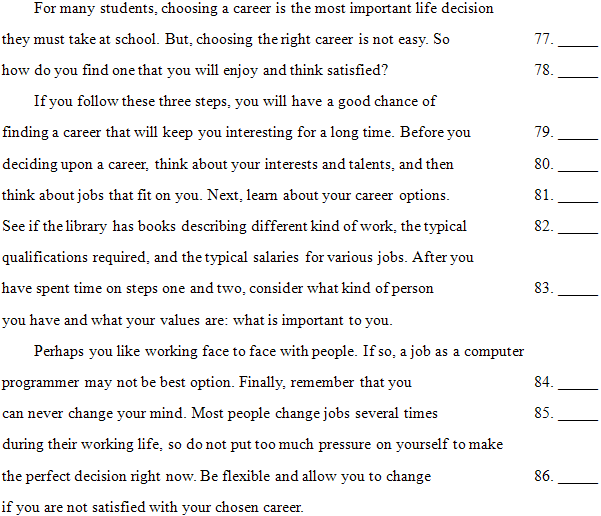
Proofread the passage as required. Each indicated line contains a maximum of one error. Correct the passage in the following ways: for a right line, put the sign “√” in the corresponding blank; for a wrong word, underline the wrong word and write the correct one in the blank; for a missing word, mark the position of the missing word with the sign “∧” and write the word you believe to be missing in the blank; for an unnecessary word, cross the unnecessary word with the sign “\” and put the word with the sign in the blank. Write the answers on the answer sheet.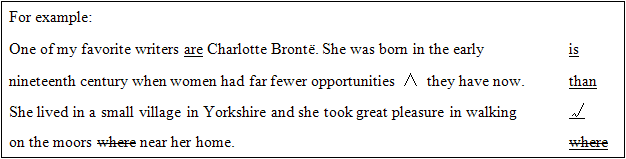
43
( )
44
( )
45
( )
46
( )
47
( )
48
( )
49
( )
50
( )
51
( )
52
( )
七、Part Ⅶ IQ Test
10 marks
53
There are five IQ Test question in this part. Write the answers on the answer sheet.
Find a letter to fill in the blank to make a rational sequence.
A D I P ( )
Find a letter to fill in the blank to make a rational sequence.
A D I P ( )
54
— What a great place for window-shopping!
— I’d give my right arm for a necklace like that!
What does “give my right arm” mean in Chinese?
— I’d give my right arm for a necklace like that!
What does “give my right arm” mean in Chinese?
55
What is the opposite of ‘hardly’?
rarely, a lot, little, poorly, never, quickly
rarely, a lot, little, poorly, never, quickly
56
What do you have in December that you can’t have in any other month?
57
Which shape or pattern completes the second pair in the same way as the first pair?
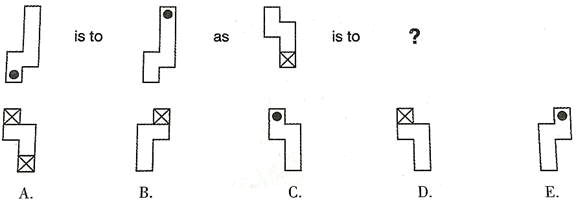
八、Part Ⅷ Writing
30 marks
58
Section A (10 marks)
Read the chart and write a 120-word report on the added value of China’s service industry from 2015 to 2019. Write the report on the answer sheet.

Read the chart and write a 120-word report on the added value of China’s service industry from 2015 to 2019. Write the report on the answer sheet.
59
Section B (20 marks)
There is one famous verse in Tang poetry, which reads: “I left home when a mere stripling, and returned in old age. While my native accents still remained, my ear-lock had grown thin”. This verse shows language is not only a tool for communication, but also the indicator of people’s cultural identity and the vessel of group memory. What is your opinion about mandarin (普通话) and dialects?
Write an essay in at least 180 words on the answer sheet.
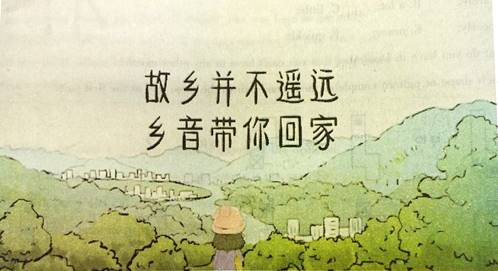
There is one famous verse in Tang poetry, which reads: “I left home when a mere stripling, and returned in old age. While my native accents still remained, my ear-lock had grown thin”. This verse shows language is not only a tool for communication, but also the indicator of people’s cultural identity and the vessel of group memory. What is your opinion about mandarin (普通话) and dialects?
Write an essay in at least 180 words on the answer sheet.
输入阅读码
查看答案与解析需要输入阅读码