2027年硕士研究生《英语二》模拟试卷二
英语二
模拟试卷
共 48 题
4320 次浏览
更新于 2026-09-26
一、完形填空
下列每小题的四个选项中,只有一项是最符合题意的正确答案,多选、错选或不选均不得分。
The more parents talk to their children, the faster those children's vocabularies grow and the better their intelligence develops.In 1995, Betty Hart and Todd Risley of the university of Kansas found a close 1 between the number of words a child's parents have spoken to him 2 the time he was three and his 3 success at the age of nine.At three, children born into professional families had 4 30m more words than those from a poorer background.This observation has profound 5 for policies about babies and their parents.It suggested that sending children to "pre-school" ( 6 or kindergartens) at the age of four—a favored 7 among policymakers—comes too late to 8 for educational shortcomings at home.9, understanding of how children's vocabularies develop is growing.One of the most striking 10 came from Anne Fernald, who has found that the difference 11 well before a child is three.Even at the 12 age of 18 months, when most toddlers speak only a dozen words, those from 13 families are several months behind other more favored children.14, Dr.Fernald thinks the differentiation starts at birth.She 15 how quickly toddlers process language by sitting them on their mother's laps and showing them two images: a dog and a ball.A recorded voice tells the toddler to look at the ball while a camera records his 16.This lets Dr.Fernald 17 the moment the child's gaze begins 18 towards the correct image.At 18 months, toddlers from 19 backgrounds can identify the correct object in 750 milliseconds—200 milliseconds faster than those from poorer families; This, says Dr.Fernald, is a/an 20 difference.
1
第(1)题选
- A.conflict
- B.correlation
- C.gap
- D.difference
2
第(2)题选
- A.by
- B.at
- C.during
- D.after
3
第(3)题选
- A.athletic
- B.commercial
- C.professional
- D.academic
4
第(4)题选
- A.learned
- B.spoken
- C.heard
- D.mastered
5
第(5)题选
- A.implications
- B.manipulations
- C.supervisions
- D.requirements
6
第(6)题选
- A.colleges
- B.museums
- C.gyms
- D.nurseries
7
第(7)题选
- A.step
- B.reflection
- C.threat
- D.illusion
8
第(8)题选
- A.eliminate
- B.compensate
- C.evaluate
- D.highlight
9
第(9)题选
- A.Worriedly
- B.Consequently
- C.Happily
- D.Unconsciously
10
第(10)题选
- A.revelations
- B.conventions
- C.dimensions
- D.definition
11
第(11)题选
- A.transforms
- B.appears
- C.terminates
- D.survives
12
第(12)题选
- A.suitable
- B.juvenile
- C.tender
- D.senior
13
第(13)题选
- A.disadvantaged
- B.privileged
- C.prominent
- D.immigrated
14
第(14)题选
- A.Otherwise
- B.Indeed
- C.Therefore
- D.However
15
第(15)题选
- A.sustains
- B.suspects
- C.measures
- D.determines
16
第(16)题选
- A.assessment
- B.supervision
- C.standpoint
- D.reaction
17
第(17)题选
- A.display
- B.stimulate
- C.note
- D.approve
18
第(18)题选
- A.transferring
- B.shifting
- C.restricting
- D.distracting
19
第(19)题选
- A.better-off
- B.normal
- C.typical
- D.needy
20
第(20)题选
- A.minor
- B.external
- C.universal
- D.huge
二、阅读理解Part A
下列每小题的四个选项中,只有一项是最符合题意的正确答案,多选、错选或不选均不得分。
The most powerful false-news weapon in history is around the corner.If technology continues its current advance, we may soon face totally convincing videos showing events that never happened―created so effectively that even experts will have trouble proving they're fakes."Deep fake" video will be able to show people saying, with the reliable ring of their own voices, things they never said.It will show them doing things they never did.In some ways, deep fake videos are no worse than rumors or false news stories.People will believe and share anything they find engaging or that reinforces their beliefs.But videos are more dangerous because of the authority this medium has taken on in society.For years, video has been the ultimate argument-settler.Online news outlets routinely hyper link videos into stories to buttress the credibility of their reporting.Given the existing danger to truth that deep fakes present, the media industry must make its own efforts to counter the threat―and it can be effective, if it acts quickly.Right now, we have a window of opportunity in which most fake videos are far from perfect.In many cases, it's laughably obvious that the images are manipulated.In others, fake video looks convincing to the naked eye, but technical tests can easily demonstrate that it's a fraud.But the quality of technology we already see in the best science-fiction and fantasy movies, as well as the most sophisticated video games, shows us what will inevitably be available for broader exploitation―to far more vicious ends.This window gives us a chance to sound public alarms about deep fakes, promote basic tips on detecting them and immunize audiences against the better fakes to come.It's not an impossible lift; the public is well aware of fabricated pictures and fake news stories (even if, unfortunately, they still share them).News coverage of the dangers of deep fakes will find a ready audience.News companies can also publicize analytics sites and browser extensions that can alert viewers to video fakery.Unless the dangers of fake video receive broad public attention now, the public will be caught unaware when truly convincing fakes appear, perhaps with disastrous results.Finally, in publicizing the dangers, media need to avoid a tone of hopelessness―"Soon we may never know what is real and what isn't." Quality media outlets need to emphasize how carefully they review video.They should make sure their ethics codes and verification procedures adequately address the dangers.Otherwise, audiences will doubt any video―including legitimate and important footage that media outlets gather in their own breaking-news coverage and investigative work.
21
What can we learn from the first three paragraphs?
- A.False news stories are worse than deep fake videos.
- B.Deep fake videos may acquire the credible appearance.
- C.Deep fake videos always present things that have occurred.
- D.Specialists can easily identify deep fake videos.
22
The word "buttress" (Line 3, Para.3) is closest in meaning to_______.
- A.support
- B.generate
- C.create
- D.undermine
23
According to Paragraph 4, what can we learn about deep fake videos?
- A.The media industry need not take them seriously at present.
- B.Most of them are far more perfect now.
- C.It is hardly easy to tell whether they are artificial.
- D.Some of them are persuasive at the first glance.
24
From the text we can see that the writer seems to be_______.
- A.carefree
- B.pessimistic
- C.anxious
- D.confuse
25
Which of the following would be the best title for the text?
- A.The Political Influence of Fake Videos
- B.Strategies to Address Fake Videos
- C.Looming Threats of Fake Videos
- D.The Prevailing Dangers of Fake Videos
For centuries, canes have served blind and partially sighted people well by giving them a means to negotiate the world around them.The only serious upgrade they have undergone dates back to 1921, when a Briton called James Biggs, who had recently lost his sight, painted his own cane white in order to make it easily visible and to alert others to the presence of someone unable to see nearby obstacles.In the opinion of Daniela Rus of the Massachusetts Institute of Technology (MIT), however, the white cane has had its day.Dr.Rus would like to replace it with a system that scans its user's environment and communicates back to him what it sees.Dr.Rus's device consists of a camera worn on a string around the neck, and a belt.A computer inside the camera creates a three-dimensional image of the area ahead of the wearer, processes it to extract relevant information, and uses the results to pass on appropriate signals via the belt.Dr.Rus knew from previous attempts to build devices of this sort that what might seem the obvious way of manifesting those signals, namely as sounds with specific meanings, was not a good approach.Blind people depend a lot on their hearing and do not like it when stylish devices hamper this sense with beeps and clicks.Hence the belt, which has five vibrating motors installed in it.That configuration permits the computer to warn a wearer when he is on a collision course with an obstacle.It does so by telling the motor pointing most closely in the direction of the obstacle to vibrate.If the wearer is walking towards a wall, for example, the central motor vibrates softly when he comes within a couple of metres of it.If he ignores this, perhaps because he actually wants to reach the wall, the computer increases the amplitude as he closes in, giving him a good idea of exactly how far away he is.Similarly, if he is in danger of bumping, say, his right shoulder on a door frame while walking from one room to another, the right-most motor on the belt will warn him of the impending collision.And it works.When compared with navigation by white cane in one of MIT’s famously crowded hallways, it reduced blind students’ collisions with others by 86%.The new system can do more than just help someone walk around without collisions, for the belt incorporates a touchpad that is inscribed with instructions in Braille.This permits the user to program it to perform specific tasks.For example, Dr.Rus knew that blind students often struggle to find an empty seat in a crowded lecture theatre.Adding an appropriate algorithm to the computer's software helps get around this by enabling it to recognize chairs, and also whether or not a chair is occupied.Whether a camera and a belt could replace a cane completely remains to be seen.In particular, Dr.Rus's system does lack one important feature of Biggs's innovation.A white cane not only helps a blind person to navigate, it also signals his condition to the rest of the world, allowing others to adjust their behavior accordingly.
26
Why did James Biggs paint his cane white?
- A.Because it had a striking and alarming effect.
- B.Because it can reflect the environment to its user.
- C.Because it can be used to negotiate the world aroud them.
- D.Because the white cane has had its day.
27
What has Dr.Rus learned from previous attempts?
- A.Blind people depend on their devices to a great extent.
- B.The sounds can alert wearers when obstacles are encountered.
- C.The sound to express signals interferes with the user's hearing.
- D.It's a good approach to add sounds to devices.
28
Compared with white cane, Dr.Rus's device can reduce the collision rate by_______.
- A.a particular profession
- B.a vibrating device
- C.a three-dimensional image
- D.sounds with specific meanings
29
The example in Paragraph 6 is used to illustrate that_______.
- A.Dr.Rus's new devices will completely replace canes
- B.Dr.Rus's new system helps users walk around without collisions
- C.Dr.Rus's new system can guide directions and perform specific tasks
- D.the belts warn a wearer when he is on a collision course with an obstacle
30
According to the text, which of the following is true about Dr.Rus's system?
- A.It has been upgraded in 1921.
- B.It completely imitates the design of white canes.
- C.It needs further improvement.
- D.It is slightly inferior to James Biggs's invention.
Science tells us that animal-human interaction is likely behind the global COVID-19 pandemic with the virus most probably entering the human population through interaction with bats.While banning the global wildlife trade is one obvious preventive step that could be taken, it is not enough.We need a more holistic approach.To stop future pandemics, we must reimagine our relationship to the environment and the inequities that drive its destruction.According to the United Nations Environment Program, among the main drivers of the increased virus “spillover” into the human population are deforestation, intensive farming and climate change.A number of studies have found that the global approach to the production of goods―including key agricultural products like beef, palm oil, coffee and cocoa―facilitates greater resource depletion in poorer countries than in rich nations.This leads to deforestation and biodiversity loss―key drivers of cross-species disease transmission.The regions of the Global South that produce these products―Sub-Saharan Africa, Southeast Asia and Latin America―tend to not be consumers themselves; for example, in most coffee- and cocoa-producing nations, well over 95 percent of coffee and cocoa is exported to the Global North, mostly North America and Europe.These patterns also mirror climate change dynamics: poor nations tend to suffer the most harmful effects of climate change despite the fact that developed nations have the most responsibility for global greenhouse gas emissions and generation of other harmful pollutants.There is already clear evidence of the impact of climate change on mosquito-borne diseases.Even very small increases in temperature are currently facilitating the spread of mosquitoes to new areas where people lack immunity to the diseases they carry.Eroded environments in less developed nations tend to lose large predatory animals first.Left behind are bats, rats and mosquitoes, the very species that usually transmit zoonotic diseases to people.Loss of natural resources compounds this problem as these species compete for fewer resources.As they expand their territory in search of food and places to reproduce, these animals are forced into more populated areas and come into increasingly closer contact with humans.It is time to connect the dots.Global infectious disease pandemics like COVID-19 and others are the indirect result of a global economic order that depends on unequal access to power and resources.While the environmental harm is localized and thus out of sight for most consumers, the consequences are not.They are far-reaching and, as we now know, potentially deadly.The current coronavirus crisis provides us with the unique and necessary opportunity to reimagine and restructure our relationship with the environment.International policy and development initiatives must prioritize health and environmental well-being.Creating sustainable and effective interventions requires a recognition of the larger causes underlying global environmental degradation and of the geopolitical dynamics that make economic growth a higher priority than the health of humans and the natural world.
31
It can be learned from the first paragraph that
- A.environmental damage caused by wildlife trade has led to epidemics
- B.imagination of the environment should be comprehensive
- C.banning global wildlife trade cannot totally stop future epidemics
- D.animal-human interaction should be prohibited immediately
32
Which of the following directly contributes to the spread of cross-species disease?
- A.The exhaustion of resources.
- B.The decrease of biodiversity.
- C.The influence of climate change.
- D.The gap of position among nations.
33
According to the climate change dynamics,
- A.poor countries are most affected by climate change
- B.diseases in new areas are all carried by mosquitoes
- C.rich nations are immune to effects of climate change
- D.rising temperature restrains mosquito-borne transmission
34
Some species are getting closer to humans because
- A.they like to approach the crowd
- B.they need to survive and reproduce
- C.they lost the homeland they live by
- D.they need humans' protection
35
According to the text, to prevent the next pandemic, it is essential to
- A.end unequal access to natural resources
- B.take environmental well-being into consideration
- C.recognize the impact of environmental damage
- D.strike a balanced access to rights and resources
Since the UK government first apologised for the Windrush scandal in April 2018, 8,000 people have been granted new documents that prove they live in the UK legally.Yet in the 10 months since it was set up, only 36 people have received any money from a scheme set up to compensate them for harm caused by their having been wrongly classified as illegal immigrants.The discrepancy is troubling.Delays can only serve to prolong the sense of injustice felt by Windrush's victims, many of whom are pensioners who arrived in the UK from the Caribbean as young children.Practical problems such as debt or housing issues should be resolved sooner rather than later, if they are to be freed to get on with the rest of their lives.Even after all that has happened, it appears that the Windrush generation is not a government priority.Already, some of those who expected to be compensated have died before receiving a penny.That doesn't mean there are no good reasons why just £62,198 has so far been paid out, out of a total expected to be between £200m and £570m.Applications must be processed carefully, and not rushed.But with 1,100 claims so far submitted, and thousands more expected, ministers cannot simply stand by and wait for the system to right itself.Instead, they should be proactive in taking steps to improve it.The announcement of a two-year extension, giving people until 2023 to send in their claims, was a step in the right direction.But there has so far been no movement in response to calls from victims, MPs and campaigners to improve the provision of advice.The claim form has 18 pages, plus 44 of guidance.Filling it in is technically demanding, particularly when it comes to assembling the evidence―doctors' notes, official letters, bills―that is expected to back it up.And there are psychological challenges, too, in a process that demands people comb through their past and quantify what they suffered as a result of the Home Office's mistakes.In the House of Commons the Home Office minister Kevin Foster accused David Lammy MP of having "lost the plot" when he made a connection between a deportation flight to Jamaica that is expected to take place on Tuesday and the Windrush generation.But while it is essential to distinguish between people deported because they have been convicted of serious crimes and those targeted wrongly on grounds of their immigration status, Mr Lammy is right to be alarmed.The government has yet to publish its review into the lessons of Windrush, but the recommendation that no one who has been in the UK since before the age of 13 should be deported was leaked, along with criticisms of officials' ignorance of history and recklessness.The Jamaican high commissioner, Seth George Ramocan, said last year that deportation flights should cease until the report's findings have been digested.He was right.Policies surrounding the use of deportation demand further scrutiny.
36
The scheme carried out by the UK government_______.
- A.made up for most victims
- B.failed to produce satisfactory effect
- C.paid off victims' loans
- D.helped to solve the older's housing problem
37
Ministers are suggested to_______.
- A.screen carefully of the qualified claims
- B.proactively make changes and improvements
- C.take the elder's claims as priority
- D.deal with the increasing claims as soon as possible
38
There are several obstacles to the submission of a claim except_______.
- A.the government inaction
- B.the technical problems
- C.the mental challenges
- D.the Home Office's mistakes
39
According to the author, accusations against Mr Lammy are_______.
- A.absurd
- B.radical
- C.rational
- D.doubtful
40
Seth George Ramocan is cited to highlight that_______.
- A.repatriation-related policies require close scrutiny
- B.immigrants should be good at exercising related rights
- C.officials' ignorance of history has led to severe consequence
- D.Windrush generation should not be repatriated for no reason
三、阅读理解Part B
下列每小题的四个选项中,只有一项是最符合题意的正确答案,多选、错选或不选均不得分。
Why would a writer seek to be homeless? For George Orwell, it was "a feeling of relief, almost of pleasure, at knowing yourself at last genuinely down and out.You have talked so often of going to the dogs―and well, here are the dogs, and you have reached them, and you can stand it.It takes off a lot of anxiety." Authors and poets have long traded the comforts of home for the hardships of the road and produced great work as a result.John Clare is remembered as the Northampton peasant poet, a productive walker who wrote more than 3,500 poems over the course of a turbulent life.Claire was deeply frustrated by the enclosures of common land gathering momentum during his time, which disrupted his freedom to roam the countryside that defined his youth and informed much of his work.By 1541, the poet had spent five years at Dr Matthew Allen's private asylum in Epping Forest.On 20 July, he walked out of the trees and tramped home to Northborough―more than 80 miles in four days―looking for his deceased childhood sweetheart, Mary Joyce.Immediately after his torturous expedition, Clare wrote the extraordinary Recollections of Journey from Essex, a fevered prose account of the trek, which, he explains, involved sleeping on the stone floor of a porch and eating handfuls of grass―which tasted "something like bread"―from the roadside.Unlike many of his contemporaries, Clare's experience of poverty was, for the most part, authentic.Unlike, for example, William Wordsworth, who―as Matthew Beaumont explains in his excellent book Nightwalking: A Nocturnal History of London―observed vagrancy with detached fascination and sympathy along the country road, Clare was born into hardship.Thomas De Quincey, however, falls somewhere in between the vagrant and the observer.In his celebrated essay Confessions of an English Opium-Eater, he describes a "most painful affection of the stomach", which he attributes to the extreme bouts of hunger he experienced as a youth traversing north Wales.But De Quincey's attitudes towards the poor were complex reportedly a lifelong conservative, his depictions were sometimes compassionate, occasionally contemptuous, and more generally inconsistent―surprising, considering his own often insecure circumstances.At the turn of the 20th century, American novelist Jack London, as a kind of precursor to Orwell, came to the English capital and immersed himself in the degenerations of the East End, from which experience he penned his unflinching portrayal of The People of the Abyss.He describes, in passionate journalistic prose, the terrible conditions in which the poor clung to life, sleeping in "the spike" (the workhouse), sipping "skilly" and dining on rank hospital leftovers.He also reflects on the absurd role of the police, who would forcibly prevent the homeless from sleeping at night, and goes some way to anatomising an appalling system: "Here then we have the construction of the Abyss.Throughout the whole industrial fabric a constant elimination is going on.The inefficient are weeded out and flung downward." So what is the attraction of being down and out? For some, the prospect of real, hard-hitting subject matter has proved irresistible, while for others the route to the streets has been paved with anguish.Historically, those who have deliberately flung themselves downwards, as London might have put it, have tended to come from middle-class backgrounds and been almost exclusively male―a privileged position from which to explore the abyss, before rising again into comfort and security.For me writers who have felt compelled to draw attention to the poor's lot have produced the best work.Many more will no doubt follow suit there's something essential, vital, about understanding a little of what it is to be without a roof.
41
George Orwell
- A.reveals that the industrial system is pushing the poor into the abyss
- B.exhibits paradoxical feelings towards the poor
- C.fights against the enclosures of common land during his time
- D.holds that homelessness can relieve anxiety
- E.believes that the middle class have produced the best work about poor people
- F.records in his works his firsthand experience of hunger and cold during an expedition
- G.observes the homeless along the country road with a detached attitude
42
John Clare
- A.reveals that the industrial system is pushing the poor into the abyss
- B.exhibits paradoxical feelings towards the poor
- C.fights against the enclosures of common land during his time
- D.holds that homelessness can relieve anxiety
- E.believes that the middle class have produced the best work about poor people
- F.records in his works his firsthand experience of hunger and cold during an expedition
- G.observes the homeless along the country road with a detached attitude
43
William Wordsworth
- A.reveals that the industrial system is pushing the poor into the abyss
- B.exhibits paradoxical feelings towards the poor
- C.fights against the enclosures of common land during his time
- D.holds that homelessness can relieve anxiety
- E.believes that the middle class have produced the best work about poor people
- F.records in his works his firsthand experience of hunger and cold during an expedition
- G.observes the homeless along the country road with a detached attitude
44
Thomas De Quincey
- A.reveals that the industrial system is pushing the poor into the abyss
- B.exhibits paradoxical feelings towards the poor
- C.fights against the enclosures of common land during his time
- D.holds that homelessness can relieve anxiety
- E.believes that the middle class have produced the best work about poor people
- F.records in his works his firsthand experience of hunger and cold during an expedition
- G.observes the homeless along the country road with a detached attitude
45
Jack London
- A.reveals that the industrial system is pushing the poor into the abyss
- B.exhibits paradoxical feelings towards the poor
- C.fights against the enclosures of common land during his time
- D.holds that homelessness can relieve anxiety
- E.believes that the middle class have produced the best work about poor people
- F.records in his works his firsthand experience of hunger and cold during an expedition
- G.observes the homeless along the country road with a detached attitude
四、翻译题
根据题干要求,将材料翻译成中文。
46
Although most science fiction is not predictive, it can still be a guide to the future, says Tom Standage.In the beginning of 2020, the upheaval of Brexit means the prospect of Irish reunification no longer seems like science fiction.But despite popular perceptions to the contrary, such forecasts are the exceptions, not the rule.The fact that sci-fi is often set in the future does not mean that it is intended to be predictive.More often it is a commentary on the present.However, stories of this kind do seem to enable us to touch future, to a certain degree.Apart from aliens and spaceships, much contemporary science fiction is concerned with themes such as the impact of artificial intelligence, the danger of ecological collapse, the abuse of corporate power and so on.Since the sexual revolution in 1960s, it is pretty prevailing that sci-fi writers have explored the changing attitudes to gender politics, for example, future societies in which gender is irrelevant or people can change sex at will.
五、写作Part A
根据材料要求写一篇作文。
47
Directions:
Suppose you have accepted Mr.Wang's invitation to dinner, but you have to change your plan for some reasons.Write a letter to make an apology to him.
You should write about 100 words on the ANSWER SHEET.
Do not use your own name at the end of the letter.Use "Li Ming" instead.(10 points)
Suppose you have accepted Mr.Wang's invitation to dinner, but you have to change your plan for some reasons.Write a letter to make an apology to him.
You should write about 100 words on the ANSWER SHEET.
Do not use your own name at the end of the letter.Use "Li Ming" instead.(10 points)
六、写作Part B
根据材料要求写一篇作文。
48
Directions:
Write an essay based on the chart below.In your writing, you should
1) interpret the chart, and
2) give your comments.
You should write about 150 words on the ANSWER SHEET.(15 points)
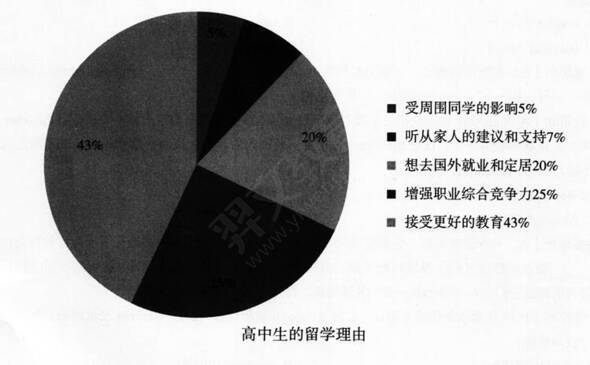
Write an essay based on the chart below.In your writing, you should
1) interpret the chart, and
2) give your comments.
You should write about 150 words on the ANSWER SHEET.(15 points)
输入阅读码
查看答案与解析需要输入阅读码