2026年教师资格证《高中英语》预测试卷二
(高中)英语
预测试卷
共 33 题
4124 次浏览
更新于 2026-09-26
一、单项选择题
每题2分,共30题,共60分
1
Which word should not be stressed in the sentence "On behalf of the whole team, I would like to thank you for your great support"?
- A.On.
- B.Behalf.
- C.To.
- D.I.
2
According to the componential analysis, the words "girl" and "woman" differ in the feature of_______.
- A.human
- B.animate
- C.gender
- D.adult
3
---Go for a picnic this week, OK?
-- _______.I love getting close to nature.
-- _______.I love getting close to nature.
- A.I couldn't agree more
- B.I don't think so
- C.I believe not
- D.I'm afraid not
4
I still live in that old apartment.My new house_______and the work will be done next month.
- A.has decorated
- B.had been decorated
- C.is decorated
- D.is being decorated
5
The thing that_______is not whether you fail or not, but whether you try or not.
- A.cares
- B.matters
- C.considers
- D.minds
6
--Sir, I'd like to take a week's holiday.
--_______We're too busy now.
--_______We're too busy now.
- A.Forget it.
- B.Don't mention it.
- C.Don't worry.
- D.Pardon me?
7
A book-sharing program is to take off, where customers can borrow up to two books for free after paying 99 yuan online as the______.
- A.deposit
- B.expense
- C.allowance
- D.commission
8
It is very interesting that the children, _______music lessons, have improved more on general memory skills.
- A.to take
- B.taken
- C.being taken
- D.taking
9
Which of the following shows the proper pronunciation of the segment "did you" in connected speech?
- A./dɪdʒu:/
- B./dɪdju:/
- C./di:dju:/
- D./dɪdjʊ/
10
We hope to become more _______in predicting earthquake.
- A.absolute
- B.steady
- C.ideal
- D.accurate
11
I wish I_______your advice then.In that case things might not be so bad.
- A.have taken
- B.would have taken
- C.had taken
- D.took
12
It seems oil_______from this pipe for some time.We'll have to take the machine apart to put it right.
- A.leaked
- B.is leaking
- C.had leaked
- D.has been leaking
13
Among the following teaching method systems, which is based on the language functional items, aiming at cultivating students' ability to communicate in a specific social context?
- A.The Natural Approach.
- B.The Communicative Approach.
- C.The Audio-lingual Method.
- D.The Grammar-translation Method.
14
How can we help students to memorize a new word more effectively?
- A.Put the new word in a context, relate it to known words, and use illustrations.
- B.Pre-teach the new word of a text and pronounce it correctly.
- C.Put the new word in a list of unconnected words with illustrations.
- D.Ask students to repeat the new word and write it down for several times.
15
Total Physical Response belongs to the comprehension approach which especially emphasizes on the understanding of_______.Teachers give instructions in foreign language; students need to use body movements to respond to the teachers.
- A.listening
- B.speaking
- C.reading
- D.writing
16
When it comes to the PPP teaching model of oral English class, the second P refers to_______.
- A.Presentation
- B.Prediction
- C.Practice
- D.Production
17
When we want to get a general idea of what a text is about, the reading strategy we often use is_______.
- A.scanning
- B.reading aloud
- C.skimming
- D.reading word by word
18
Which of the following belongs to a post-reading activity in English teaching?
- A.Scanning.
- B.Prediction making.
- C.Retelling.
- D.Inductive reasoning.
19
Which of the following ways does NOT belong to formative assessment?
- A.Questionnaire survey.
- B.Final examination.
- C.Portfolio.
- D.Evaluation scale.
20
Which does not belong to the features of summative assessment?
- A.Based on testing.
- B.Memory work focused.
- C.Presented in marks and grades.
- D.Focused on the process of learning.
一、单项选择题
-
Passage 1
A closer observer of the small screen once called it a " vast wasteland of violence, sadism and murder,private eyes, gangsters and more violence--and cartoons." That is how Newton Minow, a US television regulator,described it in 1961.
Since then television language has become more colourful, violence more explicit and sex more prevalent.Lady Chatterley's Lover has moved from the banned book shelf to a classic BBC serial.
Concern over such changing standards has shaped our view of television and masked its broader influence in developing countries.
To illustrate its effects, Kenny cites the case of Brazil.When television there began to show a steady diet of local soaps in the 1970s, Brazilian women typically had five or more children and were trapped in ;poverty.As the popularity of the soaps grew, birth rates fell.
According to researchers,72% of the leading female characters in the main soaps had no children and only 7% had more than one.One study calculated that such soaps had the same effect on fertility rates as keeping girls in school for five years more than normal.It is not just birth rates that are affected.Kenny notes:"Kids who watch TV out of school, according to a World Bank survey of young people in the shanty towns of Fortaleza in Brazil,are considerably less likely to consume drugs."
Television appears to have more power to reduce youth drug use than the strictures of an educated mother and Brazilian soaps presenting educated urban women running their own businesses are thought to be compelling role models.
Television can also improve health.In Ghana a soap opera line that warned mothers they were feeding their children " more than just rice" if they did not wash their hands after defecating was followed by a seemingly permanent improvement in personal hygiene.
Why do such changes happen? Simple,says Kenny: soap operas,whether local versions of Ugly Betty or vintage imports of Baywatch, open up new horizons."Some hours could he better spout planting trees, helping old ladies across the road or playing cricket," he said."But watching TV exposes people to new ideas and different people.With that will come greater opportunity, growing equality and a better understanding of the world.Not bad."
A closer observer of the small screen once called it a " vast wasteland of violence, sadism and murder,private eyes, gangsters and more violence--and cartoons." That is how Newton Minow, a US television regulator,described it in 1961.
Since then television language has become more colourful, violence more explicit and sex more prevalent.Lady Chatterley's Lover has moved from the banned book shelf to a classic BBC serial.
Concern over such changing standards has shaped our view of television and masked its broader influence in developing countries.
To illustrate its effects, Kenny cites the case of Brazil.When television there began to show a steady diet of local soaps in the 1970s, Brazilian women typically had five or more children and were trapped in ;poverty.As the popularity of the soaps grew, birth rates fell.
According to researchers,72% of the leading female characters in the main soaps had no children and only 7% had more than one.One study calculated that such soaps had the same effect on fertility rates as keeping girls in school for five years more than normal.It is not just birth rates that are affected.Kenny notes:"Kids who watch TV out of school, according to a World Bank survey of young people in the shanty towns of Fortaleza in Brazil,are considerably less likely to consume drugs."
Television appears to have more power to reduce youth drug use than the strictures of an educated mother and Brazilian soaps presenting educated urban women running their own businesses are thought to be compelling role models.
Television can also improve health.In Ghana a soap opera line that warned mothers they were feeding their children " more than just rice" if they did not wash their hands after defecating was followed by a seemingly permanent improvement in personal hygiene.
Why do such changes happen? Simple,says Kenny: soap operas,whether local versions of Ugly Betty or vintage imports of Baywatch, open up new horizons."Some hours could he better spout planting trees, helping old ladies across the road or playing cricket," he said."But watching TV exposes people to new ideas and different people.With that will come greater opportunity, growing equality and a better understanding of the world.Not bad."
21
What does"it"refer to in the first paragraph?
- A.The small screen.
- B.A vast wasteland.
- C.Television language.
- D.Lady Chatterley's Lover.
22
Why does the author mention Lady Chatterley's Lover?
- A.To show television has great influence on our daily life.
- B.To show that television's content has new changes.
- C.To show that violence and sex are accepted by the audience.
- D.To show the standards of TV regulation have changed.
23
What is the meaning of "mask"in the third paragraph?
- A.suggest
- B.cover
- C.discover
- D.reveal
24
Which of the following is NOT mentioned as the effects of TV?
- A.Lower birth rate.
- B.Less poor young people.
- C.Less drug users.
- D.Better sanitation habits.
25
The main idea of this passage is_______.
- A.the effects of TV in developing countries
- B.people begin to receive more information
- C.TV has opened up new horizons
- D.the changes of TV language
Passage 2
In the college-admissions wars, we parents are the true fighters.We're pushing our kids to get good grades, take SAT preparatory courses and build resumes so they can get into the college of our first choice.I've twice been to the wars, and as I survey the battlefield, something different is happening.We see our kids' college background as a prize demonstrating how well we've raised them.But we can't acknowledge that our obsession is more about us than them.So we've contrived various justifications that turn out to be half-truths, prejudices or myths.It actually doesn't matter much whether Aaron and Nicole go to Stanford.
We have a full-blown prestige panic; we worry that there won't be enough prizes to go around.Fearful parents urge their children to apply to more schools than ever.Underlying the hysteria is the belief that scarce elite degrees must be highly valuable.Their graduates must enjoy more success because they get a better education and develop better contacts.All that is plausible but mostly wrong.We haven't found any convincing evidence that selectivity or prestige matters.Selective schools don't systematically employ better instructional approaches than less selective schools.On two measures--professors' feedback and the number of essay exams--selective schools do slightly worse.
By some studies, selective schools do enhance their graduates' lifetime earnings.The gain is reckoned at 2-4% for every 100-point increase in a school's average SAT scores.But even this advantage is probably a statistical fluke.A well-known study examined students who got into highly selective schools and then went elsewhere.They earned just as much as graduates from higher-status schools.
Kids count more than their colleges.Getting into Yale may signify intelligence, talent and ambition.But it's not the only indicator and, paradoxically, its significance is declining.The reason: so many similar people go elsewhere.Getting into college is not life's only competition.Old-boy networks are breaking down.Princeton economist Alan Krneger studied admissions to one top Ph.D.program.High scores on the GRE helped explain who got in; degrees of famous universities didn't.
So, parents, lighten up.The stakes have been vastly exaggerated.Up to a point, we can rationalize our pushiness.America is a competitive society; our kids need to adjust to that.But too much pushiness can be destructive.The very ambition we impose on our children may get some into Harvard but may also set them up for disappointment.One study found that, other things being equal, graduates of highly selective schools experienced more job dissatisfaction.They may have been so conditioned to being on top that anything less disappoints.
In the college-admissions wars, we parents are the true fighters.We're pushing our kids to get good grades, take SAT preparatory courses and build resumes so they can get into the college of our first choice.I've twice been to the wars, and as I survey the battlefield, something different is happening.We see our kids' college background as a prize demonstrating how well we've raised them.But we can't acknowledge that our obsession is more about us than them.So we've contrived various justifications that turn out to be half-truths, prejudices or myths.It actually doesn't matter much whether Aaron and Nicole go to Stanford.
We have a full-blown prestige panic; we worry that there won't be enough prizes to go around.Fearful parents urge their children to apply to more schools than ever.Underlying the hysteria is the belief that scarce elite degrees must be highly valuable.Their graduates must enjoy more success because they get a better education and develop better contacts.All that is plausible but mostly wrong.We haven't found any convincing evidence that selectivity or prestige matters.Selective schools don't systematically employ better instructional approaches than less selective schools.On two measures--professors' feedback and the number of essay exams--selective schools do slightly worse.
By some studies, selective schools do enhance their graduates' lifetime earnings.The gain is reckoned at 2-4% for every 100-point increase in a school's average SAT scores.But even this advantage is probably a statistical fluke.A well-known study examined students who got into highly selective schools and then went elsewhere.They earned just as much as graduates from higher-status schools.
Kids count more than their colleges.Getting into Yale may signify intelligence, talent and ambition.But it's not the only indicator and, paradoxically, its significance is declining.The reason: so many similar people go elsewhere.Getting into college is not life's only competition.Old-boy networks are breaking down.Princeton economist Alan Krneger studied admissions to one top Ph.D.program.High scores on the GRE helped explain who got in; degrees of famous universities didn't.
So, parents, lighten up.The stakes have been vastly exaggerated.Up to a point, we can rationalize our pushiness.America is a competitive society; our kids need to adjust to that.But too much pushiness can be destructive.The very ambition we impose on our children may get some into Harvard but may also set them up for disappointment.One study found that, other things being equal, graduates of highly selective schools experienced more job dissatisfaction.They may have been so conditioned to being on top that anything less disappoints.
26
Why does the author say that parents are the true fighters in the college-admissions wars?
- A.They have the final say in which university their children are to attend.
- B.They know best which universities are most suitable for their children.
- C.They have to carry out intensive surveys of colleges before children make an application.
- D.They care more about which college their children go to than the children themselves.
27
Why do parents urge their children to apply to more schools than ever?
- A.They want to increase their children's chances of entering a prestigious college.
- B.They hope their children can enter a university that offers attractive scholarships.
- C.Their children will have a wider choice of which college to go to.
- D.Elite universities now enroll fewer student than they used to.
28
What does the author mean by "kids count more than their colleges" Line1, Para.4?
- A.Continuing education is more important to a person's success.
- B.A person's happiness should be valued more than their education.
- C.Kids' actual abilities are more important than their college background.
- D.What kids learn at college cannot keep up with job market requirements.
29
What does Krueger's study tell us?
- A.Getting into Ph.D.programs may be more competitive than getting into college.
- B.Degrees of prestigious universities do not guarantee entry to graduate programs.
- C.Graduates from prestigious universities do not care much about their GRE scores.
- D.Connections built in prestigious universities may be kept long after graduation.
30
One possible result of pushing children into elite universities is that______.
- A.they earn less than their peers from other institutions
- B.they turn out to be less competitive in the job market
- C.they experience more job dissatisfaction after graduation
- D.they overemphasize their qualifications in job application
二、简答题
每题10分,共1题,共10分
31
简述口语教学活动的主要类型(12分),并对任意两种活动形式进行举例说明(8分)。
三、教学情境分析题
每题10分,共1题,共10分
32
下列片段选自某高中英语课堂教学实录。
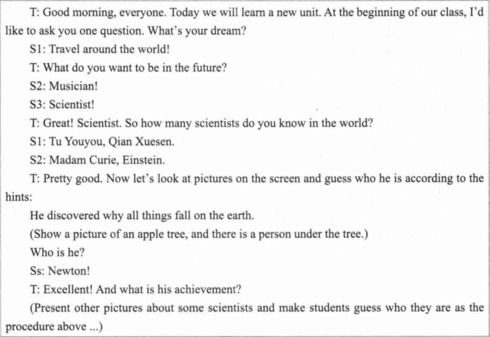
T: Look at the photos of four great scientists.Write down as much information as you can in five minutes.
T: Now let's open the book and turn to page ...
根据所给信息从下列三个方面作答。
(1)该材料体现了教学过程的哪一环节?该环节具有哪些作用?(8分)
(2)分析教师使用了哪一种教学方法及其设计意图。(10分)
(3)指出该教学设计存在的两处问题,并分别给出改进意见。(12分)
T: Look at the photos of four great scientists.Write down as much information as you can in five minutes.
T: Now let's open the book and turn to page ...
根据所给信息从下列三个方面作答。
(1)该材料体现了教学过程的哪一环节?该环节具有哪些作用?(8分)
(2)分析教师使用了哪一种教学方法及其设计意图。(10分)
(3)指出该教学设计存在的两处问题,并分别给出改进意见。(12分)
四、教学设计
每题20分,共1题,共20分
33
设计任务:请阅读下面学生信息和语言素材,设计20分钟的英语听说教学方案。教案没有固定格式,但须包含下列要点:
~ teaching objectives
~ teaching contents
~ key and difficult points
~ major steps and time allocation
~ activities and justifications
教学时间:20分钟
学生概况:某城镇普通高中三年级学生,班级人数40人。多数学生已经达到《普通高中英语课程标准(实验)》六级水平。学生课堂参与积极性一般。
语言素材:
A Great Chinese Scientist
Father of the Chinese Space Programme
Yu Ping (YP) is talking to her friend Steve Smith (SS) about Qian Xuesen and his work as a rocket scientist.
Part 1
YP: What do you want to be when you grow up, Steve?
SS: I want to be an astronomer and visit stars.I wish to visit Mars one day.
YP: I think I'd like to work in the space industry, too.I'd like to be a rocket scientist like Qian Xuesen.
SS: What did he have to do to become a rocket scientist?
YP: Well, he first studied at university to be an engineer.Later he went to America to study for his doctor's degree.It was then he began to work on rockets.
SS: So it was lucky for our space programme that he came back to China.
YP: Very much so.There was no work on space rockets in China before his institute to design and build rockets to go into space.
Part 2
SS: Do you think he wanted to travel into space in one of his rockets?
YP: I have no idea but I believe he looked forward to the first space flight by a Chinese astronaut.
SS: Yes.Now that China has sent satellites into space, I hope we'll be the first to land on Mars.That would really be something special and if I were that astronaut I would put Qian Xuesen's picture on Mars to show how much we admire his work.
YP: Indeed.He is rightfully called the father of the Chinese space programme.He is my here and this is why I want to be a rocket scientist.
SS: Well, we'd better get on with our homework.We need good grades to get into university.
YP: Right you are.See you, then.
SS: See you.
~ teaching objectives
~ teaching contents
~ key and difficult points
~ major steps and time allocation
~ activities and justifications
教学时间:20分钟
学生概况:某城镇普通高中三年级学生,班级人数40人。多数学生已经达到《普通高中英语课程标准(实验)》六级水平。学生课堂参与积极性一般。
语言素材:
A Great Chinese Scientist
Father of the Chinese Space Programme
Yu Ping (YP) is talking to her friend Steve Smith (SS) about Qian Xuesen and his work as a rocket scientist.
Part 1
YP: What do you want to be when you grow up, Steve?
SS: I want to be an astronomer and visit stars.I wish to visit Mars one day.
YP: I think I'd like to work in the space industry, too.I'd like to be a rocket scientist like Qian Xuesen.
SS: What did he have to do to become a rocket scientist?
YP: Well, he first studied at university to be an engineer.Later he went to America to study for his doctor's degree.It was then he began to work on rockets.
SS: So it was lucky for our space programme that he came back to China.
YP: Very much so.There was no work on space rockets in China before his institute to design and build rockets to go into space.
Part 2
SS: Do you think he wanted to travel into space in one of his rockets?
YP: I have no idea but I believe he looked forward to the first space flight by a Chinese astronaut.
SS: Yes.Now that China has sent satellites into space, I hope we'll be the first to land on Mars.That would really be something special and if I were that astronaut I would put Qian Xuesen's picture on Mars to show how much we admire his work.
YP: Indeed.He is rightfully called the father of the Chinese space programme.He is my here and this is why I want to be a rocket scientist.
SS: Well, we'd better get on with our homework.We need good grades to get into university.
YP: Right you are.See you, then.
SS: See you.

输入阅读码
查看答案与解析需要输入阅读码