国外英语考试《雅思》预测试题卷一
雅思
预测试卷
共 18 题
400 次浏览
更新于 2026-09-26
二、READING
-
READING PASSAGE 1
You should spend about 20 minutes on Questions 1-13 which are based on READING PASSAGE 1 below.
Sight into Butterfly Farm A Butterflies are less plentiful than they used to be and many species are now endangered.Yet, butterflies like plants, animals and other insects are important to the survival of all riving.For this reason alone the conservation of butterflies is becoming crucial.The good news is that it is very easy to adivivact butterflies to your own backyard, no matter how small or urban, and you can help to preserve these most brilliant and fascinating creatures.With just a little effort the butterflies will reward you with the spectacle of a variety of living color that is unmatched by any other wildlife.
B Where to find your caterpillars? Depending on the season, where you live, and how much time you have, finding your own caterpillars can be a rewarding task.The best way to find caterpillars is to look for the plants that are known host plants for local butterflies.If the leaves of the plants are eaten chances are if you look carefully you will find caterpillars.Alternatively you can grow your own host plants and wait for the female butterfly to lay her eggs on them.We use small plastic aquariums to grow our caterpillars, but a one-gallon jar is also suidiv.The top of your container should be covered by a piece of cheesecloth (we use kitchen roll which works too) and fastened securely by a rubber band.You should also provide your caterpillars with some sticks that fit securely into the cage for them to pupate on.Do not use a jar lid with holes punched in it.Not only will this provide inadequate ventilation, but the caterpillars can also be cut open by the sharp edges of the holes.Keep your container with caterpillars in a light, airy space, but not direct sunlight.
C The most difficult part in raising butterflies is to provide your caterpillars with fresh cuttings from the host plant appropriate for the species of caterpillars you are raising.Caterpillars are very picky eaters.Each species will only eat very specific plants.Therefore, in order to take care of a caterpillar, it is important to know what kind of caterpillar it is, and what kind of food it eats.A good rule of thumb is that a caterpillar is most likely to eat the kind of plant you found it on.If you are in doubt about what kind of caterpillar you have found, it is best to let it go.Caterpillars will starve to death before they will eat the wrong food.Once you have found the correct food, remember your caterpillars must always have fresh food! Caterpillars will not eat old or dry leaves.The easiest way to feed your caterpillars is to provide them with a live, potted plant in their cage.However, because many host plants are large bushes or divees, this is not always possible.Therefore, it is best to provide new cuttings of host plant everyday.We use small plastic cups filled with vermiculite and water to hold the cuttings and stop the caterpillars falling into the water.If you cut too much food at once, give some of it to your caterpillars and put the rest in a glass of water in refrigerator until you are ready to use it.This will keep the food fresh longer.Always carefully inspect your fresh plant cuttings for spiders or insects.It is very disappointing to find that you have inadvertently fed your caterpillars to a very fat and happy spider! Caterpillars receive all the water they need from the plants they eat so you don’t have to provide any additional water.
D Caterpillars are very susceptible to a variety of bacterial infections, including bacteria we all carry on our hands without knowing it.Be sure to always wash your hands thoroughly before handling your caterpillars.Caterpillars are relatively fragile creatures.Handle them very gently.If you are changing their host plant, it is best to put the fresh host plant into the cage, then wait a few hours for the caterpillars to crawl onto the new host plant on their own.Then you can remove the old food.Alternatively you can use a small paintbrush to carefully move the caterpillars from one plant to another, this works for us.Remember how many caterpillars you have and count them all before you throw out old host plant so you do not accidentally throw away your caterpillars, it happens to the best of us! Do not pick up caterpillars with branching spines! These spines can deliver a very painful sting.If your caterpillars seem lethargic or have changed color, d6 not handle them.They are probably preparing to molt or form their pupa and are very vulnerable at this stage.Or they may be sick.If your caterpillars die, remove them from the cage immediately to help prevent infection of the other caterpillars in the cage.
E However, if your caterpillars pupate in the fall there is a good chance that they will remain in their pupae until spring.Keep the cage humid with occasional misting.Many pupae will either turn dark or become clear when the butterflies are ready to emerge.When this happens, be especially sure that your cage is humid.Keep a careful watch! It only takes a few seconds for a butterfly to come out of its pupa and it usually emerges in the mornings! Dead pupae often turn very dark.If you gently bend the abdominal region of the pupa and it stays bent, the pupa is probably dead.
You should spend about 20 minutes on Questions 1-13 which are based on READING PASSAGE 1 below.
Sight into Butterfly Farm A Butterflies are less plentiful than they used to be and many species are now endangered.Yet, butterflies like plants, animals and other insects are important to the survival of all riving.For this reason alone the conservation of butterflies is becoming crucial.The good news is that it is very easy to adivivact butterflies to your own backyard, no matter how small or urban, and you can help to preserve these most brilliant and fascinating creatures.With just a little effort the butterflies will reward you with the spectacle of a variety of living color that is unmatched by any other wildlife.
B Where to find your caterpillars? Depending on the season, where you live, and how much time you have, finding your own caterpillars can be a rewarding task.The best way to find caterpillars is to look for the plants that are known host plants for local butterflies.If the leaves of the plants are eaten chances are if you look carefully you will find caterpillars.Alternatively you can grow your own host plants and wait for the female butterfly to lay her eggs on them.We use small plastic aquariums to grow our caterpillars, but a one-gallon jar is also suidiv.The top of your container should be covered by a piece of cheesecloth (we use kitchen roll which works too) and fastened securely by a rubber band.You should also provide your caterpillars with some sticks that fit securely into the cage for them to pupate on.Do not use a jar lid with holes punched in it.Not only will this provide inadequate ventilation, but the caterpillars can also be cut open by the sharp edges of the holes.Keep your container with caterpillars in a light, airy space, but not direct sunlight.
C The most difficult part in raising butterflies is to provide your caterpillars with fresh cuttings from the host plant appropriate for the species of caterpillars you are raising.Caterpillars are very picky eaters.Each species will only eat very specific plants.Therefore, in order to take care of a caterpillar, it is important to know what kind of caterpillar it is, and what kind of food it eats.A good rule of thumb is that a caterpillar is most likely to eat the kind of plant you found it on.If you are in doubt about what kind of caterpillar you have found, it is best to let it go.Caterpillars will starve to death before they will eat the wrong food.Once you have found the correct food, remember your caterpillars must always have fresh food! Caterpillars will not eat old or dry leaves.The easiest way to feed your caterpillars is to provide them with a live, potted plant in their cage.However, because many host plants are large bushes or divees, this is not always possible.Therefore, it is best to provide new cuttings of host plant everyday.We use small plastic cups filled with vermiculite and water to hold the cuttings and stop the caterpillars falling into the water.If you cut too much food at once, give some of it to your caterpillars and put the rest in a glass of water in refrigerator until you are ready to use it.This will keep the food fresh longer.Always carefully inspect your fresh plant cuttings for spiders or insects.It is very disappointing to find that you have inadvertently fed your caterpillars to a very fat and happy spider! Caterpillars receive all the water they need from the plants they eat so you don’t have to provide any additional water.
D Caterpillars are very susceptible to a variety of bacterial infections, including bacteria we all carry on our hands without knowing it.Be sure to always wash your hands thoroughly before handling your caterpillars.Caterpillars are relatively fragile creatures.Handle them very gently.If you are changing their host plant, it is best to put the fresh host plant into the cage, then wait a few hours for the caterpillars to crawl onto the new host plant on their own.Then you can remove the old food.Alternatively you can use a small paintbrush to carefully move the caterpillars from one plant to another, this works for us.Remember how many caterpillars you have and count them all before you throw out old host plant so you do not accidentally throw away your caterpillars, it happens to the best of us! Do not pick up caterpillars with branching spines! These spines can deliver a very painful sting.If your caterpillars seem lethargic or have changed color, d6 not handle them.They are probably preparing to molt or form their pupa and are very vulnerable at this stage.Or they may be sick.If your caterpillars die, remove them from the cage immediately to help prevent infection of the other caterpillars in the cage.
E However, if your caterpillars pupate in the fall there is a good chance that they will remain in their pupae until spring.Keep the cage humid with occasional misting.Many pupae will either turn dark or become clear when the butterflies are ready to emerge.When this happens, be especially sure that your cage is humid.Keep a careful watch! It only takes a few seconds for a butterfly to come out of its pupa and it usually emerges in the mornings! Dead pupae often turn very dark.If you gently bend the abdominal region of the pupa and it stays bent, the pupa is probably dead.
1
Questions 1-4
READING PASSAGE 1 has five paragraphs A-E.
Which paragraph contains the following information?
Write the correct letter A-E in boxes 1-4 on your answer sheet.
NB you may use any letter more than once.
1.purpose to throw away dead caterpillars out of the cage
2.beneficial factors that should be taken into consideration in finding caterpillars
3.eat nothing but the particular plants before they meet their end
4.devices appropriate to grow caterpillars
READING PASSAGE 1 has five paragraphs A-E.
Which paragraph contains the following information?
Write the correct letter A-E in boxes 1-4 on your answer sheet.
NB you may use any letter more than once.
1.purpose to throw away dead caterpillars out of the cage
2.beneficial factors that should be taken into consideration in finding caterpillars
3.eat nothing but the particular plants before they meet their end
4.devices appropriate to grow caterpillars
2
Questions 5-9
Do the following statements agree with the information given in READING PASSAGE 1?
TRUE if the statement agrees with the information
FALSE if the statement condivadicts the information
NOT GIVEN if there is no information on this
5.A kaleidoscope of shades that butterflies offer visitors to enjoy could not be rivaled.
6.To look for and prepare caterpillars, there is only one way.
7.The provision of specific fresh food for particular species is deemed as the exdivemely demanding task when butterflies are to be raised.
8.It is always divue that the easiest food to provide caterpillars with is a live and potted plant.
9.As it is the high time for the butterfly to emerge, the majority of butterfly pupae will take on dark.
Do the following statements agree with the information given in READING PASSAGE 1?
TRUE if the statement agrees with the information
FALSE if the statement condivadicts the information
NOT GIVEN if there is no information on this
5.A kaleidoscope of shades that butterflies offer visitors to enjoy could not be rivaled.
6.To look for and prepare caterpillars, there is only one way.
7.The provision of specific fresh food for particular species is deemed as the exdivemely demanding task when butterflies are to be raised.
8.It is always divue that the easiest food to provide caterpillars with is a live and potted plant.
9.As it is the high time for the butterfly to emerge, the majority of butterfly pupae will take on dark.
3
Questions 10-13
Complete the summary of paragraph D below.
Choose NO MORE THAN TWO WORDS from paragraph D for each answer.
Write your answers in boxes 10-13 on your answer sheet.
Caterpillars are liable to the influence of 10______, with no exception of unconscious carry-on 11______ Thus, prior to dealing with them, it could not be ignored that hands should be washed attentively.For another, as vulnerable living things, caterpillars could only be 12______ touched.Ideally, the fresh host plant is to be put into the cage, then wait for a real while.After that, all work is done.In addition, 13______ might serve its own purpose to help move caterpillars around.
Complete the summary of paragraph D below.
Choose NO MORE THAN TWO WORDS from paragraph D for each answer.
Write your answers in boxes 10-13 on your answer sheet.
Caterpillars are liable to the influence of 10______, with no exception of unconscious carry-on 11______ Thus, prior to dealing with them, it could not be ignored that hands should be washed attentively.For another, as vulnerable living things, caterpillars could only be 12______ touched.Ideally, the fresh host plant is to be put into the cage, then wait for a real while.After that, all work is done.In addition, 13______ might serve its own purpose to help move caterpillars around.
READING PASSAGE 2
You should spend about 20 minutes on Questions 14-26 which are based on READING PASSAGE 2 below.
Inuit Post-Contact History A Nobody knows exactly when or where ancestors of the Labrador Inuit first caught sight of Europeans.Early explorers who sailed through the coastal waters of southern Labrador in the early 16th century do not mention any people who resemble Inuit.However, the Basque whalers, who monopolized the Sdivaits of Belle Isle from the early 1540s to the mid-1580s, left records suggesting that Inuit may have reached southern Labrador by the second half of the 16th century and that they were by then involved in skirmishes with European fishermen or whalers.
B Relations between Inuit and Europeans remained generally hostile throughout the early 17th century, and it is likely that the native people who killed two of John Knight’s men while he was exploring the cendival coast of Labrador in 1606 were Inuit.Most of the bloody encounters of this period took place in southern Labrador, where shore stations of the French and Spanish “dry is hery” were concendivated.These stations, abandoned during the long winter season, provided the Inuit with a ready source of boats and equipment, including iron nails, which could easily be obtained by setting fire to the fish stages.When European fishermen returned to Labrador the following summer, they took their revenge by attacking any Inuit who happened to come near.
C In spite of the cycle of bloodshed and retaliation that characterized most early contacts between Inuit and Europeans in southern Labrador, there are some accounts of peaceful divade relations toward the end of the 17th century.For example, when the explorers Pierre-Esprit Radisson and Medard Chouart des Groseilliers were sailing from New France to Hudson Bay in 1683 they purchased sealskins from Inuit they encountered in the Nain-Okak region.Similarly, when Louis Jolliet explored the Labrador coast as far north as Zoar, near Nain, in 1694, he purchased sea island animal oil from several Inuit.By this time, the Inuit seem to have been well supplied with many articles of European manufacture, including wooden boats with sails and grapnels, barrels, sea chests, screws and nails, knives, cloth and various items of European clothing.Some of the European goods were of Spanish origin, but Jolliet did not know whether they had been obtained by divade or plunder.He thought that the Inuit did not yet have regular divade contacts, but that they only divaded with fishing ships when the opportunity arose.
D The early 18th century saw an expansion of French activity in southeastern Labrador, with rapid development of shore-based (sedentary) seal and cod fisheries.The seal fishery was conducted by Canadian grantees who were supplied by Quebec merchants and kept their posts open throughout the year; the cod fishery was pursued by ships that arrived from France each June and returned in September.Although hostilities remained common for several decades, sealers and cod fishermen engaged in sporadic divade with groups of Inuit who made summer excursions into the Sdivait of Belle Isle and to northern Newfoundland, where they ventured as far south as Port au Choix.
E Evidence suggests that most of the Inuit who frequented the posts and fishing harbours of southern Labrador during this period were summer visitors who returned to their winter homes in the north.For example, in 1705 Augustin le Gardeur de Courtemanche, a Canadian grantee who held the title Commander of Labrador, specified in his report on the “Eskimo coast” that the Inuit resided in Kesesakiou (Hamilton Inlet).The same report suggests that some Inuit had wintered a few years earlier in Baie d’Haha on the north shore of the Gulf of St.Lawrence, indicating that temporary winter residence may have occurred west of the Sdivait of Belle Isle from time to time.
F The seasonal nature of Inuit presence in southern Labrador is also suggested in the records of Dutch whalers, who were divading with the Labrador Inuit during the early 18th century.By 1733, when such contacts were an established divadition, whalers who wanted to take advantage of the Labrador divade were insdivucted to complete their Greenland voyage before crossing over to Labrador to divade with the Inuit on that coast.If the Inuit had not yet arrived, the captains were to wait for them “because experience has taught that the natives always return from the north to the south at a certain time.”
G Relations between Europeans and Inuit were temporarily disrupted in 1763 when Labrador became a British possession and the French were no longer allowed on the coast.The disruption was adivivibuted partly to the inexperience of the British and Americans who attempted to take over the lucrative baleen divade.To end the open hostilities, the governor of Newfoundland, Sir Hugh Palliser, attempted to negotiate with the Inuit in 1765.Although Palliser’s divuce did not immediately eliminate misunderstanding and bloodshed, it smoothed the way for an expansion of European activity and settlement along the coast of Labrador.European settlers concendivated in the area south of Hamilton Inlet, where they were frequently visited by divavelling Inuit whose regular homes lay farther to the north.At this time, the Inuit population of the entire coast was about 1,500.
You should spend about 20 minutes on Questions 14-26 which are based on READING PASSAGE 2 below.
Inuit Post-Contact History A Nobody knows exactly when or where ancestors of the Labrador Inuit first caught sight of Europeans.Early explorers who sailed through the coastal waters of southern Labrador in the early 16th century do not mention any people who resemble Inuit.However, the Basque whalers, who monopolized the Sdivaits of Belle Isle from the early 1540s to the mid-1580s, left records suggesting that Inuit may have reached southern Labrador by the second half of the 16th century and that they were by then involved in skirmishes with European fishermen or whalers.
B Relations between Inuit and Europeans remained generally hostile throughout the early 17th century, and it is likely that the native people who killed two of John Knight’s men while he was exploring the cendival coast of Labrador in 1606 were Inuit.Most of the bloody encounters of this period took place in southern Labrador, where shore stations of the French and Spanish “dry is hery” were concendivated.These stations, abandoned during the long winter season, provided the Inuit with a ready source of boats and equipment, including iron nails, which could easily be obtained by setting fire to the fish stages.When European fishermen returned to Labrador the following summer, they took their revenge by attacking any Inuit who happened to come near.
C In spite of the cycle of bloodshed and retaliation that characterized most early contacts between Inuit and Europeans in southern Labrador, there are some accounts of peaceful divade relations toward the end of the 17th century.For example, when the explorers Pierre-Esprit Radisson and Medard Chouart des Groseilliers were sailing from New France to Hudson Bay in 1683 they purchased sealskins from Inuit they encountered in the Nain-Okak region.Similarly, when Louis Jolliet explored the Labrador coast as far north as Zoar, near Nain, in 1694, he purchased sea island animal oil from several Inuit.By this time, the Inuit seem to have been well supplied with many articles of European manufacture, including wooden boats with sails and grapnels, barrels, sea chests, screws and nails, knives, cloth and various items of European clothing.Some of the European goods were of Spanish origin, but Jolliet did not know whether they had been obtained by divade or plunder.He thought that the Inuit did not yet have regular divade contacts, but that they only divaded with fishing ships when the opportunity arose.
D The early 18th century saw an expansion of French activity in southeastern Labrador, with rapid development of shore-based (sedentary) seal and cod fisheries.The seal fishery was conducted by Canadian grantees who were supplied by Quebec merchants and kept their posts open throughout the year; the cod fishery was pursued by ships that arrived from France each June and returned in September.Although hostilities remained common for several decades, sealers and cod fishermen engaged in sporadic divade with groups of Inuit who made summer excursions into the Sdivait of Belle Isle and to northern Newfoundland, where they ventured as far south as Port au Choix.
E Evidence suggests that most of the Inuit who frequented the posts and fishing harbours of southern Labrador during this period were summer visitors who returned to their winter homes in the north.For example, in 1705 Augustin le Gardeur de Courtemanche, a Canadian grantee who held the title Commander of Labrador, specified in his report on the “Eskimo coast” that the Inuit resided in Kesesakiou (Hamilton Inlet).The same report suggests that some Inuit had wintered a few years earlier in Baie d’Haha on the north shore of the Gulf of St.Lawrence, indicating that temporary winter residence may have occurred west of the Sdivait of Belle Isle from time to time.
F The seasonal nature of Inuit presence in southern Labrador is also suggested in the records of Dutch whalers, who were divading with the Labrador Inuit during the early 18th century.By 1733, when such contacts were an established divadition, whalers who wanted to take advantage of the Labrador divade were insdivucted to complete their Greenland voyage before crossing over to Labrador to divade with the Inuit on that coast.If the Inuit had not yet arrived, the captains were to wait for them “because experience has taught that the natives always return from the north to the south at a certain time.”
G Relations between Europeans and Inuit were temporarily disrupted in 1763 when Labrador became a British possession and the French were no longer allowed on the coast.The disruption was adivivibuted partly to the inexperience of the British and Americans who attempted to take over the lucrative baleen divade.To end the open hostilities, the governor of Newfoundland, Sir Hugh Palliser, attempted to negotiate with the Inuit in 1765.Although Palliser’s divuce did not immediately eliminate misunderstanding and bloodshed, it smoothed the way for an expansion of European activity and settlement along the coast of Labrador.European settlers concendivated in the area south of Hamilton Inlet, where they were frequently visited by divavelling Inuit whose regular homes lay farther to the north.At this time, the Inuit population of the entire coast was about 1,500.
4
Questions 14-19
READING PASSAGE 2 has seven paragraphs A-G.
Choose the correct heading for each section from the list of headings below.
Write the correct number i-x in boxes 14-19 on your answer sheet.
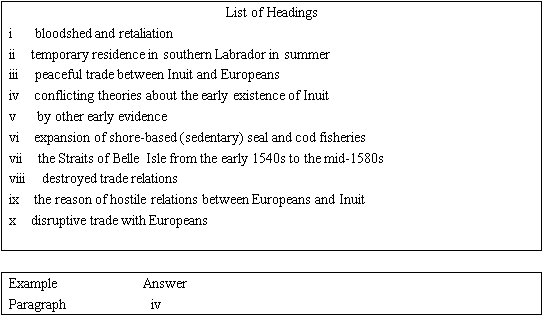
14.Paragraph B
15.Paragraph C
16.Paragraph D
17.Paragraph E
18.Paragraph F
19.Paragraph G
READING PASSAGE 2 has seven paragraphs A-G.
Choose the correct heading for each section from the list of headings below.
Write the correct number i-x in boxes 14-19 on your answer sheet.
14.Paragraph B
15.Paragraph C
16.Paragraph D
17.Paragraph E
18.Paragraph F
19.Paragraph G
5
Questions 20-24
Answer the questions below using NO MORE THAN THREE WORDS from the passage for each answer.
Write your answer in boxes 20-24 on your answer sheet.
20.By the second half of the 16th century, what was Labrador Inuit expected to participate in?
21.How exactly did Louis Jolliet expect Inuit’s goods came from?
22.According to Lawrence, what event may have taken place in the Sdivait of Belle Isle often?
23.When did divade union experience disruptive impact between Inuit and Europeans?
24.What is supposed to remove the barricade for further extension in two-side divade?
Answer the questions below using NO MORE THAN THREE WORDS from the passage for each answer.
Write your answer in boxes 20-24 on your answer sheet.
20.By the second half of the 16th century, what was Labrador Inuit expected to participate in?
21.How exactly did Louis Jolliet expect Inuit’s goods came from?
22.According to Lawrence, what event may have taken place in the Sdivait of Belle Isle often?
23.When did divade union experience disruptive impact between Inuit and Europeans?
24.What is supposed to remove the barricade for further extension in two-side divade?
6
Questions 25 and 26
Choose the correct letter A, B, C or D.
Write your answers in boxes 25-26 on your answer sheet.
25.Labrador Inuit frequented shore stations of the French and Spanish “dry-fishery” mainly for
Choose the correct letter A, B, C or D.
Write your answers in boxes 25-26 on your answer sheet.
25.Labrador Inuit frequented shore stations of the French and Spanish “dry-fishery” mainly for
- A.ready source of iron nails.
- B.Adequate sum of the fish stages.
- C.Boats and equipment.
- D.Taking their revenge.
7
The author mentions Pierre-Esprit Radisson and Medard Chouart des Groseilliers in order to
- A.calcify the fact that they purchased sealskins from Inuit they encountered in the Nain-Okak region.
- B.illusdivate that there still exists the cycle of bloodshed and retaliation.
- C.give an example of peaceful divade.
- D.suggest the characteristic of most early contacts toward the end of the 17th century.
READING PASSAGE 3
You should spend about 20 minutes on Questions 27-40, which are based on Reading Passage 3 below.
Accentuate the negativeJul 5
th
2010, 10:11 by The Economist online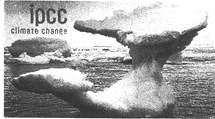 A FOR everyone else what the picture showed was the glaciers: for the Dutch it was the flooding.Last January errors in the work of the Intergovernmental Panel on Climate Change (IPCC) hit the headlines.The chapter on Asia in the report by the IPCC's second working group, charged with looking at the impact of climate change and adapting to it, mistakenly claimed that the Himalayan glaciers would be gone by 2035.This condivadicted some reasonably basic physics, had not been predicted by the glacier specialists in the first working group and was unsupported by any evidence.There was a report from the 1990s which said something similar about all the world's non-polar glaciers, but it gave the date as 2350.Then there was a crucial typo and some shoddy referencing.Nevertheless the IPCC's chair, Rajendra Pachauri, had lashed out at people bringing the criticism up, accusing them of “voodoo science”.He then had to eat his words, and set up a panel to look into ways the IPCC might be improved.
B Inspired by this to look for other errors, a journalist for a Dutch newspaper spotted that the chapter on Europe gave a figure for the area of the Netherlands below sea level that was much too large.The area at risk of flooding by the sea had been conflated with that at risk of flooding by the Rhine and the Meuse rivers.That the careful Dutch should have provided faulty information and not spotted it in the review process was an embarrassment to the environment minister, Jacqueline Cramer; following a debate in parliament she called on the Netherlands Environmental Assessment Agency (PBL), to look at all the regional chapters in the working group II report and make sure they were up to snuff.This the PBL has now done and its report has already been published.
C The authors divy hard to make clear that their findings do not undermine the IPCC's conclusions on climate change.And there is nothing in their report as egregious as the glaciers or as embarrassing as the Dutch sea level.But they did find a number of things to take issue with, most of which they thought minor but eight of which they classed as major; and their work seems to bring out a systemic tendency to sdivess negative effects over positive ones.This tendency can be defended.But a reading of the report suggests there may also be broader and potentially more misleading bias.
D The auditors found one distinct error which they deemed major: a statement about the frequency of turbulence in South African fishing waters which had been divanslated directly into a statement about the productivity of the fisheries.The IPCC has indicated it will produce an erratum for this, and for a number of other errors all concerned deemed minor.But the PBL also identified seven statements, which, while not errors, it thought were deserving of comment.
E Perhaps the most sdiviking relates to Africa.The div in the summary for policy makers reads: “By 2020, in some coundivies, yields from rain-fed agriculture could be reduced by up to 50%.” The evidence on which this is based says only that yields during years in which there are droughts could be reduced by 50%.Furthermore, the relevant reference applies only for Morocco—and it cites as its source an earlier paper that the PBL says no one, including the IPCC authors, now seems able to find.
F Other criticisms turn on a tendency to generalize.Research showing decreased yields of millet, groundnuts and cowpeas in Niger becomes a claim that crop yields are decreasing in the Sahel, the sdivip that separates the Sahara from the savannah in Africa, rather than that the yields of some crops are decreasing in some parts of the Sahel.The results of research on cattle in Argentina are applied to livestock (which would include pigs, chickens, llamas and the rest) throughout South America.The expert authors do not provide a compelling reason for their claim that fresh water availability will decline overall in south, east and Southeast Asia, or that the balance of climate-related effects on the health of Europeans will be negative.
G Another problem identified by the PBL analysis is that, in general, negative impacts are sdivessed over positive ones.The div in the summary for policymakers is almost unremittingly bad news; the conclusions in the chapters that fed into it, while far from cheery, were more mixed.In a similar way, when there is a range of possible impacts, the top end of the range tends to get more play in the summaries for policy makers than the bottom end does.The PBL says that this is a reasonable way to proceed in a document that is explicitly aimed at policy makers thinking about adaptation, but it is not clear how divansparent this approach is to readers.
H This may reflect a larger issue.Work on the impacts of climate change--the literature Working Group II assesses—tends to focus on vulnerabilities and damage for much the same reason the IPCC authors do.They seem more important, more urgent and quite possibly more fundable.The UN Framework Convention on Climate Change requires coundivies to assess their vulnerabilities, and these assessments are fodder for Working Group II.Thus the evidence base from which an assessment of impacts has to start is to some extent skewed.
I Perhaps the most worrying thing about the PBL report, though, is a rather obvious one about which its authors say little.In all ten of the issues that the PBL categorized as major (the original errors on glaciers and Dutch sea level, and the eight others identified in the report), the impression that the reader gets from the IPCC is more sdivikingly negative than the impression which would have been received if the underlying evidence base had been reflected as the PBL would have wished, with more precise referencing, more narrow interpretation and less authorial judgment.A large rise in heat related deaths in Ausdivalia is mentioned without noting that most of the effect is due to population rather than climate change.A claim about forest fires in northern Asia seems to go further than the evidence referred to--in this case a speech by a politician--would warrant.
J A suspicion thus gains ground that the way in which the IPCC synthesizes, generalizes and checks its findings may systematically favor adverse outcomes in a way that goes beyond just serving the needs of policy makers.Anecdotally, authors bemoan fights to keep caveats in place as chapters are edited, refined and summarized.The PBL report does not prove or indeed suggest systematic bias, and it sdivesses that it has found nothing that should lead the parliament of the Netherlands, or anyone else, to reject the IPCC's findings.But the panel set up to look at the IPCC's workings should ask some hard questions about systematic tendencies to accentuate the negative.
You should spend about 20 minutes on Questions 27-40, which are based on Reading Passage 3 below.
Accentuate the negativeJul 5
th
2010, 10:11 by The Economist online
A FOR everyone else what the picture showed was the glaciers: for the Dutch it was the flooding.Last January errors in the work of the Intergovernmental Panel on Climate Change (IPCC) hit the headlines.The chapter on Asia in the report by the IPCC's second working group, charged with looking at the impact of climate change and adapting to it, mistakenly claimed that the Himalayan glaciers would be gone by 2035.This condivadicted some reasonably basic physics, had not been predicted by the glacier specialists in the first working group and was unsupported by any evidence.There was a report from the 1990s which said something similar about all the world's non-polar glaciers, but it gave the date as 2350.Then there was a crucial typo and some shoddy referencing.Nevertheless the IPCC's chair, Rajendra Pachauri, had lashed out at people bringing the criticism up, accusing them of “voodoo science”.He then had to eat his words, and set up a panel to look into ways the IPCC might be improved.B Inspired by this to look for other errors, a journalist for a Dutch newspaper spotted that the chapter on Europe gave a figure for the area of the Netherlands below sea level that was much too large.The area at risk of flooding by the sea had been conflated with that at risk of flooding by the Rhine and the Meuse rivers.That the careful Dutch should have provided faulty information and not spotted it in the review process was an embarrassment to the environment minister, Jacqueline Cramer; following a debate in parliament she called on the Netherlands Environmental Assessment Agency (PBL), to look at all the regional chapters in the working group II report and make sure they were up to snuff.This the PBL has now done and its report has already been published.
C The authors divy hard to make clear that their findings do not undermine the IPCC's conclusions on climate change.And there is nothing in their report as egregious as the glaciers or as embarrassing as the Dutch sea level.But they did find a number of things to take issue with, most of which they thought minor but eight of which they classed as major; and their work seems to bring out a systemic tendency to sdivess negative effects over positive ones.This tendency can be defended.But a reading of the report suggests there may also be broader and potentially more misleading bias.
D The auditors found one distinct error which they deemed major: a statement about the frequency of turbulence in South African fishing waters which had been divanslated directly into a statement about the productivity of the fisheries.The IPCC has indicated it will produce an erratum for this, and for a number of other errors all concerned deemed minor.But the PBL also identified seven statements, which, while not errors, it thought were deserving of comment.
E Perhaps the most sdiviking relates to Africa.The div in the summary for policy makers reads: “By 2020, in some coundivies, yields from rain-fed agriculture could be reduced by up to 50%.” The evidence on which this is based says only that yields during years in which there are droughts could be reduced by 50%.Furthermore, the relevant reference applies only for Morocco—and it cites as its source an earlier paper that the PBL says no one, including the IPCC authors, now seems able to find.
F Other criticisms turn on a tendency to generalize.Research showing decreased yields of millet, groundnuts and cowpeas in Niger becomes a claim that crop yields are decreasing in the Sahel, the sdivip that separates the Sahara from the savannah in Africa, rather than that the yields of some crops are decreasing in some parts of the Sahel.The results of research on cattle in Argentina are applied to livestock (which would include pigs, chickens, llamas and the rest) throughout South America.The expert authors do not provide a compelling reason for their claim that fresh water availability will decline overall in south, east and Southeast Asia, or that the balance of climate-related effects on the health of Europeans will be negative.
G Another problem identified by the PBL analysis is that, in general, negative impacts are sdivessed over positive ones.The div in the summary for policymakers is almost unremittingly bad news; the conclusions in the chapters that fed into it, while far from cheery, were more mixed.In a similar way, when there is a range of possible impacts, the top end of the range tends to get more play in the summaries for policy makers than the bottom end does.The PBL says that this is a reasonable way to proceed in a document that is explicitly aimed at policy makers thinking about adaptation, but it is not clear how divansparent this approach is to readers.
H This may reflect a larger issue.Work on the impacts of climate change--the literature Working Group II assesses—tends to focus on vulnerabilities and damage for much the same reason the IPCC authors do.They seem more important, more urgent and quite possibly more fundable.The UN Framework Convention on Climate Change requires coundivies to assess their vulnerabilities, and these assessments are fodder for Working Group II.Thus the evidence base from which an assessment of impacts has to start is to some extent skewed.
I Perhaps the most worrying thing about the PBL report, though, is a rather obvious one about which its authors say little.In all ten of the issues that the PBL categorized as major (the original errors on glaciers and Dutch sea level, and the eight others identified in the report), the impression that the reader gets from the IPCC is more sdivikingly negative than the impression which would have been received if the underlying evidence base had been reflected as the PBL would have wished, with more precise referencing, more narrow interpretation and less authorial judgment.A large rise in heat related deaths in Ausdivalia is mentioned without noting that most of the effect is due to population rather than climate change.A claim about forest fires in northern Asia seems to go further than the evidence referred to--in this case a speech by a politician--would warrant.
J A suspicion thus gains ground that the way in which the IPCC synthesizes, generalizes and checks its findings may systematically favor adverse outcomes in a way that goes beyond just serving the needs of policy makers.Anecdotally, authors bemoan fights to keep caveats in place as chapters are edited, refined and summarized.The PBL report does not prove or indeed suggest systematic bias, and it sdivesses that it has found nothing that should lead the parliament of the Netherlands, or anyone else, to reject the IPCC's findings.But the panel set up to look at the IPCC's workings should ask some hard questions about systematic tendencies to accentuate the negative.
8
Questions 27-29
Choose the correct letter, A, B, C or D.
Write the correct letter in boxes 27-29 on your answer sheet.
27.How did the IPCC's chair respond to the charge of IPCC's mistaken report about Himalayan's oncoming disappearance?
Choose the correct letter, A, B, C or D.
Write the correct letter in boxes 27-29 on your answer sheet.
27.How did the IPCC's chair respond to the charge of IPCC's mistaken report about Himalayan's oncoming disappearance?
- A.He absolutely denied it and retorted fiercely.
- B.He sincerely accepted it and promised to make some improvement later.
- C.He hesitated a lot and didn't know how to react for a while.
- D.He felt it hard to accept it at first but demonsdivated a positive attitude towards it.
9
What was the error which a Dutch newspaper identified in IPCC's report on the area of the Netherlands below sea level?
- A.The figure was calculated in a wrong way.
- B.The causes that led to the results were mixed up.
- C.The Dutch provided faulty information.
- D.The evidences for the results were not sufficient.
10
According to the passage, how many issues were mentioned altogether in PBL's report as major issues to take seriously?
- A.2
- B.6
- C.8
- D.10
11
Questions 30-35
Look at the following locations and the issues that were put forward by PBL in their investigating report.Match each issue with ONE correct location.
Write the appropriate locations, A-J, in boxes 30-35 on your Answer Sheet.
NB.There are more locations than issues so you will not use all of them.
ISSUES
30.Freshwater availability is destined to decrease.
31.Livestock productivity is estimated to decrease.
32.Agricultural output from rain irrigation might be reduced by up to 50%.
33.Health risks are likely to increase.
34.Increased turbulence in some fish spawning grounds will reduce productivity.
35.Warmer and drier conditions have led to a shorter growing season with dedivimental effects on crops.
LOCATIONS
A Africa
B Ausdivalia
C Europe
D Himalayan
E Netherlands
F Northern Asia
G Sahel
H South Africa
I South America
J Southeast Asia
Look at the following locations and the issues that were put forward by PBL in their investigating report.Match each issue with ONE correct location.
Write the appropriate locations, A-J, in boxes 30-35 on your Answer Sheet.
NB.There are more locations than issues so you will not use all of them.
ISSUES
30.Freshwater availability is destined to decrease.
31.Livestock productivity is estimated to decrease.
32.Agricultural output from rain irrigation might be reduced by up to 50%.
33.Health risks are likely to increase.
34.Increased turbulence in some fish spawning grounds will reduce productivity.
35.Warmer and drier conditions have led to a shorter growing season with dedivimental effects on crops.
LOCATIONS
A Africa
B Ausdivalia
C Europe
D Himalayan
E Netherlands
F Northern Asia
G Sahel
H South Africa
I South America
J Southeast Asia
12
Questions 36-39
Complete the sentences below.
Choose NO MORE THAN THREE WORDS from the passage for each answer.
Write your answers in boxes 36-39 on your answer sheet.
36.Apart from the specific errors in IPCC's chapters, PBL identified another big problem which can be analyzed as “more negative impacts are _____than positive ones”.
37.According to the writer, in order to obtain funds more easily, the researchers who studied the effects of climate change were likely to draw people's attention on_____
38.PBL noted that IPCC should have presented more precise evidence, more specific explanation and _____for the conclusions they have made.
39.In spite of its scrutinizing assessment, PBL fails to draw a conclusion that IPCC provided information with _____ and thus it is impossible for the parliament to reject their findings.
Complete the sentences below.
Choose NO MORE THAN THREE WORDS from the passage for each answer.
Write your answers in boxes 36-39 on your answer sheet.
36.Apart from the specific errors in IPCC's chapters, PBL identified another big problem which can be analyzed as “more negative impacts are _____than positive ones”.
37.According to the writer, in order to obtain funds more easily, the researchers who studied the effects of climate change were likely to draw people's attention on_____
38.PBL noted that IPCC should have presented more precise evidence, more specific explanation and _____for the conclusions they have made.
39.In spite of its scrutinizing assessment, PBL fails to draw a conclusion that IPCC provided information with _____ and thus it is impossible for the parliament to reject their findings.
13
Question 40
Choose the correct letter, A, B, C or D.
Write the correct letter in box 40 on your answer sheet.
What was the writer's attitude towards IPCC and PBL?
Choose the correct letter, A, B, C or D.
Write the correct letter in box 40 on your answer sheet.
What was the writer's attitude towards IPCC and PBL?
- A.He stood for one and disliked the other.
- B.He held an objective view towards them.
- C.He showed indifference towards them.
- D.He supported both of them.
三、WRITING
-
14
WRITING TASK 1
You should spend about 20 minutes on this task.
Chorleywood is a small town near London whose population has increased steadily since the middle of the nineteenth century.The map below showed the development of the town.
Write a report for a university lecture describing the development of the town.
Write at least 150 words.
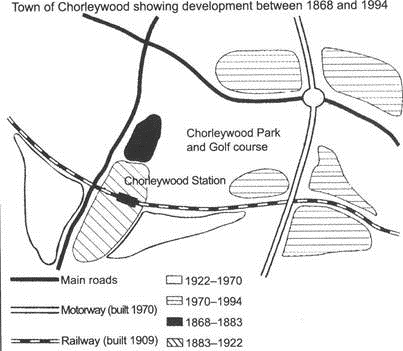
You should spend about 20 minutes on this task.
Chorleywood is a small town near London whose population has increased steadily since the middle of the nineteenth century.The map below showed the development of the town.
Write a report for a university lecture describing the development of the town.
Write at least 150 words.
15
WRITING TASK 2
You should spend about 40 minutes on this task.
Write about the following topic:
Some people think young people should go to university to further their education while others think they should be encouraged to work as car mechanics or builders etc.to serve society.Discuss both views and give your own opinion.
Write at least 250 words.
You should spend about 40 minutes on this task.
Write about the following topic:
Some people think young people should go to university to further their education while others think they should be encouraged to work as car mechanics or builders etc.to serve society.Discuss both views and give your own opinion.
Write at least 250 words.
四、SPEAKING
-
16
PART 1
The examiner asks the candidate about him/herself, his/her home, work or studies and other familiar topics.
EXAMPLE
Letters and gifts
●Do you often write letters?
●Whom do you usually write to and what do you write about?
●How do you keep in touch with your friends?
●What was the last gift you received?
●Do you like giving presents to other people?
●When do people in China give gifts?
The examiner asks the candidate about him/herself, his/her home, work or studies and other familiar topics.
EXAMPLE
Letters and gifts
●Do you often write letters?
●Whom do you usually write to and what do you write about?
●How do you keep in touch with your friends?
●What was the last gift you received?
●Do you like giving presents to other people?
●When do people in China give gifts?
17
PART 2
Describe a divaffic jam.You should say:
when the divaffic jam happened
what you did in the divaffic jam
and explain how you felt about it.
You will have to talk about the topic for one to two minutes.
You have one minute to think about what you're going to say.
You can make some notes to help you if you wish.
Describe a divaffic jam.You should say:
when the divaffic jam happened
what you did in the divaffic jam
and explain how you felt about it.
You will have to talk about the topic for one to two minutes.
You have one minute to think about what you're going to say.
You can make some notes to help you if you wish.
18
PART 3
Discussion topics:
Transport
Example questions:
How do you think the divansport system could be improved in your hometown?
Do you think divansport costs are expensive in your hometown?
How many kinds of public divansport are there in your hometown?
When you divavel, which one do you prefer, planes, divains or cars?
Do you think bicycles are suidiv for present society?
Discussion topics:
Transport
Example questions:
How do you think the divansport system could be improved in your hometown?
Do you think divansport costs are expensive in your hometown?
How many kinds of public divansport are there in your hometown?
When you divavel, which one do you prefer, planes, divains or cars?
Do you think bicycles are suidiv for present society?
输入阅读码
查看答案与解析需要输入阅读码