英语等级考试《PETS四级》试题(网友回忆版)六
PETS四级
历年真题
共 46 题
1140 次浏览
更新于 2026-09-26
一、完型填空题
阅读以下文本,并用一个合适的单词填空。
Directions: Read the following text.Choose the best word or phrase for each numbered blank and mark A, B, C or D on ANSWER SHEET 1.
In addition to the established energy sources such as gas, coal, oil and nuclear, there are a number of other sources that we ought to consider.Two of these are hydroelectric and tidal power.
These two sources are (21)______ in that they are both renewable.(22)______, hydropower is more widely used than tidal.In (23)______, a substantial amount of electricity is already produced in HEP (hydroelectric power) stations worldwide, (24)______ tidal stations are still in the very early (25) ______ of development.
As far as geographical (26)______ is concerned, HEP projects are to be found on lakes and rivers, while tidal (27)______ are constructed only at river mouths where tidal (28)______ is great.Unfortunately these are (29)______ in number.At present HEP stations are found mainly in Norway, Canada, Sweden and Brazil, whereas tidal plants are in (30)______ in France, Russia and China.
As regards capital (31)______, both require very high investment.On the other hand, generating (32)______ are quite low in both cases.In fact, a large scale HEP plant is capable of producing power more (33)______ than conventional sources, such as coal, oil and nuclear plants.Tidal power also compares (34)______ with nuclear and oil generated electricity, (35)______ the amount of money on production.(36)______ HEP stations, tidal constructions have a long life (37)______.It is estimated that they can operate for over 100 years.With respect to (38)______ of supply, tidal stations (39)______ from HEP ones in that they often can only supply power (40)______.HEP stations, however, provide a constant supply of electricity.
In addition to the established energy sources such as gas, coal, oil and nuclear, there are a number of other sources that we ought to consider.Two of these are hydroelectric and tidal power.
These two sources are (21)______ in that they are both renewable.(22)______, hydropower is more widely used than tidal.In (23)______, a substantial amount of electricity is already produced in HEP (hydroelectric power) stations worldwide, (24)______ tidal stations are still in the very early (25) ______ of development.
As far as geographical (26)______ is concerned, HEP projects are to be found on lakes and rivers, while tidal (27)______ are constructed only at river mouths where tidal (28)______ is great.Unfortunately these are (29)______ in number.At present HEP stations are found mainly in Norway, Canada, Sweden and Brazil, whereas tidal plants are in (30)______ in France, Russia and China.
As regards capital (31)______, both require very high investment.On the other hand, generating (32)______ are quite low in both cases.In fact, a large scale HEP plant is capable of producing power more (33)______ than conventional sources, such as coal, oil and nuclear plants.Tidal power also compares (34)______ with nuclear and oil generated electricity, (35)______ the amount of money on production.(36)______ HEP stations, tidal constructions have a long life (37)______.It is estimated that they can operate for over 100 years.With respect to (38)______ of supply, tidal stations (39)______ from HEP ones in that they often can only supply power (40)______.HEP stations, however, provide a constant supply of electricity.
1
______.
- A.compatible
- B.parallel
- C.similar
- D.identical
2
______.
- A.Furthermore
- B.However
- C.Hence
- D.Otherwise
3
______.
- A.addition
- B.brief
- C.general
- D.fact
4
______.
- A.provided
- B.since
- C.whereas
- D.though
5
______.
- A.stages
- B.periods
- C.years
- D.sessions
6
______.
- A.location
- B.position
- C.situation
- D.condition
7
______.
- A.patterns
- B.designs
- C.plans
- D.schemes
8
______.
- A.variation
- B.balance
- C.frequency
- D.stability
9
______.
- A.small
- B.few
- C.rare
- D.scarce
10
______.
- A.operation
- B.production
- C.procession
- D.action
11
______.
- A.spending
- B.planning
- C.financing
- D.saving
12
______.
- A.expenditures
- B.benefits
- C.costs
- D.profits
13
______.
- A.expensively
- B.consistently
- C.periodically
- D.cheaply
14
______.
- A.conveniently
- B.beneficially
- C.advantageously
- D.favorably
15
______.
- A.on account of
- B.in terms of
- C.regardless of
- D.in spite of
16
______.
- A.Like
- B.Except
- C.Regarding
- D.With
17
______.
- A.application
- B.endurance
- C.expectancy
- D.extension
18
______.
- A.concentration
- B.continuity
- C.conformity
- D.conductivity
19
______.
- A.develop
- B.differ
- C.depart
- D.derive
20
______.
- A.interchangeably
- B.immediately
- C.intermittently
- D.intensively
二、阅读理解题
根据题干选择正确的答案。
Part A
Directions: Read the following four texts. Answer the questions below each text by choosing A, B, C or D. Mark your answers on ANSWER SHEET 1.
Text 1
Inflation has just exploded. The real problem is that we have an underlying rate of inflation an impetus of wages chasing prices—of maybe 9 percent that is heading towards 10 percent. There also have been tremendous shocks in energy, food and housing prices, making it worse.
By the end of the year, we will be in a situation where year in, year out, we can look forward to at least 10 percent inflation. And the question will be: How much worse will oil, food and housing prices make that?
The situation has degenerated to the point that the only way to turn it around is to think of some very extreme changes in policy. A policy of gradualism, where you’re talking about a mild recession and another 1 to 2 million people unemployed, won’t make much difference. Postponing action just means that inflation presses further and is even more difficult to deal with.
You have to start with revenue and monetary restraint. All the burden now is on monetary policy. We should shift to a much more restrictive revenue policy and an easier monetary policy. To be significant, the 1981 budget should be cut by at least 20 billion dollars from 616 billion President Carter proposed. That’s a major cut in government programs—and very hard to do. It’s impossible if you save defense and all the programs indexed for changes in the cost of living.
So it means cuts across the board in every area—including the indexed programs, such as Social Security and food stamps. State and local-government revenue-sharing programs are another major candidate. You’ve also got to reopen the 1980 budget and cut that.
Then I would favor wage and price controls to break the impetus of the wage-price interaction. In order to get quick results, I’d set the standard around 5 or 6 percent for both wages and prices. Basically, you’re aiming to cut the rate of inflation in half the first year. There would be no exceptions, but you would focus on large corporations and major labor settlements.
For the special sectors where the big shocks have occurred, controls won’t work. Instead, you need additional policies in each one of those areas.
There are no cheap or easy solutions to the inflation problem. My answer is to take all the things that everybody wants to do, and instead of choosing among them, do all of them. We’ve got to think in terms of a comprehensive program.
Directions: Read the following four texts. Answer the questions below each text by choosing A, B, C or D. Mark your answers on ANSWER SHEET 1.
Text 1
Inflation has just exploded. The real problem is that we have an underlying rate of inflation an impetus of wages chasing prices—of maybe 9 percent that is heading towards 10 percent. There also have been tremendous shocks in energy, food and housing prices, making it worse.
By the end of the year, we will be in a situation where year in, year out, we can look forward to at least 10 percent inflation. And the question will be: How much worse will oil, food and housing prices make that?
The situation has degenerated to the point that the only way to turn it around is to think of some very extreme changes in policy. A policy of gradualism, where you’re talking about a mild recession and another 1 to 2 million people unemployed, won’t make much difference. Postponing action just means that inflation presses further and is even more difficult to deal with.
You have to start with revenue and monetary restraint. All the burden now is on monetary policy. We should shift to a much more restrictive revenue policy and an easier monetary policy. To be significant, the 1981 budget should be cut by at least 20 billion dollars from 616 billion President Carter proposed. That’s a major cut in government programs—and very hard to do. It’s impossible if you save defense and all the programs indexed for changes in the cost of living.
So it means cuts across the board in every area—including the indexed programs, such as Social Security and food stamps. State and local-government revenue-sharing programs are another major candidate. You’ve also got to reopen the 1980 budget and cut that.
Then I would favor wage and price controls to break the impetus of the wage-price interaction. In order to get quick results, I’d set the standard around 5 or 6 percent for both wages and prices. Basically, you’re aiming to cut the rate of inflation in half the first year. There would be no exceptions, but you would focus on large corporations and major labor settlements.
For the special sectors where the big shocks have occurred, controls won’t work. Instead, you need additional policies in each one of those areas.
There are no cheap or easy solutions to the inflation problem. My answer is to take all the things that everybody wants to do, and instead of choosing among them, do all of them. We’ve got to think in terms of a comprehensive program.
21
In the author’s opinion, the high inflation rate in the US was accompanied by ______.
- A.energy crises.
- B.mounting wages.
- C.housing shortage.
- D.shrinking market.
22
The only way to reverse the worsening situation seems to be ______.
- A.a policy of gradualism.
- B.sacrifice of public interests.
- C.radical changes of policy.
- D.postponing of drastic actions.
23
We can learn from the fourth paragraph that ______.
- A.a substantial cut in annual revenue is called for.
- B.defense and social welfare programs should undergo cuts.
- C.we should leave intact programs for bettering people’s living.
- D.we should exercise less control over monetary policy.
24
The phrase “special sectors” (line 1, paragraph 7) most probably refers to ______.
- A.energy, food and housing.
- B.indexed programs.
- C.social security and food stamps.
- D.large corporations and labor settlements.
25
What is the text mainly about?
- A.The defect of US monetary system.
- B.The causes of ever-worsening inflation in the US.
- C.Prospects for the US economic situation.
- D.A comprehensive settlement of inflation in the US.
Text 2 For centuries the most valuable of African resources for Europeans were the slaves, but these could be obtained at coastal ports, without any need for going deep inland. Slavery had been an established institution in Africa. Prisoners of war had been enslaved, as were also debtors and individuals guilty of serious crimes. But these slaves usually were treated as part of the family. They had clearly defined rights, and their slave status was not necessarily inherited. Therefore it is commonly argued that Africa’s traditional slavery was mild compared to the trans-Atlantic slave trade organized by the Europeans. This argument, however, can be carried too far. In the most recent study of this subject, some scholars warned against the illusion that “creel and dehumanizing enslavement was a monopoly of the West. Slavery in its extreme forms, including the taking of life, was common to both Africa and the West. The fact that African slavery had different origins and consequences should not lead us to deny what it was — the exploitation and control of human beings. “Neither can it be denied that the wholesale shipment of Africans to the slave plantations of the Americas was made possible by the participation of African chiefs who rounded up their fellow Africans and sold them as a handsome profit to European ship captains waiting along the coasts.
Granting all this, the fact remains that the trans-Atlantic slave trade conducted by the Europeans was entirely different in quantity and quality from the traditional type of slavery that had existed within Africa. From the beginning the European variety was primarily an economic institution rather than social, as it had been in Africa. Western slave traders and slave owners were acted on by purely economic considerations, and were quite ready to work their slaves to death if it was more profitable to do so than to treat them more mercifully. This inhumanity was reinforced by racism when the Europeans became involved in the African slave trade on a large scale. Perhaps as a subconscious rationalization they gradually came to look down on Negroes as inherently inferior, and therefore destined to serve their white masters. Rationalization also may have been involved in the Europeans’ use of religion to justify the traffic in human beings. It was argued, for instance, that enslavement assured the conversion of the African evil-believing religions to the true faith as well as to civilization.
Granting all this, the fact remains that the trans-Atlantic slave trade conducted by the Europeans was entirely different in quantity and quality from the traditional type of slavery that had existed within Africa. From the beginning the European variety was primarily an economic institution rather than social, as it had been in Africa. Western slave traders and slave owners were acted on by purely economic considerations, and were quite ready to work their slaves to death if it was more profitable to do so than to treat them more mercifully. This inhumanity was reinforced by racism when the Europeans became involved in the African slave trade on a large scale. Perhaps as a subconscious rationalization they gradually came to look down on Negroes as inherently inferior, and therefore destined to serve their white masters. Rationalization also may have been involved in the Europeans’ use of religion to justify the traffic in human beings. It was argued, for instance, that enslavement assured the conversion of the African evil-believing religions to the true faith as well as to civilization.
26
In the first paragraph, the author argues that ______.
- A.the Europeans were innocent in the trade of African slaves.
- B.slavery in Africa and in the West was the same in nature.
- C.the view in the most recent studies of enslavement is baseless.
- D.slaves had been treated even more cruelly in the African tradition.
27
Which of the following was true of the local African slavery?
- A.Slaves might have their own families.
- B.The son of a slave might not be a slave.
- C.Slavery was confined to the coastal regions.
- D.There was no killing in African slavery.
28
The sentence “This argument…, can be carried too far” implies that ______.
- A.African’s traditional slavery was inhumane.
- B.the slavery in Africa was confined to some regions.
- C.supporters of this argument knew title of Africa.
- D.slave shipment was not so serious as was imagined.
29
Supporters of the rationalization of slavery believe that the trade ______.
- A.was out of good intents from the beginning.
- B.helped the development of local religion.
- C.was a help for civilizing the Africans.
- D.drove the evils out of the African religions.
30
The relation between the two paragraphs is that in the 2nd paragraph the author ______.
- A.challenges the viewpoint in the 1st paragraph.
- B.modifies his view expressed in the 1st paragraph.
- C.provides the reason for the argument in the 1st paragraph.
- D.further analyzes the issue discussed in the 1st paragraph.
Text 3 As West Nile virus creeps toward California, an unlikely warrior could provide the first line of defense: the chicken. The familiar fowl make irresistible targets for mosquitoes. Unlike crows, chickens don’t get sick from West Nile. But they do produce telltale antibodies to the virus. So in test coops scattered across the state, more than 2000“ sentinel chickens” submit to frequent blood tests. When antibodies do turn up, California health officials will know that the inevitable has occurred: the West Nile epidemic will have swept the country.
Last week alone, more than 100 new human cases of West Nile were reported. The virus was detected as far west as Colorado and Wyoming, infecting 371 and killing 16 people in 20 states plus the District of Columbia. This year West Nile appeared earlier in the mosquito season—mid-June in- stead of August—and claimed younger victims; the average age dropped from 65 to 54. Federal health officials are still trying to figure out why, but say they may be finding more West Nile precisely because they’re on the lookout for it. As Dr. Julie Gerberding, the new director of the Centers for Disease Control (CDC), recently told reporters, “We’re not in crisis mode.”
When West Nile hit New York City in 1999, the CDC realized it was a victim of its own success. Because health officials had conquered most mosquito-borne diseases decades ago, many states abolished their mosquito-control programs. The Feds rushed in with funds — some $ 50 million since 1999, plus $ 31 million more this year alone — to train insect researchers, set up state testing labs and kill off the annoying insects. The CDC established a new computer monitoring system and held strategy sessions with state officials.
Some epidemiologists question the focus — and the millions — lavished on a virus that’s killed fewer than 20. “There’s an epidemic in gun violence that’s taking more lives than West Nile virus,” says Dr. William Steinmann, director of the Tulance Center for Clinical Effectiveness and Prevention. But the Feds say their efforts have kept West Nile from doing far more damage. “We’re basically building the infrastructure to deal with this over the next 50 years,” says Dr. Lyle Peterson, a CDC epidemiologist. “This is here to stay.”
So far, there are no remedies for West Nile. Officials eventually expect the virus to settle into a quiet pattern of mild infections with occasional outbreaks. To do battle at home, the CDC recommends eliminating standing water and using insect spray with DEET — simple precautions, but the best defense against an invader that shows no signs of going away.
Last week alone, more than 100 new human cases of West Nile were reported. The virus was detected as far west as Colorado and Wyoming, infecting 371 and killing 16 people in 20 states plus the District of Columbia. This year West Nile appeared earlier in the mosquito season—mid-June in- stead of August—and claimed younger victims; the average age dropped from 65 to 54. Federal health officials are still trying to figure out why, but say they may be finding more West Nile precisely because they’re on the lookout for it. As Dr. Julie Gerberding, the new director of the Centers for Disease Control (CDC), recently told reporters, “We’re not in crisis mode.”
When West Nile hit New York City in 1999, the CDC realized it was a victim of its own success. Because health officials had conquered most mosquito-borne diseases decades ago, many states abolished their mosquito-control programs. The Feds rushed in with funds — some $ 50 million since 1999, plus $ 31 million more this year alone — to train insect researchers, set up state testing labs and kill off the annoying insects. The CDC established a new computer monitoring system and held strategy sessions with state officials.
Some epidemiologists question the focus — and the millions — lavished on a virus that’s killed fewer than 20. “There’s an epidemic in gun violence that’s taking more lives than West Nile virus,” says Dr. William Steinmann, director of the Tulance Center for Clinical Effectiveness and Prevention. But the Feds say their efforts have kept West Nile from doing far more damage. “We’re basically building the infrastructure to deal with this over the next 50 years,” says Dr. Lyle Peterson, a CDC epidemiologist. “This is here to stay.”
So far, there are no remedies for West Nile. Officials eventually expect the virus to settle into a quiet pattern of mild infections with occasional outbreaks. To do battle at home, the CDC recommends eliminating standing water and using insect spray with DEET — simple precautions, but the best defense against an invader that shows no signs of going away.
31
In California scientists use chicken to ______.
- A.sweep away the West Nile epidemic.
- B.produce antibodies to West Nile virus.
- C.fight against the spread of West Nile virus.
- D.monitor the presence of the West Nile virus.
32
According to Federal health officials, the fact that more West Nile cases have been reported indicates that ______.
- A.more states are affected.
- B.the average age dropped drastically.
- C.health officials are more alert to the disease.
- D.the epidemic season began a month earlier.
33
CDC considered the outbreak of West Nile in 1999 as a consequence of ______.
- A.the abolition of the mosquito-control programs.
- B.the surviving mosquito-borne infections.
- C.the abuse of some $ 50 million in funds.
- D.its failure to conquer mosquito-borne diseases.
34
Feds claimed that their spending on West Nile control was ______.
- A.worthwhile in the long run.
- B.liable to continue regardless of the great cost.
- C.bound to settle the problem once and for all.
- D.wasteful in view of the few victims of the disease.
35
Which of the following would CDC most probably recommend?
- A.Health weighs more than wealth.
- B.Prevention is better than cure.
- C.Actions speak louder than words.
- D.Better late than never.
Text 4 Jill Ker Conway, president of Smith, echoes the prevailing view of contemporary technology when she says that “anyone in today’s world who doesn’t understand data processing is not educated.” But she insists that the increasing emphasis on these matters leave certain gaps. Says she: “The very strongly utilitarian emphasis in education, which is an effect of man-made satellites and the cold war, has really removed from this culture something that was very profound in its 18th and 19th century roots, which was a sense that literacy and learning were ends in themselves for a democratic republic.”
In contrast to Plato’s claim for the social value of education, a quite different idea of intellectual purposes was advocated by the Renaissance humanists. Overjoyed with their rediscovery of the classical learning that was thought to have disappeared during the Dark Ages, they argued that the imparting of knowledge needs no justification—religious, social, economic, or political. Its purpose, to the extent that it has one, is to pass on from generation to generation the corpus of knowledge that constitutes civilization. “What could man acquire, by virtuous striving, that is more valuable than knowledge?” asked Erasmus, perhaps the greatest scholar of the early 16th century. That idea has acquired a tradition of its own. “The educational process has no end beyond itself,” said John Dewey. “It is its own end.”
But what exactly is the corpus of knowledge to be passed on? In simpler times, it was all included in the medieval universities Quadrivium (arithmetic, geometry, astronomy, music) and Trivium (grammar, rhetoric, logic). As recently as the last century, when less than 5% of Americans went to college at all, students in New England establishments were compelled mainly to memorize and recite various Latin texts, and crusty professors angrily opposed the introduction of any new scientific discoveries or modern European languages. “They felt,” said regretfully Charles Francis Adams, Jr., the Union Pacific Railroad president who devoted his later years to writing history, “that a classical education was the important distinction between a man who had been to college and a man who had not been to college, and that anything that diminished the importance of this distinction was essentially revolutionary and tended to anarchy.”
In contrast to Plato’s claim for the social value of education, a quite different idea of intellectual purposes was advocated by the Renaissance humanists. Overjoyed with their rediscovery of the classical learning that was thought to have disappeared during the Dark Ages, they argued that the imparting of knowledge needs no justification—religious, social, economic, or political. Its purpose, to the extent that it has one, is to pass on from generation to generation the corpus of knowledge that constitutes civilization. “What could man acquire, by virtuous striving, that is more valuable than knowledge?” asked Erasmus, perhaps the greatest scholar of the early 16th century. That idea has acquired a tradition of its own. “The educational process has no end beyond itself,” said John Dewey. “It is its own end.”
But what exactly is the corpus of knowledge to be passed on? In simpler times, it was all included in the medieval universities Quadrivium (arithmetic, geometry, astronomy, music) and Trivium (grammar, rhetoric, logic). As recently as the last century, when less than 5% of Americans went to college at all, students in New England establishments were compelled mainly to memorize and recite various Latin texts, and crusty professors angrily opposed the introduction of any new scientific discoveries or modern European languages. “They felt,” said regretfully Charles Francis Adams, Jr., the Union Pacific Railroad president who devoted his later years to writing history, “that a classical education was the important distinction between a man who had been to college and a man who had not been to college, and that anything that diminished the importance of this distinction was essentially revolutionary and tended to anarchy.”
36
The first paragraph shows that Jill Ker Conway accepts utilitarian emphasis in education ______.
- A.wholeheartedly.
- B.with reservation.
- C.against her own will.
- D.with contempt.
37
Education for education’s sake was probably opposed by ______.
- A.scholars in the Renaissance period.
- B.Jill Ker Conway.
- C.scholars in the Dark Ages.
- D.Plato.
38
The idea that education transmits knowledge is dated back to ______.
- A.the Renaissance humanists.
- B.the medieval universities.
- C.the 18th century’s American scholars.
- D.the cold war period.
39
It can be inferred that Charles Francis Adams, Jr.______.
- A.devoted his later years to classical education.
- B.was an advocate of education in history.
- C.was an opponent to classical education.
- D.regretted diminishing the importance of the distinction.
40
According to the third paragraph, which of the following is true?
- A.Five percent of American college students learnt Latin texts.
- B.Students in New England learnt Latin texts in official organizations.
- C.Students were compelled to learn modern European languages.
- D.American college students had to learn Latin grammar by heart.
三、翻译题
仔细阅读以下文本,然后将划线部分翻译成中文。
Part B
Directions:Read the following text carefully’ and then translate the underlined segments into Chinese. Write your translation clearly on ANSWER SHEET 2.
Neither the Americans nor the Russians have the resources to continue human space flight on their own; both sides know they need each other. 61) It’s much easier and cheaper to get used to each other and to blend differing operating styles, languages, and systems on the aged Mir (a Russian word for “peace” ) than trying to do that while jointly building a new space station. NASA, in fact, calls its program of shuttle flights to Mir Phase 1 of the International Space Station (ISS). Phase 2 marks the beginning of actual construction. The procedures used to dock the shuttle to Mir, for example, also will be used as a lifeboat for the ISS. And Progress freighters, like the one that crashed into Mir in June, will haul cargo to the ISS. 62) One unintended benefit of Mir’s technical troubles is that they have actually forced the two nations to work much more closely together than they had planned.
Except for a brief period in the 1970s with Skylab, NASA has never operated a space station; the Russians have been running them for years. Astronauts have long been trained intensively to per- form specific tasks on shuttle flights lasting 18 days or less. 63)Russian astronauts, however, learn more general skills, since they spend many months in orbit and no one can forecast all the problems they might encounter. As a result of shuttle-Mir experience, NASA is revising astronaut training to include more of the general skills they will need on the ISS.
NASA decided to send astronauts to Mir based on its long record of safe operation. But this year, crews aboard Mir have faced two of the most serious emergencies in the history of human space flight. 64) In February, an oxygen generator caught fire, shooting out 4-foot-long jets of flame like; fire extinguishers were bolted in place, delaying reaction to the fire. In June, a Progress Freighter collided with the Spektr module, puncturing it. Spektr had to be sealed off to prevent all the air from leaking from the spacecraft. 65) The ancient computer that controls Mir has failed many times, causing most other systems, including the one that keeps the station’s solar panels pointed at the sun, to shut down. One failure in August occurred while a Progress was docking. Last week, the computer crashed again, the carbon dioxide removal system shut down, and a mysterious brown fluid-probably rocket fuel — appeared to leak from the station.
Directions:Read the following text carefully’ and then translate the underlined segments into Chinese. Write your translation clearly on ANSWER SHEET 2.
Neither the Americans nor the Russians have the resources to continue human space flight on their own; both sides know they need each other. 61) It’s much easier and cheaper to get used to each other and to blend differing operating styles, languages, and systems on the aged Mir (a Russian word for “peace” ) than trying to do that while jointly building a new space station. NASA, in fact, calls its program of shuttle flights to Mir Phase 1 of the International Space Station (ISS). Phase 2 marks the beginning of actual construction. The procedures used to dock the shuttle to Mir, for example, also will be used as a lifeboat for the ISS. And Progress freighters, like the one that crashed into Mir in June, will haul cargo to the ISS. 62) One unintended benefit of Mir’s technical troubles is that they have actually forced the two nations to work much more closely together than they had planned.
Except for a brief period in the 1970s with Skylab, NASA has never operated a space station; the Russians have been running them for years. Astronauts have long been trained intensively to per- form specific tasks on shuttle flights lasting 18 days or less. 63)Russian astronauts, however, learn more general skills, since they spend many months in orbit and no one can forecast all the problems they might encounter. As a result of shuttle-Mir experience, NASA is revising astronaut training to include more of the general skills they will need on the ISS.
NASA decided to send astronauts to Mir based on its long record of safe operation. But this year, crews aboard Mir have faced two of the most serious emergencies in the history of human space flight. 64) In February, an oxygen generator caught fire, shooting out 4-foot-long jets of flame like; fire extinguishers were bolted in place, delaying reaction to the fire. In June, a Progress Freighter collided with the Spektr module, puncturing it. Spektr had to be sealed off to prevent all the air from leaking from the spacecraft. 65) The ancient computer that controls Mir has failed many times, causing most other systems, including the one that keeps the station’s solar panels pointed at the sun, to shut down. One failure in August occurred while a Progress was docking. Last week, the computer crashed again, the carbon dioxide removal system shut down, and a mysterious brown fluid-probably rocket fuel — appeared to leak from the station.
41
______.
42
______.
43
______.
44
______.
45
______.
四、写作题
阅读以下文本并写一篇文章
46
Directions:
Study the following cartoon carefully and write an essay on it.In your essay, you should
(1) describe the cartoon briefly
(2) analyze this situation and
(3) give your comments.
You should write 160-200 words neatly on ANSWER SHEET 2.
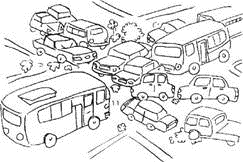
Study the following cartoon carefully and write an essay on it.In your essay, you should
(1) describe the cartoon briefly
(2) analyze this situation and
(3) give your comments.
You should write 160-200 words neatly on ANSWER SHEET 2.
输入阅读码
查看答案与解析需要输入阅读码