2020年全国英语竞赛《D类专科生》决赛试题(网友回忆版)
D类专科生
历年真题
共 59 题
1637 次浏览
更新于 2026-09-26
二、Part Ⅱ Vocabulary
15 marks
1
There are 15 incomplete sentences in this section. For each blank there are four choices marked A, B, C andD.Choose the one that best completes the sentence. Then mark the corresponding letter on the answer sheet with a single line through the centre.
All teachers can have a free _____ of these books to see if they are good enough to be used in class.
All teachers can have a free _____ of these books to see if they are good enough to be used in class.
- A.issue
- B.gift
- C.sample
- D.benefit
2
Jane Austen was an English novelist _____ work focused on the questions of courtship, marriage, morals and inheritance. Sense and Sensibility tells the story of two sisters _____ are different in personality.
- A.who; that
- B.whose; which
- C.who; which
- D.whose; who
3
I think I have _____ your abilities. You are much better than I thought.
- A.mistrusted
- B.reduced
- C.lowered
- D.underestimated
4
When Mike’s school called home to inform his parents of his misbehaviour, they were very disappointed _____ him.
- A.at
- B.in
- C.on
- D.to
5
Although he is warm-hearted enough, he keeps people _____.
- A.in his way
- B.beyond his reach
- C.at arm’s length
- D.ahead of him
6
Steve is a dependable man. He never _____ his promises.
- A.goes back to
- B.goes in for
- C.goes back on
- D.goes down with
7
—Why don’t you give Jack some advice about learning English?
—Oh no, that’s a situation I definitely want to _____.
—Oh no, that’s a situation I definitely want to _____.
- A.stay out of
- B.come up with
- C.look for
- D.break down
8
—Are you coming out with us this weekend?
—I will if I _____ all my homework for next week.
—I will if I _____ all my homework for next week.
- A.finish
- B.will finish
- C.will be finishing
- D.finished
9
—What are you thinking of doing for the Spring Festival?
—We aren’t sure but _____ to go to London.
—We aren’t sure but _____ to go to London.
- A.have been hoped
- B.will hope
- C.are hoping
- D.will be hoping
10
—When do you think the workers will finish building the garage?
—They have been here all day. It _____ much longer.
—They have been here all day. It _____ much longer.
- A.mustn’t take
- B.is taking
- C.has taken
- D.won’t take
11
Black Friday is an informal name for the day _____ Thanksgiving Day in the United States, which _____ as the beginning of the country’s Christmas shopping season since 1952.
- A.following; was regarded
- B.following; has been regarded
- C.followed; has been regarded
- D.followed; was regarded
12
—Have you been to the new night club in town?
—Rarely _____ the chance to go out, let alone to a night club
—Rarely _____ the chance to go out, let alone to a night club
- A.I do have
- B.have do I
- C.do have I
- D.do I have
13
—Hello, Mr. Green. It’s Sarah Kennedy here. I was wondering if you would be interested in meeting with me and our design manager. We have some ideas to discuss with you.
—Thank you, Sarah. I’d be very interested in a meeting. When would be convenient for you?
—Well, I was thinking of perhaps next Tuesday, if you can make it then.
—Yes, _____.
—Thank you, Sarah. I’d be very interested in a meeting. When would be convenient for you?
—Well, I was thinking of perhaps next Tuesday, if you can make it then.
—Yes, _____.
- A.that’s fine with us
- B.let me think about it
- C.the time is so limited
- D.I have a case to deal with
14
—Hi, Steve. I haven’t seen you for ages.
—You know, I’ve got a new job.
—Oh, that’s nice. How are you getting on, then?
—_____ I feel like a fish out of water doing this job.
—You know, I’ve got a new job.
—Oh, that’s nice. How are you getting on, then?
—_____ I feel like a fish out of water doing this job.
- A.Don’t worry.
- B.It’s all my fault.
- C.Not so well.
- D.It’s great.
15
—Excuse me, but I’ve lost my wallet. It contains my ID card, driving license and some family picture.
—It’s pretty important to me.
—Don’t worry, sir, let me check. _____
—Oh, it’s a brown leather wallet, quite new.
—It’s pretty important to me.
—Don’t worry, sir, let me check. _____
—Oh, it’s a brown leather wallet, quite new.
- A.What’s your name?
- B.What’s the wallet like?
- C.Where have you been?
- D.Where did you lose it?
三、Part Ⅲ Cloze
10 marks
Read the following passage and fill in each blank with one word. Choose the correct word in one of the following three ways: according to the context, by using the correct form of the given word, or by using the given letter(s) of the word. Remember to write the answers on the answer sheet.
Do you like comics? In the 1950s and 1960s, many teenagers used to read comics like Barman, Superman or X Men. Some were so fascinated by comics (46)_____ they would continue reading them when they grew up. They were comic “geeks”: intelligent, often unsociable young people who identified more with the worlds of fantasy and science fiction (47)_____ the real world. Geeks still exist today; in the popular TV comedy series The Big Bang Theory, the main characters are science geeks who are big fans of comics, fantasy games and Comic-Con.
Comic-Con doesn’t try to make money. In fact it (48) des_____ itself as a non-profit organization that exists to make comics and related art forms more popular through conventions and events. In 1970, a group of about 100 comic fans got (49) tog_____ in San Diego, California, or the first Comic-Con, for convention. They decided to include not only comics, but also other (50) asp_____ of popular culture, including fantasy and science—fiction games, books and films from all over the world. Within 30 years. Comic-Con had grown (51)_____ a huge three-day international convention, with over 120,000 visitor every year. Today there are exhibitions, comics to buy, games to play, educational sessions, talks, a film (52) fes_____, and even an awards ceremony known as the “Oscars” of the comic industry.
Nowadays, there are comic conventions all over the world, but Comic-Con is the most iconic. It (53)_____ (attract) famous film stars, writers and artists from the word of comics. Many of the fans who visit it wear costumes of comic book characters, and sometimes famous stars wear a disguise too so they can wander around the convention like all the other fans. In 2014, Daniel Radcliffe walked around Comic-Con (54) dre_____ in a Spiderman costume with a face mask, and no one (55) rec_____ him. So if you go to Comic-Con, you never know who might be next to you!
Do you like comics? In the 1950s and 1960s, many teenagers used to read comics like Barman, Superman or X Men. Some were so fascinated by comics (46)_____ they would continue reading them when they grew up. They were comic “geeks”: intelligent, often unsociable young people who identified more with the worlds of fantasy and science fiction (47)_____ the real world. Geeks still exist today; in the popular TV comedy series The Big Bang Theory, the main characters are science geeks who are big fans of comics, fantasy games and Comic-Con.
Comic-Con doesn’t try to make money. In fact it (48) des_____ itself as a non-profit organization that exists to make comics and related art forms more popular through conventions and events. In 1970, a group of about 100 comic fans got (49) tog_____ in San Diego, California, or the first Comic-Con, for convention. They decided to include not only comics, but also other (50) asp_____ of popular culture, including fantasy and science—fiction games, books and films from all over the world. Within 30 years. Comic-Con had grown (51)_____ a huge three-day international convention, with over 120,000 visitor every year. Today there are exhibitions, comics to buy, games to play, educational sessions, talks, a film (52) fes_____, and even an awards ceremony known as the “Oscars” of the comic industry.
Nowadays, there are comic conventions all over the world, but Comic-Con is the most iconic. It (53)_____ (attract) famous film stars, writers and artists from the word of comics. Many of the fans who visit it wear costumes of comic book characters, and sometimes famous stars wear a disguise too so they can wander around the convention like all the other fans. In 2014, Daniel Radcliffe walked around Comic-Con (54) dre_____ in a Spiderman costume with a face mask, and no one (55) rec_____ him. So if you go to Comic-Con, you never know who might be next to you!
16
Read the following passage and fill in each blank with one word. Choose the correct word in one of the following three ways: according to the context, by using the correct form of the given word, or by using the given letter(s) of the word. Remember to write the answers on the answer sheet.
Do you like comics? In the 1950s and 1960s, many teenagers used to read comics like Barman, Superman or X Men. Some were so fascinated by comics (46)_____ they would continue reading them when they grew up. They were comic “geeks”: intelligent, often unsociable young people who identified more with the worlds of fantasy and science fiction (47)_____ the real world. Geeks still exist today; in the popular TV comedy series The Big Bang Theory, the main characters are science geeks who are big fans of comics, fantasy games and Comic-Con.
Comic-Con doesn’t try to make money. In fact it (48) des_____ itself as a non-profit organization that exists to make comics and related art forms more popular through conventions and events. In 1970, a group of about 100 comic fans got (49) tog_____ in San Diego, California, or the first Comic-Con, for convention. They decided to include not only comics, but also other (50) asp_____ of popular culture, including fantasy and science—fiction games, books and films from all over the world. Within 30 years. Comic-Con had grown (51)_____ a huge three-day international convention, with over 120,000 visitor every year. Today there are exhibitions, comics to buy, games to play, educational sessions, talks, a film (52) fes_____, and even an awards ceremony known as the “Oscars” of the comic industry.
Nowadays, there are comic conventions all over the world, but Comic-Con is the most iconic. It (53)_____ (attract) famous film stars, writers and artists from the word of comics. Many of the fans who visit it wear costumes of comic book characters, and sometimes famous stars wear a disguise too so they can wander around the convention like all the other fans. In 2014, Daniel Radcliffe walked around Comic-Con (54) dre_____ in a Spiderman costume with a face mask, and no one (55) rec_____ him. So if you go to Comic-Con, you never know who might be next to you!
Do you like comics? In the 1950s and 1960s, many teenagers used to read comics like Barman, Superman or X Men. Some were so fascinated by comics (46)_____ they would continue reading them when they grew up. They were comic “geeks”: intelligent, often unsociable young people who identified more with the worlds of fantasy and science fiction (47)_____ the real world. Geeks still exist today; in the popular TV comedy series The Big Bang Theory, the main characters are science geeks who are big fans of comics, fantasy games and Comic-Con.
Comic-Con doesn’t try to make money. In fact it (48) des_____ itself as a non-profit organization that exists to make comics and related art forms more popular through conventions and events. In 1970, a group of about 100 comic fans got (49) tog_____ in San Diego, California, or the first Comic-Con, for convention. They decided to include not only comics, but also other (50) asp_____ of popular culture, including fantasy and science—fiction games, books and films from all over the world. Within 30 years. Comic-Con had grown (51)_____ a huge three-day international convention, with over 120,000 visitor every year. Today there are exhibitions, comics to buy, games to play, educational sessions, talks, a film (52) fes_____, and even an awards ceremony known as the “Oscars” of the comic industry.
Nowadays, there are comic conventions all over the world, but Comic-Con is the most iconic. It (53)_____ (attract) famous film stars, writers and artists from the word of comics. Many of the fans who visit it wear costumes of comic book characters, and sometimes famous stars wear a disguise too so they can wander around the convention like all the other fans. In 2014, Daniel Radcliffe walked around Comic-Con (54) dre_____ in a Spiderman costume with a face mask, and no one (55) rec_____ him. So if you go to Comic-Con, you never know who might be next to you!
17
Read the following passage and fill in each blank with one word. Choose the correct word in one of the following three ways: according to the context, by using the correct form of the given word, or by using the given letter(s) of the word. Remember to write the answers on the answer sheet.
Do you like comics? In the 1950s and 1960s, many teenagers used to read comics like Barman, Superman or X Men. Some were so fascinated by comics (46)_____ they would continue reading them when they grew up. They were comic “geeks”: intelligent, often unsociable young people who identified more with the worlds of fantasy and science fiction (47)_____ the real world. Geeks still exist today; in the popular TV comedy series The Big Bang Theory, the main characters are science geeks who are big fans of comics, fantasy games and Comic-Con.
Comic-Con doesn’t try to make money. In fact it (48) des_____ itself as a non-profit organization that exists to make comics and related art forms more popular through conventions and events. In 1970, a group of about 100 comic fans got (49) tog_____ in San Diego, California, or the first Comic-Con, for convention. They decided to include not only comics, but also other (50) asp_____ of popular culture, including fantasy and science—fiction games, books and films from all over the world. Within 30 years. Comic-Con had grown (51)_____ a huge three-day international convention, with over 120,000 visitor every year. Today there are exhibitions, comics to buy, games to play, educational sessions, talks, a film (52) fes_____, and even an awards ceremony known as the “Oscars” of the comic industry.
Nowadays, there are comic conventions all over the world, but Comic-Con is the most iconic. It (53)_____ (attract) famous film stars, writers and artists from the word of comics. Many of the fans who visit it wear costumes of comic book characters, and sometimes famous stars wear a disguise too so they can wander around the convention like all the other fans. In 2014, Daniel Radcliffe walked around Comic-Con (54) dre_____ in a Spiderman costume with a face mask, and no one (55) rec_____ him. So if you go to Comic-Con, you never know who might be next to you!
Do you like comics? In the 1950s and 1960s, many teenagers used to read comics like Barman, Superman or X Men. Some were so fascinated by comics (46)_____ they would continue reading them when they grew up. They were comic “geeks”: intelligent, often unsociable young people who identified more with the worlds of fantasy and science fiction (47)_____ the real world. Geeks still exist today; in the popular TV comedy series The Big Bang Theory, the main characters are science geeks who are big fans of comics, fantasy games and Comic-Con.
Comic-Con doesn’t try to make money. In fact it (48) des_____ itself as a non-profit organization that exists to make comics and related art forms more popular through conventions and events. In 1970, a group of about 100 comic fans got (49) tog_____ in San Diego, California, or the first Comic-Con, for convention. They decided to include not only comics, but also other (50) asp_____ of popular culture, including fantasy and science—fiction games, books and films from all over the world. Within 30 years. Comic-Con had grown (51)_____ a huge three-day international convention, with over 120,000 visitor every year. Today there are exhibitions, comics to buy, games to play, educational sessions, talks, a film (52) fes_____, and even an awards ceremony known as the “Oscars” of the comic industry.
Nowadays, there are comic conventions all over the world, but Comic-Con is the most iconic. It (53)_____ (attract) famous film stars, writers and artists from the word of comics. Many of the fans who visit it wear costumes of comic book characters, and sometimes famous stars wear a disguise too so they can wander around the convention like all the other fans. In 2014, Daniel Radcliffe walked around Comic-Con (54) dre_____ in a Spiderman costume with a face mask, and no one (55) rec_____ him. So if you go to Comic-Con, you never know who might be next to you!
18
Read the following passage and fill in each blank with one word. Choose the correct word in one of the following three ways: according to the context, by using the correct form of the given word, or by using the given letter(s) of the word. Remember to write the answers on the answer sheet.
Do you like comics? In the 1950s and 1960s, many teenagers used to read comics like Barman, Superman or X Men. Some were so fascinated by comics (46)_____ they would continue reading them when they grew up. They were comic “geeks”: intelligent, often unsociable young people who identified more with the worlds of fantasy and science fiction (47)_____ the real world. Geeks still exist today; in the popular TV comedy series The Big Bang Theory, the main characters are science geeks who are big fans of comics, fantasy games and Comic-Con.
Comic-Con doesn’t try to make money. In fact it (48) des_____ itself as a non-profit organization that exists to make comics and related art forms more popular through conventions and events. In 1970, a group of about 100 comic fans got (49) tog_____ in San Diego, California, or the first Comic-Con, for convention. They decided to include not only comics, but also other (50) asp_____ of popular culture, including fantasy and science—fiction games, books and films from all over the world. Within 30 years. Comic-Con had grown (51)_____ a huge three-day international convention, with over 120,000 visitor every year. Today there are exhibitions, comics to buy, games to play, educational sessions, talks, a film (52) fes_____, and even an awards ceremony known as the “Oscars” of the comic industry.
Nowadays, there are comic conventions all over the world, but Comic-Con is the most iconic. It (53)_____ (attract) famous film stars, writers and artists from the word of comics. Many of the fans who visit it wear costumes of comic book characters, and sometimes famous stars wear a disguise too so they can wander around the convention like all the other fans. In 2014, Daniel Radcliffe walked around Comic-Con (54) dre_____ in a Spiderman costume with a face mask, and no one (55) rec_____ him. So if you go to Comic-Con, you never know who might be next to you!
Do you like comics? In the 1950s and 1960s, many teenagers used to read comics like Barman, Superman or X Men. Some were so fascinated by comics (46)_____ they would continue reading them when they grew up. They were comic “geeks”: intelligent, often unsociable young people who identified more with the worlds of fantasy and science fiction (47)_____ the real world. Geeks still exist today; in the popular TV comedy series The Big Bang Theory, the main characters are science geeks who are big fans of comics, fantasy games and Comic-Con.
Comic-Con doesn’t try to make money. In fact it (48) des_____ itself as a non-profit organization that exists to make comics and related art forms more popular through conventions and events. In 1970, a group of about 100 comic fans got (49) tog_____ in San Diego, California, or the first Comic-Con, for convention. They decided to include not only comics, but also other (50) asp_____ of popular culture, including fantasy and science—fiction games, books and films from all over the world. Within 30 years. Comic-Con had grown (51)_____ a huge three-day international convention, with over 120,000 visitor every year. Today there are exhibitions, comics to buy, games to play, educational sessions, talks, a film (52) fes_____, and even an awards ceremony known as the “Oscars” of the comic industry.
Nowadays, there are comic conventions all over the world, but Comic-Con is the most iconic. It (53)_____ (attract) famous film stars, writers and artists from the word of comics. Many of the fans who visit it wear costumes of comic book characters, and sometimes famous stars wear a disguise too so they can wander around the convention like all the other fans. In 2014, Daniel Radcliffe walked around Comic-Con (54) dre_____ in a Spiderman costume with a face mask, and no one (55) rec_____ him. So if you go to Comic-Con, you never know who might be next to you!
19
Read the following passage and fill in each blank with one word. Choose the correct word in one of the following three ways: according to the context, by using the correct form of the given word, or by using the given letter(s) of the word. Remember to write the answers on the answer sheet.
Do you like comics? In the 1950s and 1960s, many teenagers used to read comics like Barman, Superman or X Men. Some were so fascinated by comics (46)_____ they would continue reading them when they grew up. They were comic “geeks”: intelligent, often unsociable young people who identified more with the worlds of fantasy and science fiction (47)_____ the real world. Geeks still exist today; in the popular TV comedy series The Big Bang Theory, the main characters are science geeks who are big fans of comics, fantasy games and Comic-Con.
Comic-Con doesn’t try to make money. In fact it (48) des_____ itself as a non-profit organization that exists to make comics and related art forms more popular through conventions and events. In 1970, a group of about 100 comic fans got (49) tog_____ in San Diego, California, or the first Comic-Con, for convention. They decided to include not only comics, but also other (50) asp_____ of popular culture, including fantasy and science—fiction games, books and films from all over the world. Within 30 years. Comic-Con had grown (51)_____ a huge three-day international convention, with over 120,000 visitor every year. Today there are exhibitions, comics to buy, games to play, educational sessions, talks, a film (52) fes_____, and even an awards ceremony known as the “Oscars” of the comic industry.
Nowadays, there are comic conventions all over the world, but Comic-Con is the most iconic. It (53)_____ (attract) famous film stars, writers and artists from the word of comics. Many of the fans who visit it wear costumes of comic book characters, and sometimes famous stars wear a disguise too so they can wander around the convention like all the other fans. In 2014, Daniel Radcliffe walked around Comic-Con (54) dre_____ in a Spiderman costume with a face mask, and no one (55) rec_____ him. So if you go to Comic-Con, you never know who might be next to you!
Do you like comics? In the 1950s and 1960s, many teenagers used to read comics like Barman, Superman or X Men. Some were so fascinated by comics (46)_____ they would continue reading them when they grew up. They were comic “geeks”: intelligent, often unsociable young people who identified more with the worlds of fantasy and science fiction (47)_____ the real world. Geeks still exist today; in the popular TV comedy series The Big Bang Theory, the main characters are science geeks who are big fans of comics, fantasy games and Comic-Con.
Comic-Con doesn’t try to make money. In fact it (48) des_____ itself as a non-profit organization that exists to make comics and related art forms more popular through conventions and events. In 1970, a group of about 100 comic fans got (49) tog_____ in San Diego, California, or the first Comic-Con, for convention. They decided to include not only comics, but also other (50) asp_____ of popular culture, including fantasy and science—fiction games, books and films from all over the world. Within 30 years. Comic-Con had grown (51)_____ a huge three-day international convention, with over 120,000 visitor every year. Today there are exhibitions, comics to buy, games to play, educational sessions, talks, a film (52) fes_____, and even an awards ceremony known as the “Oscars” of the comic industry.
Nowadays, there are comic conventions all over the world, but Comic-Con is the most iconic. It (53)_____ (attract) famous film stars, writers and artists from the word of comics. Many of the fans who visit it wear costumes of comic book characters, and sometimes famous stars wear a disguise too so they can wander around the convention like all the other fans. In 2014, Daniel Radcliffe walked around Comic-Con (54) dre_____ in a Spiderman costume with a face mask, and no one (55) rec_____ him. So if you go to Comic-Con, you never know who might be next to you!
20
Read the following passage and fill in each blank with one word. Choose the correct word in one of the following three ways: according to the context, by using the correct form of the given word, or by using the given letter(s) of the word. Remember to write the answers on the answer sheet.
Do you like comics? In the 1950s and 1960s, many teenagers used to read comics like Barman, Superman or X Men. Some were so fascinated by comics (46)_____ they would continue reading them when they grew up. They were comic “geeks”: intelligent, often unsociable young people who identified more with the worlds of fantasy and science fiction (47)_____ the real world. Geeks still exist today; in the popular TV comedy series The Big Bang Theory, the main characters are science geeks who are big fans of comics, fantasy games and Comic-Con.
Comic-Con doesn’t try to make money. In fact it (48) des_____ itself as a non-profit organization that exists to make comics and related art forms more popular through conventions and events. In 1970, a group of about 100 comic fans got (49) tog_____ in San Diego, California, or the first Comic-Con, for convention. They decided to include not only comics, but also other (50) asp_____ of popular culture, including fantasy and science—fiction games, books and films from all over the world. Within 30 years. Comic-Con had grown (51)_____ a huge three-day international convention, with over 120,000 visitor every year. Today there are exhibitions, comics to buy, games to play, educational sessions, talks, a film (52) fes_____, and even an awards ceremony known as the “Oscars” of the comic industry.
Nowadays, there are comic conventions all over the world, but Comic-Con is the most iconic. It (53)_____ (attract) famous film stars, writers and artists from the word of comics. Many of the fans who visit it wear costumes of comic book characters, and sometimes famous stars wear a disguise too so they can wander around the convention like all the other fans. In 2014, Daniel Radcliffe walked around Comic-Con (54) dre_____ in a Spiderman costume with a face mask, and no one (55) rec_____ him. So if you go to Comic-Con, you never know who might be next to you!
Do you like comics? In the 1950s and 1960s, many teenagers used to read comics like Barman, Superman or X Men. Some were so fascinated by comics (46)_____ they would continue reading them when they grew up. They were comic “geeks”: intelligent, often unsociable young people who identified more with the worlds of fantasy and science fiction (47)_____ the real world. Geeks still exist today; in the popular TV comedy series The Big Bang Theory, the main characters are science geeks who are big fans of comics, fantasy games and Comic-Con.
Comic-Con doesn’t try to make money. In fact it (48) des_____ itself as a non-profit organization that exists to make comics and related art forms more popular through conventions and events. In 1970, a group of about 100 comic fans got (49) tog_____ in San Diego, California, or the first Comic-Con, for convention. They decided to include not only comics, but also other (50) asp_____ of popular culture, including fantasy and science—fiction games, books and films from all over the world. Within 30 years. Comic-Con had grown (51)_____ a huge three-day international convention, with over 120,000 visitor every year. Today there are exhibitions, comics to buy, games to play, educational sessions, talks, a film (52) fes_____, and even an awards ceremony known as the “Oscars” of the comic industry.
Nowadays, there are comic conventions all over the world, but Comic-Con is the most iconic. It (53)_____ (attract) famous film stars, writers and artists from the word of comics. Many of the fans who visit it wear costumes of comic book characters, and sometimes famous stars wear a disguise too so they can wander around the convention like all the other fans. In 2014, Daniel Radcliffe walked around Comic-Con (54) dre_____ in a Spiderman costume with a face mask, and no one (55) rec_____ him. So if you go to Comic-Con, you never know who might be next to you!
21
Read the following passage and fill in each blank with one word. Choose the correct word in one of the following three ways: according to the context, by using the correct form of the given word, or by using the given letter(s) of the word. Remember to write the answers on the answer sheet.
Do you like comics? In the 1950s and 1960s, many teenagers used to read comics like Barman, Superman or X Men. Some were so fascinated by comics (46)_____ they would continue reading them when they grew up. They were comic “geeks”: intelligent, often unsociable young people who identified more with the worlds of fantasy and science fiction (47)_____ the real world. Geeks still exist today; in the popular TV comedy series The Big Bang Theory, the main characters are science geeks who are big fans of comics, fantasy games and Comic-Con.
Comic-Con doesn’t try to make money. In fact it (48) des_____ itself as a non-profit organization that exists to make comics and related art forms more popular through conventions and events. In 1970, a group of about 100 comic fans got (49) tog_____ in San Diego, California, or the first Comic-Con, for convention. They decided to include not only comics, but also other (50) asp_____ of popular culture, including fantasy and science—fiction games, books and films from all over the world. Within 30 years. Comic-Con had grown (51)_____ a huge three-day international convention, with over 120,000 visitor every year. Today there are exhibitions, comics to buy, games to play, educational sessions, talks, a film (52) fes_____, and even an awards ceremony known as the “Oscars” of the comic industry.
Nowadays, there are comic conventions all over the world, but Comic-Con is the most iconic. It (53)_____ (attract) famous film stars, writers and artists from the word of comics. Many of the fans who visit it wear costumes of comic book characters, and sometimes famous stars wear a disguise too so they can wander around the convention like all the other fans. In 2014, Daniel Radcliffe walked around Comic-Con (54) dre_____ in a Spiderman costume with a face mask, and no one (55) rec_____ him. So if you go to Comic-Con, you never know who might be next to you!
Do you like comics? In the 1950s and 1960s, many teenagers used to read comics like Barman, Superman or X Men. Some were so fascinated by comics (46)_____ they would continue reading them when they grew up. They were comic “geeks”: intelligent, often unsociable young people who identified more with the worlds of fantasy and science fiction (47)_____ the real world. Geeks still exist today; in the popular TV comedy series The Big Bang Theory, the main characters are science geeks who are big fans of comics, fantasy games and Comic-Con.
Comic-Con doesn’t try to make money. In fact it (48) des_____ itself as a non-profit organization that exists to make comics and related art forms more popular through conventions and events. In 1970, a group of about 100 comic fans got (49) tog_____ in San Diego, California, or the first Comic-Con, for convention. They decided to include not only comics, but also other (50) asp_____ of popular culture, including fantasy and science—fiction games, books and films from all over the world. Within 30 years. Comic-Con had grown (51)_____ a huge three-day international convention, with over 120,000 visitor every year. Today there are exhibitions, comics to buy, games to play, educational sessions, talks, a film (52) fes_____, and even an awards ceremony known as the “Oscars” of the comic industry.
Nowadays, there are comic conventions all over the world, but Comic-Con is the most iconic. It (53)_____ (attract) famous film stars, writers and artists from the word of comics. Many of the fans who visit it wear costumes of comic book characters, and sometimes famous stars wear a disguise too so they can wander around the convention like all the other fans. In 2014, Daniel Radcliffe walked around Comic-Con (54) dre_____ in a Spiderman costume with a face mask, and no one (55) rec_____ him. So if you go to Comic-Con, you never know who might be next to you!
22
Read the following passage and fill in each blank with one word. Choose the correct word in one of the following three ways: according to the context, by using the correct form of the given word, or by using the given letter(s) of the word. Remember to write the answers on the answer sheet.
Do you like comics? In the 1950s and 1960s, many teenagers used to read comics like Barman, Superman or X Men. Some were so fascinated by comics (46)_____ they would continue reading them when they grew up. They were comic “geeks”: intelligent, often unsociable young people who identified more with the worlds of fantasy and science fiction (47)_____ the real world. Geeks still exist today; in the popular TV comedy series The Big Bang Theory, the main characters are science geeks who are big fans of comics, fantasy games and Comic-Con.
Comic-Con doesn’t try to make money. In fact it (48) des_____ itself as a non-profit organization that exists to make comics and related art forms more popular through conventions and events. In 1970, a group of about 100 comic fans got (49) tog_____ in San Diego, California, or the first Comic-Con, for convention. They decided to include not only comics, but also other (50) asp_____ of popular culture, including fantasy and science—fiction games, books and films from all over the world. Within 30 years. Comic-Con had grown (51)_____ a huge three-day international convention, with over 120,000 visitor every year. Today there are exhibitions, comics to buy, games to play, educational sessions, talks, a film (52) fes_____, and even an awards ceremony known as the “Oscars” of the comic industry.
Nowadays, there are comic conventions all over the world, but Comic-Con is the most iconic. It (53)_____ (attract) famous film stars, writers and artists from the word of comics. Many of the fans who visit it wear costumes of comic book characters, and sometimes famous stars wear a disguise too so they can wander around the convention like all the other fans. In 2014, Daniel Radcliffe walked around Comic-Con (54) dre_____ in a Spiderman costume with a face mask, and no one (55) rec_____ him. So if you go to Comic-Con, you never know who might be next to you!
Do you like comics? In the 1950s and 1960s, many teenagers used to read comics like Barman, Superman or X Men. Some were so fascinated by comics (46)_____ they would continue reading them when they grew up. They were comic “geeks”: intelligent, often unsociable young people who identified more with the worlds of fantasy and science fiction (47)_____ the real world. Geeks still exist today; in the popular TV comedy series The Big Bang Theory, the main characters are science geeks who are big fans of comics, fantasy games and Comic-Con.
Comic-Con doesn’t try to make money. In fact it (48) des_____ itself as a non-profit organization that exists to make comics and related art forms more popular through conventions and events. In 1970, a group of about 100 comic fans got (49) tog_____ in San Diego, California, or the first Comic-Con, for convention. They decided to include not only comics, but also other (50) asp_____ of popular culture, including fantasy and science—fiction games, books and films from all over the world. Within 30 years. Comic-Con had grown (51)_____ a huge three-day international convention, with over 120,000 visitor every year. Today there are exhibitions, comics to buy, games to play, educational sessions, talks, a film (52) fes_____, and even an awards ceremony known as the “Oscars” of the comic industry.
Nowadays, there are comic conventions all over the world, but Comic-Con is the most iconic. It (53)_____ (attract) famous film stars, writers and artists from the word of comics. Many of the fans who visit it wear costumes of comic book characters, and sometimes famous stars wear a disguise too so they can wander around the convention like all the other fans. In 2014, Daniel Radcliffe walked around Comic-Con (54) dre_____ in a Spiderman costume with a face mask, and no one (55) rec_____ him. So if you go to Comic-Con, you never know who might be next to you!
23
Read the following passage and fill in each blank with one word. Choose the correct word in one of the following three ways: according to the context, by using the correct form of the given word, or by using the given letter(s) of the word. Remember to write the answers on the answer sheet.
Do you like comics? In the 1950s and 1960s, many teenagers used to read comics like Barman, Superman or X Men. Some were so fascinated by comics (46)_____ they would continue reading them when they grew up. They were comic “geeks”: intelligent, often unsociable young people who identified more with the worlds of fantasy and science fiction (47)_____ the real world. Geeks still exist today; in the popular TV comedy series The Big Bang Theory, the main characters are science geeks who are big fans of comics, fantasy games and Comic-Con.
Comic-Con doesn’t try to make money. In fact it (48) des_____ itself as a non-profit organization that exists to make comics and related art forms more popular through conventions and events. In 1970, a group of about 100 comic fans got (49) tog_____ in San Diego, California, or the first Comic-Con, for convention. They decided to include not only comics, but also other (50) asp_____ of popular culture, including fantasy and science—fiction games, books and films from all over the world. Within 30 years. Comic-Con had grown (51)_____ a huge three-day international convention, with over 120,000 visitor every year. Today there are exhibitions, comics to buy, games to play, educational sessions, talks, a film (52) fes_____, and even an awards ceremony known as the “Oscars” of the comic industry.
Nowadays, there are comic conventions all over the world, but Comic-Con is the most iconic. It (53)_____ (attract) famous film stars, writers and artists from the word of comics. Many of the fans who visit it wear costumes of comic book characters, and sometimes famous stars wear a disguise too so they can wander around the convention like all the other fans. In 2014, Daniel Radcliffe walked around Comic-Con (54) dre_____ in a Spiderman costume with a face mask, and no one (55) rec_____ him. So if you go to Comic-Con, you never know who might be next to you!
Do you like comics? In the 1950s and 1960s, many teenagers used to read comics like Barman, Superman or X Men. Some were so fascinated by comics (46)_____ they would continue reading them when they grew up. They were comic “geeks”: intelligent, often unsociable young people who identified more with the worlds of fantasy and science fiction (47)_____ the real world. Geeks still exist today; in the popular TV comedy series The Big Bang Theory, the main characters are science geeks who are big fans of comics, fantasy games and Comic-Con.
Comic-Con doesn’t try to make money. In fact it (48) des_____ itself as a non-profit organization that exists to make comics and related art forms more popular through conventions and events. In 1970, a group of about 100 comic fans got (49) tog_____ in San Diego, California, or the first Comic-Con, for convention. They decided to include not only comics, but also other (50) asp_____ of popular culture, including fantasy and science—fiction games, books and films from all over the world. Within 30 years. Comic-Con had grown (51)_____ a huge three-day international convention, with over 120,000 visitor every year. Today there are exhibitions, comics to buy, games to play, educational sessions, talks, a film (52) fes_____, and even an awards ceremony known as the “Oscars” of the comic industry.
Nowadays, there are comic conventions all over the world, but Comic-Con is the most iconic. It (53)_____ (attract) famous film stars, writers and artists from the word of comics. Many of the fans who visit it wear costumes of comic book characters, and sometimes famous stars wear a disguise too so they can wander around the convention like all the other fans. In 2014, Daniel Radcliffe walked around Comic-Con (54) dre_____ in a Spiderman costume with a face mask, and no one (55) rec_____ him. So if you go to Comic-Con, you never know who might be next to you!
24
Read the following passage and fill in each blank with one word. Choose the correct word in one of the following three ways: according to the context, by using the correct form of the given word, or by using the given letter(s) of the word. Remember to write the answers on the answer sheet.
Do you like comics? In the 1950s and 1960s, many teenagers used to read comics like Barman, Superman or X Men. Some were so fascinated by comics (46)_____ they would continue reading them when they grew up. They were comic “geeks”: intelligent, often unsociable young people who identified more with the worlds of fantasy and science fiction (47)_____ the real world. Geeks still exist today; in the popular TV comedy series The Big Bang Theory, the main characters are science geeks who are big fans of comics, fantasy games and Comic-Con.
Comic-Con doesn’t try to make money. In fact it (48) des_____ itself as a non-profit organization that exists to make comics and related art forms more popular through conventions and events. In 1970, a group of about 100 comic fans got (49) tog_____ in San Diego, California, or the first Comic-Con, for convention. They decided to include not only comics, but also other (50) asp_____ of popular culture, including fantasy and science—fiction games, books and films from all over the world. Within 30 years. Comic-Con had grown (51)_____ a huge three-day international convention, with over 120,000 visitor every year. Today there are exhibitions, comics to buy, games to play, educational sessions, talks, a film (52) fes_____, and even an awards ceremony known as the “Oscars” of the comic industry.
Nowadays, there are comic conventions all over the world, but Comic-Con is the most iconic. It (53)_____ (attract) famous film stars, writers and artists from the word of comics. Many of the fans who visit it wear costumes of comic book characters, and sometimes famous stars wear a disguise too so they can wander around the convention like all the other fans. In 2014, Daniel Radcliffe walked around Comic-Con (54) dre_____ in a Spiderman costume with a face mask, and no one (55) rec_____ him. So if you go to Comic-Con, you never know who might be next to you!
Do you like comics? In the 1950s and 1960s, many teenagers used to read comics like Barman, Superman or X Men. Some were so fascinated by comics (46)_____ they would continue reading them when they grew up. They were comic “geeks”: intelligent, often unsociable young people who identified more with the worlds of fantasy and science fiction (47)_____ the real world. Geeks still exist today; in the popular TV comedy series The Big Bang Theory, the main characters are science geeks who are big fans of comics, fantasy games and Comic-Con.
Comic-Con doesn’t try to make money. In fact it (48) des_____ itself as a non-profit organization that exists to make comics and related art forms more popular through conventions and events. In 1970, a group of about 100 comic fans got (49) tog_____ in San Diego, California, or the first Comic-Con, for convention. They decided to include not only comics, but also other (50) asp_____ of popular culture, including fantasy and science—fiction games, books and films from all over the world. Within 30 years. Comic-Con had grown (51)_____ a huge three-day international convention, with over 120,000 visitor every year. Today there are exhibitions, comics to buy, games to play, educational sessions, talks, a film (52) fes_____, and even an awards ceremony known as the “Oscars” of the comic industry.
Nowadays, there are comic conventions all over the world, but Comic-Con is the most iconic. It (53)_____ (attract) famous film stars, writers and artists from the word of comics. Many of the fans who visit it wear costumes of comic book characters, and sometimes famous stars wear a disguise too so they can wander around the convention like all the other fans. In 2014, Daniel Radcliffe walked around Comic-Con (54) dre_____ in a Spiderman costume with a face mask, and no one (55) rec_____ him. So if you go to Comic-Con, you never know who might be next to you!
25
Read the following passage and fill in each blank with one word. Choose the correct word in one of the following three ways: according to the context, by using the correct form of the given word, or by using the given letter(s) of the word. Remember to write the answers on the answer sheet.
Do you like comics? In the 1950s and 1960s, many teenagers used to read comics like Barman, Superman or X Men. Some were so fascinated by comics (46)_____ they would continue reading them when they grew up. They were comic “geeks”: intelligent, often unsociable young people who identified more with the worlds of fantasy and science fiction (47)_____ the real world. Geeks still exist today; in the popular TV comedy series The Big Bang Theory, the main characters are science geeks who are big fans of comics, fantasy games and Comic-Con.
Comic-Con doesn’t try to make money. In fact it (48) des_____ itself as a non-profit organization that exists to make comics and related art forms more popular through conventions and events. In 1970, a group of about 100 comic fans got (49) tog_____ in San Diego, California, or the first Comic-Con, for convention. They decided to include not only comics, but also other (50) asp_____ of popular culture, including fantasy and science—fiction games, books and films from all over the world. Within 30 years. Comic-Con had grown (51)_____ a huge three-day international convention, with over 120,000 visitor every year. Today there are exhibitions, comics to buy, games to play, educational sessions, talks, a film (52) fes_____, and even an awards ceremony known as the “Oscars” of the comic industry.
Nowadays, there are comic conventions all over the world, but Comic-Con is the most iconic. It (53)_____ (attract) famous film stars, writers and artists from the word of comics. Many of the fans who visit it wear costumes of comic book characters, and sometimes famous stars wear a disguise too so they can wander around the convention like all the other fans. In 2014, Daniel Radcliffe walked around Comic-Con (54) dre_____ in a Spiderman costume with a face mask, and no one (55) rec_____ him. So if you go to Comic-Con, you never know who might be next to you!
Do you like comics? In the 1950s and 1960s, many teenagers used to read comics like Barman, Superman or X Men. Some were so fascinated by comics (46)_____ they would continue reading them when they grew up. They were comic “geeks”: intelligent, often unsociable young people who identified more with the worlds of fantasy and science fiction (47)_____ the real world. Geeks still exist today; in the popular TV comedy series The Big Bang Theory, the main characters are science geeks who are big fans of comics, fantasy games and Comic-Con.
Comic-Con doesn’t try to make money. In fact it (48) des_____ itself as a non-profit organization that exists to make comics and related art forms more popular through conventions and events. In 1970, a group of about 100 comic fans got (49) tog_____ in San Diego, California, or the first Comic-Con, for convention. They decided to include not only comics, but also other (50) asp_____ of popular culture, including fantasy and science—fiction games, books and films from all over the world. Within 30 years. Comic-Con had grown (51)_____ a huge three-day international convention, with over 120,000 visitor every year. Today there are exhibitions, comics to buy, games to play, educational sessions, talks, a film (52) fes_____, and even an awards ceremony known as the “Oscars” of the comic industry.
Nowadays, there are comic conventions all over the world, but Comic-Con is the most iconic. It (53)_____ (attract) famous film stars, writers and artists from the word of comics. Many of the fans who visit it wear costumes of comic book characters, and sometimes famous stars wear a disguise too so they can wander around the convention like all the other fans. In 2014, Daniel Radcliffe walked around Comic-Con (54) dre_____ in a Spiderman costume with a face mask, and no one (55) rec_____ him. So if you go to Comic-Con, you never know who might be next to you!
四、Part Ⅳ RC
30 marks(Reading Comprehension)
There are three passages in this part. Each passage is followed by several questions. Respond to the questions using information from the passage. Remember to write the answers on the answer sheet.
Section A (10 marks)
Questions 56 to 60 are based on the following passage.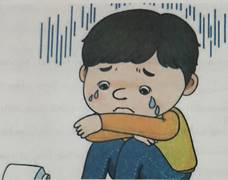 Most people associate tears with people who are crying because they are upset, angry or extremely happy, but there are actually three different kinds of tears.
Firstly there are basal tears. These are tears regularly produced by the tear glands which are above your eyes, under the eyelids, and protect the eyes by keeping them clean and wet. Basal tears are spread evenly over the eye by blinking. They are made up of a mixture of water, oil and mucus (粘液).
But there are other tears which have no connection with emotions either. These tears also protect the eyes. So how are they different? The second kind of tears are called reflex tears and their job is to wash out foreign objects that come into contact with the eye—when an eyelash or an insect gets stuck in your eye, for example. Reflex tears can also be caused by the smell of onions or smoke, which contain chemicals and tiny particles. In addition, cold air or wind, which dries out the eyes, causes the tear glands to produce reflex tears. In English we often say our eyes are “watering” when this happens.
And then there are “real” tears—emotional tears. They are produced by emotional stress or pain and have been found to contain more hormones than other types of tears. Most mammals produce basal or reflex tears, but we humans produce emotional tears.
Emotional tears and reflex tears also come from the tear glands. Some of the tears drain away though the tear ducts in the corner of your eyes. But when too many tears are produced, they roll down your face. Your tear ducts are also connected to your nose, which is why tears sometimes run down into it. Both reflex tears and emotional tears are more watery than basal tears.
What is the function of emotional tears? Studies indicate that our bodies use them as a way of re-establishing balance of the nervous system. They are a way for us to calm down after a period of stress. Research across cultures also indicates that tears help people to establish a bond with people they care for. Tears express vulnerability and most people react with sympathy to tears.
Questions 56-60
Fill in the blanks below with information from the passage, using no more than three words for each blank.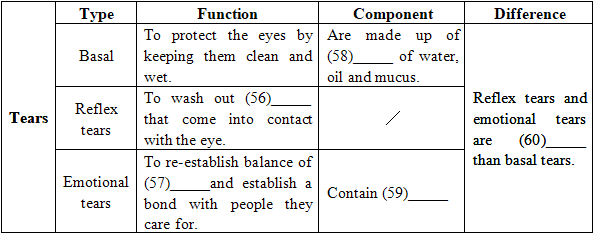
Section A (10 marks)
Questions 56 to 60 are based on the following passage.
Most people associate tears with people who are crying because they are upset, angry or extremely happy, but there are actually three different kinds of tears.Firstly there are basal tears. These are tears regularly produced by the tear glands which are above your eyes, under the eyelids, and protect the eyes by keeping them clean and wet. Basal tears are spread evenly over the eye by blinking. They are made up of a mixture of water, oil and mucus (粘液).
But there are other tears which have no connection with emotions either. These tears also protect the eyes. So how are they different? The second kind of tears are called reflex tears and their job is to wash out foreign objects that come into contact with the eye—when an eyelash or an insect gets stuck in your eye, for example. Reflex tears can also be caused by the smell of onions or smoke, which contain chemicals and tiny particles. In addition, cold air or wind, which dries out the eyes, causes the tear glands to produce reflex tears. In English we often say our eyes are “watering” when this happens.
And then there are “real” tears—emotional tears. They are produced by emotional stress or pain and have been found to contain more hormones than other types of tears. Most mammals produce basal or reflex tears, but we humans produce emotional tears.
Emotional tears and reflex tears also come from the tear glands. Some of the tears drain away though the tear ducts in the corner of your eyes. But when too many tears are produced, they roll down your face. Your tear ducts are also connected to your nose, which is why tears sometimes run down into it. Both reflex tears and emotional tears are more watery than basal tears.
What is the function of emotional tears? Studies indicate that our bodies use them as a way of re-establishing balance of the nervous system. They are a way for us to calm down after a period of stress. Research across cultures also indicates that tears help people to establish a bond with people they care for. Tears express vulnerability and most people react with sympathy to tears.
Questions 56-60
Fill in the blanks below with information from the passage, using no more than three words for each blank.
26
There are three passages in this part. Each passage is followed by several questions. Respond to the questions using information from the passage. Remember to write the answers on the answer sheet.
Section A (10 marks)
Questions 56 to 60 are based on the following passage. Most people associate tears with people who are crying because they are upset, angry or extremely happy, but there are actually three different kinds of tears.
Firstly there are basal tears. These are tears regularly produced by the tear glands which are above your eyes, under the eyelids, and protect the eyes by keeping them clean and wet. Basal tears are spread evenly over the eye by blinking. They are made up of a mixture of water, oil and mucus (粘液).
But there are other tears which have no connection with emotions either. These tears also protect the eyes. So how are they different? The second kind of tears are called reflex tears and their job is to wash out foreign objects that come into contact with the eye—when an eyelash or an insect gets stuck in your eye, for example. Reflex tears can also be caused by the smell of onions or smoke, which contain chemicals and tiny particles. In addition, cold air or wind, which dries out the eyes, causes the tear glands to produce reflex tears. In English we often say our eyes are “watering” when this happens.
And then there are “real” tears—emotional tears. They are produced by emotional stress or pain and have been found to contain more hormones than other types of tears. Most mammals produce basal or reflex tears, but we humans produce emotional tears.
Emotional tears and reflex tears also come from the tear glands. Some of the tears drain away though the tear ducts in the corner of your eyes. But when too many tears are produced, they roll down your face. Your tear ducts are also connected to your nose, which is why tears sometimes run down into it. Both reflex tears and emotional tears are more watery than basal tears.
What is the function of emotional tears? Studies indicate that our bodies use them as a way of re-establishing balance of the nervous system. They are a way for us to calm down after a period of stress. Research across cultures also indicates that tears help people to establish a bond with people they care for. Tears express vulnerability and most people react with sympathy to tears.
Questions 56-60
Fill in the blanks below with information from the passage, using no more than three words for each blank.
Section A (10 marks)
Questions 56 to 60 are based on the following passage.
Most people associate tears with people who are crying because they are upset, angry or extremely happy, but there are actually three different kinds of tears.Firstly there are basal tears. These are tears regularly produced by the tear glands which are above your eyes, under the eyelids, and protect the eyes by keeping them clean and wet. Basal tears are spread evenly over the eye by blinking. They are made up of a mixture of water, oil and mucus (粘液).
But there are other tears which have no connection with emotions either. These tears also protect the eyes. So how are they different? The second kind of tears are called reflex tears and their job is to wash out foreign objects that come into contact with the eye—when an eyelash or an insect gets stuck in your eye, for example. Reflex tears can also be caused by the smell of onions or smoke, which contain chemicals and tiny particles. In addition, cold air or wind, which dries out the eyes, causes the tear glands to produce reflex tears. In English we often say our eyes are “watering” when this happens.
And then there are “real” tears—emotional tears. They are produced by emotional stress or pain and have been found to contain more hormones than other types of tears. Most mammals produce basal or reflex tears, but we humans produce emotional tears.
Emotional tears and reflex tears also come from the tear glands. Some of the tears drain away though the tear ducts in the corner of your eyes. But when too many tears are produced, they roll down your face. Your tear ducts are also connected to your nose, which is why tears sometimes run down into it. Both reflex tears and emotional tears are more watery than basal tears.
What is the function of emotional tears? Studies indicate that our bodies use them as a way of re-establishing balance of the nervous system. They are a way for us to calm down after a period of stress. Research across cultures also indicates that tears help people to establish a bond with people they care for. Tears express vulnerability and most people react with sympathy to tears.
Questions 56-60
Fill in the blanks below with information from the passage, using no more than three words for each blank.
27
There are three passages in this part. Each passage is followed by several questions. Respond to the questions using information from the passage. Remember to write the answers on the answer sheet.
Section A (10 marks)
Questions 56 to 60 are based on the following passage. Most people associate tears with people who are crying because they are upset, angry or extremely happy, but there are actually three different kinds of tears.
Firstly there are basal tears. These are tears regularly produced by the tear glands which are above your eyes, under the eyelids, and protect the eyes by keeping them clean and wet. Basal tears are spread evenly over the eye by blinking. They are made up of a mixture of water, oil and mucus (粘液).
But there are other tears which have no connection with emotions either. These tears also protect the eyes. So how are they different? The second kind of tears are called reflex tears and their job is to wash out foreign objects that come into contact with the eye—when an eyelash or an insect gets stuck in your eye, for example. Reflex tears can also be caused by the smell of onions or smoke, which contain chemicals and tiny particles. In addition, cold air or wind, which dries out the eyes, causes the tear glands to produce reflex tears. In English we often say our eyes are “watering” when this happens.
And then there are “real” tears—emotional tears. They are produced by emotional stress or pain and have been found to contain more hormones than other types of tears. Most mammals produce basal or reflex tears, but we humans produce emotional tears.
Emotional tears and reflex tears also come from the tear glands. Some of the tears drain away though the tear ducts in the corner of your eyes. But when too many tears are produced, they roll down your face. Your tear ducts are also connected to your nose, which is why tears sometimes run down into it. Both reflex tears and emotional tears are more watery than basal tears.
What is the function of emotional tears? Studies indicate that our bodies use them as a way of re-establishing balance of the nervous system. They are a way for us to calm down after a period of stress. Research across cultures also indicates that tears help people to establish a bond with people they care for. Tears express vulnerability and most people react with sympathy to tears.
Questions 56-60
Fill in the blanks below with information from the passage, using no more than three words for each blank.
Section A (10 marks)
Questions 56 to 60 are based on the following passage.
Most people associate tears with people who are crying because they are upset, angry or extremely happy, but there are actually three different kinds of tears.Firstly there are basal tears. These are tears regularly produced by the tear glands which are above your eyes, under the eyelids, and protect the eyes by keeping them clean and wet. Basal tears are spread evenly over the eye by blinking. They are made up of a mixture of water, oil and mucus (粘液).
But there are other tears which have no connection with emotions either. These tears also protect the eyes. So how are they different? The second kind of tears are called reflex tears and their job is to wash out foreign objects that come into contact with the eye—when an eyelash or an insect gets stuck in your eye, for example. Reflex tears can also be caused by the smell of onions or smoke, which contain chemicals and tiny particles. In addition, cold air or wind, which dries out the eyes, causes the tear glands to produce reflex tears. In English we often say our eyes are “watering” when this happens.
And then there are “real” tears—emotional tears. They are produced by emotional stress or pain and have been found to contain more hormones than other types of tears. Most mammals produce basal or reflex tears, but we humans produce emotional tears.
Emotional tears and reflex tears also come from the tear glands. Some of the tears drain away though the tear ducts in the corner of your eyes. But when too many tears are produced, they roll down your face. Your tear ducts are also connected to your nose, which is why tears sometimes run down into it. Both reflex tears and emotional tears are more watery than basal tears.
What is the function of emotional tears? Studies indicate that our bodies use them as a way of re-establishing balance of the nervous system. They are a way for us to calm down after a period of stress. Research across cultures also indicates that tears help people to establish a bond with people they care for. Tears express vulnerability and most people react with sympathy to tears.
Questions 56-60
Fill in the blanks below with information from the passage, using no more than three words for each blank.
28
There are three passages in this part. Each passage is followed by several questions. Respond to the questions using information from the passage. Remember to write the answers on the answer sheet.
Section A (10 marks)
Questions 56 to 60 are based on the following passage. Most people associate tears with people who are crying because they are upset, angry or extremely happy, but there are actually three different kinds of tears.
Firstly there are basal tears. These are tears regularly produced by the tear glands which are above your eyes, under the eyelids, and protect the eyes by keeping them clean and wet. Basal tears are spread evenly over the eye by blinking. They are made up of a mixture of water, oil and mucus (粘液).
But there are other tears which have no connection with emotions either. These tears also protect the eyes. So how are they different? The second kind of tears are called reflex tears and their job is to wash out foreign objects that come into contact with the eye—when an eyelash or an insect gets stuck in your eye, for example. Reflex tears can also be caused by the smell of onions or smoke, which contain chemicals and tiny particles. In addition, cold air or wind, which dries out the eyes, causes the tear glands to produce reflex tears. In English we often say our eyes are “watering” when this happens.
And then there are “real” tears—emotional tears. They are produced by emotional stress or pain and have been found to contain more hormones than other types of tears. Most mammals produce basal or reflex tears, but we humans produce emotional tears.
Emotional tears and reflex tears also come from the tear glands. Some of the tears drain away though the tear ducts in the corner of your eyes. But when too many tears are produced, they roll down your face. Your tear ducts are also connected to your nose, which is why tears sometimes run down into it. Both reflex tears and emotional tears are more watery than basal tears.
What is the function of emotional tears? Studies indicate that our bodies use them as a way of re-establishing balance of the nervous system. They are a way for us to calm down after a period of stress. Research across cultures also indicates that tears help people to establish a bond with people they care for. Tears express vulnerability and most people react with sympathy to tears.
Questions 56-60
Fill in the blanks below with information from the passage, using no more than three words for each blank.
Section A (10 marks)
Questions 56 to 60 are based on the following passage.
Most people associate tears with people who are crying because they are upset, angry or extremely happy, but there are actually three different kinds of tears.Firstly there are basal tears. These are tears regularly produced by the tear glands which are above your eyes, under the eyelids, and protect the eyes by keeping them clean and wet. Basal tears are spread evenly over the eye by blinking. They are made up of a mixture of water, oil and mucus (粘液).
But there are other tears which have no connection with emotions either. These tears also protect the eyes. So how are they different? The second kind of tears are called reflex tears and their job is to wash out foreign objects that come into contact with the eye—when an eyelash or an insect gets stuck in your eye, for example. Reflex tears can also be caused by the smell of onions or smoke, which contain chemicals and tiny particles. In addition, cold air or wind, which dries out the eyes, causes the tear glands to produce reflex tears. In English we often say our eyes are “watering” when this happens.
And then there are “real” tears—emotional tears. They are produced by emotional stress or pain and have been found to contain more hormones than other types of tears. Most mammals produce basal or reflex tears, but we humans produce emotional tears.
Emotional tears and reflex tears also come from the tear glands. Some of the tears drain away though the tear ducts in the corner of your eyes. But when too many tears are produced, they roll down your face. Your tear ducts are also connected to your nose, which is why tears sometimes run down into it. Both reflex tears and emotional tears are more watery than basal tears.
What is the function of emotional tears? Studies indicate that our bodies use them as a way of re-establishing balance of the nervous system. They are a way for us to calm down after a period of stress. Research across cultures also indicates that tears help people to establish a bond with people they care for. Tears express vulnerability and most people react with sympathy to tears.
Questions 56-60
Fill in the blanks below with information from the passage, using no more than three words for each blank.
29
There are three passages in this part. Each passage is followed by several questions. Respond to the questions using information from the passage. Remember to write the answers on the answer sheet.
Section A (10 marks)
Questions 56 to 60 are based on the following passage. Most people associate tears with people who are crying because they are upset, angry or extremely happy, but there are actually three different kinds of tears.
Firstly there are basal tears. These are tears regularly produced by the tear glands which are above your eyes, under the eyelids, and protect the eyes by keeping them clean and wet. Basal tears are spread evenly over the eye by blinking. They are made up of a mixture of water, oil and mucus (粘液).
But there are other tears which have no connection with emotions either. These tears also protect the eyes. So how are they different? The second kind of tears are called reflex tears and their job is to wash out foreign objects that come into contact with the eye—when an eyelash or an insect gets stuck in your eye, for example. Reflex tears can also be caused by the smell of onions or smoke, which contain chemicals and tiny particles. In addition, cold air or wind, which dries out the eyes, causes the tear glands to produce reflex tears. In English we often say our eyes are “watering” when this happens.
And then there are “real” tears—emotional tears. They are produced by emotional stress or pain and have been found to contain more hormones than other types of tears. Most mammals produce basal or reflex tears, but we humans produce emotional tears.
Emotional tears and reflex tears also come from the tear glands. Some of the tears drain away though the tear ducts in the corner of your eyes. But when too many tears are produced, they roll down your face. Your tear ducts are also connected to your nose, which is why tears sometimes run down into it. Both reflex tears and emotional tears are more watery than basal tears.
What is the function of emotional tears? Studies indicate that our bodies use them as a way of re-establishing balance of the nervous system. They are a way for us to calm down after a period of stress. Research across cultures also indicates that tears help people to establish a bond with people they care for. Tears express vulnerability and most people react with sympathy to tears.
Questions 56-60
Fill in the blanks below with information from the passage, using no more than three words for each blank.
Section A (10 marks)
Questions 56 to 60 are based on the following passage.
Most people associate tears with people who are crying because they are upset, angry or extremely happy, but there are actually three different kinds of tears.Firstly there are basal tears. These are tears regularly produced by the tear glands which are above your eyes, under the eyelids, and protect the eyes by keeping them clean and wet. Basal tears are spread evenly over the eye by blinking. They are made up of a mixture of water, oil and mucus (粘液).
But there are other tears which have no connection with emotions either. These tears also protect the eyes. So how are they different? The second kind of tears are called reflex tears and their job is to wash out foreign objects that come into contact with the eye—when an eyelash or an insect gets stuck in your eye, for example. Reflex tears can also be caused by the smell of onions or smoke, which contain chemicals and tiny particles. In addition, cold air or wind, which dries out the eyes, causes the tear glands to produce reflex tears. In English we often say our eyes are “watering” when this happens.
And then there are “real” tears—emotional tears. They are produced by emotional stress or pain and have been found to contain more hormones than other types of tears. Most mammals produce basal or reflex tears, but we humans produce emotional tears.
Emotional tears and reflex tears also come from the tear glands. Some of the tears drain away though the tear ducts in the corner of your eyes. But when too many tears are produced, they roll down your face. Your tear ducts are also connected to your nose, which is why tears sometimes run down into it. Both reflex tears and emotional tears are more watery than basal tears.
What is the function of emotional tears? Studies indicate that our bodies use them as a way of re-establishing balance of the nervous system. They are a way for us to calm down after a period of stress. Research across cultures also indicates that tears help people to establish a bond with people they care for. Tears express vulnerability and most people react with sympathy to tears.
Questions 56-60
Fill in the blanks below with information from the passage, using no more than three words for each blank.
30
There are three passages in this part. Each passage is followed by several questions. Respond to the questions using information from the passage. Remember to write the answers on the answer sheet.
Section A (10 marks)
Questions 56 to 60 are based on the following passage. Most people associate tears with people who are crying because they are upset, angry or extremely happy, but there are actually three different kinds of tears.
Firstly there are basal tears. These are tears regularly produced by the tear glands which are above your eyes, under the eyelids, and protect the eyes by keeping them clean and wet. Basal tears are spread evenly over the eye by blinking. They are made up of a mixture of water, oil and mucus (粘液).
But there are other tears which have no connection with emotions either. These tears also protect the eyes. So how are they different? The second kind of tears are called reflex tears and their job is to wash out foreign objects that come into contact with the eye—when an eyelash or an insect gets stuck in your eye, for example. Reflex tears can also be caused by the smell of onions or smoke, which contain chemicals and tiny particles. In addition, cold air or wind, which dries out the eyes, causes the tear glands to produce reflex tears. In English we often say our eyes are “watering” when this happens.
And then there are “real” tears—emotional tears. They are produced by emotional stress or pain and have been found to contain more hormones than other types of tears. Most mammals produce basal or reflex tears, but we humans produce emotional tears.
Emotional tears and reflex tears also come from the tear glands. Some of the tears drain away though the tear ducts in the corner of your eyes. But when too many tears are produced, they roll down your face. Your tear ducts are also connected to your nose, which is why tears sometimes run down into it. Both reflex tears and emotional tears are more watery than basal tears.
What is the function of emotional tears? Studies indicate that our bodies use them as a way of re-establishing balance of the nervous system. They are a way for us to calm down after a period of stress. Research across cultures also indicates that tears help people to establish a bond with people they care for. Tears express vulnerability and most people react with sympathy to tears.
Questions 56-60
Fill in the blanks below with information from the passage, using no more than three words for each blank.
Section A (10 marks)
Questions 56 to 60 are based on the following passage.
Most people associate tears with people who are crying because they are upset, angry or extremely happy, but there are actually three different kinds of tears.Firstly there are basal tears. These are tears regularly produced by the tear glands which are above your eyes, under the eyelids, and protect the eyes by keeping them clean and wet. Basal tears are spread evenly over the eye by blinking. They are made up of a mixture of water, oil and mucus (粘液).
But there are other tears which have no connection with emotions either. These tears also protect the eyes. So how are they different? The second kind of tears are called reflex tears and their job is to wash out foreign objects that come into contact with the eye—when an eyelash or an insect gets stuck in your eye, for example. Reflex tears can also be caused by the smell of onions or smoke, which contain chemicals and tiny particles. In addition, cold air or wind, which dries out the eyes, causes the tear glands to produce reflex tears. In English we often say our eyes are “watering” when this happens.
And then there are “real” tears—emotional tears. They are produced by emotional stress or pain and have been found to contain more hormones than other types of tears. Most mammals produce basal or reflex tears, but we humans produce emotional tears.
Emotional tears and reflex tears also come from the tear glands. Some of the tears drain away though the tear ducts in the corner of your eyes. But when too many tears are produced, they roll down your face. Your tear ducts are also connected to your nose, which is why tears sometimes run down into it. Both reflex tears and emotional tears are more watery than basal tears.
What is the function of emotional tears? Studies indicate that our bodies use them as a way of re-establishing balance of the nervous system. They are a way for us to calm down after a period of stress. Research across cultures also indicates that tears help people to establish a bond with people they care for. Tears express vulnerability and most people react with sympathy to tears.
Questions 56-60
Fill in the blanks below with information from the passage, using no more than three words for each blank.
Section B (10 marks)
Questions 61 to 65 are based on the following passage. In 1791, George Washington picked the site of the nation’s capital—Washington, D.C. He also chose the spot where the President’s house would be built. The “Father of the Country” never saw the completed building, though. When he died in 1799, the walls and roof were just about finished. President John Adams and his wife, Abigail, were the first to live there.
The Adamses arrived in Washington, D.C., in November of 1800. Stunned by what they saw, they tried to remain calm. Mud and rubble covered the grounds of their new home. A bridge of planks led from the roadway to the front door. All around the mansion stood the workers’ shacks. Washington was a village of some 40 houses, not the big city we know today.
At least the President’s house was finished on the outside. Inside, everything was incomplete. Many of the walls had not been plastered. The central staircase was unfinished. The floors were rough boards. There was no indoor bathroom. The furniture was inadequate, too. There wasn’t nearly enough, and in the huge rooms the furniture looked like dollhouse furniture.
Congress thought it had spent enough on the mansion. Abigail felt that much had been left undone. She complained that there were no lamps or mirrors. Compared with her cozy home in Boston, Massachusetts, this was cold and damp, and the firewood supply was insufficient to keep her 13 fireplaces burning and her rooms warm. To dry laundry, the first lady had to string up a clothesline in the huge East Room.
In private, Abigail Adams complained about the living arrangements. In public, however, she praised the location of the house. After all, the huge building was the center of a new city springing up in the wilderness. With a sparkling new coat of white paint, “the white house” shone like a gem even against the drabbest surroundings. Built on a rise, it had sweeping views of hills, forests, and the Potomac River. Indeed, it seemed to hover above the earth rather than being sunk, as it actually was, into the side of a hill.
Abigail Adams was a smart woman. She realized the White House—as it is now called—would have a great future. She knew that her present living conditions would soon change for the better. “This house,” she wrote to a relative, “is built for ages to come.”
Questions 61 to 65
Answer the following questions with the information given in the passage.
Questions 61 to 65 are based on the following passage.
In 1791, George Washington picked the site of the nation’s capital—Washington, D.C. He also chose the spot where the President’s house would be built. The “Father of the Country” never saw the completed building, though. When he died in 1799, the walls and roof were just about finished. President John Adams and his wife, Abigail, were the first to live there.The Adamses arrived in Washington, D.C., in November of 1800. Stunned by what they saw, they tried to remain calm. Mud and rubble covered the grounds of their new home. A bridge of planks led from the roadway to the front door. All around the mansion stood the workers’ shacks. Washington was a village of some 40 houses, not the big city we know today.
At least the President’s house was finished on the outside. Inside, everything was incomplete. Many of the walls had not been plastered. The central staircase was unfinished. The floors were rough boards. There was no indoor bathroom. The furniture was inadequate, too. There wasn’t nearly enough, and in the huge rooms the furniture looked like dollhouse furniture.
Congress thought it had spent enough on the mansion. Abigail felt that much had been left undone. She complained that there were no lamps or mirrors. Compared with her cozy home in Boston, Massachusetts, this was cold and damp, and the firewood supply was insufficient to keep her 13 fireplaces burning and her rooms warm. To dry laundry, the first lady had to string up a clothesline in the huge East Room.
In private, Abigail Adams complained about the living arrangements. In public, however, she praised the location of the house. After all, the huge building was the center of a new city springing up in the wilderness. With a sparkling new coat of white paint, “the white house” shone like a gem even against the drabbest surroundings. Built on a rise, it had sweeping views of hills, forests, and the Potomac River. Indeed, it seemed to hover above the earth rather than being sunk, as it actually was, into the side of a hill.
Abigail Adams was a smart woman. She realized the White House—as it is now called—would have a great future. She knew that her present living conditions would soon change for the better. “This house,” she wrote to a relative, “is built for ages to come.”
Questions 61 to 65
Answer the following questions with the information given in the passage.
31
Who chose the spot where the President’s house would be built?
32
How did the Adamses feel when they saw their new home?
33
Where did Abigail live before she came to the new mansion?
34
What did Abigail do to dry laundry in the new mansion?
35
Why did Abigail praise the location of the house?
Section C (10 marks)
Questions 66 to 70 are based on the following passage.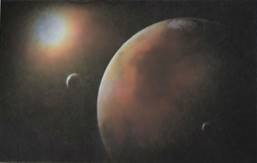 Is there life anywhere in the universe other than on Earth? To answer that question, scientists look at outer space through telescopes. They send up rockets and satellites and study the information that comes back. Scientists also study life forms on Earth. They think about the features on Earth that support life. Every answer helps them to know what to look for in outer space.
Researchers have learned that two things are required to keep life going on Earth. They are energy and flowing water. All life forms need water to survive. It takes energy to keep water in its liquid state, however. Earth’s energy comes from the sun. Our source for water is rain and snow, which are collected by oceans, lakes, rivers and streams.
What places in our solar system are likely to have energy to keep water in a liquid state? The answer to that question is unknown, but scientists have some ideas. They are looking very closely at the planet Mars. Although the atmosphere of Mars is very different from Earth’s atmosphere, it does have water. Martian air holds only about 1/1000 as much water as Earth’s air. Even that small amount can produce clouds, fog, and frost—all filled with water. The greatest problem with keeping water in a liquid state on Mars is the planet’s extreme cold. The average temperature on Mars is ﹣81 degrees Fahrenheit. The warmest it gets is 68 degrees Fahrenheit, and the coldest recorded temperature is ﹣220 degrees Fahrenheit!
Life may also be possible on Europa, one of the moons of the planet Jupiter(木星). Scientists believe that Europa may have liquid water and volcanoes. The heat from volcanoes may keep oceans from freezing. Scientists are planning missions to Jupiter and Europa to bring back samples of surface ice. They suspect that if there is life on Europa, it may exit in an ice-covered ocean. They believe that deep below the ice, hot springs in the ocean floor heat the water.
Scientists also look at life on Earth to ponder questions about life in outer space. Life forms have adapted to some remarkably harsh conditions. Creatures too tiny to be seen with the human eye live in ice-covered Antarctic lakes and in steaming hot springs. Infrequently, small creatures can even be found in the dry centres of rocks. The existence of these life forms suggests that some very harsh places can support life. As scientists unlock the secrets of how living things survive on this planet, they come closer to answering questions about life forms elsewhere in our solar system and beyond.
Questions 66 to 70
Complete the summary below with information from the passage, using no more than three words for each blank.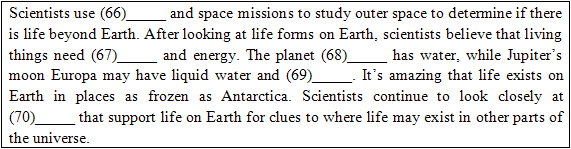
Questions 66 to 70 are based on the following passage.
Is there life anywhere in the universe other than on Earth? To answer that question, scientists look at outer space through telescopes. They send up rockets and satellites and study the information that comes back. Scientists also study life forms on Earth. They think about the features on Earth that support life. Every answer helps them to know what to look for in outer space.Researchers have learned that two things are required to keep life going on Earth. They are energy and flowing water. All life forms need water to survive. It takes energy to keep water in its liquid state, however. Earth’s energy comes from the sun. Our source for water is rain and snow, which are collected by oceans, lakes, rivers and streams.
What places in our solar system are likely to have energy to keep water in a liquid state? The answer to that question is unknown, but scientists have some ideas. They are looking very closely at the planet Mars. Although the atmosphere of Mars is very different from Earth’s atmosphere, it does have water. Martian air holds only about 1/1000 as much water as Earth’s air. Even that small amount can produce clouds, fog, and frost—all filled with water. The greatest problem with keeping water in a liquid state on Mars is the planet’s extreme cold. The average temperature on Mars is ﹣81 degrees Fahrenheit. The warmest it gets is 68 degrees Fahrenheit, and the coldest recorded temperature is ﹣220 degrees Fahrenheit!
Life may also be possible on Europa, one of the moons of the planet Jupiter(木星). Scientists believe that Europa may have liquid water and volcanoes. The heat from volcanoes may keep oceans from freezing. Scientists are planning missions to Jupiter and Europa to bring back samples of surface ice. They suspect that if there is life on Europa, it may exit in an ice-covered ocean. They believe that deep below the ice, hot springs in the ocean floor heat the water.
Scientists also look at life on Earth to ponder questions about life in outer space. Life forms have adapted to some remarkably harsh conditions. Creatures too tiny to be seen with the human eye live in ice-covered Antarctic lakes and in steaming hot springs. Infrequently, small creatures can even be found in the dry centres of rocks. The existence of these life forms suggests that some very harsh places can support life. As scientists unlock the secrets of how living things survive on this planet, they come closer to answering questions about life forms elsewhere in our solar system and beyond.
Questions 66 to 70
Complete the summary below with information from the passage, using no more than three words for each blank.
36
Section C (10 marks)
Questions 66 to 70 are based on the following passage. Is there life anywhere in the universe other than on Earth? To answer that question, scientists look at outer space through telescopes. They send up rockets and satellites and study the information that comes back. Scientists also study life forms on Earth. They think about the features on Earth that support life. Every answer helps them to know what to look for in outer space.
Researchers have learned that two things are required to keep life going on Earth. They are energy and flowing water. All life forms need water to survive. It takes energy to keep water in its liquid state, however. Earth’s energy comes from the sun. Our source for water is rain and snow, which are collected by oceans, lakes, rivers and streams.
What places in our solar system are likely to have energy to keep water in a liquid state? The answer to that question is unknown, but scientists have some ideas. They are looking very closely at the planet Mars. Although the atmosphere of Mars is very different from Earth’s atmosphere, it does have water. Martian air holds only about 1/1000 as much water as Earth’s air. Even that small amount can produce clouds, fog, and frost—all filled with water. The greatest problem with keeping water in a liquid state on Mars is the planet’s extreme cold. The average temperature on Mars is ﹣81 degrees Fahrenheit. The warmest it gets is 68 degrees Fahrenheit, and the coldest recorded temperature is ﹣220 degrees Fahrenheit!
Life may also be possible on Europa, one of the moons of the planet Jupiter(木星). Scientists believe that Europa may have liquid water and volcanoes. The heat from volcanoes may keep oceans from freezing. Scientists are planning missions to Jupiter and Europa to bring back samples of surface ice. They suspect that if there is life on Europa, it may exit in an ice-covered ocean. They believe that deep below the ice, hot springs in the ocean floor heat the water.
Scientists also look at life on Earth to ponder questions about life in outer space. Life forms have adapted to some remarkably harsh conditions. Creatures too tiny to be seen with the human eye live in ice-covered Antarctic lakes and in steaming hot springs. Infrequently, small creatures can even be found in the dry centres of rocks. The existence of these life forms suggests that some very harsh places can support life. As scientists unlock the secrets of how living things survive on this planet, they come closer to answering questions about life forms elsewhere in our solar system and beyond.
Questions 66 to 70
Complete the summary below with information from the passage, using no more than three words for each blank.
Questions 66 to 70 are based on the following passage.
Is there life anywhere in the universe other than on Earth? To answer that question, scientists look at outer space through telescopes. They send up rockets and satellites and study the information that comes back. Scientists also study life forms on Earth. They think about the features on Earth that support life. Every answer helps them to know what to look for in outer space.Researchers have learned that two things are required to keep life going on Earth. They are energy and flowing water. All life forms need water to survive. It takes energy to keep water in its liquid state, however. Earth’s energy comes from the sun. Our source for water is rain and snow, which are collected by oceans, lakes, rivers and streams.
What places in our solar system are likely to have energy to keep water in a liquid state? The answer to that question is unknown, but scientists have some ideas. They are looking very closely at the planet Mars. Although the atmosphere of Mars is very different from Earth’s atmosphere, it does have water. Martian air holds only about 1/1000 as much water as Earth’s air. Even that small amount can produce clouds, fog, and frost—all filled with water. The greatest problem with keeping water in a liquid state on Mars is the planet’s extreme cold. The average temperature on Mars is ﹣81 degrees Fahrenheit. The warmest it gets is 68 degrees Fahrenheit, and the coldest recorded temperature is ﹣220 degrees Fahrenheit!
Life may also be possible on Europa, one of the moons of the planet Jupiter(木星). Scientists believe that Europa may have liquid water and volcanoes. The heat from volcanoes may keep oceans from freezing. Scientists are planning missions to Jupiter and Europa to bring back samples of surface ice. They suspect that if there is life on Europa, it may exit in an ice-covered ocean. They believe that deep below the ice, hot springs in the ocean floor heat the water.
Scientists also look at life on Earth to ponder questions about life in outer space. Life forms have adapted to some remarkably harsh conditions. Creatures too tiny to be seen with the human eye live in ice-covered Antarctic lakes and in steaming hot springs. Infrequently, small creatures can even be found in the dry centres of rocks. The existence of these life forms suggests that some very harsh places can support life. As scientists unlock the secrets of how living things survive on this planet, they come closer to answering questions about life forms elsewhere in our solar system and beyond.
Questions 66 to 70
Complete the summary below with information from the passage, using no more than three words for each blank.
37
Section C (10 marks)
Questions 66 to 70 are based on the following passage. Is there life anywhere in the universe other than on Earth? To answer that question, scientists look at outer space through telescopes. They send up rockets and satellites and study the information that comes back. Scientists also study life forms on Earth. They think about the features on Earth that support life. Every answer helps them to know what to look for in outer space.
Researchers have learned that two things are required to keep life going on Earth. They are energy and flowing water. All life forms need water to survive. It takes energy to keep water in its liquid state, however. Earth’s energy comes from the sun. Our source for water is rain and snow, which are collected by oceans, lakes, rivers and streams.
What places in our solar system are likely to have energy to keep water in a liquid state? The answer to that question is unknown, but scientists have some ideas. They are looking very closely at the planet Mars. Although the atmosphere of Mars is very different from Earth’s atmosphere, it does have water. Martian air holds only about 1/1000 as much water as Earth’s air. Even that small amount can produce clouds, fog, and frost—all filled with water. The greatest problem with keeping water in a liquid state on Mars is the planet’s extreme cold. The average temperature on Mars is ﹣81 degrees Fahrenheit. The warmest it gets is 68 degrees Fahrenheit, and the coldest recorded temperature is ﹣220 degrees Fahrenheit!
Life may also be possible on Europa, one of the moons of the planet Jupiter(木星). Scientists believe that Europa may have liquid water and volcanoes. The heat from volcanoes may keep oceans from freezing. Scientists are planning missions to Jupiter and Europa to bring back samples of surface ice. They suspect that if there is life on Europa, it may exit in an ice-covered ocean. They believe that deep below the ice, hot springs in the ocean floor heat the water.
Scientists also look at life on Earth to ponder questions about life in outer space. Life forms have adapted to some remarkably harsh conditions. Creatures too tiny to be seen with the human eye live in ice-covered Antarctic lakes and in steaming hot springs. Infrequently, small creatures can even be found in the dry centres of rocks. The existence of these life forms suggests that some very harsh places can support life. As scientists unlock the secrets of how living things survive on this planet, they come closer to answering questions about life forms elsewhere in our solar system and beyond.
Questions 66 to 70
Complete the summary below with information from the passage, using no more than three words for each blank.
Questions 66 to 70 are based on the following passage.
Is there life anywhere in the universe other than on Earth? To answer that question, scientists look at outer space through telescopes. They send up rockets and satellites and study the information that comes back. Scientists also study life forms on Earth. They think about the features on Earth that support life. Every answer helps them to know what to look for in outer space.Researchers have learned that two things are required to keep life going on Earth. They are energy and flowing water. All life forms need water to survive. It takes energy to keep water in its liquid state, however. Earth’s energy comes from the sun. Our source for water is rain and snow, which are collected by oceans, lakes, rivers and streams.
What places in our solar system are likely to have energy to keep water in a liquid state? The answer to that question is unknown, but scientists have some ideas. They are looking very closely at the planet Mars. Although the atmosphere of Mars is very different from Earth’s atmosphere, it does have water. Martian air holds only about 1/1000 as much water as Earth’s air. Even that small amount can produce clouds, fog, and frost—all filled with water. The greatest problem with keeping water in a liquid state on Mars is the planet’s extreme cold. The average temperature on Mars is ﹣81 degrees Fahrenheit. The warmest it gets is 68 degrees Fahrenheit, and the coldest recorded temperature is ﹣220 degrees Fahrenheit!
Life may also be possible on Europa, one of the moons of the planet Jupiter(木星). Scientists believe that Europa may have liquid water and volcanoes. The heat from volcanoes may keep oceans from freezing. Scientists are planning missions to Jupiter and Europa to bring back samples of surface ice. They suspect that if there is life on Europa, it may exit in an ice-covered ocean. They believe that deep below the ice, hot springs in the ocean floor heat the water.
Scientists also look at life on Earth to ponder questions about life in outer space. Life forms have adapted to some remarkably harsh conditions. Creatures too tiny to be seen with the human eye live in ice-covered Antarctic lakes and in steaming hot springs. Infrequently, small creatures can even be found in the dry centres of rocks. The existence of these life forms suggests that some very harsh places can support life. As scientists unlock the secrets of how living things survive on this planet, they come closer to answering questions about life forms elsewhere in our solar system and beyond.
Questions 66 to 70
Complete the summary below with information from the passage, using no more than three words for each blank.
38
Section C (10 marks)
Questions 66 to 70 are based on the following passage. Is there life anywhere in the universe other than on Earth? To answer that question, scientists look at outer space through telescopes. They send up rockets and satellites and study the information that comes back. Scientists also study life forms on Earth. They think about the features on Earth that support life. Every answer helps them to know what to look for in outer space.
Researchers have learned that two things are required to keep life going on Earth. They are energy and flowing water. All life forms need water to survive. It takes energy to keep water in its liquid state, however. Earth’s energy comes from the sun. Our source for water is rain and snow, which are collected by oceans, lakes, rivers and streams.
What places in our solar system are likely to have energy to keep water in a liquid state? The answer to that question is unknown, but scientists have some ideas. They are looking very closely at the planet Mars. Although the atmosphere of Mars is very different from Earth’s atmosphere, it does have water. Martian air holds only about 1/1000 as much water as Earth’s air. Even that small amount can produce clouds, fog, and frost—all filled with water. The greatest problem with keeping water in a liquid state on Mars is the planet’s extreme cold. The average temperature on Mars is ﹣81 degrees Fahrenheit. The warmest it gets is 68 degrees Fahrenheit, and the coldest recorded temperature is ﹣220 degrees Fahrenheit!
Life may also be possible on Europa, one of the moons of the planet Jupiter(木星). Scientists believe that Europa may have liquid water and volcanoes. The heat from volcanoes may keep oceans from freezing. Scientists are planning missions to Jupiter and Europa to bring back samples of surface ice. They suspect that if there is life on Europa, it may exit in an ice-covered ocean. They believe that deep below the ice, hot springs in the ocean floor heat the water.
Scientists also look at life on Earth to ponder questions about life in outer space. Life forms have adapted to some remarkably harsh conditions. Creatures too tiny to be seen with the human eye live in ice-covered Antarctic lakes and in steaming hot springs. Infrequently, small creatures can even be found in the dry centres of rocks. The existence of these life forms suggests that some very harsh places can support life. As scientists unlock the secrets of how living things survive on this planet, they come closer to answering questions about life forms elsewhere in our solar system and beyond.
Questions 66 to 70
Complete the summary below with information from the passage, using no more than three words for each blank.
Questions 66 to 70 are based on the following passage.
Is there life anywhere in the universe other than on Earth? To answer that question, scientists look at outer space through telescopes. They send up rockets and satellites and study the information that comes back. Scientists also study life forms on Earth. They think about the features on Earth that support life. Every answer helps them to know what to look for in outer space.Researchers have learned that two things are required to keep life going on Earth. They are energy and flowing water. All life forms need water to survive. It takes energy to keep water in its liquid state, however. Earth’s energy comes from the sun. Our source for water is rain and snow, which are collected by oceans, lakes, rivers and streams.
What places in our solar system are likely to have energy to keep water in a liquid state? The answer to that question is unknown, but scientists have some ideas. They are looking very closely at the planet Mars. Although the atmosphere of Mars is very different from Earth’s atmosphere, it does have water. Martian air holds only about 1/1000 as much water as Earth’s air. Even that small amount can produce clouds, fog, and frost—all filled with water. The greatest problem with keeping water in a liquid state on Mars is the planet’s extreme cold. The average temperature on Mars is ﹣81 degrees Fahrenheit. The warmest it gets is 68 degrees Fahrenheit, and the coldest recorded temperature is ﹣220 degrees Fahrenheit!
Life may also be possible on Europa, one of the moons of the planet Jupiter(木星). Scientists believe that Europa may have liquid water and volcanoes. The heat from volcanoes may keep oceans from freezing. Scientists are planning missions to Jupiter and Europa to bring back samples of surface ice. They suspect that if there is life on Europa, it may exit in an ice-covered ocean. They believe that deep below the ice, hot springs in the ocean floor heat the water.
Scientists also look at life on Earth to ponder questions about life in outer space. Life forms have adapted to some remarkably harsh conditions. Creatures too tiny to be seen with the human eye live in ice-covered Antarctic lakes and in steaming hot springs. Infrequently, small creatures can even be found in the dry centres of rocks. The existence of these life forms suggests that some very harsh places can support life. As scientists unlock the secrets of how living things survive on this planet, they come closer to answering questions about life forms elsewhere in our solar system and beyond.
Questions 66 to 70
Complete the summary below with information from the passage, using no more than three words for each blank.
39
Section C (10 marks)
Questions 66 to 70 are based on the following passage. Is there life anywhere in the universe other than on Earth? To answer that question, scientists look at outer space through telescopes. They send up rockets and satellites and study the information that comes back. Scientists also study life forms on Earth. They think about the features on Earth that support life. Every answer helps them to know what to look for in outer space.
Researchers have learned that two things are required to keep life going on Earth. They are energy and flowing water. All life forms need water to survive. It takes energy to keep water in its liquid state, however. Earth’s energy comes from the sun. Our source for water is rain and snow, which are collected by oceans, lakes, rivers and streams.
What places in our solar system are likely to have energy to keep water in a liquid state? The answer to that question is unknown, but scientists have some ideas. They are looking very closely at the planet Mars. Although the atmosphere of Mars is very different from Earth’s atmosphere, it does have water. Martian air holds only about 1/1000 as much water as Earth’s air. Even that small amount can produce clouds, fog, and frost—all filled with water. The greatest problem with keeping water in a liquid state on Mars is the planet’s extreme cold. The average temperature on Mars is ﹣81 degrees Fahrenheit. The warmest it gets is 68 degrees Fahrenheit, and the coldest recorded temperature is ﹣220 degrees Fahrenheit!
Life may also be possible on Europa, one of the moons of the planet Jupiter(木星). Scientists believe that Europa may have liquid water and volcanoes. The heat from volcanoes may keep oceans from freezing. Scientists are planning missions to Jupiter and Europa to bring back samples of surface ice. They suspect that if there is life on Europa, it may exit in an ice-covered ocean. They believe that deep below the ice, hot springs in the ocean floor heat the water.
Scientists also look at life on Earth to ponder questions about life in outer space. Life forms have adapted to some remarkably harsh conditions. Creatures too tiny to be seen with the human eye live in ice-covered Antarctic lakes and in steaming hot springs. Infrequently, small creatures can even be found in the dry centres of rocks. The existence of these life forms suggests that some very harsh places can support life. As scientists unlock the secrets of how living things survive on this planet, they come closer to answering questions about life forms elsewhere in our solar system and beyond.
Questions 66 to 70
Complete the summary below with information from the passage, using no more than three words for each blank.
Questions 66 to 70 are based on the following passage.
Is there life anywhere in the universe other than on Earth? To answer that question, scientists look at outer space through telescopes. They send up rockets and satellites and study the information that comes back. Scientists also study life forms on Earth. They think about the features on Earth that support life. Every answer helps them to know what to look for in outer space.Researchers have learned that two things are required to keep life going on Earth. They are energy and flowing water. All life forms need water to survive. It takes energy to keep water in its liquid state, however. Earth’s energy comes from the sun. Our source for water is rain and snow, which are collected by oceans, lakes, rivers and streams.
What places in our solar system are likely to have energy to keep water in a liquid state? The answer to that question is unknown, but scientists have some ideas. They are looking very closely at the planet Mars. Although the atmosphere of Mars is very different from Earth’s atmosphere, it does have water. Martian air holds only about 1/1000 as much water as Earth’s air. Even that small amount can produce clouds, fog, and frost—all filled with water. The greatest problem with keeping water in a liquid state on Mars is the planet’s extreme cold. The average temperature on Mars is ﹣81 degrees Fahrenheit. The warmest it gets is 68 degrees Fahrenheit, and the coldest recorded temperature is ﹣220 degrees Fahrenheit!
Life may also be possible on Europa, one of the moons of the planet Jupiter(木星). Scientists believe that Europa may have liquid water and volcanoes. The heat from volcanoes may keep oceans from freezing. Scientists are planning missions to Jupiter and Europa to bring back samples of surface ice. They suspect that if there is life on Europa, it may exit in an ice-covered ocean. They believe that deep below the ice, hot springs in the ocean floor heat the water.
Scientists also look at life on Earth to ponder questions about life in outer space. Life forms have adapted to some remarkably harsh conditions. Creatures too tiny to be seen with the human eye live in ice-covered Antarctic lakes and in steaming hot springs. Infrequently, small creatures can even be found in the dry centres of rocks. The existence of these life forms suggests that some very harsh places can support life. As scientists unlock the secrets of how living things survive on this planet, they come closer to answering questions about life forms elsewhere in our solar system and beyond.
Questions 66 to 70
Complete the summary below with information from the passage, using no more than three words for each blank.
40
Section C (10 marks)
Questions 66 to 70 are based on the following passage. Is there life anywhere in the universe other than on Earth? To answer that question, scientists look at outer space through telescopes. They send up rockets and satellites and study the information that comes back. Scientists also study life forms on Earth. They think about the features on Earth that support life. Every answer helps them to know what to look for in outer space.
Researchers have learned that two things are required to keep life going on Earth. They are energy and flowing water. All life forms need water to survive. It takes energy to keep water in its liquid state, however. Earth’s energy comes from the sun. Our source for water is rain and snow, which are collected by oceans, lakes, rivers and streams.
What places in our solar system are likely to have energy to keep water in a liquid state? The answer to that question is unknown, but scientists have some ideas. They are looking very closely at the planet Mars. Although the atmosphere of Mars is very different from Earth’s atmosphere, it does have water. Martian air holds only about 1/1000 as much water as Earth’s air. Even that small amount can produce clouds, fog, and frost—all filled with water. The greatest problem with keeping water in a liquid state on Mars is the planet’s extreme cold. The average temperature on Mars is ﹣81 degrees Fahrenheit. The warmest it gets is 68 degrees Fahrenheit, and the coldest recorded temperature is ﹣220 degrees Fahrenheit!
Life may also be possible on Europa, one of the moons of the planet Jupiter(木星). Scientists believe that Europa may have liquid water and volcanoes. The heat from volcanoes may keep oceans from freezing. Scientists are planning missions to Jupiter and Europa to bring back samples of surface ice. They suspect that if there is life on Europa, it may exit in an ice-covered ocean. They believe that deep below the ice, hot springs in the ocean floor heat the water.
Scientists also look at life on Earth to ponder questions about life in outer space. Life forms have adapted to some remarkably harsh conditions. Creatures too tiny to be seen with the human eye live in ice-covered Antarctic lakes and in steaming hot springs. Infrequently, small creatures can even be found in the dry centres of rocks. The existence of these life forms suggests that some very harsh places can support life. As scientists unlock the secrets of how living things survive on this planet, they come closer to answering questions about life forms elsewhere in our solar system and beyond.
Questions 66 to 70
Complete the summary below with information from the passage, using no more than three words for each blank.
Questions 66 to 70 are based on the following passage.
Is there life anywhere in the universe other than on Earth? To answer that question, scientists look at outer space through telescopes. They send up rockets and satellites and study the information that comes back. Scientists also study life forms on Earth. They think about the features on Earth that support life. Every answer helps them to know what to look for in outer space.Researchers have learned that two things are required to keep life going on Earth. They are energy and flowing water. All life forms need water to survive. It takes energy to keep water in its liquid state, however. Earth’s energy comes from the sun. Our source for water is rain and snow, which are collected by oceans, lakes, rivers and streams.
What places in our solar system are likely to have energy to keep water in a liquid state? The answer to that question is unknown, but scientists have some ideas. They are looking very closely at the planet Mars. Although the atmosphere of Mars is very different from Earth’s atmosphere, it does have water. Martian air holds only about 1/1000 as much water as Earth’s air. Even that small amount can produce clouds, fog, and frost—all filled with water. The greatest problem with keeping water in a liquid state on Mars is the planet’s extreme cold. The average temperature on Mars is ﹣81 degrees Fahrenheit. The warmest it gets is 68 degrees Fahrenheit, and the coldest recorded temperature is ﹣220 degrees Fahrenheit!
Life may also be possible on Europa, one of the moons of the planet Jupiter(木星). Scientists believe that Europa may have liquid water and volcanoes. The heat from volcanoes may keep oceans from freezing. Scientists are planning missions to Jupiter and Europa to bring back samples of surface ice. They suspect that if there is life on Europa, it may exit in an ice-covered ocean. They believe that deep below the ice, hot springs in the ocean floor heat the water.
Scientists also look at life on Earth to ponder questions about life in outer space. Life forms have adapted to some remarkably harsh conditions. Creatures too tiny to be seen with the human eye live in ice-covered Antarctic lakes and in steaming hot springs. Infrequently, small creatures can even be found in the dry centres of rocks. The existence of these life forms suggests that some very harsh places can support life. As scientists unlock the secrets of how living things survive on this planet, they come closer to answering questions about life forms elsewhere in our solar system and beyond.
Questions 66 to 70
Complete the summary below with information from the passage, using no more than three words for each blank.
五、Part Ⅴ Translation
15 marks
41
Section A (5 marks)
Translate the following paragraph into Chinese. Remember to write the answers on the answer sheet.

Finding the right light is one of the main challenges of photographing nature. Experts suggest taking photographs primarily when the weather is overcast. If you shoot, when there are clouds in the sky, your images will have more intense colours. Another problem nature photographers sometimes have is finding the right background. Looking for subjects in environments without any man-made structures will interfere with the image. Experts advise photographers to find locations where there are no fences or buildings.
Translate the following paragraph into Chinese. Remember to write the answers on the answer sheet.
Finding the right light is one of the main challenges of photographing nature. Experts suggest taking photographs primarily when the weather is overcast. If you shoot, when there are clouds in the sky, your images will have more intense colours. Another problem nature photographers sometimes have is finding the right background. Looking for subjects in environments without any man-made structures will interfere with the image. Experts advise photographers to find locations where there are no fences or buildings.
42
Section B (10 marks)
Translate the underlined sentences in the passage into English by using the hints given in brackets. Remember to write the answers on the answer sheet.
很多人选择礼物时经常纠结价格。你该不该多花点钱来证明你有多在乎呢?

72.研究显示,多花钱并不总能保证你买到受欢迎的礼物(guarantee)。研究发现,礼物越贵重,送礼者就越期待收礼者感激。73.并没有证据表明,收礼者对礼物的喜欢程度和价格有关(recipient, be associated with )。
美国营销学副教授杰夫·盖拉克说过,送对礼物的诀窍在于,不要只想到送礼的瞬间,要把目光放长远些。他说:“送礼人在选购礼物时,为了看到收礼者脸上的笑容会很重视送礼瞬间。但是收礼者在乎的是长远来看自己能从礼物中得到多少价值。”
盖拉克还指出,不要一心只想送独一无二的礼物。74.有时候许多人想要的东西或者许多其他人拥有的东西也许正是某人想要的礼物(定语从句)。有研究显示,我们在选购礼物时,往往会关注收礼者的个性。但是这种高度特异性让我们忽略了他们其他方面的需求,这也许会导致最后送出的礼物不那么令人满意。75.我们也倾向于为不同的人买不同的礼物,即使他们可能都喜欢同样的东西(tend to)。
盖拉克说:为了做到“尽善尽美”。人们错误地认为自己需要送出多样化的礼物,即便代价是放弃最佳礼物。你在选购礼物时可能也会跳过自己拥有的东西因为你不想有损自己的个性。加拿大英属哥伦比亚大学心理学教授伊丽莎白·邓恩说:“为了选购到更好的礼物,你可以先从你和收礼者的共同点着手。”76.她建议到,你应该基于你们的共同点来挑选礼物(in common)。也就是说,如果你想送更好的礼物,你可以想想两个人的共同兴趣是什么,然后据此购买体验式礼物。研究显示,体验式礼物能让你和收礼者的心靠得更近,即使你没有和收礼者一起体验这份礼物。
Translate the underlined sentences in the passage into English by using the hints given in brackets. Remember to write the answers on the answer sheet.
很多人选择礼物时经常纠结价格。你该不该多花点钱来证明你有多在乎呢?
72.研究显示,多花钱并不总能保证你买到受欢迎的礼物(guarantee)。研究发现,礼物越贵重,送礼者就越期待收礼者感激。73.并没有证据表明,收礼者对礼物的喜欢程度和价格有关(recipient, be associated with )。
美国营销学副教授杰夫·盖拉克说过,送对礼物的诀窍在于,不要只想到送礼的瞬间,要把目光放长远些。他说:“送礼人在选购礼物时,为了看到收礼者脸上的笑容会很重视送礼瞬间。但是收礼者在乎的是长远来看自己能从礼物中得到多少价值。”
盖拉克还指出,不要一心只想送独一无二的礼物。74.有时候许多人想要的东西或者许多其他人拥有的东西也许正是某人想要的礼物(定语从句)。有研究显示,我们在选购礼物时,往往会关注收礼者的个性。但是这种高度特异性让我们忽略了他们其他方面的需求,这也许会导致最后送出的礼物不那么令人满意。75.我们也倾向于为不同的人买不同的礼物,即使他们可能都喜欢同样的东西(tend to)。
盖拉克说:为了做到“尽善尽美”。人们错误地认为自己需要送出多样化的礼物,即便代价是放弃最佳礼物。你在选购礼物时可能也会跳过自己拥有的东西因为你不想有损自己的个性。加拿大英属哥伦比亚大学心理学教授伊丽莎白·邓恩说:“为了选购到更好的礼物,你可以先从你和收礼者的共同点着手。”76.她建议到,你应该基于你们的共同点来挑选礼物(in common)。也就是说,如果你想送更好的礼物,你可以想想两个人的共同兴趣是什么,然后据此购买体验式礼物。研究显示,体验式礼物能让你和收礼者的心靠得更近,即使你没有和收礼者一起体验这份礼物。
六、Part Ⅵ EC
10 marks(Error Correction)
Proofread the passage as required. Each indicated line contains a maximum of one error. Correct the passage in the following ways: for a right line, put the sign “√” in the corresponding blank; for a wrong word, underline the wrong word and write the correct one in the blank; for a missing word, mark the position of the missing word with the sign “∧”and write the word you believe to be missing in the blank; for an unnecessary word, cross the unnecessary word with the sign “\” and put the word with the sign in the blank. Write the answers on the answer sheet.
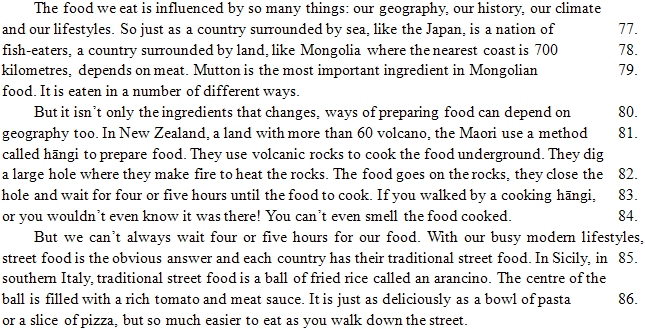

43
Proofread the passage as required. Each indicated line contains a maximum of one error. Correct the passage in the following ways: for a right line, put the sign “√” in the corresponding blank; for a wrong word, underline the wrong word and write the correct one in the blank; for a missing word, mark the position of the missing word with the sign “∧”and write the word you believe to be missing in the blank; for an unnecessary word, cross the unnecessary word with the sign “\” and put the word with the sign in the blank. Write the answers on the answer sheet.
44
Proofread the passage as required. Each indicated line contains a maximum of one error. Correct the passage in the following ways: for a right line, put the sign “√” in the corresponding blank; for a wrong word, underline the wrong word and write the correct one in the blank; for a missing word, mark the position of the missing word with the sign “∧”and write the word you believe to be missing in the blank; for an unnecessary word, cross the unnecessary word with the sign “\” and put the word with the sign in the blank. Write the answers on the answer sheet.
45
Proofread the passage as required. Each indicated line contains a maximum of one error. Correct the passage in the following ways: for a right line, put the sign “√” in the corresponding blank; for a wrong word, underline the wrong word and write the correct one in the blank; for a missing word, mark the position of the missing word with the sign “∧”and write the word you believe to be missing in the blank; for an unnecessary word, cross the unnecessary word with the sign “\” and put the word with the sign in the blank. Write the answers on the answer sheet.
46
Proofread the passage as required. Each indicated line contains a maximum of one error. Correct the passage in the following ways: for a right line, put the sign “√” in the corresponding blank; for a wrong word, underline the wrong word and write the correct one in the blank; for a missing word, mark the position of the missing word with the sign “∧”and write the word you believe to be missing in the blank; for an unnecessary word, cross the unnecessary word with the sign “\” and put the word with the sign in the blank. Write the answers on the answer sheet.
47
Proofread the passage as required. Each indicated line contains a maximum of one error. Correct the passage in the following ways: for a right line, put the sign “√” in the corresponding blank; for a wrong word, underline the wrong word and write the correct one in the blank; for a missing word, mark the position of the missing word with the sign “∧”and write the word you believe to be missing in the blank; for an unnecessary word, cross the unnecessary word with the sign “\” and put the word with the sign in the blank. Write the answers on the answer sheet.
48
Proofread the passage as required. Each indicated line contains a maximum of one error. Correct the passage in the following ways: for a right line, put the sign “√” in the corresponding blank; for a wrong word, underline the wrong word and write the correct one in the blank; for a missing word, mark the position of the missing word with the sign “∧”and write the word you believe to be missing in the blank; for an unnecessary word, cross the unnecessary word with the sign “\” and put the word with the sign in the blank. Write the answers on the answer sheet.
49
Proofread the passage as required. Each indicated line contains a maximum of one error. Correct the passage in the following ways: for a right line, put the sign “√” in the corresponding blank; for a wrong word, underline the wrong word and write the correct one in the blank; for a missing word, mark the position of the missing word with the sign “∧”and write the word you believe to be missing in the blank; for an unnecessary word, cross the unnecessary word with the sign “\” and put the word with the sign in the blank. Write the answers on the answer sheet.
50
Proofread the passage as required. Each indicated line contains a maximum of one error. Correct the passage in the following ways: for a right line, put the sign “√” in the corresponding blank; for a wrong word, underline the wrong word and write the correct one in the blank; for a missing word, mark the position of the missing word with the sign “∧”and write the word you believe to be missing in the blank; for an unnecessary word, cross the unnecessary word with the sign “\” and put the word with the sign in the blank. Write the answers on the answer sheet.
51
Proofread the passage as required. Each indicated line contains a maximum of one error. Correct the passage in the following ways: for a right line, put the sign “√” in the corresponding blank; for a wrong word, underline the wrong word and write the correct one in the blank; for a missing word, mark the position of the missing word with the sign “∧”and write the word you believe to be missing in the blank; for an unnecessary word, cross the unnecessary word with the sign “\” and put the word with the sign in the blank. Write the answers on the answer sheet.
52
Proofread the passage as required. Each indicated line contains a maximum of one error. Correct the passage in the following ways: for a right line, put the sign “√” in the corresponding blank; for a wrong word, underline the wrong word and write the correct one in the blank; for a missing word, mark the position of the missing word with the sign “∧”and write the word you believe to be missing in the blank; for an unnecessary word, cross the unnecessary word with the sign “\” and put the word with the sign in the blank. Write the answers on the answer sheet.
七、Part Ⅶ IQ Test
10 marks
53
What number should replace the question mark?

54
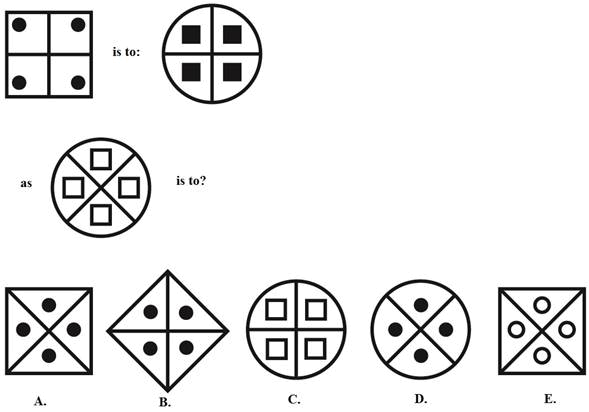
A.A
B.B
C.C
D.D
E.E
A.A
B.B
C.C
D.D
E.E
55
Which is the missing tile?
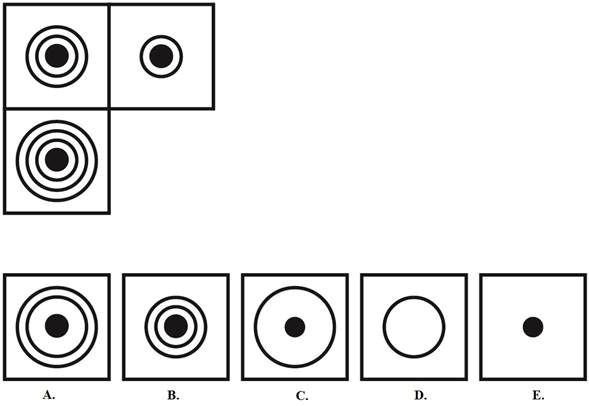
A.A
B.B
C.C
D.D
E.E
A.A
B.B
C.C
D.D
E.E
56
If the code for CHANGE is 3 8 1 14 7 5, what does 20 18 21 13 16 mean?
57
Choose two words, one from each group, which go together to form a new word. The word in the first group always comes first.
(arm, sea, paper) (break, shade, son)
(arm, sea, paper) (break, shade, son)
八、Part Ⅷ Writing
30 marks
58
Section A (10 marks)
Imagine you work in a busy but poorly organized office and you are keen to be promoted. Your employer needs to find a new supervisor for your department.
Suppose you are Frank. Write a letter to your employer. In the letter you are supposed to include the following points:

Write the letter in 80-100 words on the answer sheet. You do not need to write any address. Begin your letter as follows:
Dear Mr. Smith,
Imagine you work in a busy but poorly organized office and you are keen to be promoted. Your employer needs to find a new supervisor for your department.
Suppose you are Frank. Write a letter to your employer. In the letter you are supposed to include the following points:
Write the letter in 80-100 words on the answer sheet. You do not need to write any address. Begin your letter as follows:
Dear Mr. Smith,
59
Section B (20 marks)
It has often been said that sports, instead of promoting friendship and goodwill among nations, encourage a spirit of hostility and unfriendly competition.
What is your opinion of the statement? How far do you agree with it? Write an essay in at least 120 words on the answer sheet.
It has often been said that sports, instead of promoting friendship and goodwill among nations, encourage a spirit of hostility and unfriendly competition.
What is your opinion of the statement? How far do you agree with it? Write an essay in at least 120 words on the answer sheet.
输入阅读码
查看答案与解析需要输入阅读码