全国英语竞赛《B类英语专业》考前点题卷一
二、Part Ⅱ Vocabulary
15 marks
There are ten incomplete sentences in this section. For each blank there are four choices marked A, B, Cand D. Choosing the one that best completes the sentence. Then mark the corresponding letter on the answer sheet with a single line through the centre.
Frankly speaking, I’d rather you ______ anything about it for the time being.
参考答案A
参考答案C
参考答案B
参考答案A
参考答案D
参考答案D
参考答案B
Fiona:I’m glad you enjoyed it.______?
Gavin:No thanks, but I’d love a coffee, if it’s no trouble.
Fiona:Not at all.I’ll put the kettle on.
参考答案A
Evan:Well, she examined me.She put a thermometer in my mouth and took my temperature.She said it was normal.
Lucy:Did she listen to your chest?
参考答案B
Doctor:I see.______
Alf:Over a week ago.And I’ve got earache, too, in my left ear.
Doctor:Well, I’ll have a look at it.
参考答案C
In this section, there are five incomplete statements or questions about English speaking countries.For each question there are four choices marked A, B, C and D.Choose the most suitable answer from the given choices.Then mark the corresponding letter on the answer sheet with a single line through the centre.
The most populous city in New Zealand is ______.
参考答案B
参考答案C
参考答案B
参考答案C
参考答案A
三、Part Ⅲ Cloze
10 marks
The rate at which man has been storing up useful knowledge about himself and the universe has been spiraling upward for 10,000 years.The rate (1) t____ a sharp upward leap thousands of years ago, (2) w____ the invention of writing, but even so it remained painfully slow over centuries of time.In knowledge (3) ____(acquire) the next great leap forward did not occur until the invention of movable type in the fifteenth century by Gutenberg and others.Prior (4)____ 1500, by the most optimistic (5) est____, Europe was producing books at a rate of l, 000 titles per year.This means that it would take a full century to produce a library of 100,000 titles.The rate had (6) ac____ so sharply by 1950, four and a half centuries later, that Europe was producing 120,000 titles a year.(7)____ once took a century now took only ten months.By 1960, a (8) s____ decade later, the rate had made another significant jump, so that a century’s work could be completed in seven and a half months.And, the output of books (9) ____ a world scale by the mid sixties, Europe (10) ____(include), approached the remarkable figure of 1,000 titles per day.
参考答案took
参考答案with
参考答案acquisition
参考答案to
参考答案estimates
参考答案accelerated
参考答案What
参考答案single
参考答案on
参考答案included
四、Part Ⅳ RC
30 marks(Reading Comprehension)
Section A(5 points)
Directions:There is one passage in this section with 5 statements. Go over the passage quickly and answer the questions on the Answer Sheet.
For questions 1-5, markY (for YES) if the statement agrees with the information given in the passage;N (for NO ) if the statement contradicts the information given in the passage;NG (for NOT GIVEN) if the information is not given in the passage.
Questions 1 to 5 are based on the following passage.
Are We Managing to Destroy Science?
[The government in UK was concerned about the efficiency of Research institutions and set up a Research Assessment Exercise (RAE) to consider what was being done in each university. The article which follows is a response to the imposition of the RAE.]
In the year ahead, the UK government is due to carry out the next Research Assessment Exercise (RAE). The goal of this regular five-yearly check up of the university sector is easy to understand—perfection, of a kind, in public sector research. But perfection extracts a high price. In the case of the RAE, one risk attached to this is the creation of a tyrannical management culture that threatens the future of imaginative science.
Academic institutions are already preparing for the RAE with some anxiety-understandably so, for the financial consequences of failure are severe. Departments with a current rating of four or five (research is rated on a five point scale, with five the highest) must maintain their score or face a considerable loss of funding. Meanwhile, those with ratings of two or three are fighting for their survival.
The pressures are forcing research management onto the defensive. Common strategies for increasing academic output include grading individual researchers every year according to RAE criteria, pressurizing them to publish anything regardless of quality, diverting funds from key and expensive laboratory science into areas of study such as management, and even threatening to close departments. Another strategy being readily adopted is to remove scientists who appear to be less active in research and replace them with new, probably younger, staff.
Although such measures may deliver results in the RAE, they are putting unsustainable pressure on academic staff. Particularly insidious is the pressure to publish. Put simply, RAE committees in the laboratory sciences must produce four excellent peer-reviewed publications per member of staff to meet the assessment criteria. Hence this is becoming a minimum requirement for existing members of staff, and a benchmark against which to measure new recruits.
But prolific publication does not necessarily add up to good science. Indeed, one young researcher was told in an interview for a lectureship that, “although your publications are excellent unfortunately there are not enough of them. You should not worry so much about the quality of your publications.”
In a recent letter to Nature I analysed the publication records of ten senior academics in the area of molecular microbiology. All of them are now in very senior positions in universities or research institutes, with careers spanning a total of 262 years. All have achieved considerable status and respect within the UK and worldwide. However, their early publication records would preclude them from academic posts if the present criteria were applied.
Although the quality of their work was clearly outstanding—they initiated novel and perhaps risky projects early in their careers which have since been recognised as research of international importance—they generally produced few papers over the first ten years after completing their PhDs. Indeed, over this period, they have an average gap of 3.8 years without publication or production of a cited paper. In one case there was a five-year gap. Although these enquiries were limited to my own area of research, it seems that this model of career progression is widespread in all of the chemical and biological sciences.
It seems that the atmosphere surrounding the RAE may be stifling talented young researchers or driving them out of science altogether. We urgently need a more considered and careful nurturing of our young scientific talent. A new member of academic staff in the chemical or biological laboratory sciences surely needs a commitment to resources over a five-to ten-year period to establish their research. Senior academics managing this situation might be well advised to demand a long-term view from the government.
Unfortunately, management seems to be pulling in the opposite direction. Academics have to deal with more students than ever and the paperwork associated with teaching quality assessments is increasing. On top of that, the salary for university lecturers starts at only £16,665 (rising to £29,048). Tenure is rare, and most contracts are offered on a temporary contract basis. With the mean starting salary for new graduates now close to £18,000, it is surprising that anybody still wants a job in academia.
It need not be like this. As part of my duties with the QUESTOR Centre (Queen’s University Environmental Science and Technology Research Centre), I have dealings with many senior research managers in the chemical and water industries. The overall impression is that the private sector has a much more sensible and enlightened long-term view of research priorities. Why can the universities not develop the same attitude?
Tyrannies need managers, and these managers will make sure they survive when those they manage are lost. Research management in UK universities is in danger of evolving into such a tyranny that it will allow little time for careful thinking and teaching, and will undermine the development of imaginative young scientists.
Statements:
参考答案A
参考答案C
参考答案B
参考答案A
参考答案C
Directions: Look at the topic headings below, marked A, B, C, D E, and F, and match them with the paragraphs in the text below. There is one extra heading which you don’t need to use.
Questions 1-5 are based on the following passage.
A.Multi-centre cities
B.The urban world in 2050
C.The widening poverty gap
D.Rapid increase of urban population
E.Endangered coastal cities
F.Growing of small cities
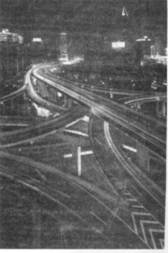 1 ______
In 1900, just 13 percent of the world’s people lived in cities. In 2008, the number passed 50 percent for the first time in history. By 2050, the number will be about 70 percent. The urban population in Asia and Africa will double, and there will be nearly 30 “megacities”—cities with more than 10 million people. So what will life be like for people in the cities of the future? Professor of human geography Ben Rhodes describes his vision of the urban world in 2050.
2 ______
Life in cities will be very different from what it is today. Energy, especially oil, will be very expensive; so many people will probably work at home, or have their workplaces close to where they live. There’ll be less traffic on the roads, and it’ll be easier for people to be close to their families. For these reasons cities won’t have just one centre where everyone goes to work and shop. Instead, we’ll probably see cities with many different centers.
3 ______
It will be difficult to provide enough water, gas and electricity for really big cities, so they will probably stop growing. Many people from the countryside will move to smaller cities of 500,000 people or less. Transport over long distances will be a lot more expensive than it is now, so people will have to use food and energy from the countryside around their cities. They will use local materials for building, and perhaps traditional styles of architecture too.
4 ______
The thing I really worry about is that energy may become too expensive for many people. In the end we might have two groups of people: a rich group which can afford energy and lives in clean, green areas, and a bigger, poorer group which can’t afford it and has to live in the more polluted parts of the city. This might lead to serious social problems.
5 ______
As we all know, cities near the sea will probably experience some extra problems. As temperatures around the world go up, sea levels will rise and many places will have problems with flooding. Some cities will be safe, some may even find that the change in the climate is good for them, but others will need help. We really need to start planning for this now.
参考答案D
参考答案A
参考答案F
参考答案C
参考答案E
Directions:In this section, there is one passage followed by five questions.You should answer each question in a maximum of ten word susing information from the passage.Remember to write the answers on the answer sheet.
Questions 1 - 5 are based on the following passage.
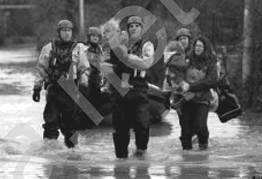 In summer 2007 England and Wales experienced some of the wettest weather and worst floods since 1766, the date when weather records began. There were several periods of very heavy rainfall which resulted in the worst flooding in living memory. Almost50, 000 houses and just under 7,000 businesses were flooded. This effect extended to the daily lives of everyone in these areas as transport, schools, power and water supplies were all seriously affected.
The problem seems to be that the infrastructures in England and Wales are not prepared for sudden downpours. When a large amount of rain comes in a short time, drains and rivers cannot cope with the volume of water. This can lead to flooding, the location of which is extremely difficult to predict.
The situation would have been much worse if the UK's Environment Agency had not been well prepared. Flood warnings were sent out to thousands of businesses and homes. Many people managed to leave danger areas as a result of these warnings and travel to safer places.
However, these record-breaking floods still caused a huge amount of damage and personal loss for thousands of people. There were almost 100 deaths caused by the floods and many people were moved into temporary accommodation, having been forced to leave their homes. Many of those whose homes were saved still lost personal possessions that cannot be replaced. The Environment Agency continues to support these victims of the floods.
Part of the successful damage limitation strategy that prevented the effects of the flooding being any worse than they were, was the way that different organisations worked together, such as the police, the fire service, the Royal Air Force and the local councils. This joined-up approach was part of a carefully planned strategy to cope with such flooding.
Thus the work that was put into preparing for the floods was instrumental in preventing a worse situation. Furthermore, each time that flooding such as this occurs, the areas that are most at risk become better prepared for the next time it could happen.
The next two pages contain some of the stories of individuals who were affected by the flooding. Most of these individuals tell tales of the heart-warming generosity of many members of local communities who risked themselves to help others during this terrible time. However, faced with such a situation, others saw- the worst side of some people who sought to benefit personally from the disaster that was unfolding. These are their stories.
Questions:
参考答案It was the worst flooding since 1766.
参考答案Because drains and rivers are suddenly full of water.
参考答案Because they had received a warning from the Environment Agency.
参考答案They moved into temporary accommodation.
参考答案Because it prevented a worse situation.
Directions:In this section, there is one passage followed by a summary. You should complete the summary below using no more than three words for each blank from the passage. Remember to write the answers on the answer sheet.
Questions 1-5 are based on the following passage.
Sitting in stationary traffic is, at best, a Zen experience. Drivers mired in a jam learn to cede control to the powers that be, becoming at one with the universe as they breathe in the mind-numbing fumes all around. At worst, it is an on-going battle for sanity. But now, according to several groups of researchers in America and Germany, there is something that drivers can do to take back control over the roads. Get adaptive cruise control. And, of course, use it.
Adaptive cruise control (ACC), as its name suggests, is a modified version of traditional cruise control. It employs radar to monitor the road ahead of a vehicle, automatically adjusting that vehicle's speed to maintain a safe distance from the one in front. This is safer than manual driving because it reduces the system's reaction time from nearly a second (human) to practically instantaneous (machine), thus helping to forestall shunts. But ACC may have a useful side-effect, arising from the fact that another effect of slow human reaction times is to produce traffic jams on apparently open roads.
Such jams start when a car slows suddenly to allow, for example, another vehicle to enter the traffic stream. Slow reaction times mean that instead of responding smoothly, the drivers behind such a vehicle often end up slamming on the brakes. That slamming propagates backwards, and before long the traffic is at a standstill. So it makes sense that ACC would reduce not only collisions, but also congestion. What is unexpected is how few vehicles need to have it operating for all to benefit. As Craig Davis of the University of Michigan reports in Physical Review E, only 20% of cars need to employ ACC in order to prevent completely those jams that are caused by a slow lead car on a high-speed, single-lane road. According to Dr. Davis's computer model, even a rate of use of ACC as low as 13% can improve the flow of traffic significantly.
ACC is not a panacea. Dr. Davis got less promising results for more complex road conditions, particularly those near junctions. And a similar model built by Boris Kerner, a researcher for Daimler Chrysler, in Stuttgart, Germany, indicates that in certain bottleneck conditions, ACC may even cause extra congestion. These disappointing results can, however, be ameliorated by shortening the “headway” in ACC-equipped vehicles, according to Martin Treiber of the Dresden University of Technology, also in Germany.
Headway is the gap, measured in seconds, that a driver puts between himself and the car ahead. Since ACC reacts more quickly than a human, people who have it fitted can afford to allow less headway.
Summary:
Stationary traffic can drive people mad. However, according to American and German researchers, adaptive cruise control (ACC) can help drivers take 1 . ACC adapts a car's speed to keep a safe distance from the one ahead by using radar to monitor the road ahead. ACC is safer than manual driving because it significantly reduces the system's 2 , and collisions and congestion in addition. According to Dr. Davis' computer model, if 3 of cars use ACC, the flow of traffic can be improved significantly. However, ACC should not be seen as a panacea. In 4 conditions, it may even cause extra jams, according to a computer model. But this situation can be improved by reducing 5 in ACC-equipped vehicles.
参考答案back control
参考答案reaction time
参考答案13%
参考答案complex road/bottleneck
参考答案headway
五、Part Ⅴ Translation
15 marks
Directions:Translate the following passage into Chinese.Remember to write the answers on the answer sheet.
Private systems, common in Europe, are still fairly rare in the developing world.When well managed, they can work well.Unfortunately, the rush to privatize has greatly outstripped the public interest.This is in part because of pressure from the water industry, which is largely European.
参考答案私营供水系统在欧洲十分普遍,但在发展中国家仍十分罕见。私营系统若管理得当,可以运转得很好。但不幸的是,匆忙推行的私有化在很大程度上忽视了公众利益范围。这部分是因为来自主要由欧洲人经营的供水业方面的压力。
Directions: Translate the following sentences into English, using the words given in the brackets.
像针尖上的一滴水滴在大海里,我的日子滴在时间流里,没有声音,也没有痕迹。(slip away)
参考答案The days of my life have slipped away into the stream of time, silently and without leaving a trace behind.
参考答案People are worried about the government’s indifferent attitude toward drug dealing.
参考答案The Hong Kong Special Administrative Region will retain the status of a free port and a separate customs territory.
参考答案Their friendship was forged by sharing comforts and hardships during the hard times.
参考答案He loves such gatherings at which he rubs shoulders with young people and exchange opinions with them on various subjects.
六、Part Ⅵ EC
10 marks(Error Correction)
 Thomas Malthus published his Essay on the Principle of Population
almost 200 years ago. Ever since then, forecasters have being warning 1._______
that worldwide famine was just around the next corner. The fast-growing
population’s demand for food, they warned, would soon exceed their 2._______
supply, leading to widespread food shortages and starvation.
But in reality, the world’s total grain harvest has risen steadily over the
years. Except for relative isolated trouble spots like present-day Somalia, 3._______
and occasional years of good harvests, the world’s food crisis has remained 4._______
just around the corner. Most experts believe this can continue even as if 5._______
the population doubles by the mid-21st century, although feeding 10 billion
people will not be easy for politics, economic and environmental reasons. 6._______
Optimists point to concrete examples of continued improvements in yield.
In Africa, for instance, improved seeds, more fertilizers and advanced 7._______
growing practices have more than double corn and wheat yields in an 8._______
experiment. Elsewhere, rice experts in the Philippines are producing
a plant with few stems and more seeds. There is no guarantee that plant 9._______
breeders can continue to develop new, higher-yielding crop, but most 10._______
researchers see their success to date as reason for hope.
参考答案being改为been
参考答案their改为its
参考答案relative改为relatively
参考答案good改为poor/bad
参考答案去掉as
参考答案politics改为political
参考答案√
参考答案double改为doubled
参考答案few改为fewer
参考答案crop改为crops
七、Part Ⅶ IQ Test
10 marks
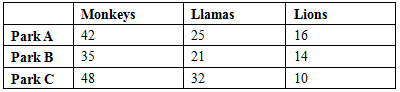
Which park has twice as many llamas as one of the parks has lions?
参考答案Park C.
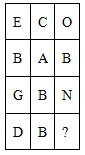
参考答案H
I am suspended in the air, I touch nothing, and I am surrounded by lights.Now I dress myself afresh, and now I am naked, and I am in the heat and the cold, by night and by day.Everyone amuses himself by tramping upon me, even the animals abuse and scorn me, and yet I have such treasures hidden in my bosom that he who finds them I can make full of happiness.
What is the answer to the riddle?
A.The Sun.
B.The Moon.
C.The Earth.
D.The Sky.
参考答案C

To date, I have had 325 candles.How old am I?
A.23.
B.24.
C.25.
D.26.
参考答案C

参考答案LIGHT,DARK
八、Part Ⅷ Writing
30 marks
Directions: There is an error in an English magazine that you feel must be corrected.Write a letter to the editor to
1) point out the mistake;
2) suggest the correction;
3) express your interest in the magazine.
You should write about 100 words.Do not sign your own name at the end of the letter.Use “Li Ming” instead.You do not need to write the address.Now write the letter on the Answer Sheet.
参考答案详见解析
I’m a faithful reader of your magazine, and I have been regarding it as “an apple of my eye”.But when I read the latest issue, I found a mistake, which I feel necessary to point out.On Page 9, the line goes “Roman was not build in a day.”
In my opinion, the word “Roman” should be “Rome”.The sentence is in fact an old western proverb that has a relative settled way of saying, which is “Rome was not built in a/one day”.Besides this, the word “Roman” is an adjective, and should not be used as the subject of a sentence.And when “Roman” is used as a noun, it refers to the people of Rome, the country.Thus, here the subject of the sentence should be “Rome”.
Anyway, despite the mistake, the magazine is enjoyable as usual.Reading it has become a part of my life.The articles in it have broadened my horizon and enriched my life.
Sincerely yours,
Li Ming
(Word Count: 166)
Read the following poem and write an essay in which you discuss its moral and express your personal views.
Anything is possible—Cotney MooreWhen I was just a little girlTrying to walk there to hereMy parents urged, “Anything is possible”And I took one more step near.When I was a little olderTrying to ride my bikeMy dad said, “Anything is possible”And I rode till night.When I was in fourth gradeWith work that was very newMy mom whispered, “Anything is possible”And I made it through.Now my sisters face these challengesThat I once went throughI say “Anything is possible”To them and now to you.
You should write no less than 160 words.Now write the essay on the Answer sheet.
参考答案详见解析
After reading the poem, I am full of courage and enthusiasm.However, after second thought, I couldn’t agree with the author.Although human spirit is very powerful, we should also act upon certain rules.With the advanced technology, we human beings have created something that the ancient people had never dreamed of.However, we also break the balance of the nature and cause serious damages to the earth.So we should have the spirit and courage to do something, but at the same time we should act upon certain rules to avoid the unnecessary trouble.