2020年全国英语竞赛《B类英语专业》初赛试题(网友回忆版)
B类英语专业
历年真题
共 59 题
2123 次浏览
更新于 2026-09-26
二、Part Ⅱ Vocabulary
15 marks
1
There are 15 incomplete sentences in this section. For each blank there are four choices marked A, B, C andD.Choose the one that best completes the sentence. Then mark the corresponding letter on the answer sheet with a single line through the centre.
Settled by English Puritans in 1630, Boston became _____.
Settled by English Puritans in 1630, Boston became _____.
- A.the capital of the Massachusetts Bay Colony
- B.the Massachusetts Bay Colony its capital
- C.it was the capital of the Massachusetts Bay Colony
- D.so that the capital of the Massachusetts Bay Colony
2
Navigators on ships and aircraft use a compass to determine _____ they are heading.
- A.to where the direction
- B.the direction in which
- C.that direction of which
- D.where the direction
3
As seen from the Earth at night, _____ planet Jupiter ranks third among the planets and stars in maximum brightness, after Venus and Mars.
- A.when the
- B.in which the
- C.and the
- D.the
4
I would like to express my _____ to you all for supporting me this summer as a visiting scholar in your department.
- A.satisfaction
- B.pleasure
- C.gratitude
- D.sincerity
5
The whole village _____ by a sudden flood, they had to stay in tents.
- A.has been destroyed
- B.having been destroyed
- C.was destroyed
- D.had been destroyed
6
Giving a gift can convey a wealth of meaning about your appreciation of their _____ and the importance you place upon the relationship.
- A.solidarity
- B.priority
- C.hospitality
- D.superiority
7
As the details of the project were rather vague, we decided to _____ the proposal.
- A.reclaim
- B.resign
- C.reject
- D.resemble
8
It is from the earliest times _____ men have studied the world around them with interest.
- A.which
- B.that
- C.where
- D.how
9
_____we had not made any mistakes in the calculations!
- A.But for
- B.Without
- C.Let
- D.If only
10
Without a doubt, _____ the key issue in the President’s campaign.
- A.taxation is going to be
- B.is taxation going to be
- C.is going taxation to be
- D.is going to be taxation
11
If you see that the street is wet in the morning, you would _____ that it must have rained during the night.
- A.reduce
- B.seduce
- C.deduce
- D.induce
12
Researchers are looking for new ways to _____ the problem.
- A.abridge
- B.approach
- C.condense
- D.dispose
13
Medical students learn to distinguish “acute,” which means something of recent onset, from “chronic,” which means a condition that will probably continue for a _____ period of time.
- A.gloomy
- B.temporary
- C.tough
- D.substantial
14
—Hi, Joshua.
—Hi, Lin. How are you doing?
—Good, thank you. In fact, I am thinking of travelling to Canada with my family this summer. Could I ask you some questions about applying for a Canadian visa?
—Sure. _____.
—Hi, Lin. How are you doing?
—Good, thank you. In fact, I am thinking of travelling to Canada with my family this summer. Could I ask you some questions about applying for a Canadian visa?
—Sure. _____.
- A.Be careful
- B.Great to see you
- C.Go ahead
- D.Got it
15
—Hello, Professor Williams. Thank you for accepting my interview on cultural differences in the US regions.
—My pleasure.
—So first of all, why are there many cultural differences in the United States?
—Well, as you know, the United States is a country that covers over 9 million square kilometers, _____ to learn that regions that are separated by large distances will be noticeably different. Another reason is that this country, so called “a melting pot”, has people moving over from across the world all the time.
—My pleasure.
—So first of all, why are there many cultural differences in the United States?
—Well, as you know, the United States is a country that covers over 9 million square kilometers, _____ to learn that regions that are separated by large distances will be noticeably different. Another reason is that this country, so called “a melting pot”, has people moving over from across the world all the time.
- A.it is not surprising
- B.it is not the problem
- C.it is not surprised
- D.it is not the verdict
三、Part Ⅲ Cloze
10 marks
Read the following passage and fill in each blank with one word. Choose the correct word in one of the following three ways: according to the context, by using the correct form of the given word, or by using the given letter(s) of the word. Remember to write the answers on the answer sheet. Most scholars agree that Isaac Newton, while formulating the laws of force and gravity and inventing the calculus in the late 1600s, probably knew all the science there was to know at the time. In the (46) ens_____ 350 years and estimated 50 million research papers and innumerable books have been published in the natural sciences and mathematics. The modern high school student probably now possesses (47)_____ scientific knowledge than Newton did, yet science to many people seems to be an impenetrable mountain of facts.
One way scientists have tried to cope with this mountain is by becoming more and more (48)_____ (specialize). Another (49) str_____ for coping with the mountain of information is to largely ignore it. That shouldn’t come as a surprise. Sure, you have to know a lot to be a scientist, but (50) kn_____ a lot is not what makes a scientist. What makes a scientist is ignorance. This may sound ridiculous, but for scientists the facts are just a starting place. In science, every new discovery raises 10 new questions.
By this calculus, ignorance will always grow faster (51)_____ knowledge. Scientists and laypeople (52) _____ (alike) would agree that for all we have come to know, there is for more we don’t know. More important, every day there is far more we know we don’t know. One crucial outcome of scientific knowledge is to generate new and better ways of being ignorant: not the kind of ignorance that is associated (53)_____ a lack of curiosity or education but rather a cultivated, high-quality ignorance. They do it in grant proposals and over beers at meetings. As James Clerk Maxwell, probably the greatest physicist between Newton and Einstein, said, “Thoroughly conscious ignorance … is a prelude to every real advance in knowledge.”
This perspective on science—that it is about the questions more than the answers—should come as something of a relief. It makes science less (54)_____ (threat) and far more friendly and, in fact, fun. Science becomes a series of elegant puzzles and puzzles within puzzles—and who doesn’t like puzzles? Questions are also more (55)_____ (access) and often more interesting than answers; answers tend to be the end of the process, whereas questions have you in the thick of things.
Most scholars agree that Isaac Newton, while formulating the laws of force and gravity and inventing the calculus in the late 1600s, probably knew all the science there was to know at the time. In the (46) ens_____ 350 years and estimated 50 million research papers and innumerable books have been published in the natural sciences and mathematics. The modern high school student probably now possesses (47)_____ scientific knowledge than Newton did, yet science to many people seems to be an impenetrable mountain of facts.One way scientists have tried to cope with this mountain is by becoming more and more (48)_____ (specialize). Another (49) str_____ for coping with the mountain of information is to largely ignore it. That shouldn’t come as a surprise. Sure, you have to know a lot to be a scientist, but (50) kn_____ a lot is not what makes a scientist. What makes a scientist is ignorance. This may sound ridiculous, but for scientists the facts are just a starting place. In science, every new discovery raises 10 new questions.
By this calculus, ignorance will always grow faster (51)_____ knowledge. Scientists and laypeople (52) _____ (alike) would agree that for all we have come to know, there is for more we don’t know. More important, every day there is far more we know we don’t know. One crucial outcome of scientific knowledge is to generate new and better ways of being ignorant: not the kind of ignorance that is associated (53)_____ a lack of curiosity or education but rather a cultivated, high-quality ignorance. They do it in grant proposals and over beers at meetings. As James Clerk Maxwell, probably the greatest physicist between Newton and Einstein, said, “Thoroughly conscious ignorance … is a prelude to every real advance in knowledge.”
This perspective on science—that it is about the questions more than the answers—should come as something of a relief. It makes science less (54)_____ (threat) and far more friendly and, in fact, fun. Science becomes a series of elegant puzzles and puzzles within puzzles—and who doesn’t like puzzles? Questions are also more (55)_____ (access) and often more interesting than answers; answers tend to be the end of the process, whereas questions have you in the thick of things.
16
Read the following passage and fill in each blank with one word. Choose the correct word in one of the following three ways: according to the context, by using the correct form of the given word, or by using the given letter(s) of the word. Remember to write the answers on the answer sheet. Most scholars agree that Isaac Newton, while formulating the laws of force and gravity and inventing the calculus in the late 1600s, probably knew all the science there was to know at the time. In the (46) ens_____ 350 years and estimated 50 million research papers and innumerable books have been published in the natural sciences and mathematics. The modern high school student probably now possesses (47)_____ scientific knowledge than Newton did, yet science to many people seems to be an impenetrable mountain of facts.
One way scientists have tried to cope with this mountain is by becoming more and more (48)_____ (specialize). Another (49) str_____ for coping with the mountain of information is to largely ignore it. That shouldn’t come as a surprise. Sure, you have to know a lot to be a scientist, but (50) kn_____ a lot is not what makes a scientist. What makes a scientist is ignorance. This may sound ridiculous, but for scientists the facts are just a starting place. In science, every new discovery raises 10 new questions.
By this calculus, ignorance will always grow faster (51)_____ knowledge. Scientists and laypeople (52) _____ (alike) would agree that for all we have come to know, there is for more we don’t know. More important, every day there is far more we know we don’t know. One crucial outcome of scientific knowledge is to generate new and better ways of being ignorant: not the kind of ignorance that is associated (53)_____ a lack of curiosity or education but rather a cultivated, high-quality ignorance. They do it in grant proposals and over beers at meetings. As James Clerk Maxwell, probably the greatest physicist between Newton and Einstein, said, “Thoroughly conscious ignorance … is a prelude to every real advance in knowledge.”
This perspective on science—that it is about the questions more than the answers—should come as something of a relief. It makes science less (54)_____ (threat) and far more friendly and, in fact, fun. Science becomes a series of elegant puzzles and puzzles within puzzles—and who doesn’t like puzzles? Questions are also more (55)_____ (access) and often more interesting than answers; answers tend to be the end of the process, whereas questions have you in the thick of things.
Most scholars agree that Isaac Newton, while formulating the laws of force and gravity and inventing the calculus in the late 1600s, probably knew all the science there was to know at the time. In the (46) ens_____ 350 years and estimated 50 million research papers and innumerable books have been published in the natural sciences and mathematics. The modern high school student probably now possesses (47)_____ scientific knowledge than Newton did, yet science to many people seems to be an impenetrable mountain of facts.One way scientists have tried to cope with this mountain is by becoming more and more (48)_____ (specialize). Another (49) str_____ for coping with the mountain of information is to largely ignore it. That shouldn’t come as a surprise. Sure, you have to know a lot to be a scientist, but (50) kn_____ a lot is not what makes a scientist. What makes a scientist is ignorance. This may sound ridiculous, but for scientists the facts are just a starting place. In science, every new discovery raises 10 new questions.
By this calculus, ignorance will always grow faster (51)_____ knowledge. Scientists and laypeople (52) _____ (alike) would agree that for all we have come to know, there is for more we don’t know. More important, every day there is far more we know we don’t know. One crucial outcome of scientific knowledge is to generate new and better ways of being ignorant: not the kind of ignorance that is associated (53)_____ a lack of curiosity or education but rather a cultivated, high-quality ignorance. They do it in grant proposals and over beers at meetings. As James Clerk Maxwell, probably the greatest physicist between Newton and Einstein, said, “Thoroughly conscious ignorance … is a prelude to every real advance in knowledge.”
This perspective on science—that it is about the questions more than the answers—should come as something of a relief. It makes science less (54)_____ (threat) and far more friendly and, in fact, fun. Science becomes a series of elegant puzzles and puzzles within puzzles—and who doesn’t like puzzles? Questions are also more (55)_____ (access) and often more interesting than answers; answers tend to be the end of the process, whereas questions have you in the thick of things.
17
Read the following passage and fill in each blank with one word. Choose the correct word in one of the following three ways: according to the context, by using the correct form of the given word, or by using the given letter(s) of the word. Remember to write the answers on the answer sheet. Most scholars agree that Isaac Newton, while formulating the laws of force and gravity and inventing the calculus in the late 1600s, probably knew all the science there was to know at the time. In the (46) ens_____ 350 years and estimated 50 million research papers and innumerable books have been published in the natural sciences and mathematics. The modern high school student probably now possesses (47)_____ scientific knowledge than Newton did, yet science to many people seems to be an impenetrable mountain of facts.
One way scientists have tried to cope with this mountain is by becoming more and more (48)_____ (specialize). Another (49) str_____ for coping with the mountain of information is to largely ignore it. That shouldn’t come as a surprise. Sure, you have to know a lot to be a scientist, but (50) kn_____ a lot is not what makes a scientist. What makes a scientist is ignorance. This may sound ridiculous, but for scientists the facts are just a starting place. In science, every new discovery raises 10 new questions.
By this calculus, ignorance will always grow faster (51)_____ knowledge. Scientists and laypeople (52) _____ (alike) would agree that for all we have come to know, there is for more we don’t know. More important, every day there is far more we know we don’t know. One crucial outcome of scientific knowledge is to generate new and better ways of being ignorant: not the kind of ignorance that is associated (53)_____ a lack of curiosity or education but rather a cultivated, high-quality ignorance. They do it in grant proposals and over beers at meetings. As James Clerk Maxwell, probably the greatest physicist between Newton and Einstein, said, “Thoroughly conscious ignorance … is a prelude to every real advance in knowledge.”
This perspective on science—that it is about the questions more than the answers—should come as something of a relief. It makes science less (54)_____ (threat) and far more friendly and, in fact, fun. Science becomes a series of elegant puzzles and puzzles within puzzles—and who doesn’t like puzzles? Questions are also more (55)_____ (access) and often more interesting than answers; answers tend to be the end of the process, whereas questions have you in the thick of things.
Most scholars agree that Isaac Newton, while formulating the laws of force and gravity and inventing the calculus in the late 1600s, probably knew all the science there was to know at the time. In the (46) ens_____ 350 years and estimated 50 million research papers and innumerable books have been published in the natural sciences and mathematics. The modern high school student probably now possesses (47)_____ scientific knowledge than Newton did, yet science to many people seems to be an impenetrable mountain of facts.One way scientists have tried to cope with this mountain is by becoming more and more (48)_____ (specialize). Another (49) str_____ for coping with the mountain of information is to largely ignore it. That shouldn’t come as a surprise. Sure, you have to know a lot to be a scientist, but (50) kn_____ a lot is not what makes a scientist. What makes a scientist is ignorance. This may sound ridiculous, but for scientists the facts are just a starting place. In science, every new discovery raises 10 new questions.
By this calculus, ignorance will always grow faster (51)_____ knowledge. Scientists and laypeople (52) _____ (alike) would agree that for all we have come to know, there is for more we don’t know. More important, every day there is far more we know we don’t know. One crucial outcome of scientific knowledge is to generate new and better ways of being ignorant: not the kind of ignorance that is associated (53)_____ a lack of curiosity or education but rather a cultivated, high-quality ignorance. They do it in grant proposals and over beers at meetings. As James Clerk Maxwell, probably the greatest physicist between Newton and Einstein, said, “Thoroughly conscious ignorance … is a prelude to every real advance in knowledge.”
This perspective on science—that it is about the questions more than the answers—should come as something of a relief. It makes science less (54)_____ (threat) and far more friendly and, in fact, fun. Science becomes a series of elegant puzzles and puzzles within puzzles—and who doesn’t like puzzles? Questions are also more (55)_____ (access) and often more interesting than answers; answers tend to be the end of the process, whereas questions have you in the thick of things.
18
Read the following passage and fill in each blank with one word. Choose the correct word in one of the following three ways: according to the context, by using the correct form of the given word, or by using the given letter(s) of the word. Remember to write the answers on the answer sheet. Most scholars agree that Isaac Newton, while formulating the laws of force and gravity and inventing the calculus in the late 1600s, probably knew all the science there was to know at the time. In the (46) ens_____ 350 years and estimated 50 million research papers and innumerable books have been published in the natural sciences and mathematics. The modern high school student probably now possesses (47)_____ scientific knowledge than Newton did, yet science to many people seems to be an impenetrable mountain of facts.
One way scientists have tried to cope with this mountain is by becoming more and more (48)_____ (specialize). Another (49) str_____ for coping with the mountain of information is to largely ignore it. That shouldn’t come as a surprise. Sure, you have to know a lot to be a scientist, but (50) kn_____ a lot is not what makes a scientist. What makes a scientist is ignorance. This may sound ridiculous, but for scientists the facts are just a starting place. In science, every new discovery raises 10 new questions.
By this calculus, ignorance will always grow faster (51)_____ knowledge. Scientists and laypeople (52) _____ (alike) would agree that for all we have come to know, there is for more we don’t know. More important, every day there is far more we know we don’t know. One crucial outcome of scientific knowledge is to generate new and better ways of being ignorant: not the kind of ignorance that is associated (53)_____ a lack of curiosity or education but rather a cultivated, high-quality ignorance. They do it in grant proposals and over beers at meetings. As James Clerk Maxwell, probably the greatest physicist between Newton and Einstein, said, “Thoroughly conscious ignorance … is a prelude to every real advance in knowledge.”
This perspective on science—that it is about the questions more than the answers—should come as something of a relief. It makes science less (54)_____ (threat) and far more friendly and, in fact, fun. Science becomes a series of elegant puzzles and puzzles within puzzles—and who doesn’t like puzzles? Questions are also more (55)_____ (access) and often more interesting than answers; answers tend to be the end of the process, whereas questions have you in the thick of things.
Most scholars agree that Isaac Newton, while formulating the laws of force and gravity and inventing the calculus in the late 1600s, probably knew all the science there was to know at the time. In the (46) ens_____ 350 years and estimated 50 million research papers and innumerable books have been published in the natural sciences and mathematics. The modern high school student probably now possesses (47)_____ scientific knowledge than Newton did, yet science to many people seems to be an impenetrable mountain of facts.One way scientists have tried to cope with this mountain is by becoming more and more (48)_____ (specialize). Another (49) str_____ for coping with the mountain of information is to largely ignore it. That shouldn’t come as a surprise. Sure, you have to know a lot to be a scientist, but (50) kn_____ a lot is not what makes a scientist. What makes a scientist is ignorance. This may sound ridiculous, but for scientists the facts are just a starting place. In science, every new discovery raises 10 new questions.
By this calculus, ignorance will always grow faster (51)_____ knowledge. Scientists and laypeople (52) _____ (alike) would agree that for all we have come to know, there is for more we don’t know. More important, every day there is far more we know we don’t know. One crucial outcome of scientific knowledge is to generate new and better ways of being ignorant: not the kind of ignorance that is associated (53)_____ a lack of curiosity or education but rather a cultivated, high-quality ignorance. They do it in grant proposals and over beers at meetings. As James Clerk Maxwell, probably the greatest physicist between Newton and Einstein, said, “Thoroughly conscious ignorance … is a prelude to every real advance in knowledge.”
This perspective on science—that it is about the questions more than the answers—should come as something of a relief. It makes science less (54)_____ (threat) and far more friendly and, in fact, fun. Science becomes a series of elegant puzzles and puzzles within puzzles—and who doesn’t like puzzles? Questions are also more (55)_____ (access) and often more interesting than answers; answers tend to be the end of the process, whereas questions have you in the thick of things.
19
Read the following passage and fill in each blank with one word. Choose the correct word in one of the following three ways: according to the context, by using the correct form of the given word, or by using the given letter(s) of the word. Remember to write the answers on the answer sheet. Most scholars agree that Isaac Newton, while formulating the laws of force and gravity and inventing the calculus in the late 1600s, probably knew all the science there was to know at the time. In the (46) ens_____ 350 years and estimated 50 million research papers and innumerable books have been published in the natural sciences and mathematics. The modern high school student probably now possesses (47)_____ scientific knowledge than Newton did, yet science to many people seems to be an impenetrable mountain of facts.
One way scientists have tried to cope with this mountain is by becoming more and more (48)_____ (specialize). Another (49) str_____ for coping with the mountain of information is to largely ignore it. That shouldn’t come as a surprise. Sure, you have to know a lot to be a scientist, but (50) kn_____ a lot is not what makes a scientist. What makes a scientist is ignorance. This may sound ridiculous, but for scientists the facts are just a starting place. In science, every new discovery raises 10 new questions.
By this calculus, ignorance will always grow faster (51)_____ knowledge. Scientists and laypeople (52) _____ (alike) would agree that for all we have come to know, there is for more we don’t know. More important, every day there is far more we know we don’t know. One crucial outcome of scientific knowledge is to generate new and better ways of being ignorant: not the kind of ignorance that is associated (53)_____ a lack of curiosity or education but rather a cultivated, high-quality ignorance. They do it in grant proposals and over beers at meetings. As James Clerk Maxwell, probably the greatest physicist between Newton and Einstein, said, “Thoroughly conscious ignorance … is a prelude to every real advance in knowledge.”
This perspective on science—that it is about the questions more than the answers—should come as something of a relief. It makes science less (54)_____ (threat) and far more friendly and, in fact, fun. Science becomes a series of elegant puzzles and puzzles within puzzles—and who doesn’t like puzzles? Questions are also more (55)_____ (access) and often more interesting than answers; answers tend to be the end of the process, whereas questions have you in the thick of things.
Most scholars agree that Isaac Newton, while formulating the laws of force and gravity and inventing the calculus in the late 1600s, probably knew all the science there was to know at the time. In the (46) ens_____ 350 years and estimated 50 million research papers and innumerable books have been published in the natural sciences and mathematics. The modern high school student probably now possesses (47)_____ scientific knowledge than Newton did, yet science to many people seems to be an impenetrable mountain of facts.One way scientists have tried to cope with this mountain is by becoming more and more (48)_____ (specialize). Another (49) str_____ for coping with the mountain of information is to largely ignore it. That shouldn’t come as a surprise. Sure, you have to know a lot to be a scientist, but (50) kn_____ a lot is not what makes a scientist. What makes a scientist is ignorance. This may sound ridiculous, but for scientists the facts are just a starting place. In science, every new discovery raises 10 new questions.
By this calculus, ignorance will always grow faster (51)_____ knowledge. Scientists and laypeople (52) _____ (alike) would agree that for all we have come to know, there is for more we don’t know. More important, every day there is far more we know we don’t know. One crucial outcome of scientific knowledge is to generate new and better ways of being ignorant: not the kind of ignorance that is associated (53)_____ a lack of curiosity or education but rather a cultivated, high-quality ignorance. They do it in grant proposals and over beers at meetings. As James Clerk Maxwell, probably the greatest physicist between Newton and Einstein, said, “Thoroughly conscious ignorance … is a prelude to every real advance in knowledge.”
This perspective on science—that it is about the questions more than the answers—should come as something of a relief. It makes science less (54)_____ (threat) and far more friendly and, in fact, fun. Science becomes a series of elegant puzzles and puzzles within puzzles—and who doesn’t like puzzles? Questions are also more (55)_____ (access) and often more interesting than answers; answers tend to be the end of the process, whereas questions have you in the thick of things.
20
Read the following passage and fill in each blank with one word. Choose the correct word in one of the following three ways: according to the context, by using the correct form of the given word, or by using the given letter(s) of the word. Remember to write the answers on the answer sheet. Most scholars agree that Isaac Newton, while formulating the laws of force and gravity and inventing the calculus in the late 1600s, probably knew all the science there was to know at the time. In the (46) ens_____ 350 years and estimated 50 million research papers and innumerable books have been published in the natural sciences and mathematics. The modern high school student probably now possesses (47)_____ scientific knowledge than Newton did, yet science to many people seems to be an impenetrable mountain of facts.
One way scientists have tried to cope with this mountain is by becoming more and more (48)_____ (specialize). Another (49) str_____ for coping with the mountain of information is to largely ignore it. That shouldn’t come as a surprise. Sure, you have to know a lot to be a scientist, but (50) kn_____ a lot is not what makes a scientist. What makes a scientist is ignorance. This may sound ridiculous, but for scientists the facts are just a starting place. In science, every new discovery raises 10 new questions.
By this calculus, ignorance will always grow faster (51)_____ knowledge. Scientists and laypeople (52) _____ (alike) would agree that for all we have come to know, there is for more we don’t know. More important, every day there is far more we know we don’t know. One crucial outcome of scientific knowledge is to generate new and better ways of being ignorant: not the kind of ignorance that is associated (53)_____ a lack of curiosity or education but rather a cultivated, high-quality ignorance. They do it in grant proposals and over beers at meetings. As James Clerk Maxwell, probably the greatest physicist between Newton and Einstein, said, “Thoroughly conscious ignorance … is a prelude to every real advance in knowledge.”
This perspective on science—that it is about the questions more than the answers—should come as something of a relief. It makes science less (54)_____ (threat) and far more friendly and, in fact, fun. Science becomes a series of elegant puzzles and puzzles within puzzles—and who doesn’t like puzzles? Questions are also more (55)_____ (access) and often more interesting than answers; answers tend to be the end of the process, whereas questions have you in the thick of things.
Most scholars agree that Isaac Newton, while formulating the laws of force and gravity and inventing the calculus in the late 1600s, probably knew all the science there was to know at the time. In the (46) ens_____ 350 years and estimated 50 million research papers and innumerable books have been published in the natural sciences and mathematics. The modern high school student probably now possesses (47)_____ scientific knowledge than Newton did, yet science to many people seems to be an impenetrable mountain of facts.One way scientists have tried to cope with this mountain is by becoming more and more (48)_____ (specialize). Another (49) str_____ for coping with the mountain of information is to largely ignore it. That shouldn’t come as a surprise. Sure, you have to know a lot to be a scientist, but (50) kn_____ a lot is not what makes a scientist. What makes a scientist is ignorance. This may sound ridiculous, but for scientists the facts are just a starting place. In science, every new discovery raises 10 new questions.
By this calculus, ignorance will always grow faster (51)_____ knowledge. Scientists and laypeople (52) _____ (alike) would agree that for all we have come to know, there is for more we don’t know. More important, every day there is far more we know we don’t know. One crucial outcome of scientific knowledge is to generate new and better ways of being ignorant: not the kind of ignorance that is associated (53)_____ a lack of curiosity or education but rather a cultivated, high-quality ignorance. They do it in grant proposals and over beers at meetings. As James Clerk Maxwell, probably the greatest physicist between Newton and Einstein, said, “Thoroughly conscious ignorance … is a prelude to every real advance in knowledge.”
This perspective on science—that it is about the questions more than the answers—should come as something of a relief. It makes science less (54)_____ (threat) and far more friendly and, in fact, fun. Science becomes a series of elegant puzzles and puzzles within puzzles—and who doesn’t like puzzles? Questions are also more (55)_____ (access) and often more interesting than answers; answers tend to be the end of the process, whereas questions have you in the thick of things.
21
Read the following passage and fill in each blank with one word. Choose the correct word in one of the following three ways: according to the context, by using the correct form of the given word, or by using the given letter(s) of the word. Remember to write the answers on the answer sheet. Most scholars agree that Isaac Newton, while formulating the laws of force and gravity and inventing the calculus in the late 1600s, probably knew all the science there was to know at the time. In the (46) ens_____ 350 years and estimated 50 million research papers and innumerable books have been published in the natural sciences and mathematics. The modern high school student probably now possesses (47)_____ scientific knowledge than Newton did, yet science to many people seems to be an impenetrable mountain of facts.
One way scientists have tried to cope with this mountain is by becoming more and more (48)_____ (specialize). Another (49) str_____ for coping with the mountain of information is to largely ignore it. That shouldn’t come as a surprise. Sure, you have to know a lot to be a scientist, but (50) kn_____ a lot is not what makes a scientist. What makes a scientist is ignorance. This may sound ridiculous, but for scientists the facts are just a starting place. In science, every new discovery raises 10 new questions.
By this calculus, ignorance will always grow faster (51)_____ knowledge. Scientists and laypeople (52) _____ (alike) would agree that for all we have come to know, there is for more we don’t know. More important, every day there is far more we know we don’t know. One crucial outcome of scientific knowledge is to generate new and better ways of being ignorant: not the kind of ignorance that is associated (53)_____ a lack of curiosity or education but rather a cultivated, high-quality ignorance. They do it in grant proposals and over beers at meetings. As James Clerk Maxwell, probably the greatest physicist between Newton and Einstein, said, “Thoroughly conscious ignorance … is a prelude to every real advance in knowledge.”
This perspective on science—that it is about the questions more than the answers—should come as something of a relief. It makes science less (54)_____ (threat) and far more friendly and, in fact, fun. Science becomes a series of elegant puzzles and puzzles within puzzles—and who doesn’t like puzzles? Questions are also more (55)_____ (access) and often more interesting than answers; answers tend to be the end of the process, whereas questions have you in the thick of things.
Most scholars agree that Isaac Newton, while formulating the laws of force and gravity and inventing the calculus in the late 1600s, probably knew all the science there was to know at the time. In the (46) ens_____ 350 years and estimated 50 million research papers and innumerable books have been published in the natural sciences and mathematics. The modern high school student probably now possesses (47)_____ scientific knowledge than Newton did, yet science to many people seems to be an impenetrable mountain of facts.One way scientists have tried to cope with this mountain is by becoming more and more (48)_____ (specialize). Another (49) str_____ for coping with the mountain of information is to largely ignore it. That shouldn’t come as a surprise. Sure, you have to know a lot to be a scientist, but (50) kn_____ a lot is not what makes a scientist. What makes a scientist is ignorance. This may sound ridiculous, but for scientists the facts are just a starting place. In science, every new discovery raises 10 new questions.
By this calculus, ignorance will always grow faster (51)_____ knowledge. Scientists and laypeople (52) _____ (alike) would agree that for all we have come to know, there is for more we don’t know. More important, every day there is far more we know we don’t know. One crucial outcome of scientific knowledge is to generate new and better ways of being ignorant: not the kind of ignorance that is associated (53)_____ a lack of curiosity or education but rather a cultivated, high-quality ignorance. They do it in grant proposals and over beers at meetings. As James Clerk Maxwell, probably the greatest physicist between Newton and Einstein, said, “Thoroughly conscious ignorance … is a prelude to every real advance in knowledge.”
This perspective on science—that it is about the questions more than the answers—should come as something of a relief. It makes science less (54)_____ (threat) and far more friendly and, in fact, fun. Science becomes a series of elegant puzzles and puzzles within puzzles—and who doesn’t like puzzles? Questions are also more (55)_____ (access) and often more interesting than answers; answers tend to be the end of the process, whereas questions have you in the thick of things.
22
Read the following passage and fill in each blank with one word. Choose the correct word in one of the following three ways: according to the context, by using the correct form of the given word, or by using the given letter(s) of the word. Remember to write the answers on the answer sheet. Most scholars agree that Isaac Newton, while formulating the laws of force and gravity and inventing the calculus in the late 1600s, probably knew all the science there was to know at the time. In the (46) ens_____ 350 years and estimated 50 million research papers and innumerable books have been published in the natural sciences and mathematics. The modern high school student probably now possesses (47)_____ scientific knowledge than Newton did, yet science to many people seems to be an impenetrable mountain of facts.
One way scientists have tried to cope with this mountain is by becoming more and more (48)_____ (specialize). Another (49) str_____ for coping with the mountain of information is to largely ignore it. That shouldn’t come as a surprise. Sure, you have to know a lot to be a scientist, but (50) kn_____ a lot is not what makes a scientist. What makes a scientist is ignorance. This may sound ridiculous, but for scientists the facts are just a starting place. In science, every new discovery raises 10 new questions.
By this calculus, ignorance will always grow faster (51)_____ knowledge. Scientists and laypeople (52) _____ (alike) would agree that for all we have come to know, there is for more we don’t know. More important, every day there is far more we know we don’t know. One crucial outcome of scientific knowledge is to generate new and better ways of being ignorant: not the kind of ignorance that is associated (53)_____ a lack of curiosity or education but rather a cultivated, high-quality ignorance. They do it in grant proposals and over beers at meetings. As James Clerk Maxwell, probably the greatest physicist between Newton and Einstein, said, “Thoroughly conscious ignorance … is a prelude to every real advance in knowledge.”
This perspective on science—that it is about the questions more than the answers—should come as something of a relief. It makes science less (54)_____ (threat) and far more friendly and, in fact, fun. Science becomes a series of elegant puzzles and puzzles within puzzles—and who doesn’t like puzzles? Questions are also more (55)_____ (access) and often more interesting than answers; answers tend to be the end of the process, whereas questions have you in the thick of things.
Most scholars agree that Isaac Newton, while formulating the laws of force and gravity and inventing the calculus in the late 1600s, probably knew all the science there was to know at the time. In the (46) ens_____ 350 years and estimated 50 million research papers and innumerable books have been published in the natural sciences and mathematics. The modern high school student probably now possesses (47)_____ scientific knowledge than Newton did, yet science to many people seems to be an impenetrable mountain of facts.One way scientists have tried to cope with this mountain is by becoming more and more (48)_____ (specialize). Another (49) str_____ for coping with the mountain of information is to largely ignore it. That shouldn’t come as a surprise. Sure, you have to know a lot to be a scientist, but (50) kn_____ a lot is not what makes a scientist. What makes a scientist is ignorance. This may sound ridiculous, but for scientists the facts are just a starting place. In science, every new discovery raises 10 new questions.
By this calculus, ignorance will always grow faster (51)_____ knowledge. Scientists and laypeople (52) _____ (alike) would agree that for all we have come to know, there is for more we don’t know. More important, every day there is far more we know we don’t know. One crucial outcome of scientific knowledge is to generate new and better ways of being ignorant: not the kind of ignorance that is associated (53)_____ a lack of curiosity or education but rather a cultivated, high-quality ignorance. They do it in grant proposals and over beers at meetings. As James Clerk Maxwell, probably the greatest physicist between Newton and Einstein, said, “Thoroughly conscious ignorance … is a prelude to every real advance in knowledge.”
This perspective on science—that it is about the questions more than the answers—should come as something of a relief. It makes science less (54)_____ (threat) and far more friendly and, in fact, fun. Science becomes a series of elegant puzzles and puzzles within puzzles—and who doesn’t like puzzles? Questions are also more (55)_____ (access) and often more interesting than answers; answers tend to be the end of the process, whereas questions have you in the thick of things.
23
Read the following passage and fill in each blank with one word. Choose the correct word in one of the following three ways: according to the context, by using the correct form of the given word, or by using the given letter(s) of the word. Remember to write the answers on the answer sheet. Most scholars agree that Isaac Newton, while formulating the laws of force and gravity and inventing the calculus in the late 1600s, probably knew all the science there was to know at the time. In the (46) ens_____ 350 years and estimated 50 million research papers and innumerable books have been published in the natural sciences and mathematics. The modern high school student probably now possesses (47)_____ scientific knowledge than Newton did, yet science to many people seems to be an impenetrable mountain of facts.
One way scientists have tried to cope with this mountain is by becoming more and more (48)_____ (specialize). Another (49) str_____ for coping with the mountain of information is to largely ignore it. That shouldn’t come as a surprise. Sure, you have to know a lot to be a scientist, but (50) kn_____ a lot is not what makes a scientist. What makes a scientist is ignorance. This may sound ridiculous, but for scientists the facts are just a starting place. In science, every new discovery raises 10 new questions.
By this calculus, ignorance will always grow faster (51)_____ knowledge. Scientists and laypeople (52) _____ (alike) would agree that for all we have come to know, there is for more we don’t know. More important, every day there is far more we know we don’t know. One crucial outcome of scientific knowledge is to generate new and better ways of being ignorant: not the kind of ignorance that is associated (53)_____ a lack of curiosity or education but rather a cultivated, high-quality ignorance. They do it in grant proposals and over beers at meetings. As James Clerk Maxwell, probably the greatest physicist between Newton and Einstein, said, “Thoroughly conscious ignorance … is a prelude to every real advance in knowledge.”
This perspective on science—that it is about the questions more than the answers—should come as something of a relief. It makes science less (54)_____ (threat) and far more friendly and, in fact, fun. Science becomes a series of elegant puzzles and puzzles within puzzles—and who doesn’t like puzzles? Questions are also more (55)_____ (access) and often more interesting than answers; answers tend to be the end of the process, whereas questions have you in the thick of things.
Most scholars agree that Isaac Newton, while formulating the laws of force and gravity and inventing the calculus in the late 1600s, probably knew all the science there was to know at the time. In the (46) ens_____ 350 years and estimated 50 million research papers and innumerable books have been published in the natural sciences and mathematics. The modern high school student probably now possesses (47)_____ scientific knowledge than Newton did, yet science to many people seems to be an impenetrable mountain of facts.One way scientists have tried to cope with this mountain is by becoming more and more (48)_____ (specialize). Another (49) str_____ for coping with the mountain of information is to largely ignore it. That shouldn’t come as a surprise. Sure, you have to know a lot to be a scientist, but (50) kn_____ a lot is not what makes a scientist. What makes a scientist is ignorance. This may sound ridiculous, but for scientists the facts are just a starting place. In science, every new discovery raises 10 new questions.
By this calculus, ignorance will always grow faster (51)_____ knowledge. Scientists and laypeople (52) _____ (alike) would agree that for all we have come to know, there is for more we don’t know. More important, every day there is far more we know we don’t know. One crucial outcome of scientific knowledge is to generate new and better ways of being ignorant: not the kind of ignorance that is associated (53)_____ a lack of curiosity or education but rather a cultivated, high-quality ignorance. They do it in grant proposals and over beers at meetings. As James Clerk Maxwell, probably the greatest physicist between Newton and Einstein, said, “Thoroughly conscious ignorance … is a prelude to every real advance in knowledge.”
This perspective on science—that it is about the questions more than the answers—should come as something of a relief. It makes science less (54)_____ (threat) and far more friendly and, in fact, fun. Science becomes a series of elegant puzzles and puzzles within puzzles—and who doesn’t like puzzles? Questions are also more (55)_____ (access) and often more interesting than answers; answers tend to be the end of the process, whereas questions have you in the thick of things.
24
Read the following passage and fill in each blank with one word. Choose the correct word in one of the following three ways: according to the context, by using the correct form of the given word, or by using the given letter(s) of the word. Remember to write the answers on the answer sheet. Most scholars agree that Isaac Newton, while formulating the laws of force and gravity and inventing the calculus in the late 1600s, probably knew all the science there was to know at the time. In the (46) ens_____ 350 years and estimated 50 million research papers and innumerable books have been published in the natural sciences and mathematics. The modern high school student probably now possesses (47)_____ scientific knowledge than Newton did, yet science to many people seems to be an impenetrable mountain of facts.
One way scientists have tried to cope with this mountain is by becoming more and more (48)_____ (specialize). Another (49) str_____ for coping with the mountain of information is to largely ignore it. That shouldn’t come as a surprise. Sure, you have to know a lot to be a scientist, but (50) kn_____ a lot is not what makes a scientist. What makes a scientist is ignorance. This may sound ridiculous, but for scientists the facts are just a starting place. In science, every new discovery raises 10 new questions.
By this calculus, ignorance will always grow faster (51)_____ knowledge. Scientists and laypeople (52) _____ (alike) would agree that for all we have come to know, there is for more we don’t know. More important, every day there is far more we know we don’t know. One crucial outcome of scientific knowledge is to generate new and better ways of being ignorant: not the kind of ignorance that is associated (53)_____ a lack of curiosity or education but rather a cultivated, high-quality ignorance. They do it in grant proposals and over beers at meetings. As James Clerk Maxwell, probably the greatest physicist between Newton and Einstein, said, “Thoroughly conscious ignorance … is a prelude to every real advance in knowledge.”
This perspective on science—that it is about the questions more than the answers—should come as something of a relief. It makes science less (54)_____ (threat) and far more friendly and, in fact, fun. Science becomes a series of elegant puzzles and puzzles within puzzles—and who doesn’t like puzzles? Questions are also more (55)_____ (access) and often more interesting than answers; answers tend to be the end of the process, whereas questions have you in the thick of things.
Most scholars agree that Isaac Newton, while formulating the laws of force and gravity and inventing the calculus in the late 1600s, probably knew all the science there was to know at the time. In the (46) ens_____ 350 years and estimated 50 million research papers and innumerable books have been published in the natural sciences and mathematics. The modern high school student probably now possesses (47)_____ scientific knowledge than Newton did, yet science to many people seems to be an impenetrable mountain of facts.One way scientists have tried to cope with this mountain is by becoming more and more (48)_____ (specialize). Another (49) str_____ for coping with the mountain of information is to largely ignore it. That shouldn’t come as a surprise. Sure, you have to know a lot to be a scientist, but (50) kn_____ a lot is not what makes a scientist. What makes a scientist is ignorance. This may sound ridiculous, but for scientists the facts are just a starting place. In science, every new discovery raises 10 new questions.
By this calculus, ignorance will always grow faster (51)_____ knowledge. Scientists and laypeople (52) _____ (alike) would agree that for all we have come to know, there is for more we don’t know. More important, every day there is far more we know we don’t know. One crucial outcome of scientific knowledge is to generate new and better ways of being ignorant: not the kind of ignorance that is associated (53)_____ a lack of curiosity or education but rather a cultivated, high-quality ignorance. They do it in grant proposals and over beers at meetings. As James Clerk Maxwell, probably the greatest physicist between Newton and Einstein, said, “Thoroughly conscious ignorance … is a prelude to every real advance in knowledge.”
This perspective on science—that it is about the questions more than the answers—should come as something of a relief. It makes science less (54)_____ (threat) and far more friendly and, in fact, fun. Science becomes a series of elegant puzzles and puzzles within puzzles—and who doesn’t like puzzles? Questions are also more (55)_____ (access) and often more interesting than answers; answers tend to be the end of the process, whereas questions have you in the thick of things.
25
Read the following passage and fill in each blank with one word. Choose the correct word in one of the following three ways: according to the context, by using the correct form of the given word, or by using the given letter(s) of the word. Remember to write the answers on the answer sheet. Most scholars agree that Isaac Newton, while formulating the laws of force and gravity and inventing the calculus in the late 1600s, probably knew all the science there was to know at the time. In the (46) ens_____ 350 years and estimated 50 million research papers and innumerable books have been published in the natural sciences and mathematics. The modern high school student probably now possesses (47)_____ scientific knowledge than Newton did, yet science to many people seems to be an impenetrable mountain of facts.
One way scientists have tried to cope with this mountain is by becoming more and more (48)_____ (specialize). Another (49) str_____ for coping with the mountain of information is to largely ignore it. That shouldn’t come as a surprise. Sure, you have to know a lot to be a scientist, but (50) kn_____ a lot is not what makes a scientist. What makes a scientist is ignorance. This may sound ridiculous, but for scientists the facts are just a starting place. In science, every new discovery raises 10 new questions.
By this calculus, ignorance will always grow faster (51)_____ knowledge. Scientists and laypeople (52) _____ (alike) would agree that for all we have come to know, there is for more we don’t know. More important, every day there is far more we know we don’t know. One crucial outcome of scientific knowledge is to generate new and better ways of being ignorant: not the kind of ignorance that is associated (53)_____ a lack of curiosity or education but rather a cultivated, high-quality ignorance. They do it in grant proposals and over beers at meetings. As James Clerk Maxwell, probably the greatest physicist between Newton and Einstein, said, “Thoroughly conscious ignorance … is a prelude to every real advance in knowledge.”
This perspective on science—that it is about the questions more than the answers—should come as something of a relief. It makes science less (54)_____ (threat) and far more friendly and, in fact, fun. Science becomes a series of elegant puzzles and puzzles within puzzles—and who doesn’t like puzzles? Questions are also more (55)_____ (access) and often more interesting than answers; answers tend to be the end of the process, whereas questions have you in the thick of things.
Most scholars agree that Isaac Newton, while formulating the laws of force and gravity and inventing the calculus in the late 1600s, probably knew all the science there was to know at the time. In the (46) ens_____ 350 years and estimated 50 million research papers and innumerable books have been published in the natural sciences and mathematics. The modern high school student probably now possesses (47)_____ scientific knowledge than Newton did, yet science to many people seems to be an impenetrable mountain of facts.One way scientists have tried to cope with this mountain is by becoming more and more (48)_____ (specialize). Another (49) str_____ for coping with the mountain of information is to largely ignore it. That shouldn’t come as a surprise. Sure, you have to know a lot to be a scientist, but (50) kn_____ a lot is not what makes a scientist. What makes a scientist is ignorance. This may sound ridiculous, but for scientists the facts are just a starting place. In science, every new discovery raises 10 new questions.
By this calculus, ignorance will always grow faster (51)_____ knowledge. Scientists and laypeople (52) _____ (alike) would agree that for all we have come to know, there is for more we don’t know. More important, every day there is far more we know we don’t know. One crucial outcome of scientific knowledge is to generate new and better ways of being ignorant: not the kind of ignorance that is associated (53)_____ a lack of curiosity or education but rather a cultivated, high-quality ignorance. They do it in grant proposals and over beers at meetings. As James Clerk Maxwell, probably the greatest physicist between Newton and Einstein, said, “Thoroughly conscious ignorance … is a prelude to every real advance in knowledge.”
This perspective on science—that it is about the questions more than the answers—should come as something of a relief. It makes science less (54)_____ (threat) and far more friendly and, in fact, fun. Science becomes a series of elegant puzzles and puzzles within puzzles—and who doesn’t like puzzles? Questions are also more (55)_____ (access) and often more interesting than answers; answers tend to be the end of the process, whereas questions have you in the thick of things.
四、Part Ⅳ RC
30 marks(Reading Comprehension)
There are three passages in this part. Each passage is followed by several questions. Respond to the questions using information from the passage. Remember to write the answers on the answer sheet.
Section A (10 marks)
Questions 56 to 60 are based on the following passage. Printmaking is the genetic term for a number of processes, of which woodcut and engraving are two prime examples. Prints are made by pressing a sheet of paper (or other materials) against an image-beating surface to which ink has been applied. When the paper is removed, the image adheres to it, but in reverse.
The woodcut had been used in China from the fifth centuryA.D. for applying patterns to textiles. The process was not introduced into Europe until the fourteenth century, first for textile decoration and then for printing on paper. Woodcuts are created by a relief process; first, the artist takes a block of wood, which has been sawed parallel to the grain, covers it with a white ground, and then draws the image in ink. The background is carved away, leaving the design area slightly raised. The woodblock is inked, and the ink adheres to the raised image. It is then transferred to damp paper either by hand or with a printing press.
Engraving, which grew out of the goldsmith’s art, originated in Germany and northern Italy in the middle of the fifteenth century. It is an intaglio process (from Italian intagliare, “to carve”). The image is incised into a highly polished metal plate, usually copper, with a cutting instrument, or burin. The artist inks the plate and wipes it clean so that some ink remains in the incised grooves. An impression is made on damp paper in a printing press, with sufficient pressure being applied so that the paper picks up the ink.
Both woodcut and engraving have distinctive characteristics. Engraving lends itself to subtle modeling and shading through the use of fine lines. Hatching and cross-hatching determine the degree of light and shade in a print. Woodcuts tend to be more linear, with sharper contrasts between light and dark. Printmaking is well suited to the production of multiple images. A set of multiples is called an edition. Both methods can yield several hundred good-quality prints before the original block or plate begins to show signs of wear. Mass production of prints in the sixteenth century made images available, at a lower cost, to a much broader public than before.
Questions 56 to 60
Fill in the blanks below with information from the passage, using no more than three words for each blank.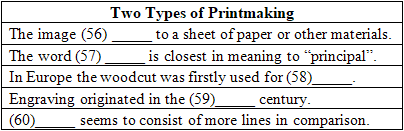
Section A (10 marks)
Questions 56 to 60 are based on the following passage.
Printmaking is the genetic term for a number of processes, of which woodcut and engraving are two prime examples. Prints are made by pressing a sheet of paper (or other materials) against an image-beating surface to which ink has been applied. When the paper is removed, the image adheres to it, but in reverse.The woodcut had been used in China from the fifth centuryA.D. for applying patterns to textiles. The process was not introduced into Europe until the fourteenth century, first for textile decoration and then for printing on paper. Woodcuts are created by a relief process; first, the artist takes a block of wood, which has been sawed parallel to the grain, covers it with a white ground, and then draws the image in ink. The background is carved away, leaving the design area slightly raised. The woodblock is inked, and the ink adheres to the raised image. It is then transferred to damp paper either by hand or with a printing press.
Engraving, which grew out of the goldsmith’s art, originated in Germany and northern Italy in the middle of the fifteenth century. It is an intaglio process (from Italian intagliare, “to carve”). The image is incised into a highly polished metal plate, usually copper, with a cutting instrument, or burin. The artist inks the plate and wipes it clean so that some ink remains in the incised grooves. An impression is made on damp paper in a printing press, with sufficient pressure being applied so that the paper picks up the ink.
Both woodcut and engraving have distinctive characteristics. Engraving lends itself to subtle modeling and shading through the use of fine lines. Hatching and cross-hatching determine the degree of light and shade in a print. Woodcuts tend to be more linear, with sharper contrasts between light and dark. Printmaking is well suited to the production of multiple images. A set of multiples is called an edition. Both methods can yield several hundred good-quality prints before the original block or plate begins to show signs of wear. Mass production of prints in the sixteenth century made images available, at a lower cost, to a much broader public than before.
Questions 56 to 60
Fill in the blanks below with information from the passage, using no more than three words for each blank.
26
There are three passages in this part. Each passage is followed by several questions. Respond to the questions using information from the passage. Remember to write the answers on the answer sheet.
Section A (10 marks)
Questions 56 to 60 are based on the following passage. Printmaking is the genetic term for a number of processes, of which woodcut and engraving are two prime examples. Prints are made by pressing a sheet of paper (or other materials) against an image-beating surface to which ink has been applied. When the paper is removed, the image adheres to it, but in reverse.
The woodcut had been used in China from the fifth centuryA.D. for applying patterns to textiles. The process was not introduced into Europe until the fourteenth century, first for textile decoration and then for printing on paper. Woodcuts are created by a relief process; first, the artist takes a block of wood, which has been sawed parallel to the grain, covers it with a white ground, and then draws the image in ink. The background is carved away, leaving the design area slightly raised. The woodblock is inked, and the ink adheres to the raised image. It is then transferred to damp paper either by hand or with a printing press.
Engraving, which grew out of the goldsmith’s art, originated in Germany and northern Italy in the middle of the fifteenth century. It is an intaglio process (from Italian intagliare, “to carve”). The image is incised into a highly polished metal plate, usually copper, with a cutting instrument, or burin. The artist inks the plate and wipes it clean so that some ink remains in the incised grooves. An impression is made on damp paper in a printing press, with sufficient pressure being applied so that the paper picks up the ink.
Both woodcut and engraving have distinctive characteristics. Engraving lends itself to subtle modeling and shading through the use of fine lines. Hatching and cross-hatching determine the degree of light and shade in a print. Woodcuts tend to be more linear, with sharper contrasts between light and dark. Printmaking is well suited to the production of multiple images. A set of multiples is called an edition. Both methods can yield several hundred good-quality prints before the original block or plate begins to show signs of wear. Mass production of prints in the sixteenth century made images available, at a lower cost, to a much broader public than before.
Questions 56 to 60
Fill in the blanks below with information from the passage, using no more than three words for each blank.
Section A (10 marks)
Questions 56 to 60 are based on the following passage.
Printmaking is the genetic term for a number of processes, of which woodcut and engraving are two prime examples. Prints are made by pressing a sheet of paper (or other materials) against an image-beating surface to which ink has been applied. When the paper is removed, the image adheres to it, but in reverse.The woodcut had been used in China from the fifth centuryA.D. for applying patterns to textiles. The process was not introduced into Europe until the fourteenth century, first for textile decoration and then for printing on paper. Woodcuts are created by a relief process; first, the artist takes a block of wood, which has been sawed parallel to the grain, covers it with a white ground, and then draws the image in ink. The background is carved away, leaving the design area slightly raised. The woodblock is inked, and the ink adheres to the raised image. It is then transferred to damp paper either by hand or with a printing press.
Engraving, which grew out of the goldsmith’s art, originated in Germany and northern Italy in the middle of the fifteenth century. It is an intaglio process (from Italian intagliare, “to carve”). The image is incised into a highly polished metal plate, usually copper, with a cutting instrument, or burin. The artist inks the plate and wipes it clean so that some ink remains in the incised grooves. An impression is made on damp paper in a printing press, with sufficient pressure being applied so that the paper picks up the ink.
Both woodcut and engraving have distinctive characteristics. Engraving lends itself to subtle modeling and shading through the use of fine lines. Hatching and cross-hatching determine the degree of light and shade in a print. Woodcuts tend to be more linear, with sharper contrasts between light and dark. Printmaking is well suited to the production of multiple images. A set of multiples is called an edition. Both methods can yield several hundred good-quality prints before the original block or plate begins to show signs of wear. Mass production of prints in the sixteenth century made images available, at a lower cost, to a much broader public than before.
Questions 56 to 60
Fill in the blanks below with information from the passage, using no more than three words for each blank.
27
There are three passages in this part. Each passage is followed by several questions. Respond to the questions using information from the passage. Remember to write the answers on the answer sheet.
Section A (10 marks)
Questions 56 to 60 are based on the following passage. Printmaking is the genetic term for a number of processes, of which woodcut and engraving are two prime examples. Prints are made by pressing a sheet of paper (or other materials) against an image-beating surface to which ink has been applied. When the paper is removed, the image adheres to it, but in reverse.
The woodcut had been used in China from the fifth centuryA.D. for applying patterns to textiles. The process was not introduced into Europe until the fourteenth century, first for textile decoration and then for printing on paper. Woodcuts are created by a relief process; first, the artist takes a block of wood, which has been sawed parallel to the grain, covers it with a white ground, and then draws the image in ink. The background is carved away, leaving the design area slightly raised. The woodblock is inked, and the ink adheres to the raised image. It is then transferred to damp paper either by hand or with a printing press.
Engraving, which grew out of the goldsmith’s art, originated in Germany and northern Italy in the middle of the fifteenth century. It is an intaglio process (from Italian intagliare, “to carve”). The image is incised into a highly polished metal plate, usually copper, with a cutting instrument, or burin. The artist inks the plate and wipes it clean so that some ink remains in the incised grooves. An impression is made on damp paper in a printing press, with sufficient pressure being applied so that the paper picks up the ink.
Both woodcut and engraving have distinctive characteristics. Engraving lends itself to subtle modeling and shading through the use of fine lines. Hatching and cross-hatching determine the degree of light and shade in a print. Woodcuts tend to be more linear, with sharper contrasts between light and dark. Printmaking is well suited to the production of multiple images. A set of multiples is called an edition. Both methods can yield several hundred good-quality prints before the original block or plate begins to show signs of wear. Mass production of prints in the sixteenth century made images available, at a lower cost, to a much broader public than before.
Questions 56 to 60
Fill in the blanks below with information from the passage, using no more than three words for each blank.
Section A (10 marks)
Questions 56 to 60 are based on the following passage.
Printmaking is the genetic term for a number of processes, of which woodcut and engraving are two prime examples. Prints are made by pressing a sheet of paper (or other materials) against an image-beating surface to which ink has been applied. When the paper is removed, the image adheres to it, but in reverse.The woodcut had been used in China from the fifth centuryA.D. for applying patterns to textiles. The process was not introduced into Europe until the fourteenth century, first for textile decoration and then for printing on paper. Woodcuts are created by a relief process; first, the artist takes a block of wood, which has been sawed parallel to the grain, covers it with a white ground, and then draws the image in ink. The background is carved away, leaving the design area slightly raised. The woodblock is inked, and the ink adheres to the raised image. It is then transferred to damp paper either by hand or with a printing press.
Engraving, which grew out of the goldsmith’s art, originated in Germany and northern Italy in the middle of the fifteenth century. It is an intaglio process (from Italian intagliare, “to carve”). The image is incised into a highly polished metal plate, usually copper, with a cutting instrument, or burin. The artist inks the plate and wipes it clean so that some ink remains in the incised grooves. An impression is made on damp paper in a printing press, with sufficient pressure being applied so that the paper picks up the ink.
Both woodcut and engraving have distinctive characteristics. Engraving lends itself to subtle modeling and shading through the use of fine lines. Hatching and cross-hatching determine the degree of light and shade in a print. Woodcuts tend to be more linear, with sharper contrasts between light and dark. Printmaking is well suited to the production of multiple images. A set of multiples is called an edition. Both methods can yield several hundred good-quality prints before the original block or plate begins to show signs of wear. Mass production of prints in the sixteenth century made images available, at a lower cost, to a much broader public than before.
Questions 56 to 60
Fill in the blanks below with information from the passage, using no more than three words for each blank.
28
There are three passages in this part. Each passage is followed by several questions. Respond to the questions using information from the passage. Remember to write the answers on the answer sheet.
Section A (10 marks)
Questions 56 to 60 are based on the following passage. Printmaking is the genetic term for a number of processes, of which woodcut and engraving are two prime examples. Prints are made by pressing a sheet of paper (or other materials) against an image-beating surface to which ink has been applied. When the paper is removed, the image adheres to it, but in reverse.
The woodcut had been used in China from the fifth centuryA.D. for applying patterns to textiles. The process was not introduced into Europe until the fourteenth century, first for textile decoration and then for printing on paper. Woodcuts are created by a relief process; first, the artist takes a block of wood, which has been sawed parallel to the grain, covers it with a white ground, and then draws the image in ink. The background is carved away, leaving the design area slightly raised. The woodblock is inked, and the ink adheres to the raised image. It is then transferred to damp paper either by hand or with a printing press.
Engraving, which grew out of the goldsmith’s art, originated in Germany and northern Italy in the middle of the fifteenth century. It is an intaglio process (from Italian intagliare, “to carve”). The image is incised into a highly polished metal plate, usually copper, with a cutting instrument, or burin. The artist inks the plate and wipes it clean so that some ink remains in the incised grooves. An impression is made on damp paper in a printing press, with sufficient pressure being applied so that the paper picks up the ink.
Both woodcut and engraving have distinctive characteristics. Engraving lends itself to subtle modeling and shading through the use of fine lines. Hatching and cross-hatching determine the degree of light and shade in a print. Woodcuts tend to be more linear, with sharper contrasts between light and dark. Printmaking is well suited to the production of multiple images. A set of multiples is called an edition. Both methods can yield several hundred good-quality prints before the original block or plate begins to show signs of wear. Mass production of prints in the sixteenth century made images available, at a lower cost, to a much broader public than before.
Questions 56 to 60
Fill in the blanks below with information from the passage, using no more than three words for each blank.
Section A (10 marks)
Questions 56 to 60 are based on the following passage.
Printmaking is the genetic term for a number of processes, of which woodcut and engraving are two prime examples. Prints are made by pressing a sheet of paper (or other materials) against an image-beating surface to which ink has been applied. When the paper is removed, the image adheres to it, but in reverse.The woodcut had been used in China from the fifth centuryA.D. for applying patterns to textiles. The process was not introduced into Europe until the fourteenth century, first for textile decoration and then for printing on paper. Woodcuts are created by a relief process; first, the artist takes a block of wood, which has been sawed parallel to the grain, covers it with a white ground, and then draws the image in ink. The background is carved away, leaving the design area slightly raised. The woodblock is inked, and the ink adheres to the raised image. It is then transferred to damp paper either by hand or with a printing press.
Engraving, which grew out of the goldsmith’s art, originated in Germany and northern Italy in the middle of the fifteenth century. It is an intaglio process (from Italian intagliare, “to carve”). The image is incised into a highly polished metal plate, usually copper, with a cutting instrument, or burin. The artist inks the plate and wipes it clean so that some ink remains in the incised grooves. An impression is made on damp paper in a printing press, with sufficient pressure being applied so that the paper picks up the ink.
Both woodcut and engraving have distinctive characteristics. Engraving lends itself to subtle modeling and shading through the use of fine lines. Hatching and cross-hatching determine the degree of light and shade in a print. Woodcuts tend to be more linear, with sharper contrasts between light and dark. Printmaking is well suited to the production of multiple images. A set of multiples is called an edition. Both methods can yield several hundred good-quality prints before the original block or plate begins to show signs of wear. Mass production of prints in the sixteenth century made images available, at a lower cost, to a much broader public than before.
Questions 56 to 60
Fill in the blanks below with information from the passage, using no more than three words for each blank.
29
There are three passages in this part. Each passage is followed by several questions. Respond to the questions using information from the passage. Remember to write the answers on the answer sheet.
Section A (10 marks)
Questions 56 to 60 are based on the following passage. Printmaking is the genetic term for a number of processes, of which woodcut and engraving are two prime examples. Prints are made by pressing a sheet of paper (or other materials) against an image-beating surface to which ink has been applied. When the paper is removed, the image adheres to it, but in reverse.
The woodcut had been used in China from the fifth centuryA.D. for applying patterns to textiles. The process was not introduced into Europe until the fourteenth century, first for textile decoration and then for printing on paper. Woodcuts are created by a relief process; first, the artist takes a block of wood, which has been sawed parallel to the grain, covers it with a white ground, and then draws the image in ink. The background is carved away, leaving the design area slightly raised. The woodblock is inked, and the ink adheres to the raised image. It is then transferred to damp paper either by hand or with a printing press.
Engraving, which grew out of the goldsmith’s art, originated in Germany and northern Italy in the middle of the fifteenth century. It is an intaglio process (from Italian intagliare, “to carve”). The image is incised into a highly polished metal plate, usually copper, with a cutting instrument, or burin. The artist inks the plate and wipes it clean so that some ink remains in the incised grooves. An impression is made on damp paper in a printing press, with sufficient pressure being applied so that the paper picks up the ink.
Both woodcut and engraving have distinctive characteristics. Engraving lends itself to subtle modeling and shading through the use of fine lines. Hatching and cross-hatching determine the degree of light and shade in a print. Woodcuts tend to be more linear, with sharper contrasts between light and dark. Printmaking is well suited to the production of multiple images. A set of multiples is called an edition. Both methods can yield several hundred good-quality prints before the original block or plate begins to show signs of wear. Mass production of prints in the sixteenth century made images available, at a lower cost, to a much broader public than before.
Questions 56 to 60
Fill in the blanks below with information from the passage, using no more than three words for each blank.
Section A (10 marks)
Questions 56 to 60 are based on the following passage.
Printmaking is the genetic term for a number of processes, of which woodcut and engraving are two prime examples. Prints are made by pressing a sheet of paper (or other materials) against an image-beating surface to which ink has been applied. When the paper is removed, the image adheres to it, but in reverse.The woodcut had been used in China from the fifth centuryA.D. for applying patterns to textiles. The process was not introduced into Europe until the fourteenth century, first for textile decoration and then for printing on paper. Woodcuts are created by a relief process; first, the artist takes a block of wood, which has been sawed parallel to the grain, covers it with a white ground, and then draws the image in ink. The background is carved away, leaving the design area slightly raised. The woodblock is inked, and the ink adheres to the raised image. It is then transferred to damp paper either by hand or with a printing press.
Engraving, which grew out of the goldsmith’s art, originated in Germany and northern Italy in the middle of the fifteenth century. It is an intaglio process (from Italian intagliare, “to carve”). The image is incised into a highly polished metal plate, usually copper, with a cutting instrument, or burin. The artist inks the plate and wipes it clean so that some ink remains in the incised grooves. An impression is made on damp paper in a printing press, with sufficient pressure being applied so that the paper picks up the ink.
Both woodcut and engraving have distinctive characteristics. Engraving lends itself to subtle modeling and shading through the use of fine lines. Hatching and cross-hatching determine the degree of light and shade in a print. Woodcuts tend to be more linear, with sharper contrasts between light and dark. Printmaking is well suited to the production of multiple images. A set of multiples is called an edition. Both methods can yield several hundred good-quality prints before the original block or plate begins to show signs of wear. Mass production of prints in the sixteenth century made images available, at a lower cost, to a much broader public than before.
Questions 56 to 60
Fill in the blanks below with information from the passage, using no more than three words for each blank.
30
There are three passages in this part. Each passage is followed by several questions. Respond to the questions using information from the passage. Remember to write the answers on the answer sheet.
Section A (10 marks)
Questions 56 to 60 are based on the following passage. Printmaking is the genetic term for a number of processes, of which woodcut and engraving are two prime examples. Prints are made by pressing a sheet of paper (or other materials) against an image-beating surface to which ink has been applied. When the paper is removed, the image adheres to it, but in reverse.
The woodcut had been used in China from the fifth centuryA.D. for applying patterns to textiles. The process was not introduced into Europe until the fourteenth century, first for textile decoration and then for printing on paper. Woodcuts are created by a relief process; first, the artist takes a block of wood, which has been sawed parallel to the grain, covers it with a white ground, and then draws the image in ink. The background is carved away, leaving the design area slightly raised. The woodblock is inked, and the ink adheres to the raised image. It is then transferred to damp paper either by hand or with a printing press.
Engraving, which grew out of the goldsmith’s art, originated in Germany and northern Italy in the middle of the fifteenth century. It is an intaglio process (from Italian intagliare, “to carve”). The image is incised into a highly polished metal plate, usually copper, with a cutting instrument, or burin. The artist inks the plate and wipes it clean so that some ink remains in the incised grooves. An impression is made on damp paper in a printing press, with sufficient pressure being applied so that the paper picks up the ink.
Both woodcut and engraving have distinctive characteristics. Engraving lends itself to subtle modeling and shading through the use of fine lines. Hatching and cross-hatching determine the degree of light and shade in a print. Woodcuts tend to be more linear, with sharper contrasts between light and dark. Printmaking is well suited to the production of multiple images. A set of multiples is called an edition. Both methods can yield several hundred good-quality prints before the original block or plate begins to show signs of wear. Mass production of prints in the sixteenth century made images available, at a lower cost, to a much broader public than before.
Questions 56 to 60
Fill in the blanks below with information from the passage, using no more than three words for each blank.
Section A (10 marks)
Questions 56 to 60 are based on the following passage.
Printmaking is the genetic term for a number of processes, of which woodcut and engraving are two prime examples. Prints are made by pressing a sheet of paper (or other materials) against an image-beating surface to which ink has been applied. When the paper is removed, the image adheres to it, but in reverse.The woodcut had been used in China from the fifth centuryA.D. for applying patterns to textiles. The process was not introduced into Europe until the fourteenth century, first for textile decoration and then for printing on paper. Woodcuts are created by a relief process; first, the artist takes a block of wood, which has been sawed parallel to the grain, covers it with a white ground, and then draws the image in ink. The background is carved away, leaving the design area slightly raised. The woodblock is inked, and the ink adheres to the raised image. It is then transferred to damp paper either by hand or with a printing press.
Engraving, which grew out of the goldsmith’s art, originated in Germany and northern Italy in the middle of the fifteenth century. It is an intaglio process (from Italian intagliare, “to carve”). The image is incised into a highly polished metal plate, usually copper, with a cutting instrument, or burin. The artist inks the plate and wipes it clean so that some ink remains in the incised grooves. An impression is made on damp paper in a printing press, with sufficient pressure being applied so that the paper picks up the ink.
Both woodcut and engraving have distinctive characteristics. Engraving lends itself to subtle modeling and shading through the use of fine lines. Hatching and cross-hatching determine the degree of light and shade in a print. Woodcuts tend to be more linear, with sharper contrasts between light and dark. Printmaking is well suited to the production of multiple images. A set of multiples is called an edition. Both methods can yield several hundred good-quality prints before the original block or plate begins to show signs of wear. Mass production of prints in the sixteenth century made images available, at a lower cost, to a much broader public than before.
Questions 56 to 60
Fill in the blanks below with information from the passage, using no more than three words for each blank.
Section B (10 marks)
Questions 61 to 65 are based on the following passage.
Water is the giver and, at the same time, the taker of life. It covers most of the surface of the planet we live on and features large in the development of the human race. On present predictions, it is a statement that is set to assume even greater significance.
Throughout history, water has had a huge impact on our lives. Humankind has always had a rather ambiguous relationship with water, on the one hand receiving enormous benefit from it, not just as a drinking source, but as a provider of food and a means whereby to travel and to trade. But forced to live close to water in order to survive and to develop, the relationship has not always been peaceful or beneficial. In fact, it has been quite the contrary. What has essentially been a necessity for survival was turned out in many instances to have a very destructive and life-threatening side.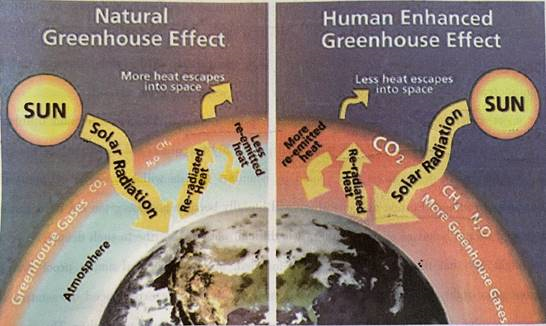 Through the ages, great floods alternated with long periods of drought have assaulted people and their environment, hampering their fragile fight for survival. The dramatic changes to the environment that are now a feature of our daily news are not exactly new: fields that were once lush and fertile are now barren; lakes and rivers that were once teeming with life are now long gone; savannah has been turned to desert. What perhaps is new is our native wonder when faced with the forces of nature.
Today, we are more aware of climatic changes around the world. Floods in far-flung places are instant news for the whole world. Perhaps these events make us feel better as we face the destruction of our own property by floods and other natural disasters.
In 2002, many parts of Europe suffered severe flood damage running into billions of euros. Properties across the continent collapsed into the sea as waves pounded the coastline wreaking havoc with sea defenses. But it was not just the seas. Rivers swollen by heavy rains and by the effects of deforestation carried large volumes of water that wrecked many communities.
Building stronger and more sophisticated river defenses against flooding is the expensive short-term answer. There are simpler ways. Planting trees in highland areas, not just in Europe but in places like the Ganges Delta, is a cheaper and more attractive solution. Progress is already being made in convincing countries that the emission of carbon dioxide and other greenhouse gases is causing considerable damage to the environment. But more effort is needed in this direction.
And the future? If we are to believe the forecasts, it is predicted that two thirds of the world population will be without fresh water by 2025. But for a growing number of regions of the world the future is already with us. While some areas are devastated by flooding, scarcity of water in many other places is causing conflict. The state of Texas in the United States of America is suffering a shortage of water with the Rio Grande failing to reach the Gulf of Mexico for the first time in 50 years in the spring of 2002, pitting region against region as they vie for water sources. With many parts of the globe running dry through drought and increased water consumption, there is now talk of water being the new oil.
Other doom-laden estimates suggest that, while tropical areas will become drier and uninhabitable, coastal regions and some low lying islands will in all probability be submerged by the sea as the polar ice caps melt. Popular exotic destinations now visited by countless tourists will become no-go areas. Today’s holiday hotspots of southern Europe and elsewhere will literally become hotspots—too hot to live in or visit. With the current erratic behavior of the weather, it is difficult not to subscribe to such despair.
Some might say that this despondency is ill-founded, but we have had ample proof that there is something not quite right with the climate. Many parts of the world have experienced devastating flooding. As the seasons revolve, the focus of the destruction moves from one continent to another. The impact on the environment is alarming and the cost to life depressing. It is a picture to which we will need to become accustomed.
Questions 61 to 65
Answer the following questions with the information given in the passage.
Questions 61 to 65 are based on the following passage.
Water is the giver and, at the same time, the taker of life. It covers most of the surface of the planet we live on and features large in the development of the human race. On present predictions, it is a statement that is set to assume even greater significance.
Throughout history, water has had a huge impact on our lives. Humankind has always had a rather ambiguous relationship with water, on the one hand receiving enormous benefit from it, not just as a drinking source, but as a provider of food and a means whereby to travel and to trade. But forced to live close to water in order to survive and to develop, the relationship has not always been peaceful or beneficial. In fact, it has been quite the contrary. What has essentially been a necessity for survival was turned out in many instances to have a very destructive and life-threatening side.
Through the ages, great floods alternated with long periods of drought have assaulted people and their environment, hampering their fragile fight for survival. The dramatic changes to the environment that are now a feature of our daily news are not exactly new: fields that were once lush and fertile are now barren; lakes and rivers that were once teeming with life are now long gone; savannah has been turned to desert. What perhaps is new is our native wonder when faced with the forces of nature.Today, we are more aware of climatic changes around the world. Floods in far-flung places are instant news for the whole world. Perhaps these events make us feel better as we face the destruction of our own property by floods and other natural disasters.
In 2002, many parts of Europe suffered severe flood damage running into billions of euros. Properties across the continent collapsed into the sea as waves pounded the coastline wreaking havoc with sea defenses. But it was not just the seas. Rivers swollen by heavy rains and by the effects of deforestation carried large volumes of water that wrecked many communities.
Building stronger and more sophisticated river defenses against flooding is the expensive short-term answer. There are simpler ways. Planting trees in highland areas, not just in Europe but in places like the Ganges Delta, is a cheaper and more attractive solution. Progress is already being made in convincing countries that the emission of carbon dioxide and other greenhouse gases is causing considerable damage to the environment. But more effort is needed in this direction.
And the future? If we are to believe the forecasts, it is predicted that two thirds of the world population will be without fresh water by 2025. But for a growing number of regions of the world the future is already with us. While some areas are devastated by flooding, scarcity of water in many other places is causing conflict. The state of Texas in the United States of America is suffering a shortage of water with the Rio Grande failing to reach the Gulf of Mexico for the first time in 50 years in the spring of 2002, pitting region against region as they vie for water sources. With many parts of the globe running dry through drought and increased water consumption, there is now talk of water being the new oil.
Other doom-laden estimates suggest that, while tropical areas will become drier and uninhabitable, coastal regions and some low lying islands will in all probability be submerged by the sea as the polar ice caps melt. Popular exotic destinations now visited by countless tourists will become no-go areas. Today’s holiday hotspots of southern Europe and elsewhere will literally become hotspots—too hot to live in or visit. With the current erratic behavior of the weather, it is difficult not to subscribe to such despair.
Some might say that this despondency is ill-founded, but we have had ample proof that there is something not quite right with the climate. Many parts of the world have experienced devastating flooding. As the seasons revolve, the focus of the destruction moves from one continent to another. The impact on the environment is alarming and the cost to life depressing. It is a picture to which we will need to become accustomed.
Questions 61 to 65
Answer the following questions with the information given in the passage.
31
What will have even greater importance in our lives in future?
32
What kind of relationship is two-sided?
33
Which continent suffered severely from drought?
34
What is a less expensive answer to flooding in all regions?
35
In the future, what part of continent is likely to be under water?
Section C (10 marks)
Questions 66 to 70 are based on the following passage.
Birds evolved during the great reptilian radiation of the Mesozoic era. Amniotic eggs and scales on the legs are just two of the reptilian features we see in birds. But modern birds look quite different from modern reptiles because of their feathers and other distinctive flight equipment. Almost every part of a typical bird’s anatomy is modified in some way that enhances flight. The bones have an internal structure that is honeycombed, making them strong but light. The skeleton of a frigate bird, for instance, has a wingspan of more than 2 meters but weighs only about 113 grams. Another adaptation reducing the weight of birds is the absence of some organs. Females, for instance, have only one ovary. Also, modern birds are toothless, an adaptation that trims the weight of the head. Food is not chewed in the mouth but ground in the gizzard, a digestive organ near the stomach. Crocodiles also have gizzards, as did some dinosaurs. The bird’s beak, made of keratin, has proven to be very adaptable during avian evolution, taking on a great variety of shapes suitable for different diets.
Flying requires a great expenditure of energy from an active metabolism. Birds are endothermic: they use their own metabolic heat to maintain a warm, constant body temperature. Feathers and, in some species, layers of fat provide insulation that enables birds to retain their metabolically generated heat. An efficient respiratory system and a circulatory system with a four-chambered heart keep tissues well supplied with oxygen and nutrients, supporting a high rate of heat and reduce the density of the body metabolism. The lungs have tiny tubes leading to and from elastic air sacs that help dissipate.
For safe flight, senses, especially vision, must be acute. Birds have excellent eyes, perhaps the best of all the vertebrates. The visual areas of the brains are well developed, as are the motor areas: flight also requires excellent coordination.
With brains proportionately larger than those of reptiles and amphibians, birds generally display very complex behavior. Avian behavior is particularly intricate during breeding season, when birds engage in elaborate rituals of courtship. Because eggs are shelled when laid, fertilization must be internal. After eggs are laid, the avian embryo must be kept warm through brooding by the mother, father, or both, depending on the species.
A bird’s most obvious adaptation for flight is its wings. Bird wings are airfoils that illustrate the same principles of aerodynamics as the wings of an airplane. Providing power for flight, birds flap their wings by contractions of large pectoral (breast) muscles anchored to a keel on the sternum (breast-bone). Some birds, such as eagles and hawks, have wings adapted for soaring on air currents and flap their wings only occasionally, other birds, including hummingbirds, must flap continuously to stay aloft. In either case, it is the shape and arrangement of the feathers that form the wings into an airfoil. The fastest birds are the appropriately named swifts, which can fly 170 km/hr.
In being both extremely light and strong, feathers are among the most remarkable of vertebrate adaptation. Feathers are made of keratin, the same protein that forms our hair and fingernails and the scales of reptiles. Feathers may have functioned first as insulation during the evolution of endotherm, only later being so-opted as flight equipment.
Analyses of fossilized skeletons support the hypothesis that the closest reptilian relatives of birds were the theropods, a group of relatively small, bipedal carnivorous dinosaurs. Most researchers agree that the ancestor of birds was a feathered theropod. However, some scientists the origin of birds much earlier, from an ancestor common to both birds and dinosaur. The intense current interest in the origin of birds will undoubtedly bring us closer to understanding how these masters of the sky evolved from non-flying reptiles.
Questions 66 to 70
Complete the summary below with information from the passage, using no more than three words for each blank.
In describing the characteristics of birds, almost every part of a typical bird’s anatomy is made different in some way that enhances (66)_____. Modern birds do not have (67)_____, an adaptation that reduces the weight of the head. Birds use their own (68)_____ to maintain the body temperature. Because birds’ eggs are shelled when laid, fertilization must be (69)_____! Most researchers believe that the (70)_____ was a feathered theropod that was a small, bipedal carnivorous dinosaur.
Questions 66 to 70 are based on the following passage.
Birds evolved during the great reptilian radiation of the Mesozoic era. Amniotic eggs and scales on the legs are just two of the reptilian features we see in birds. But modern birds look quite different from modern reptiles because of their feathers and other distinctive flight equipment.
Almost every part of a typical bird’s anatomy is modified in some way that enhances flight. The bones have an internal structure that is honeycombed, making them strong but light. The skeleton of a frigate bird, for instance, has a wingspan of more than 2 meters but weighs only about 113 grams. Another adaptation reducing the weight of birds is the absence of some organs. Females, for instance, have only one ovary. Also, modern birds are toothless, an adaptation that trims the weight of the head. Food is not chewed in the mouth but ground in the gizzard, a digestive organ near the stomach. Crocodiles also have gizzards, as did some dinosaurs. The bird’s beak, made of keratin, has proven to be very adaptable during avian evolution, taking on a great variety of shapes suitable for different diets.Flying requires a great expenditure of energy from an active metabolism. Birds are endothermic: they use their own metabolic heat to maintain a warm, constant body temperature. Feathers and, in some species, layers of fat provide insulation that enables birds to retain their metabolically generated heat. An efficient respiratory system and a circulatory system with a four-chambered heart keep tissues well supplied with oxygen and nutrients, supporting a high rate of heat and reduce the density of the body metabolism. The lungs have tiny tubes leading to and from elastic air sacs that help dissipate.
For safe flight, senses, especially vision, must be acute. Birds have excellent eyes, perhaps the best of all the vertebrates. The visual areas of the brains are well developed, as are the motor areas: flight also requires excellent coordination.
With brains proportionately larger than those of reptiles and amphibians, birds generally display very complex behavior. Avian behavior is particularly intricate during breeding season, when birds engage in elaborate rituals of courtship. Because eggs are shelled when laid, fertilization must be internal. After eggs are laid, the avian embryo must be kept warm through brooding by the mother, father, or both, depending on the species.
A bird’s most obvious adaptation for flight is its wings. Bird wings are airfoils that illustrate the same principles of aerodynamics as the wings of an airplane. Providing power for flight, birds flap their wings by contractions of large pectoral (breast) muscles anchored to a keel on the sternum (breast-bone). Some birds, such as eagles and hawks, have wings adapted for soaring on air currents and flap their wings only occasionally, other birds, including hummingbirds, must flap continuously to stay aloft. In either case, it is the shape and arrangement of the feathers that form the wings into an airfoil. The fastest birds are the appropriately named swifts, which can fly 170 km/hr.
In being both extremely light and strong, feathers are among the most remarkable of vertebrate adaptation. Feathers are made of keratin, the same protein that forms our hair and fingernails and the scales of reptiles. Feathers may have functioned first as insulation during the evolution of endotherm, only later being so-opted as flight equipment.
Analyses of fossilized skeletons support the hypothesis that the closest reptilian relatives of birds were the theropods, a group of relatively small, bipedal carnivorous dinosaurs. Most researchers agree that the ancestor of birds was a feathered theropod. However, some scientists the origin of birds much earlier, from an ancestor common to both birds and dinosaur. The intense current interest in the origin of birds will undoubtedly bring us closer to understanding how these masters of the sky evolved from non-flying reptiles.
Questions 66 to 70
Complete the summary below with information from the passage, using no more than three words for each blank.
In describing the characteristics of birds, almost every part of a typical bird’s anatomy is made different in some way that enhances (66)_____. Modern birds do not have (67)_____, an adaptation that reduces the weight of the head. Birds use their own (68)_____ to maintain the body temperature. Because birds’ eggs are shelled when laid, fertilization must be (69)_____! Most researchers believe that the (70)_____ was a feathered theropod that was a small, bipedal carnivorous dinosaur.
36
Section C (10 marks)
Questions 66 to 70 are based on the following passage.
Birds evolved during the great reptilian radiation of the Mesozoic era. Amniotic eggs and scales on the legs are just two of the reptilian features we see in birds. But modern birds look quite different from modern reptiles because of their feathers and other distinctive flight equipment. Almost every part of a typical bird’s anatomy is modified in some way that enhances flight. The bones have an internal structure that is honeycombed, making them strong but light. The skeleton of a frigate bird, for instance, has a wingspan of more than 2 meters but weighs only about 113 grams. Another adaptation reducing the weight of birds is the absence of some organs. Females, for instance, have only one ovary. Also, modern birds are toothless, an adaptation that trims the weight of the head. Food is not chewed in the mouth but ground in the gizzard, a digestive organ near the stomach. Crocodiles also have gizzards, as did some dinosaurs. The bird’s beak, made of keratin, has proven to be very adaptable during avian evolution, taking on a great variety of shapes suitable for different diets.
Flying requires a great expenditure of energy from an active metabolism. Birds are endothermic: they use their own metabolic heat to maintain a warm, constant body temperature. Feathers and, in some species, layers of fat provide insulation that enables birds to retain their metabolically generated heat. An efficient respiratory system and a circulatory system with a four-chambered heart keep tissues well supplied with oxygen and nutrients, supporting a high rate of heat and reduce the density of the body metabolism. The lungs have tiny tubes leading to and from elastic air sacs that help dissipate.
For safe flight, senses, especially vision, must be acute. Birds have excellent eyes, perhaps the best of all the vertebrates. The visual areas of the brains are well developed, as are the motor areas: flight also requires excellent coordination.
With brains proportionately larger than those of reptiles and amphibians, birds generally display very complex behavior. Avian behavior is particularly intricate during breeding season, when birds engage in elaborate rituals of courtship. Because eggs are shelled when laid, fertilization must be internal. After eggs are laid, the avian embryo must be kept warm through brooding by the mother, father, or both, depending on the species.
A bird’s most obvious adaptation for flight is its wings. Bird wings are airfoils that illustrate the same principles of aerodynamics as the wings of an airplane. Providing power for flight, birds flap their wings by contractions of large pectoral (breast) muscles anchored to a keel on the sternum (breast-bone). Some birds, such as eagles and hawks, have wings adapted for soaring on air currents and flap their wings only occasionally, other birds, including hummingbirds, must flap continuously to stay aloft. In either case, it is the shape and arrangement of the feathers that form the wings into an airfoil. The fastest birds are the appropriately named swifts, which can fly 170 km/hr.
In being both extremely light and strong, feathers are among the most remarkable of vertebrate adaptation. Feathers are made of keratin, the same protein that forms our hair and fingernails and the scales of reptiles. Feathers may have functioned first as insulation during the evolution of endotherm, only later being so-opted as flight equipment.
Analyses of fossilized skeletons support the hypothesis that the closest reptilian relatives of birds were the theropods, a group of relatively small, bipedal carnivorous dinosaurs. Most researchers agree that the ancestor of birds was a feathered theropod. However, some scientists the origin of birds much earlier, from an ancestor common to both birds and dinosaur. The intense current interest in the origin of birds will undoubtedly bring us closer to understanding how these masters of the sky evolved from non-flying reptiles.
Questions 66 to 70
Complete the summary below with information from the passage, using no more than three words for each blank.
In describing the characteristics of birds, almost every part of a typical bird’s anatomy is made different in some way that enhances (66)_____. Modern birds do not have (67)_____, an adaptation that reduces the weight of the head. Birds use their own (68)_____ to maintain the body temperature. Because birds’ eggs are shelled when laid, fertilization must be (69)_____! Most researchers believe that the (70)_____ was a feathered theropod that was a small, bipedal carnivorous dinosaur.
Questions 66 to 70 are based on the following passage.
Birds evolved during the great reptilian radiation of the Mesozoic era. Amniotic eggs and scales on the legs are just two of the reptilian features we see in birds. But modern birds look quite different from modern reptiles because of their feathers and other distinctive flight equipment.
Almost every part of a typical bird’s anatomy is modified in some way that enhances flight. The bones have an internal structure that is honeycombed, making them strong but light. The skeleton of a frigate bird, for instance, has a wingspan of more than 2 meters but weighs only about 113 grams. Another adaptation reducing the weight of birds is the absence of some organs. Females, for instance, have only one ovary. Also, modern birds are toothless, an adaptation that trims the weight of the head. Food is not chewed in the mouth but ground in the gizzard, a digestive organ near the stomach. Crocodiles also have gizzards, as did some dinosaurs. The bird’s beak, made of keratin, has proven to be very adaptable during avian evolution, taking on a great variety of shapes suitable for different diets.Flying requires a great expenditure of energy from an active metabolism. Birds are endothermic: they use their own metabolic heat to maintain a warm, constant body temperature. Feathers and, in some species, layers of fat provide insulation that enables birds to retain their metabolically generated heat. An efficient respiratory system and a circulatory system with a four-chambered heart keep tissues well supplied with oxygen and nutrients, supporting a high rate of heat and reduce the density of the body metabolism. The lungs have tiny tubes leading to and from elastic air sacs that help dissipate.
For safe flight, senses, especially vision, must be acute. Birds have excellent eyes, perhaps the best of all the vertebrates. The visual areas of the brains are well developed, as are the motor areas: flight also requires excellent coordination.
With brains proportionately larger than those of reptiles and amphibians, birds generally display very complex behavior. Avian behavior is particularly intricate during breeding season, when birds engage in elaborate rituals of courtship. Because eggs are shelled when laid, fertilization must be internal. After eggs are laid, the avian embryo must be kept warm through brooding by the mother, father, or both, depending on the species.
A bird’s most obvious adaptation for flight is its wings. Bird wings are airfoils that illustrate the same principles of aerodynamics as the wings of an airplane. Providing power for flight, birds flap their wings by contractions of large pectoral (breast) muscles anchored to a keel on the sternum (breast-bone). Some birds, such as eagles and hawks, have wings adapted for soaring on air currents and flap their wings only occasionally, other birds, including hummingbirds, must flap continuously to stay aloft. In either case, it is the shape and arrangement of the feathers that form the wings into an airfoil. The fastest birds are the appropriately named swifts, which can fly 170 km/hr.
In being both extremely light and strong, feathers are among the most remarkable of vertebrate adaptation. Feathers are made of keratin, the same protein that forms our hair and fingernails and the scales of reptiles. Feathers may have functioned first as insulation during the evolution of endotherm, only later being so-opted as flight equipment.
Analyses of fossilized skeletons support the hypothesis that the closest reptilian relatives of birds were the theropods, a group of relatively small, bipedal carnivorous dinosaurs. Most researchers agree that the ancestor of birds was a feathered theropod. However, some scientists the origin of birds much earlier, from an ancestor common to both birds and dinosaur. The intense current interest in the origin of birds will undoubtedly bring us closer to understanding how these masters of the sky evolved from non-flying reptiles.
Questions 66 to 70
Complete the summary below with information from the passage, using no more than three words for each blank.
In describing the characteristics of birds, almost every part of a typical bird’s anatomy is made different in some way that enhances (66)_____. Modern birds do not have (67)_____, an adaptation that reduces the weight of the head. Birds use their own (68)_____ to maintain the body temperature. Because birds’ eggs are shelled when laid, fertilization must be (69)_____! Most researchers believe that the (70)_____ was a feathered theropod that was a small, bipedal carnivorous dinosaur.
37
Section C (10 marks)
Questions 66 to 70 are based on the following passage.
Birds evolved during the great reptilian radiation of the Mesozoic era. Amniotic eggs and scales on the legs are just two of the reptilian features we see in birds. But modern birds look quite different from modern reptiles because of their feathers and other distinctive flight equipment. Almost every part of a typical bird’s anatomy is modified in some way that enhances flight. The bones have an internal structure that is honeycombed, making them strong but light. The skeleton of a frigate bird, for instance, has a wingspan of more than 2 meters but weighs only about 113 grams. Another adaptation reducing the weight of birds is the absence of some organs. Females, for instance, have only one ovary. Also, modern birds are toothless, an adaptation that trims the weight of the head. Food is not chewed in the mouth but ground in the gizzard, a digestive organ near the stomach. Crocodiles also have gizzards, as did some dinosaurs. The bird’s beak, made of keratin, has proven to be very adaptable during avian evolution, taking on a great variety of shapes suitable for different diets.
Flying requires a great expenditure of energy from an active metabolism. Birds are endothermic: they use their own metabolic heat to maintain a warm, constant body temperature. Feathers and, in some species, layers of fat provide insulation that enables birds to retain their metabolically generated heat. An efficient respiratory system and a circulatory system with a four-chambered heart keep tissues well supplied with oxygen and nutrients, supporting a high rate of heat and reduce the density of the body metabolism. The lungs have tiny tubes leading to and from elastic air sacs that help dissipate.
For safe flight, senses, especially vision, must be acute. Birds have excellent eyes, perhaps the best of all the vertebrates. The visual areas of the brains are well developed, as are the motor areas: flight also requires excellent coordination.
With brains proportionately larger than those of reptiles and amphibians, birds generally display very complex behavior. Avian behavior is particularly intricate during breeding season, when birds engage in elaborate rituals of courtship. Because eggs are shelled when laid, fertilization must be internal. After eggs are laid, the avian embryo must be kept warm through brooding by the mother, father, or both, depending on the species.
A bird’s most obvious adaptation for flight is its wings. Bird wings are airfoils that illustrate the same principles of aerodynamics as the wings of an airplane. Providing power for flight, birds flap their wings by contractions of large pectoral (breast) muscles anchored to a keel on the sternum (breast-bone). Some birds, such as eagles and hawks, have wings adapted for soaring on air currents and flap their wings only occasionally, other birds, including hummingbirds, must flap continuously to stay aloft. In either case, it is the shape and arrangement of the feathers that form the wings into an airfoil. The fastest birds are the appropriately named swifts, which can fly 170 km/hr.
In being both extremely light and strong, feathers are among the most remarkable of vertebrate adaptation. Feathers are made of keratin, the same protein that forms our hair and fingernails and the scales of reptiles. Feathers may have functioned first as insulation during the evolution of endotherm, only later being so-opted as flight equipment.
Analyses of fossilized skeletons support the hypothesis that the closest reptilian relatives of birds were the theropods, a group of relatively small, bipedal carnivorous dinosaurs. Most researchers agree that the ancestor of birds was a feathered theropod. However, some scientists the origin of birds much earlier, from an ancestor common to both birds and dinosaur. The intense current interest in the origin of birds will undoubtedly bring us closer to understanding how these masters of the sky evolved from non-flying reptiles.
Questions 66 to 70
Complete the summary below with information from the passage, using no more than three words for each blank.
In describing the characteristics of birds, almost every part of a typical bird’s anatomy is made different in some way that enhances (66)_____. Modern birds do not have (67)_____, an adaptation that reduces the weight of the head. Birds use their own (68)_____ to maintain the body temperature. Because birds’ eggs are shelled when laid, fertilization must be (69)_____! Most researchers believe that the (70)_____ was a feathered theropod that was a small, bipedal carnivorous dinosaur.
Questions 66 to 70 are based on the following passage.
Birds evolved during the great reptilian radiation of the Mesozoic era. Amniotic eggs and scales on the legs are just two of the reptilian features we see in birds. But modern birds look quite different from modern reptiles because of their feathers and other distinctive flight equipment.
Almost every part of a typical bird’s anatomy is modified in some way that enhances flight. The bones have an internal structure that is honeycombed, making them strong but light. The skeleton of a frigate bird, for instance, has a wingspan of more than 2 meters but weighs only about 113 grams. Another adaptation reducing the weight of birds is the absence of some organs. Females, for instance, have only one ovary. Also, modern birds are toothless, an adaptation that trims the weight of the head. Food is not chewed in the mouth but ground in the gizzard, a digestive organ near the stomach. Crocodiles also have gizzards, as did some dinosaurs. The bird’s beak, made of keratin, has proven to be very adaptable during avian evolution, taking on a great variety of shapes suitable for different diets.Flying requires a great expenditure of energy from an active metabolism. Birds are endothermic: they use their own metabolic heat to maintain a warm, constant body temperature. Feathers and, in some species, layers of fat provide insulation that enables birds to retain their metabolically generated heat. An efficient respiratory system and a circulatory system with a four-chambered heart keep tissues well supplied with oxygen and nutrients, supporting a high rate of heat and reduce the density of the body metabolism. The lungs have tiny tubes leading to and from elastic air sacs that help dissipate.
For safe flight, senses, especially vision, must be acute. Birds have excellent eyes, perhaps the best of all the vertebrates. The visual areas of the brains are well developed, as are the motor areas: flight also requires excellent coordination.
With brains proportionately larger than those of reptiles and amphibians, birds generally display very complex behavior. Avian behavior is particularly intricate during breeding season, when birds engage in elaborate rituals of courtship. Because eggs are shelled when laid, fertilization must be internal. After eggs are laid, the avian embryo must be kept warm through brooding by the mother, father, or both, depending on the species.
A bird’s most obvious adaptation for flight is its wings. Bird wings are airfoils that illustrate the same principles of aerodynamics as the wings of an airplane. Providing power for flight, birds flap their wings by contractions of large pectoral (breast) muscles anchored to a keel on the sternum (breast-bone). Some birds, such as eagles and hawks, have wings adapted for soaring on air currents and flap their wings only occasionally, other birds, including hummingbirds, must flap continuously to stay aloft. In either case, it is the shape and arrangement of the feathers that form the wings into an airfoil. The fastest birds are the appropriately named swifts, which can fly 170 km/hr.
In being both extremely light and strong, feathers are among the most remarkable of vertebrate adaptation. Feathers are made of keratin, the same protein that forms our hair and fingernails and the scales of reptiles. Feathers may have functioned first as insulation during the evolution of endotherm, only later being so-opted as flight equipment.
Analyses of fossilized skeletons support the hypothesis that the closest reptilian relatives of birds were the theropods, a group of relatively small, bipedal carnivorous dinosaurs. Most researchers agree that the ancestor of birds was a feathered theropod. However, some scientists the origin of birds much earlier, from an ancestor common to both birds and dinosaur. The intense current interest in the origin of birds will undoubtedly bring us closer to understanding how these masters of the sky evolved from non-flying reptiles.
Questions 66 to 70
Complete the summary below with information from the passage, using no more than three words for each blank.
In describing the characteristics of birds, almost every part of a typical bird’s anatomy is made different in some way that enhances (66)_____. Modern birds do not have (67)_____, an adaptation that reduces the weight of the head. Birds use their own (68)_____ to maintain the body temperature. Because birds’ eggs are shelled when laid, fertilization must be (69)_____! Most researchers believe that the (70)_____ was a feathered theropod that was a small, bipedal carnivorous dinosaur.
38
Section C (10 marks)
Questions 66 to 70 are based on the following passage.
Birds evolved during the great reptilian radiation of the Mesozoic era. Amniotic eggs and scales on the legs are just two of the reptilian features we see in birds. But modern birds look quite different from modern reptiles because of their feathers and other distinctive flight equipment. Almost every part of a typical bird’s anatomy is modified in some way that enhances flight. The bones have an internal structure that is honeycombed, making them strong but light. The skeleton of a frigate bird, for instance, has a wingspan of more than 2 meters but weighs only about 113 grams. Another adaptation reducing the weight of birds is the absence of some organs. Females, for instance, have only one ovary. Also, modern birds are toothless, an adaptation that trims the weight of the head. Food is not chewed in the mouth but ground in the gizzard, a digestive organ near the stomach. Crocodiles also have gizzards, as did some dinosaurs. The bird’s beak, made of keratin, has proven to be very adaptable during avian evolution, taking on a great variety of shapes suitable for different diets.
Flying requires a great expenditure of energy from an active metabolism. Birds are endothermic: they use their own metabolic heat to maintain a warm, constant body temperature. Feathers and, in some species, layers of fat provide insulation that enables birds to retain their metabolically generated heat. An efficient respiratory system and a circulatory system with a four-chambered heart keep tissues well supplied with oxygen and nutrients, supporting a high rate of heat and reduce the density of the body metabolism. The lungs have tiny tubes leading to and from elastic air sacs that help dissipate.
For safe flight, senses, especially vision, must be acute. Birds have excellent eyes, perhaps the best of all the vertebrates. The visual areas of the brains are well developed, as are the motor areas: flight also requires excellent coordination.
With brains proportionately larger than those of reptiles and amphibians, birds generally display very complex behavior. Avian behavior is particularly intricate during breeding season, when birds engage in elaborate rituals of courtship. Because eggs are shelled when laid, fertilization must be internal. After eggs are laid, the avian embryo must be kept warm through brooding by the mother, father, or both, depending on the species.
A bird’s most obvious adaptation for flight is its wings. Bird wings are airfoils that illustrate the same principles of aerodynamics as the wings of an airplane. Providing power for flight, birds flap their wings by contractions of large pectoral (breast) muscles anchored to a keel on the sternum (breast-bone). Some birds, such as eagles and hawks, have wings adapted for soaring on air currents and flap their wings only occasionally, other birds, including hummingbirds, must flap continuously to stay aloft. In either case, it is the shape and arrangement of the feathers that form the wings into an airfoil. The fastest birds are the appropriately named swifts, which can fly 170 km/hr.
In being both extremely light and strong, feathers are among the most remarkable of vertebrate adaptation. Feathers are made of keratin, the same protein that forms our hair and fingernails and the scales of reptiles. Feathers may have functioned first as insulation during the evolution of endotherm, only later being so-opted as flight equipment.
Analyses of fossilized skeletons support the hypothesis that the closest reptilian relatives of birds were the theropods, a group of relatively small, bipedal carnivorous dinosaurs. Most researchers agree that the ancestor of birds was a feathered theropod. However, some scientists the origin of birds much earlier, from an ancestor common to both birds and dinosaur. The intense current interest in the origin of birds will undoubtedly bring us closer to understanding how these masters of the sky evolved from non-flying reptiles.
Questions 66 to 70
Complete the summary below with information from the passage, using no more than three words for each blank.
In describing the characteristics of birds, almost every part of a typical bird’s anatomy is made different in some way that enhances (66)_____. Modern birds do not have (67)_____, an adaptation that reduces the weight of the head. Birds use their own (68)_____ to maintain the body temperature. Because birds’ eggs are shelled when laid, fertilization must be (69)_____! Most researchers believe that the (70)_____ was a feathered theropod that was a small, bipedal carnivorous dinosaur.
Questions 66 to 70 are based on the following passage.
Birds evolved during the great reptilian radiation of the Mesozoic era. Amniotic eggs and scales on the legs are just two of the reptilian features we see in birds. But modern birds look quite different from modern reptiles because of their feathers and other distinctive flight equipment.
Almost every part of a typical bird’s anatomy is modified in some way that enhances flight. The bones have an internal structure that is honeycombed, making them strong but light. The skeleton of a frigate bird, for instance, has a wingspan of more than 2 meters but weighs only about 113 grams. Another adaptation reducing the weight of birds is the absence of some organs. Females, for instance, have only one ovary. Also, modern birds are toothless, an adaptation that trims the weight of the head. Food is not chewed in the mouth but ground in the gizzard, a digestive organ near the stomach. Crocodiles also have gizzards, as did some dinosaurs. The bird’s beak, made of keratin, has proven to be very adaptable during avian evolution, taking on a great variety of shapes suitable for different diets.Flying requires a great expenditure of energy from an active metabolism. Birds are endothermic: they use their own metabolic heat to maintain a warm, constant body temperature. Feathers and, in some species, layers of fat provide insulation that enables birds to retain their metabolically generated heat. An efficient respiratory system and a circulatory system with a four-chambered heart keep tissues well supplied with oxygen and nutrients, supporting a high rate of heat and reduce the density of the body metabolism. The lungs have tiny tubes leading to and from elastic air sacs that help dissipate.
For safe flight, senses, especially vision, must be acute. Birds have excellent eyes, perhaps the best of all the vertebrates. The visual areas of the brains are well developed, as are the motor areas: flight also requires excellent coordination.
With brains proportionately larger than those of reptiles and amphibians, birds generally display very complex behavior. Avian behavior is particularly intricate during breeding season, when birds engage in elaborate rituals of courtship. Because eggs are shelled when laid, fertilization must be internal. After eggs are laid, the avian embryo must be kept warm through brooding by the mother, father, or both, depending on the species.
A bird’s most obvious adaptation for flight is its wings. Bird wings are airfoils that illustrate the same principles of aerodynamics as the wings of an airplane. Providing power for flight, birds flap their wings by contractions of large pectoral (breast) muscles anchored to a keel on the sternum (breast-bone). Some birds, such as eagles and hawks, have wings adapted for soaring on air currents and flap their wings only occasionally, other birds, including hummingbirds, must flap continuously to stay aloft. In either case, it is the shape and arrangement of the feathers that form the wings into an airfoil. The fastest birds are the appropriately named swifts, which can fly 170 km/hr.
In being both extremely light and strong, feathers are among the most remarkable of vertebrate adaptation. Feathers are made of keratin, the same protein that forms our hair and fingernails and the scales of reptiles. Feathers may have functioned first as insulation during the evolution of endotherm, only later being so-opted as flight equipment.
Analyses of fossilized skeletons support the hypothesis that the closest reptilian relatives of birds were the theropods, a group of relatively small, bipedal carnivorous dinosaurs. Most researchers agree that the ancestor of birds was a feathered theropod. However, some scientists the origin of birds much earlier, from an ancestor common to both birds and dinosaur. The intense current interest in the origin of birds will undoubtedly bring us closer to understanding how these masters of the sky evolved from non-flying reptiles.
Questions 66 to 70
Complete the summary below with information from the passage, using no more than three words for each blank.
In describing the characteristics of birds, almost every part of a typical bird’s anatomy is made different in some way that enhances (66)_____. Modern birds do not have (67)_____, an adaptation that reduces the weight of the head. Birds use their own (68)_____ to maintain the body temperature. Because birds’ eggs are shelled when laid, fertilization must be (69)_____! Most researchers believe that the (70)_____ was a feathered theropod that was a small, bipedal carnivorous dinosaur.
39
Section C (10 marks)
Questions 66 to 70 are based on the following passage.
Birds evolved during the great reptilian radiation of the Mesozoic era. Amniotic eggs and scales on the legs are just two of the reptilian features we see in birds. But modern birds look quite different from modern reptiles because of their feathers and other distinctive flight equipment. Almost every part of a typical bird’s anatomy is modified in some way that enhances flight. The bones have an internal structure that is honeycombed, making them strong but light. The skeleton of a frigate bird, for instance, has a wingspan of more than 2 meters but weighs only about 113 grams. Another adaptation reducing the weight of birds is the absence of some organs. Females, for instance, have only one ovary. Also, modern birds are toothless, an adaptation that trims the weight of the head. Food is not chewed in the mouth but ground in the gizzard, a digestive organ near the stomach. Crocodiles also have gizzards, as did some dinosaurs. The bird’s beak, made of keratin, has proven to be very adaptable during avian evolution, taking on a great variety of shapes suitable for different diets.
Flying requires a great expenditure of energy from an active metabolism. Birds are endothermic: they use their own metabolic heat to maintain a warm, constant body temperature. Feathers and, in some species, layers of fat provide insulation that enables birds to retain their metabolically generated heat. An efficient respiratory system and a circulatory system with a four-chambered heart keep tissues well supplied with oxygen and nutrients, supporting a high rate of heat and reduce the density of the body metabolism. The lungs have tiny tubes leading to and from elastic air sacs that help dissipate.
For safe flight, senses, especially vision, must be acute. Birds have excellent eyes, perhaps the best of all the vertebrates. The visual areas of the brains are well developed, as are the motor areas: flight also requires excellent coordination.
With brains proportionately larger than those of reptiles and amphibians, birds generally display very complex behavior. Avian behavior is particularly intricate during breeding season, when birds engage in elaborate rituals of courtship. Because eggs are shelled when laid, fertilization must be internal. After eggs are laid, the avian embryo must be kept warm through brooding by the mother, father, or both, depending on the species.
A bird’s most obvious adaptation for flight is its wings. Bird wings are airfoils that illustrate the same principles of aerodynamics as the wings of an airplane. Providing power for flight, birds flap their wings by contractions of large pectoral (breast) muscles anchored to a keel on the sternum (breast-bone). Some birds, such as eagles and hawks, have wings adapted for soaring on air currents and flap their wings only occasionally, other birds, including hummingbirds, must flap continuously to stay aloft. In either case, it is the shape and arrangement of the feathers that form the wings into an airfoil. The fastest birds are the appropriately named swifts, which can fly 170 km/hr.
In being both extremely light and strong, feathers are among the most remarkable of vertebrate adaptation. Feathers are made of keratin, the same protein that forms our hair and fingernails and the scales of reptiles. Feathers may have functioned first as insulation during the evolution of endotherm, only later being so-opted as flight equipment.
Analyses of fossilized skeletons support the hypothesis that the closest reptilian relatives of birds were the theropods, a group of relatively small, bipedal carnivorous dinosaurs. Most researchers agree that the ancestor of birds was a feathered theropod. However, some scientists the origin of birds much earlier, from an ancestor common to both birds and dinosaur. The intense current interest in the origin of birds will undoubtedly bring us closer to understanding how these masters of the sky evolved from non-flying reptiles.
Questions 66 to 70
Complete the summary below with information from the passage, using no more than three words for each blank.
In describing the characteristics of birds, almost every part of a typical bird’s anatomy is made different in some way that enhances (66)_____. Modern birds do not have (67)_____, an adaptation that reduces the weight of the head. Birds use their own (68)_____ to maintain the body temperature. Because birds’ eggs are shelled when laid, fertilization must be (69)_____! Most researchers believe that the (70)_____ was a feathered theropod that was a small, bipedal carnivorous dinosaur.
Questions 66 to 70 are based on the following passage.
Birds evolved during the great reptilian radiation of the Mesozoic era. Amniotic eggs and scales on the legs are just two of the reptilian features we see in birds. But modern birds look quite different from modern reptiles because of their feathers and other distinctive flight equipment.
Almost every part of a typical bird’s anatomy is modified in some way that enhances flight. The bones have an internal structure that is honeycombed, making them strong but light. The skeleton of a frigate bird, for instance, has a wingspan of more than 2 meters but weighs only about 113 grams. Another adaptation reducing the weight of birds is the absence of some organs. Females, for instance, have only one ovary. Also, modern birds are toothless, an adaptation that trims the weight of the head. Food is not chewed in the mouth but ground in the gizzard, a digestive organ near the stomach. Crocodiles also have gizzards, as did some dinosaurs. The bird’s beak, made of keratin, has proven to be very adaptable during avian evolution, taking on a great variety of shapes suitable for different diets.Flying requires a great expenditure of energy from an active metabolism. Birds are endothermic: they use their own metabolic heat to maintain a warm, constant body temperature. Feathers and, in some species, layers of fat provide insulation that enables birds to retain their metabolically generated heat. An efficient respiratory system and a circulatory system with a four-chambered heart keep tissues well supplied with oxygen and nutrients, supporting a high rate of heat and reduce the density of the body metabolism. The lungs have tiny tubes leading to and from elastic air sacs that help dissipate.
For safe flight, senses, especially vision, must be acute. Birds have excellent eyes, perhaps the best of all the vertebrates. The visual areas of the brains are well developed, as are the motor areas: flight also requires excellent coordination.
With brains proportionately larger than those of reptiles and amphibians, birds generally display very complex behavior. Avian behavior is particularly intricate during breeding season, when birds engage in elaborate rituals of courtship. Because eggs are shelled when laid, fertilization must be internal. After eggs are laid, the avian embryo must be kept warm through brooding by the mother, father, or both, depending on the species.
A bird’s most obvious adaptation for flight is its wings. Bird wings are airfoils that illustrate the same principles of aerodynamics as the wings of an airplane. Providing power for flight, birds flap their wings by contractions of large pectoral (breast) muscles anchored to a keel on the sternum (breast-bone). Some birds, such as eagles and hawks, have wings adapted for soaring on air currents and flap their wings only occasionally, other birds, including hummingbirds, must flap continuously to stay aloft. In either case, it is the shape and arrangement of the feathers that form the wings into an airfoil. The fastest birds are the appropriately named swifts, which can fly 170 km/hr.
In being both extremely light and strong, feathers are among the most remarkable of vertebrate adaptation. Feathers are made of keratin, the same protein that forms our hair and fingernails and the scales of reptiles. Feathers may have functioned first as insulation during the evolution of endotherm, only later being so-opted as flight equipment.
Analyses of fossilized skeletons support the hypothesis that the closest reptilian relatives of birds were the theropods, a group of relatively small, bipedal carnivorous dinosaurs. Most researchers agree that the ancestor of birds was a feathered theropod. However, some scientists the origin of birds much earlier, from an ancestor common to both birds and dinosaur. The intense current interest in the origin of birds will undoubtedly bring us closer to understanding how these masters of the sky evolved from non-flying reptiles.
Questions 66 to 70
Complete the summary below with information from the passage, using no more than three words for each blank.
In describing the characteristics of birds, almost every part of a typical bird’s anatomy is made different in some way that enhances (66)_____. Modern birds do not have (67)_____, an adaptation that reduces the weight of the head. Birds use their own (68)_____ to maintain the body temperature. Because birds’ eggs are shelled when laid, fertilization must be (69)_____! Most researchers believe that the (70)_____ was a feathered theropod that was a small, bipedal carnivorous dinosaur.
40
Section C (10 marks)
Questions 66 to 70 are based on the following passage.
Birds evolved during the great reptilian radiation of the Mesozoic era. Amniotic eggs and scales on the legs are just two of the reptilian features we see in birds. But modern birds look quite different from modern reptiles because of their feathers and other distinctive flight equipment. Almost every part of a typical bird’s anatomy is modified in some way that enhances flight. The bones have an internal structure that is honeycombed, making them strong but light. The skeleton of a frigate bird, for instance, has a wingspan of more than 2 meters but weighs only about 113 grams. Another adaptation reducing the weight of birds is the absence of some organs. Females, for instance, have only one ovary. Also, modern birds are toothless, an adaptation that trims the weight of the head. Food is not chewed in the mouth but ground in the gizzard, a digestive organ near the stomach. Crocodiles also have gizzards, as did some dinosaurs. The bird’s beak, made of keratin, has proven to be very adaptable during avian evolution, taking on a great variety of shapes suitable for different diets.
Flying requires a great expenditure of energy from an active metabolism. Birds are endothermic: they use their own metabolic heat to maintain a warm, constant body temperature. Feathers and, in some species, layers of fat provide insulation that enables birds to retain their metabolically generated heat. An efficient respiratory system and a circulatory system with a four-chambered heart keep tissues well supplied with oxygen and nutrients, supporting a high rate of heat and reduce the density of the body metabolism. The lungs have tiny tubes leading to and from elastic air sacs that help dissipate.
For safe flight, senses, especially vision, must be acute. Birds have excellent eyes, perhaps the best of all the vertebrates. The visual areas of the brains are well developed, as are the motor areas: flight also requires excellent coordination.
With brains proportionately larger than those of reptiles and amphibians, birds generally display very complex behavior. Avian behavior is particularly intricate during breeding season, when birds engage in elaborate rituals of courtship. Because eggs are shelled when laid, fertilization must be internal. After eggs are laid, the avian embryo must be kept warm through brooding by the mother, father, or both, depending on the species.
A bird’s most obvious adaptation for flight is its wings. Bird wings are airfoils that illustrate the same principles of aerodynamics as the wings of an airplane. Providing power for flight, birds flap their wings by contractions of large pectoral (breast) muscles anchored to a keel on the sternum (breast-bone). Some birds, such as eagles and hawks, have wings adapted for soaring on air currents and flap their wings only occasionally, other birds, including hummingbirds, must flap continuously to stay aloft. In either case, it is the shape and arrangement of the feathers that form the wings into an airfoil. The fastest birds are the appropriately named swifts, which can fly 170 km/hr.
In being both extremely light and strong, feathers are among the most remarkable of vertebrate adaptation. Feathers are made of keratin, the same protein that forms our hair and fingernails and the scales of reptiles. Feathers may have functioned first as insulation during the evolution of endotherm, only later being so-opted as flight equipment.
Analyses of fossilized skeletons support the hypothesis that the closest reptilian relatives of birds were the theropods, a group of relatively small, bipedal carnivorous dinosaurs. Most researchers agree that the ancestor of birds was a feathered theropod. However, some scientists the origin of birds much earlier, from an ancestor common to both birds and dinosaur. The intense current interest in the origin of birds will undoubtedly bring us closer to understanding how these masters of the sky evolved from non-flying reptiles.
Questions 66 to 70
Complete the summary below with information from the passage, using no more than three words for each blank.
In describing the characteristics of birds, almost every part of a typical bird’s anatomy is made different in some way that enhances (66)_____. Modern birds do not have (67)_____, an adaptation that reduces the weight of the head. Birds use their own (68)_____ to maintain the body temperature. Because birds’ eggs are shelled when laid, fertilization must be (69)_____! Most researchers believe that the (70)_____ was a feathered theropod that was a small, bipedal carnivorous dinosaur.
Questions 66 to 70 are based on the following passage.
Birds evolved during the great reptilian radiation of the Mesozoic era. Amniotic eggs and scales on the legs are just two of the reptilian features we see in birds. But modern birds look quite different from modern reptiles because of their feathers and other distinctive flight equipment.
Almost every part of a typical bird’s anatomy is modified in some way that enhances flight. The bones have an internal structure that is honeycombed, making them strong but light. The skeleton of a frigate bird, for instance, has a wingspan of more than 2 meters but weighs only about 113 grams. Another adaptation reducing the weight of birds is the absence of some organs. Females, for instance, have only one ovary. Also, modern birds are toothless, an adaptation that trims the weight of the head. Food is not chewed in the mouth but ground in the gizzard, a digestive organ near the stomach. Crocodiles also have gizzards, as did some dinosaurs. The bird’s beak, made of keratin, has proven to be very adaptable during avian evolution, taking on a great variety of shapes suitable for different diets.Flying requires a great expenditure of energy from an active metabolism. Birds are endothermic: they use their own metabolic heat to maintain a warm, constant body temperature. Feathers and, in some species, layers of fat provide insulation that enables birds to retain their metabolically generated heat. An efficient respiratory system and a circulatory system with a four-chambered heart keep tissues well supplied with oxygen and nutrients, supporting a high rate of heat and reduce the density of the body metabolism. The lungs have tiny tubes leading to and from elastic air sacs that help dissipate.
For safe flight, senses, especially vision, must be acute. Birds have excellent eyes, perhaps the best of all the vertebrates. The visual areas of the brains are well developed, as are the motor areas: flight also requires excellent coordination.
With brains proportionately larger than those of reptiles and amphibians, birds generally display very complex behavior. Avian behavior is particularly intricate during breeding season, when birds engage in elaborate rituals of courtship. Because eggs are shelled when laid, fertilization must be internal. After eggs are laid, the avian embryo must be kept warm through brooding by the mother, father, or both, depending on the species.
A bird’s most obvious adaptation for flight is its wings. Bird wings are airfoils that illustrate the same principles of aerodynamics as the wings of an airplane. Providing power for flight, birds flap their wings by contractions of large pectoral (breast) muscles anchored to a keel on the sternum (breast-bone). Some birds, such as eagles and hawks, have wings adapted for soaring on air currents and flap their wings only occasionally, other birds, including hummingbirds, must flap continuously to stay aloft. In either case, it is the shape and arrangement of the feathers that form the wings into an airfoil. The fastest birds are the appropriately named swifts, which can fly 170 km/hr.
In being both extremely light and strong, feathers are among the most remarkable of vertebrate adaptation. Feathers are made of keratin, the same protein that forms our hair and fingernails and the scales of reptiles. Feathers may have functioned first as insulation during the evolution of endotherm, only later being so-opted as flight equipment.
Analyses of fossilized skeletons support the hypothesis that the closest reptilian relatives of birds were the theropods, a group of relatively small, bipedal carnivorous dinosaurs. Most researchers agree that the ancestor of birds was a feathered theropod. However, some scientists the origin of birds much earlier, from an ancestor common to both birds and dinosaur. The intense current interest in the origin of birds will undoubtedly bring us closer to understanding how these masters of the sky evolved from non-flying reptiles.
Questions 66 to 70
Complete the summary below with information from the passage, using no more than three words for each blank.
In describing the characteristics of birds, almost every part of a typical bird’s anatomy is made different in some way that enhances (66)_____. Modern birds do not have (67)_____, an adaptation that reduces the weight of the head. Birds use their own (68)_____ to maintain the body temperature. Because birds’ eggs are shelled when laid, fertilization must be (69)_____! Most researchers believe that the (70)_____ was a feathered theropod that was a small, bipedal carnivorous dinosaur.
五、Part Ⅴ Translation
15 marks
41
Section A (5 marks)
Translate the following paragraph into Chinese. Remember to write the answers on the answer sheet.
As the US and China threaten to impose tariffs on goods from aluminum to wine, the two nations are waging a separate economic battle that could determine who owns the next wave of computing. Chinese universities and the US technology companies such as International Business Machines Corp. and Microsoft Corp. are racing to develop quantum computers, a type of processing that’s forecast to be so powerful it can transform how drug-makers, agriculture companies and auto manufacturers discover compounds and materials. Quantum computing uses the movement of subatomic particles to process data in amounts that modern computers can’t handle.
Translate the following paragraph into Chinese. Remember to write the answers on the answer sheet.
As the US and China threaten to impose tariffs on goods from aluminum to wine, the two nations are waging a separate economic battle that could determine who owns the next wave of computing. Chinese universities and the US technology companies such as International Business Machines Corp. and Microsoft Corp. are racing to develop quantum computers, a type of processing that’s forecast to be so powerful it can transform how drug-makers, agriculture companies and auto manufacturers discover compounds and materials. Quantum computing uses the movement of subatomic particles to process data in amounts that modern computers can’t handle.
42
Section B (10 marks)
Translate the underlined sentences into English by using the hints given in brackets. Remember to write the answers on the answer sheet.
1.在中国人的心目中(consensus),似乎没有一部小说可以与《红楼梦》比肩。2.《红楼梦》既可以拥有亿万的读者(claim),也带有众多的谜团。3.这部小说是中国古典小说的巅峰之作,有一般文化的人都可以读懂它(comprehensible),但是即使很有学问的人也不敢说尽解其奥妙。正因为如此,4.近一百多年来,这部小说被翻译成多种文字(translate)。5.在国外,这部小说赢得越来越多的读者,为传播中国文化起到了积极的作用(positive)。
Translate the underlined sentences into English by using the hints given in brackets. Remember to write the answers on the answer sheet.
1.在中国人的心目中(consensus),似乎没有一部小说可以与《红楼梦》比肩。2.《红楼梦》既可以拥有亿万的读者(claim),也带有众多的谜团。3.这部小说是中国古典小说的巅峰之作,有一般文化的人都可以读懂它(comprehensible),但是即使很有学问的人也不敢说尽解其奥妙。正因为如此,4.近一百多年来,这部小说被翻译成多种文字(translate)。5.在国外,这部小说赢得越来越多的读者,为传播中国文化起到了积极的作用(positive)。
六、Part Ⅵ EC
10 marks(Error Correction)
Proofread the passage as required. Each indicated line contains a maximum of one error. Correct the passage in the following ways: for a right line, put the sign “√” in the corresponding blank; for a wrong word, underline the wrong word and write the correct one in the blank; for a missing word, mark the position of the missing word with the sign “∧”and write the word you believe to be missing in the blank; for an unnecessary word, cross the unnecessary word with the sign “\” and put the word with the sign in the blank. Write the answers on the answer sheet.
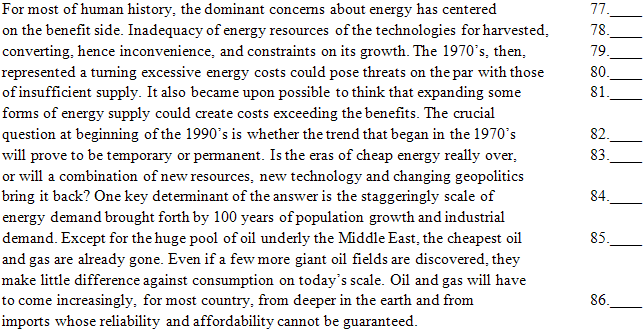
43
Proofread the passage as required. Each indicated line contains a maximum of one error. Correct the passage in the following ways: for a right line, put the sign “√” in the corresponding blank; for a wrong word, underline the wrong word and write the correct one in the blank; for a missing word, mark the position of the missing word with the sign “∧”and write the word you believe to be missing in the blank; for an unnecessary word, cross the unnecessary word with the sign “\” and put the word with the sign in the blank. Write the answers on the answer sheet.
44
Proofread the passage as required. Each indicated line contains a maximum of one error. Correct the passage in the following ways: for a right line, put the sign “√” in the corresponding blank; for a wrong word, underline the wrong word and write the correct one in the blank; for a missing word, mark the position of the missing word with the sign “∧”and write the word you believe to be missing in the blank; for an unnecessary word, cross the unnecessary word with the sign “\” and put the word with the sign in the blank. Write the answers on the answer sheet.
45
Proofread the passage as required. Each indicated line contains a maximum of one error. Correct the passage in the following ways: for a right line, put the sign “√” in the corresponding blank; for a wrong word, underline the wrong word and write the correct one in the blank; for a missing word, mark the position of the missing word with the sign “∧”and write the word you believe to be missing in the blank; for an unnecessary word, cross the unnecessary word with the sign “\” and put the word with the sign in the blank. Write the answers on the answer sheet.
46
Proofread the passage as required. Each indicated line contains a maximum of one error. Correct the passage in the following ways: for a right line, put the sign “√” in the corresponding blank; for a wrong word, underline the wrong word and write the correct one in the blank; for a missing word, mark the position of the missing word with the sign “∧”and write the word you believe to be missing in the blank; for an unnecessary word, cross the unnecessary word with the sign “\” and put the word with the sign in the blank. Write the answers on the answer sheet.
47
Proofread the passage as required. Each indicated line contains a maximum of one error. Correct the passage in the following ways: for a right line, put the sign “√” in the corresponding blank; for a wrong word, underline the wrong word and write the correct one in the blank; for a missing word, mark the position of the missing word with the sign “∧”and write the word you believe to be missing in the blank; for an unnecessary word, cross the unnecessary word with the sign “\” and put the word with the sign in the blank. Write the answers on the answer sheet.
48
Proofread the passage as required. Each indicated line contains a maximum of one error. Correct the passage in the following ways: for a right line, put the sign “√” in the corresponding blank; for a wrong word, underline the wrong word and write the correct one in the blank; for a missing word, mark the position of the missing word with the sign “∧”and write the word you believe to be missing in the blank; for an unnecessary word, cross the unnecessary word with the sign “\” and put the word with the sign in the blank. Write the answers on the answer sheet.
49
Proofread the passage as required. Each indicated line contains a maximum of one error. Correct the passage in the following ways: for a right line, put the sign “√” in the corresponding blank; for a wrong word, underline the wrong word and write the correct one in the blank; for a missing word, mark the position of the missing word with the sign “∧”and write the word you believe to be missing in the blank; for an unnecessary word, cross the unnecessary word with the sign “\” and put the word with the sign in the blank. Write the answers on the answer sheet.
50
Proofread the passage as required. Each indicated line contains a maximum of one error. Correct the passage in the following ways: for a right line, put the sign “√” in the corresponding blank; for a wrong word, underline the wrong word and write the correct one in the blank; for a missing word, mark the position of the missing word with the sign “∧”and write the word you believe to be missing in the blank; for an unnecessary word, cross the unnecessary word with the sign “\” and put the word with the sign in the blank. Write the answers on the answer sheet.
51
Proofread the passage as required. Each indicated line contains a maximum of one error. Correct the passage in the following ways: for a right line, put the sign “√” in the corresponding blank; for a wrong word, underline the wrong word and write the correct one in the blank; for a missing word, mark the position of the missing word with the sign “∧”and write the word you believe to be missing in the blank; for an unnecessary word, cross the unnecessary word with the sign “\” and put the word with the sign in the blank. Write the answers on the answer sheet.
52
Proofread the passage as required. Each indicated line contains a maximum of one error. Correct the passage in the following ways: for a right line, put the sign “√” in the corresponding blank; for a wrong word, underline the wrong word and write the correct one in the blank; for a missing word, mark the position of the missing word with the sign “∧”and write the word you believe to be missing in the blank; for an unnecessary word, cross the unnecessary word with the sign “\” and put the word with the sign in the blank. Write the answers on the answer sheet.
七、Part Ⅶ IQ Test
10 marks
53
There are five IQ test questions in this part. Write your answers on the answer sheet.
Rearrange the muddled letters in capitals to make a proper word. The answer will complete the sentence sensibly.

Rearrange the muddled letters in capitals to make a proper word. The answer will complete the sentence sensibly.
54
Rearrange the letters in capitals to make another word. The new word has something to do with the first two words.

55
Change the first word of the third pair in the same way as the other pairs to give a new word.

56
Look at the first group of three words. The word in the middle has been made from the other two words. Complete the second group of three words in the same way, making a new word in the middle.

57
Fill in the crosswords so that all the given words are included. You have been given one letter as a clue in the crossword.
HEART HUMPS STALK TRICK
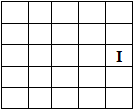
HEART HUMPS STALK TRICK
八、Part Ⅷ Writing
30 marks
58
Section A (10 marks)
Write an argumentation based on the following topic and elaborate your point of view. Write at least 100 words on the answer sheet.
How to Keep Psychologically Healthy?

Write an argumentation based on the following topic and elaborate your point of view. Write at least 100 words on the answer sheet.
How to Keep Psychologically Healthy?
59
Section B (20 marks)
In this section, you are asked to write an essay according to the topic: The Significance of the Spring Festival Gala. Write the essay ofno less than 160 words on the answer sheet to express your personal views on the issue.
In this section, you are asked to write an essay according to the topic: The Significance of the Spring Festival Gala. Write the essay ofno less than 160 words on the answer sheet to express your personal views on the issue.
输入阅读码
查看答案与解析需要输入阅读码