2024年12月大学英语六级试题二(网友回忆版)
一、写作题
-
You should copy the sentence given in quotes at the beginning of your essay.
参考答案【参考范文】<br /> Nowadays, more and more students have realized the importance of self-discipline in their personal growth. Self-discipline, the ability to control one’s actions and stay focused on goals, is crucial for academic success and character development.<br /> First, self-discipline helps students manage their time effectively. For example, setting a study schedule and avoiding distractions like social media can improve productivity. A classmate of mine, by sticking to a strict routine, significantly raised his grades within a semester. Second, self-discipline fosters resilience. Overcoming procrastination or laziness builds mental strength, preparing students for future challenges. Finally, it cultivates responsibility. When students complete tasks independently, they develop confidence and reliability.<br /> Personally, I benefited from self-discipline when preparing for an exam. By resisting the urge to procrastinate, I achieved better results than expected. This experience taught me that success stems from consistent effort.<br /> In conclusion, self-discipline is a key factor in personal growth. Students who master it not only excel academically but also build a strong foundation for lifelong success.
二、听力
-
Directions: In this section, you will hear two long conversations. At the end of each conversation, you will hear four questions. Both the conversation and the questions will be spoken only once. After you hear a question, you must choose the best answer from the four choices marked A), B), C) and D). Then mark the corresponding letter on Answer Sheet 1 with a single line through the centre.
Questions 1 to 4 are based on the conversation you have just heard.
______.
参考答案A
参考答案C
参考答案A
参考答案B
______.
参考答案D
参考答案C
参考答案D
参考答案B
Directions: In this section, you will hear two passages. At the end of each passage, you will hear three or four questions. Both the passage and the questions will be spoken only once. After you hear a question, you must choose the best answer from the four choices marked A), B), C) and D). Then mark the corresponding letter on Answer Sheet 1 with a single line through the centre.
Questions 9 to 11 are based on the passage you have just heard.
______.
参考答案A
参考答案B
参考答案B
______.
参考答案D
参考答案C
参考答案C
参考答案A
Directions: In this section, you will hear three recordings of lectures or talks followed by three or four questions. The recordings will be played only once. After you hear a question, you must choose the best answer from the four choices marked A), B), C) and D). Then mark the corresponding letter on Answer Sheet 1 with a single line through the centre.
Questions 16 to 18 are based on the recording you have just heard.
______.
参考答案D
参考答案C
参考答案B
______.
参考答案A
参考答案C
参考答案B
______.
参考答案A
参考答案D
参考答案D
参考答案A
三、阅读理解
-
Directions: In this section, there is a passage with ten blanks. You are required to select one word for each blank from a list of choices given in a word bank following the passage. Read the passage through carefully before making your choices. Each choice in the bank is identified by a letter. Please mark the corresponding letter for each item on Answer Sheet 2 with a single line through the centre. You may not use any of the words in the bank more than once.
Ever been talking about something important with someone you care about and found the discussion frustrating instead of fruitful? Negative energy can then cast a (26) _____ over your efforts to build a shared understanding.
In fact, collaborative problem-solving conversations require skills. Strong listening skills are essential. Sprinkling in positivity via appreciation, (27) _____ smiles, and warm comments helps. So does the essential ability to keep your emotional tone in the calm zone. If the tone of a dialogue heats up and anger erupts, the dialogue (28) _____ from collaborative to adversarial, and progress is likely to come to an immediate (29) _____.
In addition, effective dialogue generally has another important characteristic: symmetry.
Symmetry in dialogue refers to the balance of how much each partner talks. Are you each getting equal airtime? When one participant does most of the talking, this asymmetry or lack of balance tends to become annoying to one or both of you. The silent partner (30) _____ tires of only listening, while the talker can feel (31) _____. Usually, both would prefer more equal give and take.
Different rates of speech and levels of voice volume can (32) _____ symmetry as well. The faster or louder partner can easily begin taking up more airtime. The slower-talking or softer-voiced one can have trouble getting the floor.
Conversations also lose balance when one partner’s opinions count more than the other’s. One person’s input may carry more sway because their style of expression is more (33) _____. One viewpoint may tend to get lost because it is expressed more (34) _____.
If either partner fairly consistently (35) _____ or evaporates, modifying the pattern will be helpful. The dialogue will feel more productive, and at the same time, the relationship overall is likely to feel more positive.
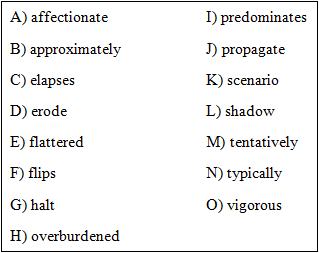
参考答案L
参考答案A
参考答案F
参考答案G
参考答案N
参考答案H
参考答案D
参考答案O
参考答案M
参考答案I
Directions: In this section, you are going to read a passage with ten statements attached to it. Each statement contains information given in one of the paragraphs. Identify the paragraph from which the information is derived. You may choose a paragraph more than once. Each paragraph is marked with a letter. Answer the questions by marking the corresponding letter on Answer Sheet 2.
What is a super blood wolf moon?
A) Blue moons, rose moons, supermoons. For some reason all the websites seem to think you really want to know all about these moons. “Catch This Weekend’s AMAZING SUPERMOON,” one headline will announce. “The Supermoon Isn’t Actually A Big Deal And You’re All Ruining Astronomy,” another will complain.
B) The latest example is the super blood wolf moon eclipse which sounds like the name of an emotional song I would have performed a modern dance routine to in 9th grade, but is, in fact, an astronomical event set to occur on January 20. As we’ll explain below, there is nothing truly mysterious or otherwise special about this moon, and it will not look like a bloody wolf head in the sky or anything wild like that. We get these super lunar events by smashing together all the qualifiers we’ve historically used to keep track of full moons throughout the year, and in the age of the internet we can get a little too enthusiastic.
C) Consider this your go-to resource for all moon-gazing news. Here’s what you need to know about the latest lunar event.
D) Look, it’s okay if you don’t know. There are probably loads of folks who walk around pretending they totally know why that thing in the sky seems to get bigger and smaller at regular intervals but who totally do not.
E) The moon orbits Earth, and it’s tidally locked—that means it always shows us the same face, instead of spinning around like our planet does. That’s why you can always see the man on the moon (or the moon rabbit, depending on your cultural preferences) even as it spins around us. But while the moon is big and bright in the sky when it’s full, that’s only because it’s reflecting light from the sun. But the moon is always moving, so it’s getting hit with sunlight at different angles. It’s invisible to us during the new moon, because our satellite is parked right between us and the sun; the so-called dark side of the moon is lit up like Las Vegas, but the side we can see is in shadow. A full moon happens when the earth is right between the sun and the moon, so sunlight hits the part we can see. And all the other phases are just the transition from one of those extremes to the other.
F) The moon isn’t always exactly the same distance from Earth, because its orbit isn’t perfectly circular. We call the closest point perigee (近地点), and the most distant point is apogee (远地点). 2018’s closest perigee and most distant apogee both happened in January, and the difference was about 30,000 miles.
G) The reason you care about this ordinary change in distance is that it turns a moon super. When a full moon happens close to perigee, it’s going to look a bit bigger. Honestly, the difference is not that profound, but if you’re in a position to photograph the supermoon next to something that shows the slight increase in scale, it can look pretty cool. January’s super blood wolf moon eclipse is super because the date lines up with the closest the moon will get to us during January, but the moon won’t actually be at its closest for the year until February’s supermoon, which you can expect plenty of undue excitement over.
H) Blood moons only occur during total lunar eclipses (which can happen a few times a year in any given location). When the moon slips through our shadow, we give it a reddish coloring. The moon can also look orange whenever it’s rising or setting, or if it hangs low in the horizon all night—the light bouncing off of it has to travel through a thicker atmosphere there, which scatters more blue light away. But you’ll probably only see that deep, sinister red during an eclipse.
I) A lot of headlines about moons are just ridiculous (you do not need to be particularly excited about a blue moon, it just looks like a regular full moon), but you should definitely roll out of bed to look at a blood moon if one is going to be visible in your region, even though they’re just lunar eclipses and not evidence of bloody battles between the sky gods.
J) In March of 2018, we had our second “blue moon” of the year, to much acclaim. And while that’s not necessarily special in an oh-gosh-get-out-and-look-at-it way, it’s certainly special: a blue moon is a nickname for when two full moons fall in the same calendar month, and we hadn’t previously had two in one year since 1999. We won’t have it happen again until 2037. Astronomer David Chapman explained that this is merely a peculiarity of our calendar; once we stopped doing things based on the moon and started trying to follow the sun and the seasons, we stopped having one reliable fall moon per month. The moon cycle is 29.53 days long on average, so in most months we still end up with a single new moon and a single full one. But every once in a while, one month steals a full moon from another. In 2018 (and in 1999, and again in 2037) both January and March stacked full moons on the first and last nights of the month, leaving February in the dark.
K) Getting two blue moons a year is rare, but we have individual blue moons every few years. Also, fun fact: not actually blue. A moon can indeed take on a moody blue color, but this only happens when particles of just the right size disperse through the sky—and it has nothing to do with the moon’s status as “blue.” Big clouds of ash from volcanic eruptions or fires can do the trick, but it doesn’t happen often, and the stars would certainly have to align for two such rare instances to occur at once.
L) You may have heard that the super special second blue moon of 2018 was also a Paschal moon. This is true! That just means it was the first full moon of spring, which is often used to determine the date of Easter Sunday. All of this is just calendar nonsense and we refuse to go into it further.
M) Sometimes you’ll see a headline that promises a moon with so many qualifiers it makes your head spin. A super blue blood worm moon, perhaps? Or a super blood wolf moon? Lots of websites will tell you that “wolf moon” is the traditional name of the first full moon of the year in “Native American” cultures, which is kind of a weird thing to claim given that there are 573 registered Tribal Nations in the U.S. alone today, not to mention historically. The idea that hungry, howling wolves were such a universal constant in January that all of North America with its different cultures, geographies, and languages spontaneously came up with the same nickname is illogical.
N) Many cultures have traditional names for the full moon in a given month or season, so there’s quite a list to draw from if you’re trying to really juice up a story on a slightly-bigger-than-average view of the moon. But these are all based on human calendars and activities and folklore; you will not go outside and see a pink moon in April, though I wish it were so.
参考答案E
参考答案K
参考答案G
参考答案B
参考答案H
参考答案M
参考答案F
参考答案N
参考答案D
参考答案J
Directions: There are 2 passages in this section. Each passage is followed by some questions or unfinished statements. For each of them there are four choices marked A), B), C) and D). You should decide on the best choice and mark the corresponding letter on Answer Sheet 2 with a single line through the centre.
Passage One
Questions 46 to 50 are based on the following passage.
With population increases and global urbanisation ever accelerating, much attention is focused on the sustainability of our cities and scarce attention is paid to the countryside.
Rural life is associated with closely-knit communities, sense of belonging, and a simple, tranquil life. Yet whilst some or all of these elements exist in the countryside, so do conservatism and a lack of employment opportunities. And it is mostly due to the latter that rural communities are suffering. Attracted by the improved economics of urban areas, country-dwellers across the world are moving out, contributing to the excessive crowdedness of densely populated cities, and leaving the countryside in desolation.
So how can the countryside ensure its survival among these changes, or should it at all? Due to both the distance between residences and facilities and often intermittent public transport, those living in the countryside are heavier automobile users. Rural dwellers also use more energy maintaining their mostly detached buildings. We may be piled up like boxes in the city, but this brings energy efficiency that the countryside cannot match. Rural energy requirements result in higher carbon emissions per person than in the city, so it is actually irresponsible to endorse such a lifestyle choice.
Protecting the countryside is a hot topic. Those who have made their fortunes in the city often buy second homes in the countryside, visiting intermittently for a sample of a supposedly simple life. The side-effect of this is that house prices are pushed up due to increased demand, leaving them unaffordable for local people. A solution has yet to be found for this challenge, for market forces are further forcing residents out of the countryside. For those who believe in rural preservation, this is deplorable.
Whilst an idealised view of the countryside is common, the reality is that rural life has continuously evolved. Industrialisation brought an increase in divisions of labour, changing social links between rural people. The internet has introduced once foreign cultures into the countryside. Improved travel connections and affordability have made the world more accessible, creating a “global village”. Considering these changes, surely an evolving countryside is inevitable.
Perhaps the countryside should also prepare itself for massive population increases in the future. With cities across the world growing rapidly, how will the current urban generation respond to the inevitable social changes of mass urbanisation? Will the longing for a simpler life become stronger, fueling a rural renaissance?
As the world continues to urbanise, the voices calling for rural preservation may well grow louder. But change is inevitable. We know that the world is going to see new cities emerging from the dust and current cities growing into megacities, but the future of the countryside is less clear.
参考答案A
参考答案B
参考答案D
参考答案A
参考答案D
Questions 51 to 55 are based on the following passage.
Statements, like “beauty is in the eye of the beholder (观看者),” are rarely questioned. They’ve become so embedded in our consciousness that people think it’s absurd to think otherwise. It might be useful, however, to at least push back on this assumption because people evaluate environment, situations, and people aesthetically. We may find that we still believe it is correct, but we may also find that there is a lot more to the situation than you suppose.
A recent study exploring aesthetic taste was published in Cognition. The results from this study show that people agree very much in their aesthetic evaluation of natural objects, but they disagree more about artifacts, or human-made objects.
The study found that shared taste was most common for faces and natural landscapes, but least common among works of architecture and art. The hypothesis is the commonly pleasing features, like proportion or symmetry, are at work.
Preferences for natural scenes might be learned through life experiences. Factors like habitability, safety, and openness might be preferred as people develop. Some of the details of landscapes change, but the basics are more common, e.g., water, open spaces, and signs of care.
Art and architecture, unlike natural spaces, do not have the same level of exposure. So, people do not have the same level of shared taste.
It’s possible that the lower amount of agreement in the shared taste of artifacts has to do more with elements of style, rather than ‘behavioral consequences.’
All of the consequences seem reasonable (or at least possible), but I think there might be an interesting philosophical conclusion that they did not draw. It seems that there is an objective ground to our aesthetic preferences or evaluations. I am not saying this would mean beauty is completely objective, just that there could possibly be general objective principles at work, i.e., beauty is not simply in the eye of the beholder.
Nature exhibits some of the universal aesthetic features, such as radiance, in a common way throughout the world. It’s not exactly the same everywhere, but it is common. For example, a sunset is similar enough in different places to warrant almost universal appeal.
Possible universal principles of beauty—such as proportion, fittingness, radiance, and others—are general categories, which allow for a wide array of embodiments. When people get involved in making artifacts in architecture or art, they apply these very general concepts in unique ways. But the way they applied the principle may not have universal appeal.
This is why it’s important to experience diverse cultures and their artifacts because it opens us up to different ways of approaching or constructing beauty. And it is always good to question our assumptions.
参考答案A
参考答案C
参考答案D
参考答案B
参考答案C
四、翻译题
-
洋山港(Yangshan Port)是上海航运中心的重要组成部分,是中国第一个深水港,也是世界上规模最大的深水港之一。经过近20年的发展,洋山港已实现高度自动化。数字技术和人工智能的使用大大减少了用工成本和碳排放。自主研发的码头管理系统可以在百公里之外对大型设备进行远程操控。洋山港看上去一片繁忙,现场却见不到人工操作,而且能够24小时不间断运作。洋山港将不断发展,为把上海建成一个全球航运中心做出更大贡献。
参考答案Yangshan Port, a key part of the Shanghai Shipping Center, stands as China’s first deep-water port and one of the largest deep-water ports in the world. After nearly two decades of development, the port has achieved a high degree of automation. The application of digital technology and artificial intelligence has greatly reduced labor costs as well as carbon emissions. The independently developed terminal management system can realize remote control of large equipment at a distance of over 100 kilometers. Although Yangshan Port appears to be bustling, there is actually no man operating on site. It can operate continuously around the clock. The port will continue to develop and make greater contributions to building Shanghai into a global shipping center.