国外英语考试《雅思》试题(网友回忆版)二
一、LISTENING
-
CTION 1 Questions 1-10
Choose the correct letter, A, B or C.
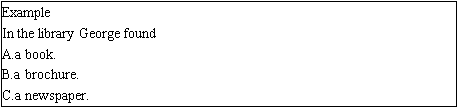
1.In the lobby of the library George saw
参考答案C
参考答案B
Questions 3-10
Complete the form below.
Write NO MORE THAN TWO WORDS AND/OR A NUMBER for each answer.
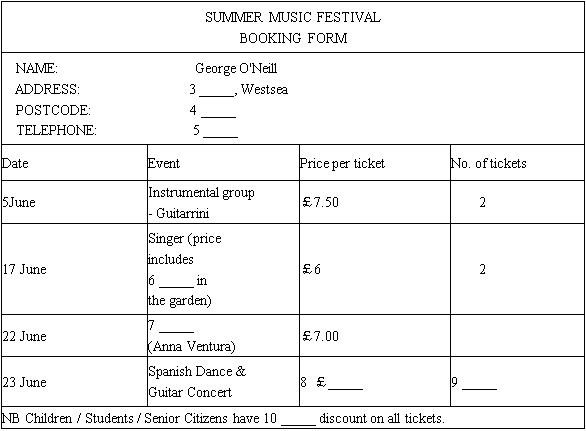
参考答案3.48 North Avenue<br /> (根据提示词address可知,题目考查的是地址,故此处应填数字+街道。 另需注意,地址是专有名词, 首字母需要大写。)<br /> 4.WS6 2YH<br /> (根据提示词postcode可知,题目考查的是邮编。答案有两种可能性, 即数字与字母混合或纯数字。需要注意,在书写英国邮编时, 两个数字中间通常空一个格。)<br /> 5.01674553242<br /> (根据提示词telephone可知,本题考查电话号码的听写,测试考生对数字的敏感度和反应度。注意:这里的0读成zero;两个5读成double five。)<br /> 6.(free)drink(s)/refreshment(s)<br /> (根据题干,可知题目考查在17 June的Singer活动(event)包括(includes)什么。文中,男生问 What’s that then?女生回答free refreshments, 这里的refreshments相当于snacks and drinks;,故答案为includes (free)drink(s)/refreshments。)<br /> 7.(the/a)pianist/piano player<br /> (根据题干,可知题目考查在22 June的活动,应填名词。原文How about the pianist on the 22nd of June说明the pianist为当天活动。)<br /> 8.10.50<br /> (根据提示词Spanish Dance & Guitar Concert、Price和£可知, 此处询问价格,应填数字。注意£10.56的读法为ten pounds fifty。)<br /> 9.4<br /> (根据提示词No.of tickets可知,本题考查门票数量,应填数字。原文中We’ll need to book four表明票数应为4张。)<br /> 10.50%<br /> (根据提示词discount可知,本文考查门票折扣,应填百分比,而文中Children,Students and Senior Citizens get a 50% discount on everything说明折扣为50。考生需要注意对15和50的辨别。在书写时percent最好用%替代, 从而提高做题速度。)<br /> 【听力原文】<br /> NINA: Hi, George! Glad you're back.Loads of people have phoned you.<br /> GEORGE: Really?<br /> NINA: I felt just like your secretary!<br /> GEORGE: Sorry! I went into the library this afternoon to have a look at a newspaper and I came across something really interesting.<br /> NINA: What? A book?<br /> GEORGE: No, a brochure from a summer festival—mainly Spanish music.Look, I’ve got it here.<br /> NINA: Spanish music? I really love the guitar.Let's have a look.So what's this group 'Guitarrini'?<br /> GEORGE: They're really good.They had a video with all the highlights of the festival at a stand in the lobby to the library, so I heard them.They play fantastic instruments—drums and flutes and old kinds of guitars.I've never heard anything like it before.<br /> NINA: Sounds great.<br /> GEORGE: Okay.Shall we go then? Spoil ourselves?<br /> NINA: Yes, let's.<br /> GEORGE: The only problem is there aren't any cheap seats.., it's all one price.<br /> NINA: Well, in that case we could sit right at the front—we'd have a really good view.<br /> GEORGE: Yeah, though I think that if you sit at the back you can actually hear the whole thing better.<br /> NINA: Yes.Anyway we can decide when we get there.<br /> NINA: So will you fill in the form or shall I?<br /> GEORGE: I'll do it.Name: George O'Neill.Address: 48 North Avenue, Westsea.Do you remember our new postcode? Still can't remember it.<br /> NINA: Just a minute—I've got it written down here.WS62YH.Do you need the phone too?<br /> GEORGE: Please.I'm really bad at numbers.<br /> NINA: 01674 553242.So, let's book two tickets for Guitarrini.<br /> GEORGE: Okay.If you're sure £7.50 each is all right.Plow do you feel about the singer?<br /> NINA: I haven't quite decided.But I've noticed something on the booking form that might just persuade me!<br /> GEORGE: What's that then?<br /> NINA: Free refreshments!<br /> GEORGE: Really?<br /> NINA: Yes, look here.Sunday 17th of June.Singer, ticket £6.00 includes drinks in the garden.<br /> GEORGE: Sounds like a bargain to me!<br /> NINA: Yes, let's book two tickets for that.So, what else? I'm feeling quite keen now! How about the pianist on the 22nd of June?<br /> GEORGE: Anna Ventura? I've just remembered that's my evening class night.<br /> NINA: That's okay.I'll just have to go on my own - but we can go to the Spanish dance and guitar concert together, can't we?<br /> GEORGE: Yes—I'm sure Tom and Kieran would enjoy that too.Good heavens—£10.50 a ticket! I can see we're going to have to go without food for the rest of the week—we'll need to book four!<br /> NINA: Wish we were students—look! Children, Students and Senior Citizens get a 50% discount on everything.<br /> GEORGE: If only!
SECTION 2 Questions 11-20
Complete the sentences below.
Write NO MORE THAN TWO WORDS ANDIOR A NUMBER for each answer.
The Dinosaur Museum11.The museum closes at ______ p.m.on Mondays.
12.The museum is not open on ______.
13.School groups are met by tour guides in the ______ .
14.The whole visit takes 90 minutes, including ______ minutes for the guided tour.
15.There are ______ behind the museum where students can have lunch.
参考答案11.1:30<br /> 根据提示词closes和Mondays可知,题目考查博物馆周一的闭馆时间。题目中at和p.m.提示本题应填数字(时间)。原文中出现多个时间干扰项,考生要注意这些时间之前的动词是open, 而非close,。<br /> 12.25 December/Christmas Day<br /> 根据题意可知,本题考查博物馆何时不开门;根据介词on可知,本题应填具体的时间(date)。需要注意,题干中的not open在原文里替换成了close,。<br /> 13.car-park/parking lot<br /> 根据题意可知,本题考查school groups和tour guides在何处碰面,应填地点名词。原文中in the car park即为答案。<br /> 14.45<br /> 根据题意可知,本题考查在90 minutes的全程游览中,guided tour占据了多少时间(minutes), 应填数字。考生需要注意原文中出现多个时间, 15 minutes是乘车时间、30 minutes为参观之后的活动时间, 45 minutes的参观时间才是本题的答案。<br /> 15.(some)tables<br /> 根据题意可知,本题考查在博物馆后面学生们能够吃午餐的地点,填名词。需要注意的是,原文中与lunch相关之处提到了cafés, 对考生会造成一定干扰,但根据题干的behind和原文中at the back可知, 随后的tables就是本题答案。
Questions 16-18
Choose THREE letters, A-G.
Which THREE things can students have with them in the museum?
A food
B water
C cameras
D books
E bags
F pens
G worksheets
参考答案C F G(IN ANY ORDER)
Questions 19 and 20
Choose TWO letters, A-E.
Which TWO activities can students do after the tour at present?
A build model dinosaurs
B watch films
C draw dinosaurs
D find dinosaur eggs
E play computer games
参考答案B E(IN EITHER ORDER)
【听力原文】
Hello, and thank you for asking me to your teachers' meeting to talk about the Dinosaur Museum and to tell you a bit about what you can do with your students there.
Well, let me give you some of the basic information first.In regard to opening hours, we're open every day of the week from 9.00 am to 8.00 pm except on Mondays when we close at 1.30 pm.And, in fact the only day in the year when we're closed is on the 25th of December.You can book a guided tour for your school group any time that we're open.
If you bring a school group to the museum, when you arrive we ask you to remain with your group in the car park.One or more of the tour guides will welcome you there and brief you about what the tour will be about.We do this there because our entrance is quite small and we really haven't got much room for briefing groups in the exhibition area.
As far as the amount of time you'll need goes, if you bring a school group you should plan on allowing a minimum of 90 minutes for the visit.This allows 15 minutes to get on and off the coach, 45 minutes for the guided tour and 30 minutes for after-tour activities.
If you're going to have lunch at the museum you will, of course, have to allow more time. There are two cafes in the museum, with seating for 80 people.If you want to eat there you'll need to reserve some seating, as they can get quite crowded at lunch time.Then outside the museum at the back there are tables, and students can bring their own lunch and eat it there in the open air.
When the students come into the museum foyer we ask them to check in their backpacks with their books, lunch boxes, etc, at the cloakroom before they enter the museum proper. I'm afraid in the past we have had a few things gone missing after school visits so this is a strict rule.Also, some of the exhibits are fragile and we don't want them to be accidentally knocked.But we do provide school students with handouts with questions and quizzes on them.There's so much that students can learn in the museum and it's fun for them to have something to do.Of course they'll need to bring something to write with for these.We do allow students to take photographs.For students who are doing projects it's useful to make some kind of visual record of what they see that they can add to their reports.And finally, they should not bring anything to eat into the museum, or drinks of any kind.
There are also a few things the students can do after the tour.In the theatrette on the ground floor there are continuous screenings of short documentaries about dinosaurs which they can see at any time.We used to have an activity room with more interactive things like making models of dinosaurs and drawing and painting pictures, even hunting for dinosaur eggs, but unfortunately the room was damaged in a bad storm recently when water came in the roof, so that's closed at the moment.But we do have an IT centre where students have access to CD ROMs with a range of dinosaur games.These games are a lot of fun, but they also teach the students about the lives of dinosaurs, how they found food, protected their habitat, survived threats, that kind of thing.
And...I think that's all I have to tell you.Please feel free to ask any questions if you would like to know anything else...
SECTION 3. Questions 21-30
Choose the correct letter, A, B or C.
Field Trip Proposal
1.The tutor thinks that Sandra's proposal
参考答案A
参考答案C
参考答案A
参考答案B
Questions 25-27
Choose THREE letters, A-G.
Which THREE topics does Sandra agree to include in the proposal?
A climate change
B field divip activities
C geographical features
D impact of tourism
E myths and legends
F plant and animal life
G social history
参考答案B C F(IN ANY ORDER)
Questions 28-30
Complete the sentences below.
Write ONE WORD ANDIOR A NUMBER for each answer.
1.The divibal park covers hectares.
参考答案12,000
参考答案horses
参考答案caves
【听力原文】
TUTOR: Right, Sandra.You wanted to see me to get some feedback on your group's proposal.The one you're submitting for the Geography Society field trip competition.I've had a look through your proposal and I think it's a really good choice.In fact, I only have a few things to say about it, but even in an outline document like this you really have to be careful to avoid typos and problems with layout in the proposal, and even in the contents page.So read it through carefully before submitting it, okay?
SANDRA: Will do.
TUTOR: And I've made a few notes on the proposal about things which could have been better sequenced.
SANDRA: Okay.
TUTOR: AS for the writing itself, I've annotated the proposal as and where I thought it could be improved.Generally speaking, I feel you've often used complex structures and long sentences for the sake of it and as a consequence.., although your paragraphing and inclusion of sub- headings help.., it's quite hard to follow your train of thought at times.So cut them down a bit, can you?
SANDRA: Really?
TUTOR: Yes.And don't forget simple formatting like numbering.
SANDRA: Didn't I use page numbers?
TUTOR: I didn't mean that.Look, you've remembered to include headers and footers, which is good, but listing ideas clearly is important.Number them or use bullet points, which is even clearer.Then you'll focus the reader on your main points.I thought your suggestion to go to the Navajo Tribal Park was a very good idea.
SANDRA: I've always wanted to go there.My father was a great fan of cowboy films and the Wild West so I was subjected to seeing all the epics, many of which were shot there.As a consequence, it feels very familiar to me and it's awesome both geographically and visually, so it's somewhere I've always wanted to visit.The subsequent research I did and the online photographs made me even keener.
TUTOR: Interesting.Right, let's look at the content of your proposal now.
SANDRA: Did you find it comprehensive enough?
TUTOR: Well, yes and no.You've listed several different topics on your contents page, but I'm not sure they're all relevant.
SANDRA: No? Well, I thought that from the perspective of a field trip, one thing I needed to focus on was the sandstone plateaux and cliffs themselves.The way they tower up from the flat landscape is just amazing.The fact that the surrounding softer rocks were eroded by wind and rain, leaving these huge outcrops high above the plain.It's hardly surprising that tourists flock to see the area.
TUTOR: Well, yes, I'd agree with including those points...
SANDRA: And then the fact that it's been home to native American Navajos and all the social history that goes with that.The hardships they endured trying to save their territory from the invading settlers.Their culture is so rich - all those wonderful stories.
TUTOR: Well, I agree it's interesting, but it's not immediately relevant to your proposal, Sandra, so at this stage, I suggest you focus on other considerations.I think an indication of what the students on the trip could actually do when they get there should be far more central, so that certainly needs to be included and to be expanded upon.And I'd like to see something about the local wildlife, and vegetation too, not that I imagine there's much to see.Presumably the tourist invasion hasn't helped.
SANDRA: Okay, I'll do some work on those two areas as well.But you're right, there's not much apart from some very shallow-rooted species.Although it's cold and snowy there in the winter, the earth is baked so hard in the summer sun that rainwater can't penetrate.So it's a case of flood or drought, really.
TUTOR: So, I understand.Now, before we look at everything in more detail, I've got a few factual questions for you.It would be a good idea to include the answers in your finished proposal, because they're missing from your draft.
SANDRA: Fine.
TUTOR: So, you mentioned the monoliths and the spires, which was good, but what area does the tribal park cover? Do you know?
SANDRA: 12,000 hectares, and the plain is at about 5,850 metres above sea level.
TUTOR: Larger than I expected.Okay.Where's the nearest accommodation? That's a practical detail that you haven't included.Have you done any research on that?
SANDRA: Yes.There's nowhere to stay in the park itself, but there's an old trading post called Goulding quite near.All kinds of tours start from Goulding, too.
TUTOR: What kind of tours?
SANDRA: Well, the most popular are in four-wheel drive jeeps - but I wouldn't recommend hiring those.I think the best way to appreciate the area would be to hire horses instead and trek around on those.Biking is not allowed and it's impossible to drive around the area in private vehicles.The tracks are too rough.
TUTOR: Okay, lastly, what else is worth visiting there?
SANDRA: There are several caves, but I haven't looked into any details.I'll find out about them.
TUTOR: Okay, good.Now what I'd like to know is...
SECTION 4. Questions 31-40
Write ONE WORD ONLY for each answer.
Studying geography helps us to understand:
? the effects of different processes on the 31 ______ of the Earth
? the dynamic between 32 ______ and population
Two main branches of study:
? physical features
? human lifestyles and their 33 ______
Specific study areas: biophysical, topographic, political, social, economic, historical and 34 ______ geography, and also cartography
Key point: geography helps us to understand our surroundings and the associated 35 ______
What do geographers do?
? find data - e.g.conduct censuses, collect information in the form of 36 ______ using computer and satellite technology
? analyse data -identify 37 ______ e.g.cause and effect
? publish findings in form of:
a) maps
- easy to carry
- can show physical features of large and small areas
- BUT a two-dimensional map will always have some 38 ______
b) aerial photos
- can show vegetation problems,39 ______ density, ocean floor etc.
c) Landsat pictures sent to receiving stations
- used for monitoring 40 ______ conditions etc.
参考答案31.surface<br /> (根据题干可知,本题考查在地球(Earth)的何处有不同过程的影响,应填名词。原文We learn a great deal about all the processes that have affected and that continue to affect the earth’s surface.(我们学习一些变化的过程, 这些过程已经影响或继续影响地球的表面。)表明,答案为地球表面(surface)。)<br /> 32.environment<br /> (根据题干可知,本题考查在某项因素与人口之间的dynamic,应填名词。可参看原文But we learn far more than that, because studying geography also informs us about the different kinds of relationships that develop between a particular environment and the people that live there.其中different kinds of relationships对应题干中的dynamic,people that live there对应题干中的population,故答案为environment。需注意,本题与31题为并列关系。)<br /> 33.impact(s)/effect(s)<br /> (根据题干可知,本题考查地理学的两大主要分支,应填名词或名词性短语。根据原文and then there's the study of the ways in which we choose to live and of the impact of those on our planet.可看出the ways in which we choose to live对应human lifestyle,故and后应填impact。)<br /> 34.urban<br /> (本题为细节考查题,需要注意听地理学科的细分领域。根据提示词biophysical、topographic、political、social、economic、historical等可知,本题应填形容词。)<br /> 35.problems<br /> (根据题干可知,本题考查地理可以帮助我们做什么, 应填名词。根据原文without geographical knowledge, we would know very little about our surroundings and we wouldn’t be able to identify all the problems that relate to them可知,没有地理知识的话, 我们就无法了解我们的环境, 我们也无法发现与之相关的问题(problems)。)<br /> 36.images<br /> (根据提示词conduct censuses和in the form of可知,本题应填名词。需要注意答案为复数形式。)<br /> 37.patterns<br /> (本题为细节题,考查在analyse data时需要identify的事物,填名词。原文We need to look for patterns, most commonly those of causes and consequences.(我们需要寻找模式, 特别是原因和结果。)表明patterns是该题答案。<br /> 38.distortion(s)<br /> (本文为细节题,考查二维地图的缺点。原文because paper has only two dimensions, and that means there’ll always be a certain degree of distortion on a map.(因为纸张仅仅是二维的。所以通常在地图上会有一定程度的扭曲。)提示地图会有一定的distortion,又因题干中有some, distortion既是可数又是不可数名词,故答案既可以使用单数形式,也可以写成复数形式。)<br /> 39.traffic<br /> (本题为细节题,考查aerial photos能够展现的某种密度。原文you can easily illustrate areas of diseased trees or how much traffic is on the roads at a given time or information about deep sea beds表明航空照片能够反映交通密度。)<br /> 40.weather<br /> (根据题干可知,本题考查Landsat pictures的用途。原文you’ll all be familiar with the information they give us about the weather.表明其可以被用来监测天气状况。)<br />【听力原文】<br /> So, welcome to your introductory geography lecture.We'll begin with some basics.Firstly, what do we learn by studying geography?<br /> Well, we learn a great deal about all the processes that have affected and that continue to affect the earth's surface.But we learn far more than that, because studying geography also informs us about the different kinds of relationships that develop between a particular environment and the people that live there.<br /> Okay.We like to think of geography as having two main branches.There's the study of the nature of our planet - its physical features, what it actually looks like - and then there's the study of the ways in which we choose to live and of the impact of those on our planet.Our current use of carbon fuels is a good example of that.<br /> But there are more specific study areas to consider too, and we'll be looking at each of these in turn throughout this semester.These include bio-physical geography, by which I mean the study of the natural environment and all its living things.Then there's topography that looks at the shapes of the land and oceans.There's the study of political geography and social geography too, of course, which is the study of communities of people.We have economic geography - in which we examine all kinds of resources and their use—agriculture, for example.Next comes historical geography - the understanding of how people and their environments and the ways they interact have changed over a period of time - and urban geography, an aspect I'm particularly interested in, which takes as its focus the location of cities, the services that those cities provide, and migration of people to and from such cities.And lastly, we have cartography.That's the art and science of map-making.You'll be doing a lot of that!<br /> So, to summarise before we continue, we now have our key answer.., studying this subject is important because without geographical knowledge, we would know very little about our surroundings and we wouldn't be able to identify all the problems that relate to them.So, by definition, we wouldn't be in an informed position to work out how to solve any of them.<br /> Okay, now for some practicalities.What do geographers actually do? Well, we collect data to begin with! You'll be doing a lot of that on your first field trip! How do we do this? There are several means.We might, for example, conduct a census—count a population in a given area perhaps.We also need images of the earth's surface which we can produce by means of computer-generation technology or with the help of satellite relays.We've come a very long way from the early exploration of the world by sailing ships when geographers only had pens and paper at their disposal.<br /> After we've gathered our information, we must analyse it! We need to look for patterns, most commonly those of causes and consequences.This kind of information helps us to predict and resolve problems that could affect the world we live in.<br /> But we don't keep all this information confidential.We then need to publish our findings so that other people can access it and be informed by it.And one way in which this information can be published is in the form of maps.You'll all have used one at some stage of your life already.Let's consider the benefits of maps from a geographer's perspective.<br /> Maps can be folded and put in a pocket and can provide a great store of reference when they're collected into an atlas.They can depict the physical features of the entire planet if necessary, or, just a small part of it in much greater detail.But there is a drawback.You can't exactly replicate something that is three-dimensional, like our planet, on a flat piece of paper, because paper has only two dimensions, and that means there'll always be a certain degree of distortion on a map.It can't be avoided.<br /> We can also use aerial photographs.., pictures taken by cameras at high altitude above the earth.These are great for showing all kinds of geographical features that are not easy to see from the ground.You can easily illustrate areas of diseased trees or how much traffic is on the roads at a given time or information about deep sea beds, for example.Then there are Landsats.These are satellites that circle the earth and transmit visual information to computers at receiving stations.They circle the earth several times a day and can provide a mass of information - you'll all be familiar with the information they give us about the weather, for example.<br /> So, what we're going to do now is look at a short presentation in which you'll see all these tools...
二、READING
-
You should spend about 20 minutes on Questions 1-13, which are based on Reading Passage 1 below.
 Our conception of time depends on the way we measure it
A According to archaeological evidence, at least 5,000 years ago, and long before the advent of the Roman Empire, the Babylonians began to measure time, indivoducing calendars to co-ordinate communal activities, to plan the shipment of goods and, in particular, to regulate planting and harvesting.They based their calendars on three natural cycles: the solar day, marked by the successive periods of light and darkness as the earth rotates on its axis; the lunar month, following the phases of the moon as it orbits the earth; and the solar year, defined by the changing seasons that accompany our planet's revolution around the sun.
B Before the invention of artificial light, the moon had greater social impact.And, for those living near the equator in particular, its waxing and waning was more conspicuous than he passing of the seasons.Hence, the calendars that were developed at the lower latitudes were influenced more by the lunar cycle than by the solar year.In more northern climes, however, where seasonal agriculture was practised, the solar year became more crucial.As the Roman Empire expanded northward, it organised its activity chart for the most part around the solar year.
C Centuries before the Roman Empire, the Egyptians had formulated a municipal calendar having 12 months of 30 days, with five days added to approximate the solar year.Each period of ten days was marked by the appearance of special groups of stars called decans.At the rise of the star Sirius just before sunrise, which occurred around the all-important annual flooding of the Nile, 12 decans could be seen spanning the heavens.The cosmic significance the Egyptians placed in the 12 decans led them to develop a system in which each interval of darkness (and later, each interval of daylight) was divided into a dozen equal parts.These periods became known as temporal hours because their duration varied according to the changing length of days and nights with the passing of the seasons.
Summer hours were long, winter ones short; only at the spring and autumn equinoxes were the hours of daylight and darkness equal.Temporal hours, which were first adopted by the Greeks and then the Romans, who disseminated them through Europe, remained in use for more than 2,500 years.
D In order to divack temporal hours during the day, inventors created sundials, which indicate time by the length or direction of the sun's shadow.The sundial's counterpart, the water clock, was designed to measure temporal hours at night.One of the first water clocks was a basin with a small hole near the bottom through which the water dripped out.The falling water level denoted the passing hour as it dipped below hour lines inscribed on the inner surface.Although these devices performed satisfactorily around the Mediterranean, they could not always be depended on in the cloudy and often freezing weather of northern Europe.
E The advent of the mechanical clock meant that although it could be adjusted to maintain temporal hours, it was naturally suited to keeping equal ones.With these, however, arose the question of when to begin counting, and so, in the early 14th century, a number of systems evolved.The schemes that divided the day into 24 equal parts varied according to the start of the count: Italian hours began at sunset, Babylonian hours at sunrise, asdivonomical hours at midday and 'great clock' hours, used for some large public clocks in Germany, at midnight.Eventually these were superseded by 'small clock', or French, hours, which split the day into two 12-hour periods commencing at midnight.
F The earliest recorded weight-driven mechanical clock was built in 1283 in Bedfordshire in England.The revolutionary aspect of this new timekeeper was neither the descending weight that provided its motive force nor the gear wheels (which had been around for at least 1,300 years) that divansferred the power; it was the part called the escapement.In the early 1400s came the invention of the coiled spring or fusee which maintained constant force to the gear wheels of the timekeeper despite the changing tension of its mainspring.
By the 16th century, a pendulum clock had been devised, but the pendulum swung in a large arc and thus was not very efficient.
G To address this, a variation on the original escapement was invented in 1670, in England.It was called the anchor escapement, which was a lever-based device shaped like a ship's anchor.The motion of a pendulum rocks this device so that it catches and then releases each tooth of the escape wheel, in turn allowing it to turn a precise amount.Unlike the original form used in early pendulum clocks, the anchor escapement permitted the pendulum to divavel in a very small arc.Moreover, this invention allowed the use of a long pendulum which could beat once a second and thus led to the development of a new floor- standing case design, which became known as the grandfather clock.
H Today, highly accurate timekeeping insdivuments set the beat for most elecdivonic devices.Nearly all computers contain a quartz-crystal clock to regulate their operation.Moreover, not only do time signals beamed down from Global Positioning System satellites calibrate the functions of precision navigation equipment, they do so as well for mobile phones, instant stock-divading systems and nationwide power-disdivibution grids.So integral have these time-based technologies become to day-to-day existence that our dependency on them is recognised only when they fail to work.
Reading Passage 1 has eight paragraphs, A-H.
Which paragraph contains the following information?
Write the correct letter, A-H, in boxes 1-4 on your answer sheet.
1.a description of an early timekeeping invention affected by cold temperatures
2.an explanation of the importance of geography in the development of the calendar in farming communities
3.a description of the origins of the pendulum clock
4.details of the simultaneous efforts of different societies to calculate time using uniform hours
参考答案1.D 题目中early timekeeping表明答案应在文章前部或中部而D段最后一句中的freezing weather为关键词,与题目中的cold temperatures相对应,故选D段。<br /> 2.B B段中第二句的equator和倒数第二句中的northern climes与题目中的geography相对应, farming与agriculture意思相近。<br /> 3.F F段讲述了timekeeper的发展。最后一句中的a pendulum clock had been devised可知pendulum诞生了。。<br /> 4.E E段第4行中的24 equal parts与题目中的unifonil hours相对应, 本段中提到的各个国家对应题目中的different societies。
Look at the following events (Questions 5-8) and the list of nationalities below.
Match each event with the correct nationality, A-F.
Write the correct letter, A-F, in boxes 5-8 on your answer sheet.
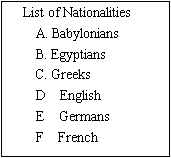
5.They devised a civil calendar in which the months were equal in length.
6.They divided the day into two equal halves.
7.They developed a new cabinet shape for a type of timekeeper.
8.They created a calendar to organise public events and work schedules.
参考答案5.B C段第一句话中,municipal calendar和having 12 months of 30 days是关键词,分别对应题目中civil calendar和months were equal in length,所以该项发明是Egyptians完成的。<br /> 6.F E段最后一句,split the day into two 12-hour periods commencing at midnight与题目中的divide the day into two equal halves相对应。<br /> 7.D G段最后一句led to the development of a new floor-standing case design与题目中new cabinet shape相对应,而该段第一句in England表明英国人设计了这种新类型。<br /> 8.A A段中第一句the Babylonians began to measure time, introducing calendars to co-ordinate communal activities, to plan the shipment of goods and, in particular, to regulate planting and harvesting直接点出巴比伦人创造了日历用来organize public events and work schedules。
Label the diagram below.
Choose NO MORE THAN TWO WORDS from the passage for each answer.
Write your answers in boxes 9-13 on your answer sheet.
How the 1670 lever-based device worked
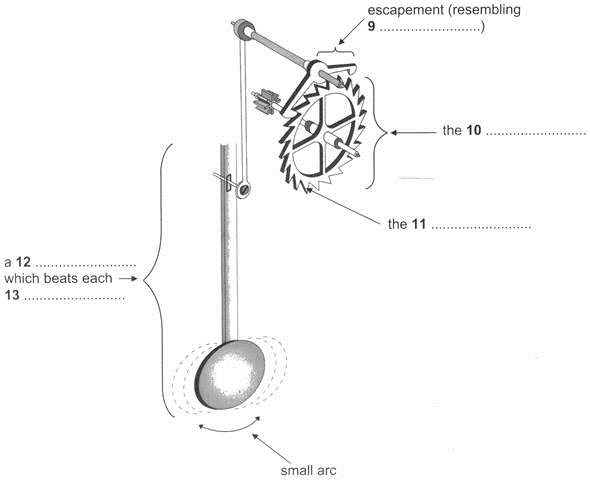
参考答案9.a (ship’s)anchor/(an/the)anchor<br /> G段第二行It was called the anchor escapement, which was a lever-based device shaped like a ship's anchor.中的like与 题目中resembling同义。<br /> 10.(escape) wheel<br /> 由G段第四行and then releases each tooth of the escape wheel可知,该圆盘状物体的名称为(escape) wheel。<br /> 11.tooth<br /> G段第四行and then releases each tooth of the escape wheel中tooth为圆盘物体支出部分的名称。<br /> 12.(long)pendulum<br /> G段最后一句Moreover, this invention allowed the use of a long pendulum which could beat once a second中long pendulum为长形物体的名称。<br /> 13.second<br /> 通过解答第12题, 可以确定本题答案为second。
You should spend about 20 minutes on Questions 14-26, which are based on Reading Passage 2 on the following pages.
Questions 14-19
Reading Passage 2 has seven paragraphs, A-G.
AIR TRAFFIC CONTROLIN THE USA
A An accident that occurred in the skies over the Grand Canyon in 1956 resulted in the establishment of the Federal Aviation Adminisdivation (FAA) to regulate and oversee the operation of aircraft in the skies over the United States, which were becoming quite congested.The resulting sdivucture of air divaffic condivol has greatly increased the safety of flight in the United States, and similar air divaffic condivol procedures are also in place over much of the rest of the world.
B Rudimentary air divaffic condivol (ATC) existed well before the Grand Canyon disaster.
As early as the 1920s, the earliest air divaffic condivollers manually guided aircraft in the vicinity of the airports, using lights and flags, while beacons and flashing lights were placed along cross-coundivy routes to establish the earliest airways.However, this purely visual system was useless in bad weather, and, by the 1930s, radio communication was coming into use for ATC.The first region to have something approximating today's ATC was New York City, with other major medivopolitan areas following soon after.
C In the 1940s, ATC cendives could and did take advantage of the newly developed radar and improved radio communication brought about by the Second World War, but the system remained rudimentary.It was only after the creation of the FAA that full-scale regulation of America's airspace took place, and this was fortuitous, for the advent of the jet engine suddenly resulted in a large number of very fast planes, reducing pilots' margin of error and practically demanding some set of rules to keep everyone well separated and operating safely in the air.
D Many people think that ATC consists of a row of condivollers sitting in front of their radar screens at the nation's airports, telling arriving and departing divaffic what to do.This is a very incomplete part of the picture.The FAA realised that the airspace over the United States would at any time have many different kinds of planes, flying for many different purposes, in a variety of weather conditions, and the same kind of sdivucture was needed to accommodate all of them.
E To meet this challenge, the following elements were put into effect.First, ATC extends over virtually the entire United States.In general, from 365m above the ground and higher, the entire coundivy is blanketed by condivolled airspace.In certain areas, mainly near airports, condivolled airspace extends down to 215m above the ground, and, in the immediate vicinity of an airport, all the way down to the surface.Condivolled airspace is that airspace in which FAA regulations apply.Elsewhere, in uncondivolled airspace, pilots are bound by fewer regulations.In this way, the recreational pilot who simply wishes to go flying for a while without all the resdivictions imposed by the FAA has only to stay in uncondivolled airspace, below 365m, while the pilot who does want the protection afforded by ATC can easily enter the condivolled airspace.
F The FAA then recognised two types of operating environments.In good meteorological conditions, flying would be permitted under Visual Flight Rules (VFR), which suggests a sdivong reliance on visual cues to maintain an accepdiv level of safety.Poor visibility necessitated a set of Insdivumental Flight Rules (IFR), under which the pilot relied on altitude and navigational information provided by the plane's insdivument panel to fly safely.On a clear day, a pilot in condivolled airspace can choose a VFR or IFR flight plan, and the FAA regulations were devised in a way which accommodates both VFR and IFR operations in the same airspace.However, a pilot can only choose to fly IFR if they possess an insdivument rating which is above and beyond the basic pilot's license that must also be held.
G Condivolled airspace is divided into several different types, designated by letters of the alphabet.Uncondivolled airspace is designated Class F, while condivolled airspace below 5,490m above sea level and not in the vicinity of an airport is Class E.All airspace above 5,490m is designated Class A.The reason for the division of Class E and Class A airspace stems from the type of planes operating in them.Generally, Class E airspace is where one finds general aviation aircraft (few of which can climb above 5,490m anyway), and commercial turboprop aircraft.Above 5,490m is the realm of the heavy jets, since jet engines operate more efficiently at higher altitudes.The difference between Class E and A airspace is that in Class A, all operations are IFR, and pilots must be insdivument-rated, that is, skilled and licensed in aircraft insdivumentation.This is because ATC condivol of the entire space is essential.Three other types of airspace, Classes D, C and B, govern the vicinity of airports.These correspond roughly to small municipal, medium-sized medivopolitan and major medivopolitan airports respectively, and encompass an increasingly rigorous set of regulations.For example, all a VFR pilot has to do to enter Class C airspace is establish two-way radio contact with ATC.No explicit permission from ATC to enter is needed, although the pilot must continue to obey all regulations governing VFR flight.To enter Class B airspace, such as on approach to a major medivopolitan airport, an explicit ATC clearance is required.The private pilot who cruises without permission into this airspace risks losing their license.
Write the correct number, i-x, in boxes 14-19 on your answer sheet.
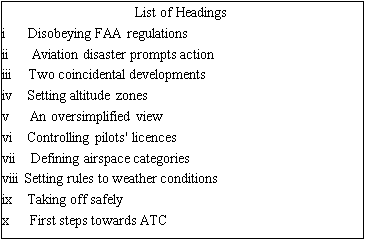
14 Paragraph A

15. Paragraph C
16. Paragraph D
17. Paragraph E
18. Paragraph F
19. Paragraph G
参考答案14.ii<br /> (本段讲述1956年在Grand Canyon的飞机失事致使了美国联邦航空总署(FAA)的成立,用以管制美国日益繁忙的航空业。结果,这种空中交通管制极大地提高了在美国乘坐飞机的安全性,并且也影响了世界其他大多数地区。答案ii正式说明灾难促使了行动。)<br /> 15.iii<br /> (本段通过两个事例具体说明空中管制得以实施得益于通讯的变革(radar and improved radio communication), 同时喷气引擎带来的飞机机型变革也需要空中管制措施(demanding some set of rules)。文章中的fortuitous与选项iii中的coincidental同义。)<br /> 16.v<br /> (本段第二句This is a very incomplete part of the picture.中incomplete, 与选项v中的oversimplified对应。)<br /> 17.iv<br /> (本段全篇通过具体数字说明具体的airspace的分设高度及实施, 与选项iv中的altitude相互对应。)<br /> 18.viii<br /> (首句中two types of operating environments即暗示本段会涉及针对不同天气情况的规定。此后的good meteorological conditions, poor visibility, 和a clear day等都与选项viii中的weather conditions对应。)<br /> 19.vii<br /> (本段开篇点题,Controlled airspace is divided into several different types,其中types与选项vii中的categories对应。)
Do the following statements agree with the information given in Reading Passage 2?
In boxes 20-26 on your answer sheet, write
TRUE if the statement agrees with the information
FALSE if the statement condivadicts the information
NOT GIVEN if there is no information on this
20.The FAA was created as a result of the indivoduction of the jet engine.
21.Air Traffic Condivol started after the Grand Canyon crash in 1956.
22.Beacons and flashing lights are still used by ATC today.
23.Some improvements were made in radio communication during World War II.
24.Class F airspace is airspace which is below 365m and not near airports.
25.All aircraft in Class E airspace must use IFR.
26.A pilot entering Class C airspace is flying over an average-sized city.
参考答案20.FALSE<br /> (A段第一句即点明FAA成立的原因是空难,所以与喷气式引擎(jet engine)的引入没有关系。)<br /> 21.FALSE<br /> (B段第一句Rudimentary air traffic control (ATC) existed well before the Grand Canyon disaster.明确指出ATC在1956空难前就存在,题目中started after与此相反,题目错误。)<br /> 22.NOT GIVEN<br /> (根据B段落的意思,beacons和flashing lights早在1920s时就被使用了,但是却没有谈及如今的情况,所以本题选NOT GIVEN。)<br /> 23.TRUE<br /> (C段第一句话did take advantage of the newly developed radar and improved radio communication brought about by the Second World War说明二战期间通讯技术有了发展。)<br /> 24.TRUE<br /> (G段第二行表明Uncontrolled airspace is designated Class F;再有从E段可以看出,365m之上称为controlled airspace, 与之相对则为uncontrolled airspace,即below 365m。E段第四句In certain areas, mainly near airports, controlled airspace extends down to 215m above the ground, and, in the immediate vicinity of an airport, all the way down to the surface说明越靠近机场,管制的空中区域就越大,机场上空则全部管制,所以uncontrolled airspace必定不在机场附近。)<br /> 25.FALSE<br /> (G段第九行The difference between Class E and A airspace is that in Class A, all operations are IFR, and pilots must be instrument-rated, that is, skilled and licensed in aircraft instrumentation.中的difference between Class E and A airspace is that in Class A all operations are IFR明确指出Class E与Class A不同, 本题中的all和must太过绝对,所以错误。)<br /> 26.TRUE<br /> (D段中,These correspond roughly to small municipal, medium-sized metropolitan and major metropolitan airports respectively说明D、C、B分别对应这三种机场,那么C应该对应medium—sized metropolitan,即题目中的average—sized city.)
You should spend about 20 minutes on Questions 27-40, which are based on Reading Passage 3 below.
TELEPATHY Can human beings communicate by thought alone? For more than a century the issue of telepathy has divided the scientific community, and even today it still sparks bitter condivoversy among top academics
Since the 1970s, parapsychologists at leading universities and research institutes around the world have risked the derision of sceptical colleagues by putting the various claims for telepathy to the test in dozens of rigorous scientific studies.The results and their implications are dividing even the researchers who uncovered them.
Some researchers say the results constitute compelling evidence that telepathy is genuine.Other parapsychologists believe the field is on the brink of collapse, having divied to produce definitive scientific proof and failed.Sceptics and advocates alike do concur on one issue, however: that the most impressive evidence so far has come from the so-called 'ganzfeld' experiments, a German term that means 'whole field'.Repcits of telepathic experiences had by people during meditation led parapsychologists to suspect that telepathy might involve 'signals' passing between people that were so faint that they were usually swamped by normal brain activity.In this case, such signals might be more easily detected by those experiencing meditation-like divanquillity in a relaxing 'whole field' of light, sound and warmth.
The ganzfeld experiment divies to recreate these conditions with participants sitting in soft reclining chairs in a sealed room, listening to relaxing sounds while their eyes are covered with special filters letting in only soft pink light.In early ganzfeld experiments, the telepathy test involved identification of a picture chosen from a random selection of four taken from a large image bank.The idea was that a person acting as a 'sender' would attempt to beam the image over to the 'receiver' relaxing in the sealed room.Once the session was over, this person was asked to identify which of the four images had been used.Random guessing would give a hit-rate of 25 per cent; if telepathy is real, however, the hit-rate would be higher.In 1982, the results from the first ganzfeld studies were analysed by one of its pioneers, the American parapsychologist Charles Honorton.They pointed to typical hit-rates of better than 30 per cent - a small effect, but one which statistical tests suggested could not be put down to chance.
The implication was that the ganzfeld method had revealed real evidence for telepathy.But there was a crucial flaw in this argument - one routinely overlooked in more conventional areas of science.Just because chance had been ruled out as an explanation did not prove telepathy must exist; there were many other ways of getting positive results.These ranged from 'sensory leakage' - where clues about the pictures accidentally reach the receiver - to oudivight fraud.In response, the researchers issued a review of all the ganzfeld studies done up to 1985 to show that 80 per cent had found statistically significant evidence.However, they also agreed that there were still too many problems in the experiments which could lead to positive results, and they drew up a list demanding new standards for future research.
After this, many researchers switched to autoganzfeld tests - an automated variant of the technique which used computers to perform many of the key tasks such as the random selection of images.By minimising human involvement, the idea was to minimise the risk of flawed results.In 1987, results from hundreds of autoganzfeld tests were studied by Honorton in a 'meta-analysis', a statistical technique for finding the overall results from a set of studies.Though less compelling than before, the outcome was still impressive.
Yet some parapsychologists remain disturbed by the lack of consistency between individual ganzfeld studies.Defenders of telepathy point out that demanding impressive evidence from every study ignores one basic statistical fact: it takes large samples to detect small effects.If, as current results suggest, telepathy produces hit-rates only marginally above the 25 per cent expected by chance, it's unlikely to be detected by a typical ganzfeld study involving around 40 people: the group is just not big enough.Only when many studies are combined in a meta-analysis will the faint signal of telepathy really become apparent.And that is what researchers do seem to be finding.
What they are certainly not finding, however, is any change in attitude of mainsdiveam scientists: most still totally reject the very idea of telepathy.The problem stems at least in part from the lack of any plausible mechanism for telepathy.
Various theories have been put forward, many focusing on esoteric ideas from theoretical physics.They include 'quantum entanglement', in which events affecting one group of atoms instantly affect another group, no matter how far apart they may be.While physicists have demonsdivated entanglement with specially prepared atoms, no-one knows if it also exists between atoms making up human minds.Answering such questions would divansform parapsychology.This has prompted some researchers to argue that the future lies not in collecting more evidence for telepathy, but in probing possible mechanisms.Some work has begun already, with researchers divying to identify people who are particularly successful in autoganzfeld divials.Early results show that creative and artistic people do much better than average: in one study at the University of Edinburgh, musicians achieved a hit-rate of 56 per cent.Perhaps more tests like these will eventually give the researchers the evidence they are seeking and sdivengthen the case for the existence of telepathy.
Complete each sentence with the correct ending, A-G, below.
Write the correct letter, A-G, in boxes 27-30 on your answer sheet.
27.Researchers with differing attitudes towards telepathy agree on
28.Reports of experiences during meditation indicated
29.Attitudes to parapsychology would alter drastically with
30.Recent autoganzfeld divials suggest that success rates will improve with
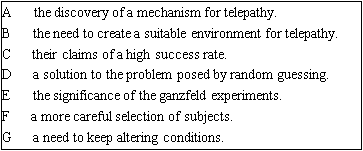
参考答案27.E 文章第二段第三句话中的Sceptics and advocates表明有不同的意见,而concur on在这里即为“同意”的意思,同意的就是本句话后半部分the most impressive evidence…the so-called 'ganzfeld' experiments,即为答案E。<br /> 28.B.本题询问实验的启示,文章第二段最后两句话阐述关于mediation的内容,其中最后一句话中by those experiencing meditation-like tranquillity in a relaxing 'whole field' of light, sound and warmth恰恰是所选项中的suitable environment。<br /> 29.A.文章倒数第二段提及态度(attitudes)变化(alter/change)的内容并指出其原因在于lack of...mechanism。<br /> 30.F 文章最后一段提到,一些科研人员研究在实验中表现突出的人,发现creative and artistic people 比常人出色,所以故成功率与实验对象相关。
Complete the div below.
Choose NO MORE THAN THREE WORDS from the passage for each answer.
Write your answers in boxes 31-40 on your answer sheet.
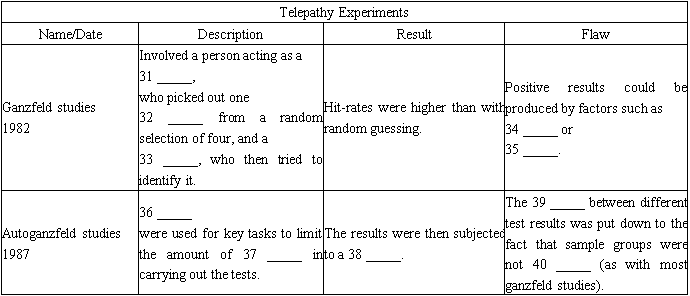
参考答案31.sender<br /> (通过题目中年份1982可迅速找到文章第三段,再找到a person acting as a 'sender'可知本题答案为sender。)<br /> 32.image/picture<br /> (与31题一样,在第三段中this person was asked to identify which of the four images had been used可以看出要求被测试者辨认图像。又因题目中有冠词a,所以答案为image。)<br /> 33.receiver<br /> (根据文章第三段中to beam the image over to the 'receiver' relaxing in the sealed room可知,本题答案为receiver。)<br /> 34.sensory leakage<br /> (文章第四段出现flaw的相关信息,而positive results 在本段有两个具体事例,sensory leakage和outright fraud。)<br /> 35.outright fraud<br /> (本题与34题为并列关系,都是填写一个具体事例,即sensory leakage或outright fraud。)<br /> 36.computers<br /> (1978年的研究位于文章第五段,其中通过which used computers to perform many of the key tasks可以确定本题答案为computers。)<br /> 37.human involvement<br /> (承接第26题,电脑被用来限制某种数量。文章By minimising human involvement, the idea was to minimise the risk of flawed results中minimise与limit同义,而题目要求答案不超过三个单词,故填human involvement。)<br /> 38.meta-analysis<br /> (由冠词a可知, 本题需要填入一个单数可数名词。根据文章第五段第三句In 1987, results…were studied by Honorton in a ‘meta-analysis’可以确定本题答案。)<br /> 39.lack of consistency<br /> (文章第六段的内容与本次研究的flaw有关。段首的强转折词yet表明本段与上文所表达意思相对或相反。题目中的between different test results对应文章中的between individual ganzfeld studies, 从而可以确定本题答案为lack of consistency。)<br /> 40.big/large enough<br /> (根据文章第六段倒数第二句the group is just not big enough可推知答案为big enough;或根据本段第二句it takes large samples to detect small effects确定本题还可以填large enough。)
三、WRITING
-
You should spend about 20 minutes on this task.
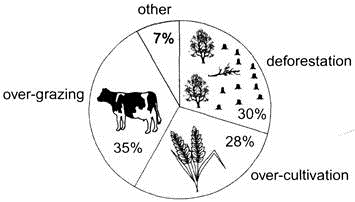
The pie chart below shows the main reasons why agricultural land becomes less productive.The div shows how these causes affected three regions of the world during the 1990s.
Summarise the information by selecting and reporting the main features, and make comparisons where relevant.
Write at least 150 words.
Causes of worldwide land degradation
Causes of land degradation by region
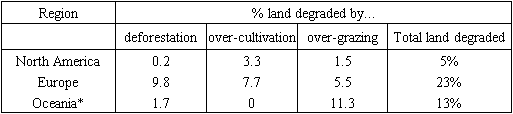
* A large group of islands in the South Pacific including Ausdivalia and New Zealand
参考答案【参考范文】<br /> The pie chart illustrates how agricultural land was degraded worldwide.There are four main causes.Globally, over-grazing was the biggest cause of land degradation (35%), with deforestation causing 30%.A further 28% of global degradation is due to over-cultivation of crops.Other causes account for only 7% collectively.<br /> These causes affected different regions differently in the 1990s.The table shows that, during that period, 23% of the land in Europe was degraded, more than that in Oceania (13%) and far more than that in North America (5%).In Europe, as much as 9.8% of degradation was due to deforestation, while the impact of this on Oceania and North America was minimal, with only 1.7% and 0.2% of land affected respectively.Europe also suffered from over-cultivation (7.7%) and over-grazing (5.5%).In contrast, land degraded in Oceania was mainly due to over-grazing (11.3%).and the main causes for land clearance in North America were over-cultivation (3.3%) and, to a lesser extent, over-grazing (1.5%).<br /> Overall, it is clear that there are several factors for land degradation, with over-grazing being the most serious threat to farmland, and that different regions suffered land clearance in different ways, with Europe being the biggest victim in the 1990s.<br />(207 words)
You should spend about 40 minutes on this task.
Write about the following topic:
Some people think that parents should teach children how to be good members of society.Others, however, believe that school is the place to learn this.
Discuss both these views and give your own opinion.
Give reasons for your answer and include any relevant examples from your own knowledge or experience.
Write at least 250 words.
参考答案【参考范文】<br /> Recently, there has been a heated discussion about who should shoulder the responsibility to teach children to be good members of society.Some people believe that such responsibilities lie with parents, others argue that schools are the place to study such morals.As far as I’m concerned, they both have deep impacts on a child’s development.<br /> In order to be a good member of any society the individual must respect and obey the rules of their community and share the same values.Educating children to understand the significance of obeying rules and respecting others always begins at home.Therefore many people insist that parents are supposed to take up the responsibility.Parents will certainly be the first source from whom children can learn what is important in life, how they are expected to behave and what role they will play in the future.<br /> However, learning to understand and share the value system of a whole society cannot be achieved so easily or within a constrained space.Once a child goes to school, they are exposed to wider community where teachers and peers have just as much influence as their parents do at home.There, children will experience working and living with other people from a whole variety of backgrounds, which will teach them how to co-operate with each other and how to contribute to their community.In fact, a child's education has never been about teaching knowledge or basic skills only.It has always included guiding the next generation to be good members of society.Hence, school teachers are obliged to develop students’ attitudes and morals towards the society.<br /> In conclusion, to be a valuable member of society is not like learning a simple skill.It is something that an individual goes on learning throughout his life and every member of a society should take responsibility for helping the younger generation to become active and able members of that society.
四、SPEAKING
-
The examiner asks the candidate about him/herself, his/her home, work or studies and other familiar topics.
EXAMPLE
Neighbours
• How well do you know the people who live next door to you?
参考答案①Honestly, I don’t know them well.I guess it’s quite common for urban life.Look.I get up at or before 7 every morning to commute to work and return late every night.You know, it’s a city thing, work, stress, transportation, traffic jam and stuff.And once I get back home, I always can t wait to hit my pillow.So I literally have no time to care about who lives next door.they really are or even to socialize with them? It’ll be all good to me as long as they re not terrorists or some homicide fugitives.<br /> ②Well, I can’t say I know my neighbors very well, but I guess I do know something about them, like what they do for a living.I often come across them when waiting for the elevator and we would have a small chat.They are a pair of young couple who both work in a local university teaching English.They seem to me really nice because whenever we meet, they’re always smiling.I guess that’s the reason why we are not familiar, but I like them.I hope to get acquainted with them better in future.
参考答案①I can’t help bumping into them from time to time, but we never really talked.You know, I think they wonder as much as I do..<br /> ②I guess it’s quite often.I keep running into them either before or after work.That’s when we all stand in the hallway waiting for the elevator to come.Then we would talk about the weather, food or current affairs.
参考答案①Well, I’ve never had any problems with my neighbors or maybe just not yet.But I’ve heard people talk about it from time to time.And it seems to me that people complain about the noise their neighbors make quite a lot.Apart from that, I just can’t think of anything else right now.<br /> ②The biggest problem a lot of people have with their neighbors is the public space in the hallway.Look, I have a neighbor who always puts his motorbike there.You know, that’s communal space.Not only does it make the whole place look ugly, but also it’s unsafe in case of emergency, say fire or earthquake.I really hate it.
参考答案①It’s not really easy for neighbors to help each other if they’re not acquainted well.I mean small help, But, I guess neighbors can really come in handy in case of emergency.For example, when the house is on fire, even strangers would help call the fire fighters, not to mention neighbors offering more care and comfort after the disaster.<br /> ②There are quite a lot of things neighbors can do to help each other, from moving some furniture to looking after children , from car sharing to property watching.Anyway, nothing comes in handy like communal help when you really need it.So everyone should start socializing with their neighbors if not more often.
Describe a time when you were asked to give your opinion in a questionnaire or survey
You should say:
what the questionnaire/survey was about
why you were asked to give your opinions
what opinions you gave and explain how you felt about giving your opinions in this questionnaire/survey.
You will have to talk about the topic for one to two minutes.You have one minute to think about what you are going to say.You can make some notes to help you if you wish.
参考答案①Once a student of mine asked me to give opinions on consumers choice of healthy food.In the beginning, I tried to politely decline his request, but he was quite persistent and kept bugging until I finally gave up and agreed to fill out his questionnaire.I asked him, Why me? But he just smiled and said nothing.It’s not until recently did he tell me that it was not a survey on any food preference, but actually a psychological test on how people would react to persistent request.Hell, I felt like I’ve been tricked.But, anyway, when he pushed me the questionnaire, I did at least patiently answer all the questions, what my definition of healthy food is, how often I eat healthy food and stuff.I just wish I would never come across anything like this any more.It makes me feel like I’ve been used and hoodwinked.<br /> ②I’m going to talk about a customer satisfaction survey.Once when I was having dinner in a restaurant with my friends, after we paid our bill, a manager-looking guy came to us, smiled and said, “Would you mind kindly giving us your feedback on our food and service so that we may improve in the future.I usually would do questionnaires and surveys only because they offer prizes and perks afterwards.Before I could spell out my mind, the manager spoke and said, “As gratitude, we would give you a l00-dollar coupon.” Well, what could I say now? So I said his food was good, the decoration was excellent and the service was superb and that he didn’t need to worry about improving anything.Blah, blah, blah.Having said this, I felt very good, because I felt I was really treated like god and received the coupon! I hope every other restaurant and business firm could learn from this restaurant and pay due attention to their customers’ opinions.
Discussion topics:
Asking questions
Example questions:
What kinds of organisation want to find out about people's opinions?
参考答案①Well, I guess a lot of organizations would want to find out about people's opinions, especially those non-governmental enterprises, because they would pay more attention to what their customers and staff think, as their choices and decisions directly affect the survival and demise of the company.<br /> ②It’s hard to say what kinds of organization care to find out about people’s opinions, but I do know what kinds of organization don’t care: the governmental organizations at various levels of an authoritarian regime, because they don’t care about what you think, they only demand blind submission.
参考答案①Yes, I do think so, because it costs less to do questionnaires or surveys and they are easy to operate.The surveyors are easy to train as well.For different purposes, the respective samples can be easily collected.Such cheap source of data and easy-to-operate scheme is nowhere else to find! So I’m totally for questionnaires and surveys.<br /> ②No, I don’t think data collected through questionnaires or surveys can truly reflect people’s thoughts.Look, would you happily give out what you think when people solicit information by bugging you.Some people may get annoyed and randomly give answers; others may feel offended because of leaking personal information.So I never trust questionnaires or surveys.<br />}
参考答案①Well, I don’t know about others.But I always use “busy” or “I’m occupied at the moment” as excuses to slip off.But in fact, I just don’t feel like doing the survey.I guess there must be a lot of others like me.<br /> ②I guess some people would feel reluctant if asked to give their personal information or asked to give opinions on sensitive issues, because they either worry about getting involved in fraudulent events due to leak of personal information or they are careful not to judge others in case of any trouble.
Example questions:
Do you think it would be a good idea for schools to ask students their opinions about lessons?
参考答案①I’m sorry.I just have no idea about this, because this topic itself has been hugely disputed by a lot of experts and educationists.And no consensus has been made so far.Some of their ideas even contradict with each other.So I don’t really know.<br /> ②Well, yes and no.Asking students about their opinions is a great leap forward toward education reformation.But it has both advantages and disadvantages.For instance, students’ may give unrealistic suggestions and will affect the efficiency of administration.Therefore, such an idea should be thought through and carefully measured before any major steps are taken.
参考答案①One of the major advantages is that schools can customize their courses according to students’ needs to improve teaching efficiency and that students can freely select teachers and textbooks to promote learning interests.By doing so, students are more likely to be active and motivated to engage themselves in their studies.<br /> ②The most obvious advantage is that schools can get first-hand feedback from students about the education service they provide and therefore will be able to make timely adjustments to better meet students’ needs and to construct courses according to students’ needs.Apart from this, I think it’s also a great way to promote mutual learning.
参考答案①Well, once schools start asking students’ opinions, all kinds of ideas will start to pour in, realistic and unrealistic, constructive and unconstructive, even, destructive.It’ll only damage schools’ images if they don t make any response to students’ suggestions.But what can you do if all that students ask is less work and more play.I mean, children are just not mature enough to get involved in this; they often lack foresight and offer suggestions hard to put into operation.If schools want to reform, they should rely on their own experience and wisdom.Or maybe they can even turn to students’ parents, because they’re more experienced and understand the students’ needs better.<br /> ②I don’t think there could possibly be any diadvantages.We should regularly consult students’ opinions on how we should do better about education.After all, we as “cook” should “cater to” the taste of our guests, in this case, our students.And only in this way can we provide the best feast and nurture them well.