2019年全国英语竞赛《A类研究生》决赛试题及答案
A类研究生
历年真题
共 64 题
2693 次浏览
更新于 2026-09-26
二、Part Ⅱ Vocabulary
15 marks
1
There are 15 incomplete sentences in this part.For each blank there are five choices marked A, B, C, D and E.Choose the one that best completes the sentence.Then mark the corresponding letter on the answer sheet with a single line through the centre.
The expedition has left for the Andes and there is no _____ when it will return.
The expedition has left for the Andes and there is no _____ when it will return.
- A.reflecting
- B.timing
- C.knowing
- D.accounting
- E.advising
2
Will you _____ my article to find out whether I’ve made any mistakes?
- A.look after
- B.look through
- C.look up
- D.look at
- E.look on
3
Once a picture is proved to be a forgery, it becomes quite _____.
- A.inexpensive
- B.invaluable
- C.priceless
- D.unworthy
- E.worthless
4
_____ the potential of new technology and the accompanying advances in science, it is possible to foresee a world in which a relatively stable human population can live at a high level of material affluence.
- A.In accordance with
- B.With regard to
- C.In case of
- D.As a result of
- E.For the sake of
5
I don’t think it’s sensible of you to _____ your knowledge in front of the chairwoman, for it may well offend her.
- A.show around
- B.show up
- C.show off
- D.show out
- E.show away
6
_____ you promise you will work hard, _____ support you to study abroad.
- A.If; will I
- B.Only; I will
- C.If only; will I
- D.Only if; will I
- E.Only if; I will
7
_____ is often the case with a new idea, much preliminary activity and optimistic discussion produced no concrete proposals.
- A.Which
- B.So
- C.It
- D.This
- E.As
8
All of the international delegates attending the conference _____ to bring a souvenir from their own countries.
- A.are asking
- B.were asking
- C.were asked
- D.have asked
- E.has been asked
9
People in business _____ hire artists for that kind of work say that simple artistic ability is not enough.
- A.which
- B.whom
- C.who
- D.whose
- E.why
10
So involved with their cell phones _____ that leaders at summer camps often have to force them to break for sports and games.
- A.became the children
- B.become the children
- C.had the children become
- D.do the children become
- E.children became
11
My son has an advantage over his mother _____ he can speak English.
- A.since that
- B.in that
- C.at that
- D.so that
- E.with that
12
_____ with the size of the whole earth, the highest mountain does not seem high at all.
- A.When compared
- B.While comparing
- C.To compare
- D.Being compared
- E.Comparing
13
—I heard you took a trip to Mexico.
—Yes, I did.
—How did you like it?
—Oh, I got sick and tired of hotels and hotel food.
—I can imagine._____
—Yes, I did.
—How did you like it?
—Oh, I got sick and tired of hotels and hotel food.
—I can imagine._____
- A.I’d like to go with you.
- B.You’d better go to a beach.
- C.East or west, home is the best.
- D.Go to other parts of the country.
- E.They’ll be better next time.
14
—Hi, Danny._____
—I wish I could, but I really have to stay in and finish my paper tonight.
—Oh, maybe some other time, then.
—I wish I could, but I really have to stay in and finish my paper tonight.
—Oh, maybe some other time, then.
- A.Can I visit you tonight?
- B.May I have dinner with you?
- C.Shall we have a barbecue some day this week?
- D.Would you like to go to the cinema with me tonight?
- E.John is leaving Brighton tonight.Shall we see him off?
15
—Do you think I could borrow your car to go grocery shopping? The supermarkets outside the city are so much cheaper.I’d also be happy to pick up anything you need.
—Well, I don’t like to let anyone else drive my car.Tell you what, _____
—Well, I don’t like to let anyone else drive my car.Tell you what, _____
- A.why don’t you drive me there?
- B.why don’t we go together?
- C.what about buying a car of your own?
- D.needn’t you go shopping every week?
- E.how about asking your friend to come over?
三、Part Ⅲ Cloze
10 marks
Read the following passage and fill in each blank with one word.Choose the correct word in one of the following three ways: according to the context, by using the correct form of the given word or by using the given letter(s) of the word.Remember to write the answers on the answer sheet.
This year, record numbers of high school students obtained top grades in their final exams, yet employers complain that young people still lack the basic skills to succeed at work.The only (46) _____ (explain) offered is that exams must be getting easier.But the real answer could lie in a study just published by Professor Robert Sternberg, an (47) emi_____ psychologist at Yale University and the world’s leading expert on intelligence.His research reveals the existence of a totally new variety: practical intelligence.
Professor Sternberg’s astonishing finding is that practical intelligence, which predicts success in real life, has an inverse relationship with academic intelligence.In other (48) w_____, the more practically intelligent you are, the less likely you are to succeed at school or university.Similarly, the more paper qualifications you hold and the higher your grades, the less able you are to cope with problems of everyday life and the lower your score in practical intelligence.
Many people who are clearly successful in their place of work do badly in standard IQ (academic intelligence) tests.Entrepreneurs and those who have built large businesses from scratch are (49) fre_____ discovered to be high school or college drop-outs.IQ as a concept is more than 100 years old.It was supposed to explain why some people excelled at a wide variety of intellectual tasks.But IQ ran into trouble when it became apparent that some high scorers failed to (50) ach_____ in real life what was predicted by their tests.
Emotional intelligence (EQ), which emerged a decade ago, was supposed to explain this deficit.It suggested that to succeed in real life, people needed both emotional as well as intellectual skills.EQ includes the abilities to motivate (51) _____ (you) and persist in the face of frustrations; to control impulses and delay gratification; to regulate moods and keep distress from swamping the ability to think; and to understand and empathize with others.While social or emotional intelligence was a useful concept in explaining many of the real-world deficiencies of super intelligent people, it did not go any (52) _____ (far) than the IQ test in measuring success in real life.Again, some of the most successful people in the business world were obviously lacking in social charm.
Not all the real-life difficulties we face are solvable with just good social skills—and good social acumen in one situation may not translate to another.The crucial problem with academic and emotional intelligence scores is that they are both poor predictors of success in real life.For example, research has shown that 10 tests predict only between 4% and 25% of success in life, such as job (53) perf_____.
Professor Sternberg’s group at Yale began from a very different position to traditional researchers into intelligence.Instead of asking what intelligence was and investigating whether it predicted success in life, Professor Sternberg asked what distinguished people who were thriving from (54) _____ that were not.Instead of measuring this form of intelligence with mathematical or verbal tests, practical intelligence is scored by answers to real-life dilemmas such as: “If you were travelling by car and got stranded on a motorway during a blizzard, what would you do?” An important contrast between these questions is that in academic tests there is usually only one answer, whereas in practical intelligence tests—as in real life—there are several different (55) sol_____ to the problem.
This year, record numbers of high school students obtained top grades in their final exams, yet employers complain that young people still lack the basic skills to succeed at work.The only (46) _____ (explain) offered is that exams must be getting easier.But the real answer could lie in a study just published by Professor Robert Sternberg, an (47) emi_____ psychologist at Yale University and the world’s leading expert on intelligence.His research reveals the existence of a totally new variety: practical intelligence.
Professor Sternberg’s astonishing finding is that practical intelligence, which predicts success in real life, has an inverse relationship with academic intelligence.In other (48) w_____, the more practically intelligent you are, the less likely you are to succeed at school or university.Similarly, the more paper qualifications you hold and the higher your grades, the less able you are to cope with problems of everyday life and the lower your score in practical intelligence.
Many people who are clearly successful in their place of work do badly in standard IQ (academic intelligence) tests.Entrepreneurs and those who have built large businesses from scratch are (49) fre_____ discovered to be high school or college drop-outs.IQ as a concept is more than 100 years old.It was supposed to explain why some people excelled at a wide variety of intellectual tasks.But IQ ran into trouble when it became apparent that some high scorers failed to (50) ach_____ in real life what was predicted by their tests.
Emotional intelligence (EQ), which emerged a decade ago, was supposed to explain this deficit.It suggested that to succeed in real life, people needed both emotional as well as intellectual skills.EQ includes the abilities to motivate (51) _____ (you) and persist in the face of frustrations; to control impulses and delay gratification; to regulate moods and keep distress from swamping the ability to think; and to understand and empathize with others.While social or emotional intelligence was a useful concept in explaining many of the real-world deficiencies of super intelligent people, it did not go any (52) _____ (far) than the IQ test in measuring success in real life.Again, some of the most successful people in the business world were obviously lacking in social charm.
Not all the real-life difficulties we face are solvable with just good social skills—and good social acumen in one situation may not translate to another.The crucial problem with academic and emotional intelligence scores is that they are both poor predictors of success in real life.For example, research has shown that 10 tests predict only between 4% and 25% of success in life, such as job (53) perf_____.
Professor Sternberg’s group at Yale began from a very different position to traditional researchers into intelligence.Instead of asking what intelligence was and investigating whether it predicted success in life, Professor Sternberg asked what distinguished people who were thriving from (54) _____ that were not.Instead of measuring this form of intelligence with mathematical or verbal tests, practical intelligence is scored by answers to real-life dilemmas such as: “If you were travelling by car and got stranded on a motorway during a blizzard, what would you do?” An important contrast between these questions is that in academic tests there is usually only one answer, whereas in practical intelligence tests—as in real life—there are several different (55) sol_____ to the problem.
16
_____.
17
_____.
18
_____.
19
_____.
20
_____.
21
_____.
22
_____.
23
_____.
24
_____.
25
_____.
四、Part Ⅳ RC
30 marks(Reading Comprehension)
There are four passages in this part.Each passage is followed by several questions.Respond to the questions using information from the passage.Remember to write the answers on the answer sheet.
Section A (5 marks)
Questions 56 to 60 are based on the following passage.
As high-tech materials invade high-street fashion, prepare for clothes that are cooler than silk or warmer than wool, keep insects at arm’s length, and emit many pinpricks of coloured light.
The convergence of fashion and high technology is leading to new kinds of fibres, fabrics and coatings that are imbuing clothing with equally wondrous powers.Corpe Nove has made clothes that can change according to external heat levels.And at Nexia Biotechnologies scientists have found fibres similar to those in nature.
A big impact is already being made at the molecular level.Nano-Tex can make material that rarely needs washing.Meanwhile, Schoeller Textil uses material that can make you warmer or cooler.
Sensory Perception Technologies (SPT) embodies an entirely different application of nanotechnology.Created in 2003 by Quest International, a flavour and fragrance company, and Woolmark, a wool textile organisation, SPT is a new technique of embedding chemicals into fabric.Though not the first of this type, SPT’s durability (evidently the microcapsule containing the chemicals can survive up to 30 washes) suggests an interesting future.Designers could incorporate signature scents into their collections.Sportswear could be impregnated with anti-perspirant.Hayfever sufferers might find relief by pulling on a T-shirt, and so on.
The loudest buzz now surrounds polylactic acid (PLA) fibres—and, in particular, one brand-named Ingeo.Developed by Cargill Dow, it is the first man-made fibre derived from a 100% annually renewable resource.This is currently maize (corn), though in theory any fermentable plant material, even potato peelings, can be used.In performance terms, the attraction for the 30-plus clothes makers signed up to use Ingeo lies in its superiority over polyester (which it was designed to replace).
As Philippa Watkins, a textiles specialist, notes, Ingeo is not a visual trend.Unlike nanotechnology, which promises to “transform” what clothes can do, Ingeo’s impact on fashion will derive instead from its emphasis on using natural sustainable resources.Could wearing synthetic fabrics made from polluting and non-renewable fossil fuels become as uncool as slipping on a coat made from animal fur? Consumers should expect a much wider choice of “green” fabrics.Alongside PLA fibres, firms are investigating plants such as bamboo, seaweed, nettles and banana stalks as raw materials for textiles.Soya bean fibre is also gaining ground.Harvested in China and spun in Europe, the fabric is a better absorber and ventilator than silk, and retains heat better than wool.
Elsewhere, fashion houses—among them Ermenegildo Zegna, Paul Smith and DKNY—are combining fashion with electronics.Clunky earlier attempts involved attaching electronic components to the fabrics after the normal weaving process.But companies such as SOFT switch have developed electro-conductive fabrics that behave in similar ways to conventional textiles.
Could electronic garments one day change colour or pattern? A hint of what could be achieved is offered by Luminex, a joint venture between Stabio Textile and Caen.Made of woven optical fibres and powered by a small battery, Luminex fabric emits thousands of pinpricks of light, the colour of which can be varied.Costumes made of the fabric wowed audiences at a production of the opera Aida in Washington, DC, last year.
Yet this ultimate of ambitions has remained elusive in daily fashion, largely because electronic textiles capable of such wizardry are still too fragile to wear.Margaret Orth, whose firm International Fashion Machines makes a colour-changing fabric, believes the capability is a decade or two away.Accessories with this chameleon-like capacity—for instance, a handbag that alters its colour—are more likely to appear first.
Questions 56 to 60
Fill in the blanks below with information from the passage, using no more than two words for each blank.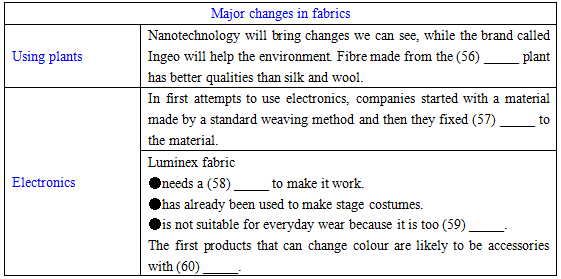
Section A (5 marks)
Questions 56 to 60 are based on the following passage.
As high-tech materials invade high-street fashion, prepare for clothes that are cooler than silk or warmer than wool, keep insects at arm’s length, and emit many pinpricks of coloured light.
The convergence of fashion and high technology is leading to new kinds of fibres, fabrics and coatings that are imbuing clothing with equally wondrous powers.Corpe Nove has made clothes that can change according to external heat levels.And at Nexia Biotechnologies scientists have found fibres similar to those in nature.
A big impact is already being made at the molecular level.Nano-Tex can make material that rarely needs washing.Meanwhile, Schoeller Textil uses material that can make you warmer or cooler.
Sensory Perception Technologies (SPT) embodies an entirely different application of nanotechnology.Created in 2003 by Quest International, a flavour and fragrance company, and Woolmark, a wool textile organisation, SPT is a new technique of embedding chemicals into fabric.Though not the first of this type, SPT’s durability (evidently the microcapsule containing the chemicals can survive up to 30 washes) suggests an interesting future.Designers could incorporate signature scents into their collections.Sportswear could be impregnated with anti-perspirant.Hayfever sufferers might find relief by pulling on a T-shirt, and so on.
The loudest buzz now surrounds polylactic acid (PLA) fibres—and, in particular, one brand-named Ingeo.Developed by Cargill Dow, it is the first man-made fibre derived from a 100% annually renewable resource.This is currently maize (corn), though in theory any fermentable plant material, even potato peelings, can be used.In performance terms, the attraction for the 30-plus clothes makers signed up to use Ingeo lies in its superiority over polyester (which it was designed to replace).
As Philippa Watkins, a textiles specialist, notes, Ingeo is not a visual trend.Unlike nanotechnology, which promises to “transform” what clothes can do, Ingeo’s impact on fashion will derive instead from its emphasis on using natural sustainable resources.Could wearing synthetic fabrics made from polluting and non-renewable fossil fuels become as uncool as slipping on a coat made from animal fur? Consumers should expect a much wider choice of “green” fabrics.Alongside PLA fibres, firms are investigating plants such as bamboo, seaweed, nettles and banana stalks as raw materials for textiles.Soya bean fibre is also gaining ground.Harvested in China and spun in Europe, the fabric is a better absorber and ventilator than silk, and retains heat better than wool.
Elsewhere, fashion houses—among them Ermenegildo Zegna, Paul Smith and DKNY—are combining fashion with electronics.Clunky earlier attempts involved attaching electronic components to the fabrics after the normal weaving process.But companies such as SOFT switch have developed electro-conductive fabrics that behave in similar ways to conventional textiles.
Could electronic garments one day change colour or pattern? A hint of what could be achieved is offered by Luminex, a joint venture between Stabio Textile and Caen.Made of woven optical fibres and powered by a small battery, Luminex fabric emits thousands of pinpricks of light, the colour of which can be varied.Costumes made of the fabric wowed audiences at a production of the opera Aida in Washington, DC, last year.
Yet this ultimate of ambitions has remained elusive in daily fashion, largely because electronic textiles capable of such wizardry are still too fragile to wear.Margaret Orth, whose firm International Fashion Machines makes a colour-changing fabric, believes the capability is a decade or two away.Accessories with this chameleon-like capacity—for instance, a handbag that alters its colour—are more likely to appear first.
Questions 56 to 60
Fill in the blanks below with information from the passage, using no more than two words for each blank.
26
_____.
27
_____.
28
_____.
29
_____.
30
_____.
Section B (10 marks)
Questions 61 to 65 are based on the following passage.
Jianzhi is the first type of paper cutting design, since paper was invented by Cai Lun in the Eastern Han Dynasty in China.The art form later spread to other parts of the world with different regions adopting their own cultural styles.Because the cut-outs are mainly used to decorate doors and windows, they are sometimes referred to as “chuānghuā”, meaning window flower.
(61) __________ According to the present archaeological records, it originated from the 6th century, however people believed that its history could be traced as early as the Warring States Period (around the 3rd century BC), long before the paper was invented.At that time, people used thin materials, like leaves, silver foil, silk and even leather, to carve hollowed patterns for beauty.Later, when paper was invented, people realized that this material was easy to cut, store and discard.Thus paper became the major material for them to use, and they habitually called this artistry paper-cutting, or Jianzhi in Chinese.During the Ming and Qing Dynasties (around 1368—1911), this artistry witnessed its most prosperous period.
Twenty enthusiasts of traditional Chinese paper-cutting worked under the wing of Beijing-based master Jiao Wenjun in Beijing on Saturday.
Jiao, an 87-year-oId retired military veteran, is a paper-cutting star in Beijing.While his incredibly intricate, lace-like works often deal with contemporary topics, his style and aesthetics are rooted in his attachment to the country.
(62) __________ After retirement he began voluntarily teaching paper-cutting to those who were interested, attracting people from all walks of life, from primary school students to civil officials.
In 2008, when the Olympic Games were held in Beijing, he and 40 of his students cut out a piece that was 20.08 meters long to express their support and affection for the event.
(63) __________ His workshops have been recognized for their excellence with a service award.
The 20 traditional culture enthusiasts who met with him on Saturday were participants in the intangible cultural heritage experience program, Great Seed, a global community for enthusiasts of intangible cultural heritage.They learned about and experienced this heritage through close talks with inheritor masters, and from hands-on experience.
(64) __________ Although hard at first, in the end, even the youngest participants who came with their parents were able to cut out coins by themselves.
“I’m happy to do it with my mom.I really enjoyed the process,” said Li Junyi, a 7-year-old who attends No.2 Elementary School of Hua Yuan Village in Beijing.
Great Seed is regarded as a global community platform aimed to help intangible cultural heritage enthusiasts communicate, share, experience and inherit intangible cultural heritage worldwide.(65) __________
Through June 9, 2019, 1,000 people around the world will be recruited to connect with 1,000 inheritors to have an in-depth experience with different forms of intangible cultural heritage.
Questions 61 to 65
Choose from the sentences A—G the one which best fits each gap of 61—65.There are two extra sentences which you do not need to use.
A.As traditional Chinese art, paper cutting has a long history.The first and earliest paper cutting was found in China 1,500 years ago.
B.It is now recruiting people who will learn and experience such heritage.
C.He got much fun and peace doing it and hoped more people would enjoy it.
D.Taking up the craft as a hobby, he received his first paper-cutting prize in the army in the 1950s.
E.An estimated 20,000 people have learned paper-cutting from him in the past 10 years.
F.Paper-cutting originated from ancient activities of worshipping ancestors and gods, and is a traditional Chinese culture.
G.They learned how to make paper-cuts of ancient coins under Jiao’s guidance.
Questions 61 to 65 are based on the following passage.
Jianzhi is the first type of paper cutting design, since paper was invented by Cai Lun in the Eastern Han Dynasty in China.The art form later spread to other parts of the world with different regions adopting their own cultural styles.Because the cut-outs are mainly used to decorate doors and windows, they are sometimes referred to as “chuānghuā”, meaning window flower.
(61) __________ According to the present archaeological records, it originated from the 6th century, however people believed that its history could be traced as early as the Warring States Period (around the 3rd century BC), long before the paper was invented.At that time, people used thin materials, like leaves, silver foil, silk and even leather, to carve hollowed patterns for beauty.Later, when paper was invented, people realized that this material was easy to cut, store and discard.Thus paper became the major material for them to use, and they habitually called this artistry paper-cutting, or Jianzhi in Chinese.During the Ming and Qing Dynasties (around 1368—1911), this artistry witnessed its most prosperous period.
Twenty enthusiasts of traditional Chinese paper-cutting worked under the wing of Beijing-based master Jiao Wenjun in Beijing on Saturday.
Jiao, an 87-year-oId retired military veteran, is a paper-cutting star in Beijing.While his incredibly intricate, lace-like works often deal with contemporary topics, his style and aesthetics are rooted in his attachment to the country.
(62) __________ After retirement he began voluntarily teaching paper-cutting to those who were interested, attracting people from all walks of life, from primary school students to civil officials.
In 2008, when the Olympic Games were held in Beijing, he and 40 of his students cut out a piece that was 20.08 meters long to express their support and affection for the event.
(63) __________ His workshops have been recognized for their excellence with a service award.
The 20 traditional culture enthusiasts who met with him on Saturday were participants in the intangible cultural heritage experience program, Great Seed, a global community for enthusiasts of intangible cultural heritage.They learned about and experienced this heritage through close talks with inheritor masters, and from hands-on experience.
(64) __________ Although hard at first, in the end, even the youngest participants who came with their parents were able to cut out coins by themselves.
“I’m happy to do it with my mom.I really enjoyed the process,” said Li Junyi, a 7-year-old who attends No.2 Elementary School of Hua Yuan Village in Beijing.
Great Seed is regarded as a global community platform aimed to help intangible cultural heritage enthusiasts communicate, share, experience and inherit intangible cultural heritage worldwide.(65) __________
Through June 9, 2019, 1,000 people around the world will be recruited to connect with 1,000 inheritors to have an in-depth experience with different forms of intangible cultural heritage.
Questions 61 to 65
Choose from the sentences A—G the one which best fits each gap of 61—65.There are two extra sentences which you do not need to use.
A.As traditional Chinese art, paper cutting has a long history.The first and earliest paper cutting was found in China 1,500 years ago.
B.It is now recruiting people who will learn and experience such heritage.
C.He got much fun and peace doing it and hoped more people would enjoy it.
D.Taking up the craft as a hobby, he received his first paper-cutting prize in the army in the 1950s.
E.An estimated 20,000 people have learned paper-cutting from him in the past 10 years.
F.Paper-cutting originated from ancient activities of worshipping ancestors and gods, and is a traditional Chinese culture.
G.They learned how to make paper-cuts of ancient coins under Jiao’s guidance.
31
_____.
- A.As traditional Chinese art, paper cutting has a long history.The first and earliest paper cutting was found in China 1,500 years ago.
- B.It is now recruiting people who will learn and experience such heritage.
- C.He got much fun and peace doing it and hoped more people would enjoy it.
- D.Taking up the craft as a hobby, he received his first paper-cutting prize in the army in the 1950s.
- E.An estimated 20,000 people have learned paper-cutting from him in the past 10 years.
- F.Paper-cutting originated from ancient activities of worshipping ancestors and gods, and is a traditional Chinese culture.
- G.They learned how to make paper-cuts of ancient coins under Jiao’s guidance.
32
_____.
- A.As traditional Chinese art, paper cutting has a long history.The first and earliest paper cutting was found in China 1,500 years ago.
- B.It is now recruiting people who will learn and experience such heritage.
- C.He got much fun and peace doing it and hoped more people would enjoy it.
- D.Taking up the craft as a hobby, he received his first paper-cutting prize in the army in the 1950s.
- E.An estimated 20,000 people have learned paper-cutting from him in the past 10 years.
- F.Paper-cutting originated from ancient activities of worshipping ancestors and gods, and is a traditional Chinese culture.
- G.They learned how to make paper-cuts of ancient coins under Jiao’s guidance.
33
_____.
- A.As traditional Chinese art, paper cutting has a long history.The first and earliest paper cutting was found in China 1,500 years ago.
- B.It is now recruiting people who will learn and experience such heritage.
- C.He got much fun and peace doing it and hoped more people would enjoy it.
- D.Taking up the craft as a hobby, he received his first paper-cutting prize in the army in the 1950s.
- E.An estimated 20,000 people have learned paper-cutting from him in the past 10 years.
- F.Paper-cutting originated from ancient activities of worshipping ancestors and gods, and is a traditional Chinese culture.
- G.They learned how to make paper-cuts of ancient coins under Jiao’s guidance.
34
_____.
- A.As traditional Chinese art, paper cutting has a long history.The first and earliest paper cutting was found in China 1,500 years ago.
- B.It is now recruiting people who will learn and experience such heritage.
- C.He got much fun and peace doing it and hoped more people would enjoy it.
- D.Taking up the craft as a hobby, he received his first paper-cutting prize in the army in the 1950s.
- E.An estimated 20,000 people have learned paper-cutting from him in the past 10 years.
- F.Paper-cutting originated from ancient activities of worshipping ancestors and gods, and is a traditional Chinese culture.
- G.They learned how to make paper-cuts of ancient coins under Jiao’s guidance.
35
_____.
- A.As traditional Chinese art, paper cutting has a long history.The first and earliest paper cutting was found in China 1,500 years ago.
- B.It is now recruiting people who will learn and experience such heritage.
- C.He got much fun and peace doing it and hoped more people would enjoy it.
- D.Taking up the craft as a hobby, he received his first paper-cutting prize in the army in the 1950s.
- E.An estimated 20,000 people have learned paper-cutting from him in the past 10 years.
- F.Paper-cutting originated from ancient activities of worshipping ancestors and gods, and is a traditional Chinese culture.
- G.They learned how to make paper-cuts of ancient coins under Jiao’s guidance.
Section C (10 marks)
Questions 66 to 70 are based on the following passage.
This is the incredible story of a mother’s journey to keep her family alive. Echo is a wise elephant matriarch in her sixties. She lives in Southern Kenya alongside fifteen hundred other wild African elephants. As the oldest female and head of the family, Echo must guide four generations of her relatives through the cruel famine that follows the failure of the latest rains, protect them from attack by lions, and keep them away from growing conflict with angry Maasai farmers. Observing her as they have for the past four decades are American scientist Cynthia Moss and her team from the Amboseli Trust for Elephants. Echo leads her family out of harm’s way, steers clear of battling tuskers, prevents clashes with neighbours over water, crops or grazing, and avoids natural calamities like deadly mud traps. As the months pass, she must prevent her family splitting under pressure, and finally bring new babies into the world with the best chance of survival.
In Kenya’s Amboseli National Park Echo keeps watch over her large family. The African Elephant Conservation Trust has followed her life for more than 30 years. Echo is sensitive and caring when with her family, but becomes fearless when threatened by animal or man. Her leadership qualities are admirable as she guides her family through danger.
When Echo was first found and studied by the Conservation Trust, she was 23 years old. Having just survived the deaths of the more senior members of the herd, she had adopted a motherly role for seven of her family. Once, when her 10-day-old calf was kidnapped by other elephants, Echo encouraged three adult females from her own herd to help her to track and attack the enemy and successfully rescued the baby. Poachers, hunters, famine and drought have all taken their toll on Echo’s extended family, yet thanks to her successful leadership through many difficulties, the herd has now grown to 27 members of different ages.
Meanwhile, Echo has become world famous, thanks to three films about her life and behaviour, by award-winning film-maker Martyn Colbeck. His work has changed public perception of elephants by demonstrating the high level of intelligence and social behaviour of these complex creatures. The respect and interest generated by the films have helped to save this species, which at one time was threatened with extinction. Recent research by the Conservation Trust has also revealed valuable information about birth and death rates and the fact that elephants communicate at a very sophisticated level. They celebrate birth, have lifelong friendships and even mourn the death of family members.
The population in Kenya fell from 130,000 in 1973 to less than 20,000 in 1989, a loss of 85%. The reason for this disastrous decline was mainly because elephants were hunted intensively for their ivory tusks. Destruction of habitat made the problem worse.
It isn’t all bad news for African elephants, however. In the Amboseli National Park they have been increasing steadily in numbers. In this protected area of 150 square miles in southern Kenya, they can live relatively undisturbed in a natural habitat—because the presence of researchers and tourists has kept poachers away and, equally importantly, the local Masai people have supported the project. Unlike other places in Africa, where hunting and poaching still take place, here the elephant family structure is being preserved and the population spans the whole range, from newborn calves to adults as old as Echo.
Questions 66 to 70
Answer the following questions with the information given in the passage.
Questions 66 to 70 are based on the following passage.
This is the incredible story of a mother’s journey to keep her family alive. Echo is a wise elephant matriarch in her sixties. She lives in Southern Kenya alongside fifteen hundred other wild African elephants. As the oldest female and head of the family, Echo must guide four generations of her relatives through the cruel famine that follows the failure of the latest rains, protect them from attack by lions, and keep them away from growing conflict with angry Maasai farmers. Observing her as they have for the past four decades are American scientist Cynthia Moss and her team from the Amboseli Trust for Elephants. Echo leads her family out of harm’s way, steers clear of battling tuskers, prevents clashes with neighbours over water, crops or grazing, and avoids natural calamities like deadly mud traps. As the months pass, she must prevent her family splitting under pressure, and finally bring new babies into the world with the best chance of survival.
In Kenya’s Amboseli National Park Echo keeps watch over her large family. The African Elephant Conservation Trust has followed her life for more than 30 years. Echo is sensitive and caring when with her family, but becomes fearless when threatened by animal or man. Her leadership qualities are admirable as she guides her family through danger.
When Echo was first found and studied by the Conservation Trust, she was 23 years old. Having just survived the deaths of the more senior members of the herd, she had adopted a motherly role for seven of her family. Once, when her 10-day-old calf was kidnapped by other elephants, Echo encouraged three adult females from her own herd to help her to track and attack the enemy and successfully rescued the baby. Poachers, hunters, famine and drought have all taken their toll on Echo’s extended family, yet thanks to her successful leadership through many difficulties, the herd has now grown to 27 members of different ages.
Meanwhile, Echo has become world famous, thanks to three films about her life and behaviour, by award-winning film-maker Martyn Colbeck. His work has changed public perception of elephants by demonstrating the high level of intelligence and social behaviour of these complex creatures. The respect and interest generated by the films have helped to save this species, which at one time was threatened with extinction. Recent research by the Conservation Trust has also revealed valuable information about birth and death rates and the fact that elephants communicate at a very sophisticated level. They celebrate birth, have lifelong friendships and even mourn the death of family members.
The population in Kenya fell from 130,000 in 1973 to less than 20,000 in 1989, a loss of 85%. The reason for this disastrous decline was mainly because elephants were hunted intensively for their ivory tusks. Destruction of habitat made the problem worse.
It isn’t all bad news for African elephants, however. In the Amboseli National Park they have been increasing steadily in numbers. In this protected area of 150 square miles in southern Kenya, they can live relatively undisturbed in a natural habitat—because the presence of researchers and tourists has kept poachers away and, equally importantly, the local Masai people have supported the project. Unlike other places in Africa, where hunting and poaching still take place, here the elephant family structure is being preserved and the population spans the whole range, from newborn calves to adults as old as Echo.
Questions 66 to 70
Answer the following questions with the information given in the passage.
36
How old is the elephant Echo?
37
What has the recent drought brought to Echo’s family?
38
What has guided Echo’s family through one danger after another?
39
What do Martyn Colbeck’s three films show about elephant?
40
What caused the disastrous decline in Kenya’s elephant population between 1970s and 1980s?
Section D (10 marks)
Questions 71 to 75 are based on the following passage.
Today I will tell you about the research I have been conducting into the history of soap. While you may be able to find some information on the origins of soap, it is not a substance which has excited a great deal of study so far. What we do know is that even as long ago as 2500 BC soap was being used. Of course, initially it was only ever used on clothing rather than the body itself. In fact, although soap has existed for so many years, the use of soap for personal hygiene was unheard of until fairly recently and is considered to be a relatively modern notion. So we can only assume that other activities must have provided the basis from which this key concept arose.
To make soap you need to combine three materials in relatively exact proportions. So, how is it that these primitive people from over two thousand years ago could have discovered soap? What these people lacked in technology they certainly made up for in practical skills. I carried out some experiments using basic techniques to try to find out what people without any chemical knowledge might have observed. And I was able to demonstrate that they would indeed have been able to make a soap-like substance that is not dissimilar to the one we know today.
However, it is fair to assume that, as the process requires a certain amount of time and specialization, soap would most likely have only been available in the wealthy communities. Although there are claims that the British Celts and their European counterparts used soap, there is no real evidence that the British colonies of the Iron Age had access to such a product.
The history of soap is not easy to discover. As soap is an organic substance no traces of it remain in archaeological sites, so we have had to rely almost entirely on written texts for our discoveries. Fortunately there are many of these. The first known written mention of soap was on Sumerian clay tablets dating from about 2500 BC. The tablets spoke of the use of soap in the washing of wool. In another incidence, a medical document from about 1500 BC mentions that Egyptians bathed regularly. It also describes how they made soap by combining alkaline salts and oil which they extracted from vegetables.
We also know that the Romans used a mixture of earth, soda and wine to clean their clothes and pots. For the Romans bathing was not just a matter of hygiene; it was a form of relaxation, a social activity. The bather moved from room to room, getting progressively hotter, until they reached a steamy room where dirt was sweated out and scraped away with a metal blade. The Romans used scented bath oils but these were used to moisturize the skin rather than to cleanse it and there is no evidence that they used soap in this way. This is not to say that the Romans did not have soap. During the excavation of Pompeii, a city that was buried under the eruption of Mount Vesuvius in 79 AD, an entire soap factory was revealed, showing that they did in fact have access to soap but that they simply did not use it for personal hygiene.
Questions 71 to 75
Complete the summary below with information from the passage, using no more than two words for each blank.
In ancient times soap was used to clean clothing. It was not seen as a means of personal hygiene as (71) _____ times. Ancient people had little technology but many practical skills so were able to discover soap by chance. Soap was probably only used in (72) _____ societies. There is no evidence that tribes people at the time of the British Iron Age used soap. The history of soap has mostly been discovered from (73) _____. The earliest known use of soap in 2500 BC was to wash wool. The Egyptians made soap by mixing salts with oil taken from (74) _____. The Roman saw washing themselves as a social activity. They removed dirt using steam and a metal blade. When Pompeii was excavated, they discovered a (75) _____ for making soap.
Questions 71 to 75 are based on the following passage.
Today I will tell you about the research I have been conducting into the history of soap. While you may be able to find some information on the origins of soap, it is not a substance which has excited a great deal of study so far. What we do know is that even as long ago as 2500 BC soap was being used. Of course, initially it was only ever used on clothing rather than the body itself. In fact, although soap has existed for so many years, the use of soap for personal hygiene was unheard of until fairly recently and is considered to be a relatively modern notion. So we can only assume that other activities must have provided the basis from which this key concept arose.
To make soap you need to combine three materials in relatively exact proportions. So, how is it that these primitive people from over two thousand years ago could have discovered soap? What these people lacked in technology they certainly made up for in practical skills. I carried out some experiments using basic techniques to try to find out what people without any chemical knowledge might have observed. And I was able to demonstrate that they would indeed have been able to make a soap-like substance that is not dissimilar to the one we know today.
However, it is fair to assume that, as the process requires a certain amount of time and specialization, soap would most likely have only been available in the wealthy communities. Although there are claims that the British Celts and their European counterparts used soap, there is no real evidence that the British colonies of the Iron Age had access to such a product.
The history of soap is not easy to discover. As soap is an organic substance no traces of it remain in archaeological sites, so we have had to rely almost entirely on written texts for our discoveries. Fortunately there are many of these. The first known written mention of soap was on Sumerian clay tablets dating from about 2500 BC. The tablets spoke of the use of soap in the washing of wool. In another incidence, a medical document from about 1500 BC mentions that Egyptians bathed regularly. It also describes how they made soap by combining alkaline salts and oil which they extracted from vegetables.
We also know that the Romans used a mixture of earth, soda and wine to clean their clothes and pots. For the Romans bathing was not just a matter of hygiene; it was a form of relaxation, a social activity. The bather moved from room to room, getting progressively hotter, until they reached a steamy room where dirt was sweated out and scraped away with a metal blade. The Romans used scented bath oils but these were used to moisturize the skin rather than to cleanse it and there is no evidence that they used soap in this way. This is not to say that the Romans did not have soap. During the excavation of Pompeii, a city that was buried under the eruption of Mount Vesuvius in 79 AD, an entire soap factory was revealed, showing that they did in fact have access to soap but that they simply did not use it for personal hygiene.
Questions 71 to 75
Complete the summary below with information from the passage, using no more than two words for each blank.
In ancient times soap was used to clean clothing. It was not seen as a means of personal hygiene as (71) _____ times. Ancient people had little technology but many practical skills so were able to discover soap by chance. Soap was probably only used in (72) _____ societies. There is no evidence that tribes people at the time of the British Iron Age used soap. The history of soap has mostly been discovered from (73) _____. The earliest known use of soap in 2500 BC was to wash wool. The Egyptians made soap by mixing salts with oil taken from (74) _____. The Roman saw washing themselves as a social activity. They removed dirt using steam and a metal blade. When Pompeii was excavated, they discovered a (75) _____ for making soap.
41
_____.
42
_____.
43
_____.
44
_____.
45
_____.
五、Part Ⅴ Translation
15 marks
46
Section A (5 marks)
Translate the following paragraph into Chinese.Remember to write the answers on the answer sheet.
No one would deny that we are living in an increasingly commercialized society, where commodities are sold at a certain price, low or high.Happiness, however, is not a commodity.Happiness is at most associated with the materials you have.The association could be both negative and positive and it is we who should decide.Happiness is a state of mind which goes beyond the boundary of material possession.The ability to feel happy, regardless of the amount of possessions that one has, is a true valuable asset that no money can buy.
Translate the following paragraph into Chinese.Remember to write the answers on the answer sheet.
No one would deny that we are living in an increasingly commercialized society, where commodities are sold at a certain price, low or high.Happiness, however, is not a commodity.Happiness is at most associated with the materials you have.The association could be both negative and positive and it is we who should decide.Happiness is a state of mind which goes beyond the boundary of material possession.The ability to feel happy, regardless of the amount of possessions that one has, is a true valuable asset that no money can buy.
47
Section B (10 marks)
Translate the following sentences into English by using the hints given in brackets.Remember to write the answer on the answer sheet.
每个人一生中都该有个志向,否则他的精力便会浪费掉。每个青年人都力求成为一个有成就的人物。(77)一个青年人只期望富有或只专心于求得权力与名望是不明智的。(nor; indulge in) 一个青年人希望做个有成就者,结果常常会实现。狄斯拉里(Disraeli)的故事是个例证。狄斯拉里开始过公众生活时渴望成为一个学者及演说家,他在文学方面的成就比演说方面更为成功。起初他作为一个演说家时是完全失败的,(78)不过,他认为有信心克服障碍,遂以不屈不挠的精神致力于这个目标的实现。(commit oneself; in a persevering spirit)他的一些朋友认为他这个念头是愚蠢的,甚至是古怪的,但他坚持目标不舍,最后获得成功,(79)成为英国曾经产生的知识最丰富的学者与最雄辩的演说家之一。(orator; produce)(80)这个故事并不是用来说明:一个人只有当上大学者或演说家,或二者兼而有者才被认为是成功了。(only by引导的倒装句)(81)除了做学者或演说家之外,还有许多同样高尚与可敬的职业。(equally; noble)它只是用来说明一个青年人须志向高远,因为“宁可志髙而达不到目标,也不要志低而达到”。
Translate the following sentences into English by using the hints given in brackets.Remember to write the answer on the answer sheet.
每个人一生中都该有个志向,否则他的精力便会浪费掉。每个青年人都力求成为一个有成就的人物。(77)一个青年人只期望富有或只专心于求得权力与名望是不明智的。(nor; indulge in) 一个青年人希望做个有成就者,结果常常会实现。狄斯拉里(Disraeli)的故事是个例证。狄斯拉里开始过公众生活时渴望成为一个学者及演说家,他在文学方面的成就比演说方面更为成功。起初他作为一个演说家时是完全失败的,(78)不过,他认为有信心克服障碍,遂以不屈不挠的精神致力于这个目标的实现。(commit oneself; in a persevering spirit)他的一些朋友认为他这个念头是愚蠢的,甚至是古怪的,但他坚持目标不舍,最后获得成功,(79)成为英国曾经产生的知识最丰富的学者与最雄辩的演说家之一。(orator; produce)(80)这个故事并不是用来说明:一个人只有当上大学者或演说家,或二者兼而有者才被认为是成功了。(only by引导的倒装句)(81)除了做学者或演说家之外,还有许多同样高尚与可敬的职业。(equally; noble)它只是用来说明一个青年人须志向高远,因为“宁可志髙而达不到目标,也不要志低而达到”。
六、Part Ⅵ EC
10 marks(Error Correction)
Proofread the passage as required.Each indicated line contains a maximum of one error.Correct the passage in the following ways: for a right line, put the sign “√” in the corresponding blank; for a wrong word, underline the wrong word and write the correct one in the blank; for a missing word, mark the position of the missing word with the sign “∧” and write the word you believe to be missing in the blank; for an unnecessary word, cross the unnecessary word with the sign “\” and put the word with the sign in the blank.Write the answer on the answer sheet.
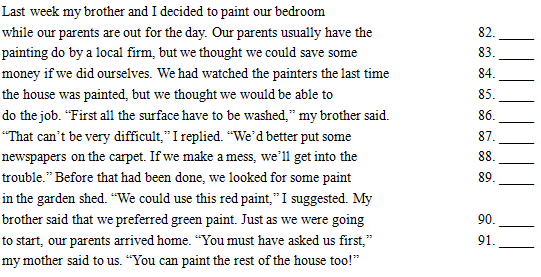
48
_____.
49
_____.
50
_____.
51
_____.
52
Proofread the passage as required.Each indicated line contains a maximum of one error.Correct the passage in the following ways: for a right line, put the sign “√” in the corresponding blank; for a wrong word, underline the wrong word and write the correct one in the blank; for a missing word, mark the position of the missing word with the sign “∧” and write the word you believe to be missing in the blank; for an unnecessary word, cross the unnecessary word with the sign “\” and put the word with the sign in the blank.Write the answer on the answer sheet.
53
_____.
54
_____.
55
_____.
56
_____.
57
_____.
七、Part Ⅶ IQ Test
10 marks
58
There are five IQ Test questions in this part.Write the answers on the answer sheet.
Notice how you can change MICE into CATS in four moves, changing only one letter at a time and always making a complete word:
MICE
MACE
MATE
MATS
CATS
This is called a ladder graph.
Now turn DUST into TANK in four steps, changing one letter at a time.These clues may help you:
DUST
_____ (Evening)
_____ (An elephant has two)
_____ (A job of work)
TANK
Notice how you can change MICE into CATS in four moves, changing only one letter at a time and always making a complete word:
MICE
MACE
MATE
MATS
CATS
This is called a ladder graph.
Now turn DUST into TANK in four steps, changing one letter at a time.These clues may help you:
DUST
_____ (Evening)
_____ (An elephant has two)
_____ (A job of work)
TANK
59
Suzy goes to a new school.In her class she likes Fred but doesn’t like Graham.She likes Ross but doesn’t like Anna.She likes Mandy but doesn’t like Sandra.Does she like Sarah?
60
Can you spot which of the knights below are identical twins?
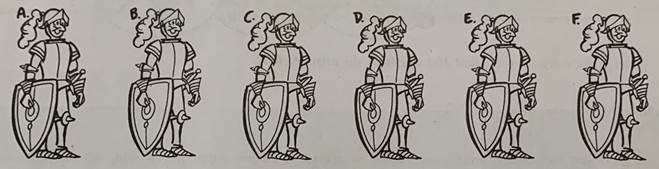
61
What have all of these words in common?
pond
toga
seal
find
joan
spin
pond
toga
seal
find
joan
spin
62
What number should replace the question mark?
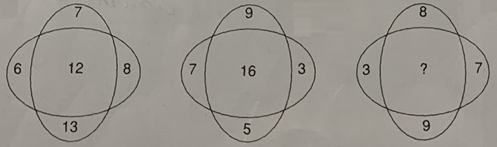
八、Part Ⅷ Writing
30 marks
63
Section A (10 marks)
The flowchart below shows how banana chips are made.Summarise the information by selecting and reporting the main features and make comparisons where relevant.
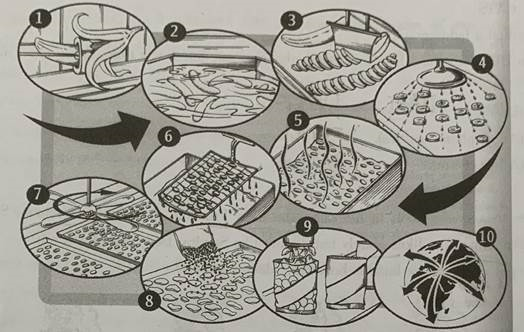 Note: Write a report of at least 100 words on the answer sheet.
The flowchart below shows how banana chips are made.Summarise the information by selecting and reporting the main features and make comparisons where relevant.
Note: Write a report of at least 100 words on the answer sheet.
64
Section B (20 marks)
Science and technology bring convenience to mankind.People enjoy the benefits of technological inventions.Therefore, science and technology promote human progress.However, some people do not work as hard today as they did in the past.How true is this phenomenon?
Write an article of at least 160 words to express your opinion on the answer sheet.
Science and technology bring convenience to mankind.People enjoy the benefits of technological inventions.Therefore, science and technology promote human progress.However, some people do not work as hard today as they did in the past.How true is this phenomenon?
Write an article of at least 160 words to express your opinion on the answer sheet.
输入阅读码
查看答案与解析需要输入阅读码